I was at the Pro-Billionaire march, unironically. Here’s why, what happened there, and how I think it went.
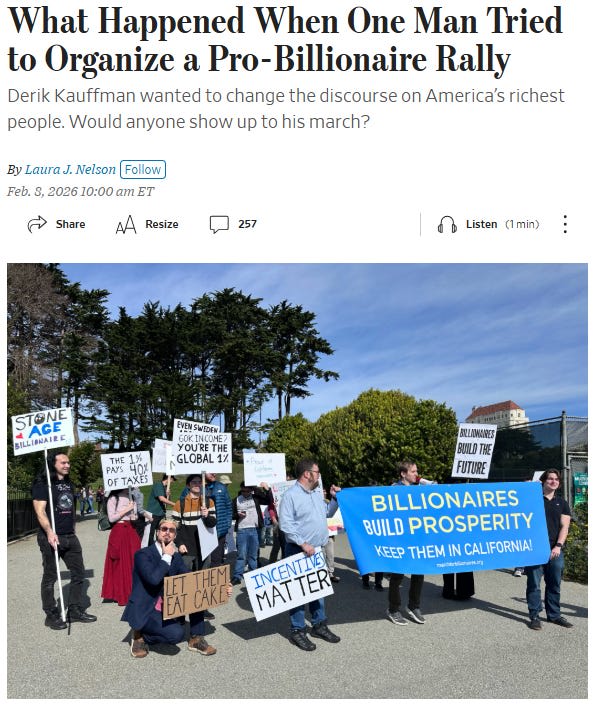
Me on the far left. From WSJ.
I. Why?
There’s a genre of horror movie where a normal protagonist is going through a normal day in a normal life. Ten minutes into the movie his friends bring out a struggling kidnap victim to slaughter, and they look at him like this is just a normal Tuesday and he slowly realizes that either he’s surrounded by complete psychopaths or the world is absolutely fucked up in some way he never imagined, and somehow this has been lost on him up until this point in his life. This kinda thing happens to me more than I’d like to admit, but normally it’s in a metaphorical way. Normally.
Sometimes I’m at the goth club, fighting back The Depression (and winning tyvm), and I’ll be involved in a conversation that veers into:
Goth 1: Man, life’s tough right now.
Goth 2: I can’t believe we’re still letting billionaires live.
Goth 3: Seriously, how corrupt is our government that we haven’t rounded them all up yet?
Goth 1: Maybe we should kill them ourselves.
Goth 2: Haha… for real, for real, if only. We’ll kill them soon enough. Just need a few more Luigi’s.
Everyone In Earshot: Yup, yup. /nodding
I am sad that this is not an exaggeration. Every bit is literally things I’ve heard people say and witnessed myself. It’s horrifying to see normal people you dance with turn into nazis so easily.

Me at Milk Bar in Denver, last year
I know why it happens. I don’t blame people for not understanding the complexities of a global economy that makes it possible to buy a nearly-magic artifact that no human alive can create on their own for just 16 cents.[1] It feels like there is a certain amount of Stuff in the world, and so if some people have a lot of Stuff that’s only possible because others have much less Stuff, and that’s unfair. If life is hard, it’s the fault of the people who took all the Stuff.
What shocks me is how socially acceptable it is to openly say that good people should support lynching strangers based on their wealth. Everyone expects that saying this will get you approval. The most racist nationalists keep their slurs to their friend groups, or behind an online buffer, unless they’re looking to start a fight. Proclaiming your hatreds among strangers is risky. Even the ICE cowards wear masks. But when it comes to revulsion for billionaires, everyone expects to be cheered.
I want this to change. I want people to think at least a tiny bit “this might be slightly socially costly to say.” In theory, one way to do that is to be public about the fact that real people exist that find that sort of unthinking hatred repugnant. A group demonstration of this could be one way to do that. I signed up for the Pro-Billionaire march in hopes that it could advance this sentiment.
II. You Get About Five Words
The previous section is aprox 500 words. As we all know, when trying to convince a lot of people of something You Get About Five Words. How the hell do I encapsulate all that in Five Words?
I want to point at the hate directly. My first sign attempt included “Hate is Ugly.” But that is cliche and doesn’t really communicate anything. Anyone could say it. More importantly, I don’t believe that hate is always wrong. It’s good to hate certain things. Nazis. Criminals. Two-Boxers. If you don’t hate anything then you don’t love anything either. The problem is that blanket hate of billionaires is bad. I want to point at the fact that the hate is destructive and stupid rather than appropriately defensive.
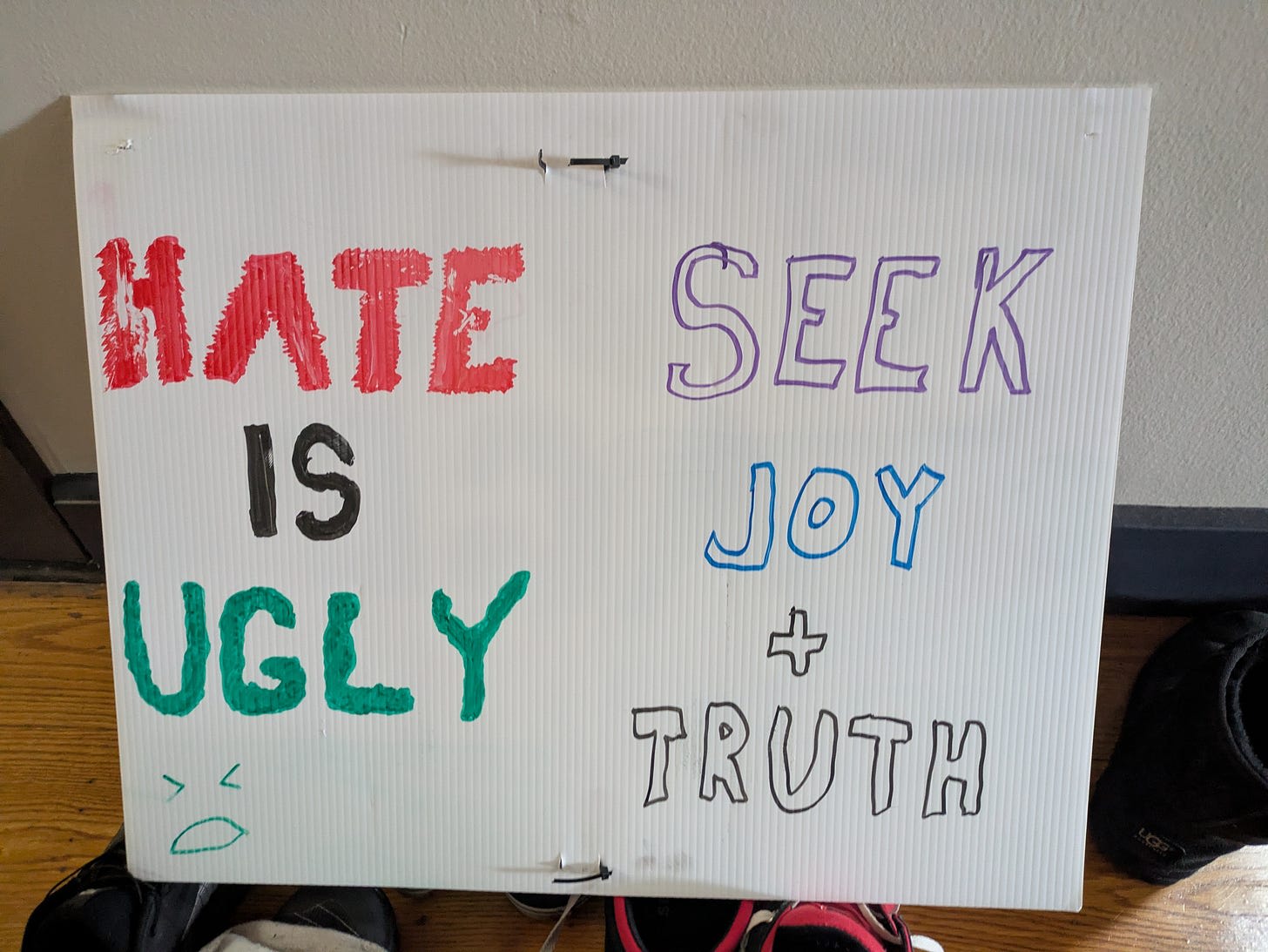
I did end up putting it on the back of my sign anyway
III. The Code of Honorable Wealth
The thing I want everyone to internalize, the thing that could let us talk about the future together, is the sentiment behind Paul Graham’s essay How To Make Wealth, which in my memory will always be remembered as Let Nerds Keep Their Stuff
For most of the world’s history, if you did somehow accumulate a fortune, the ruler or his henchmen would find a way to steal it. But in medieval Europe something new happened. A new class of merchants and manufacturers began to collect in towns. [10] Together they were able to withstand the local feudal lord. So for the first time in our history, the bullies stopped stealing the nerds’ lunch money. This was naturally a great incentive, and possibly indeed the main cause of the second big change, industrialization.
[…] the Europeans rode on the crest of a powerful new idea: allowing those who made a lot of money to keep it. Once you’re allowed to do that, people who want to get rich can do it by generating wealth instead of stealing it.
You need to read the whole essay to get the emotional payload that makes this summary deeply salient. But that essay is nearly 9000 words! Not good for a marching sign.
The closest I can distill it to is this:
Our society has a Code we live by. The Code says that if you make the world better by creating things for your fellow man that she values, you can sell the thing you made for a price she’s happy to pay. If you create enough value that you get very rich by doing this, then that is Honorable Wealth. You can keep it. You still pay taxes, but we recognize you did an honorable thing and won’t come after you for it.
This Code has led to many people pursuing Honorable Wealth rather than the old methods of Conquest, Slavery, and Theft. Because of this Code DIRECTLY, we have immense amounts of wealth. We get infinite hot water in our homes by turning a tap. We get antibiotics, and limitless music, and elastic pants. We can work forty hours a week rather than grinding our bodies to death before our 50th birthday.
Following this Code means that, in a global economy of 8 Billion people, some people can and will become billionaires by completely Honorable means. Yes, some will also use conquest or corruption or theft. Those people are evil and should be stopped. But in the USA, the majority of our billionaires have made their wealth by Honorable means.
Coming after those billionaires isn’t just bad for those billionaires. It is revoking the Code of Honorable Wealth. It is returning to Rule of the Violent, and slave economies, and grinding global poverty. Protecting the Code is incredibly important NOT because it serves some billionaires, but because it serves every single person in our society that lives above the level of a 16th century peasant.
That’s less than 9000 words, but STILL won’t fit on a sign. ARGH.
IV. Stone Age Billionaire
Maybe a single vivid image can get across what I mean. From Paul Graham’s essay:
A surprising number of people retain from childhood the idea that there is a fixed amount of wealth in the world. […] I can remember believing, as a child, that if a few rich people had all the money, it left less for everyone else.
This isn’t just a “surprising number of people,” this is the default. The world is full of Stuff. When you do work for someone they give you some of their Stuff, and when you want something from someone else you give them some of your Stuff. The nature of specialization and global supply chains is such that almost no one sees new Stuff being built in a way that noticeably grows the pool of all Stuff, so it feels constant. For most people their labor adds to the global pool of Stuff the same amount their sweating changes the local humidity level. Technically non-zero, but not so’s you’d notice.
But if you take a longer view it’s obvious that humans have created a TON of stuff. By the standards of our ancestors, we are all absolutely billionaires. We are drowning in wealth, our lives are joyous and easy compared to our forebearers struggling in their caves. Every single one of us is a Stone Age Billionaire. If people stop to think about why we are billionaires compared to our stone-age grandparents, maybe they’ll remember the importance of the Code that created this world. Is there an image that sparks that? Can I convey this image with a sign?
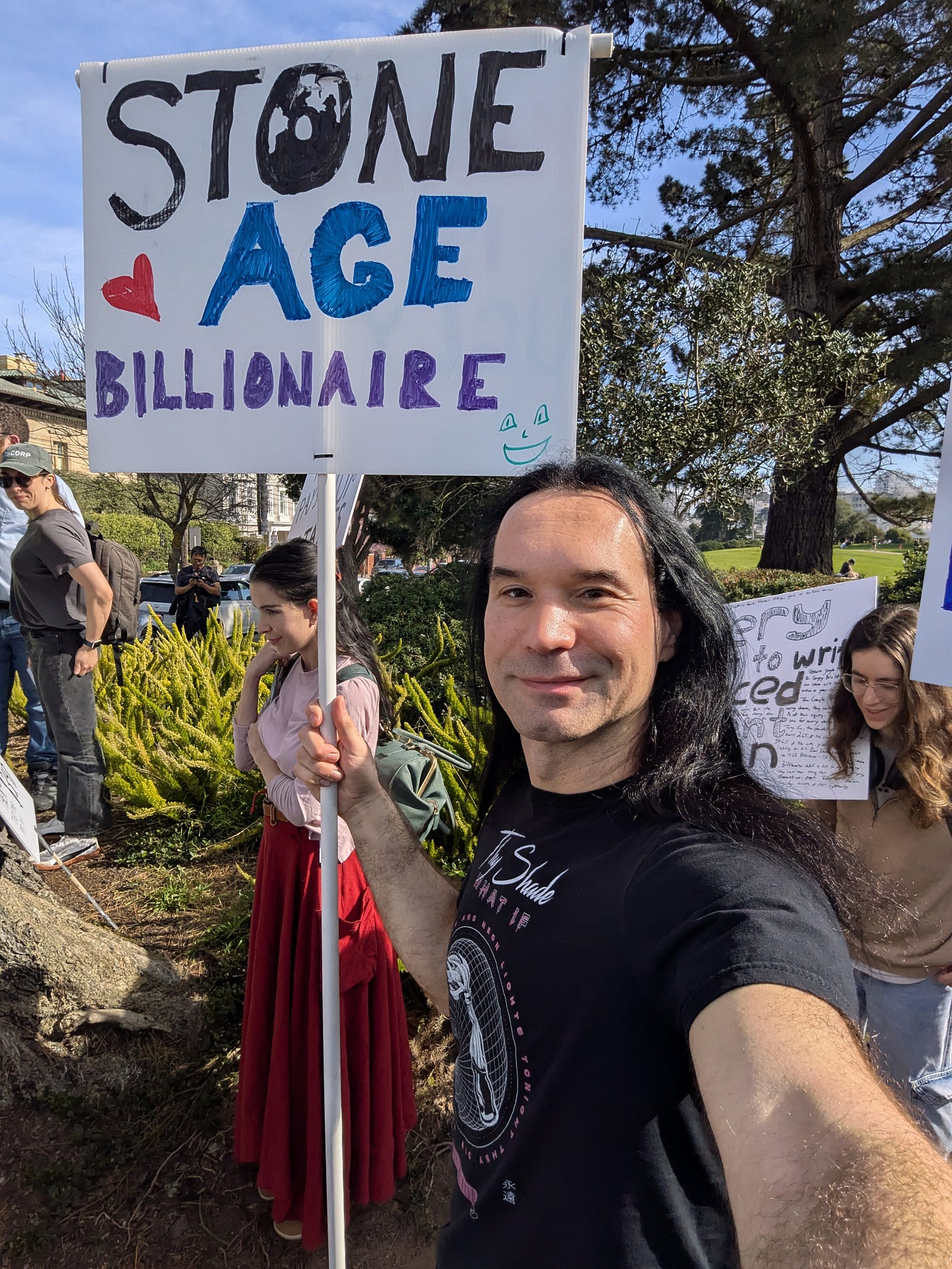
Turns out that no, I cannot. My words not good! There is way too much of an inferential gap. No one got it, and to be totally honest I kinda knew this wasn’t gonna do it. But it was 10am on Saturday, 30 minutes before I was meeting my friends to carpool to the protest, and I was out of ideas. At best I could hope that someone would ask me about the sign. (Very few people did.)
V. At The Protest
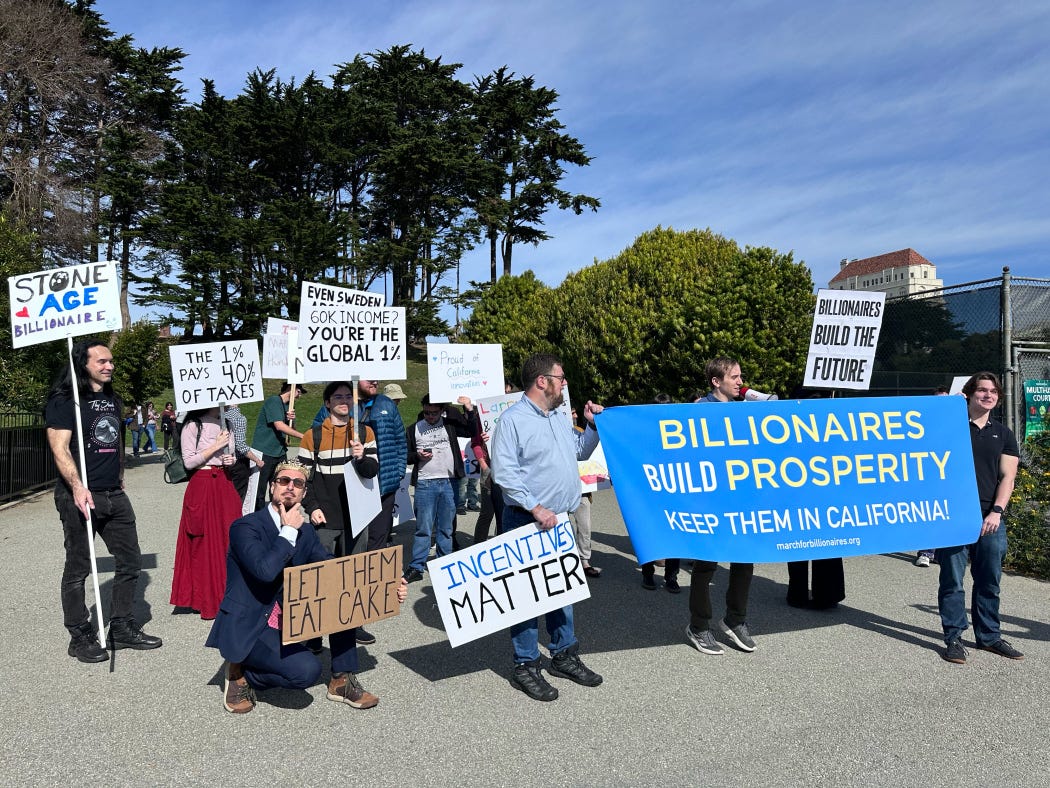
Including myself and my friends, there were aprox 25 Pro-Billionaire protestors. Journalists seemed to be about 15? I don’t know if a ratio this extreme is good or bad. It was quite a sight seeing a gaggle of them rushing up around the side of the protest to get photos of us from the front.
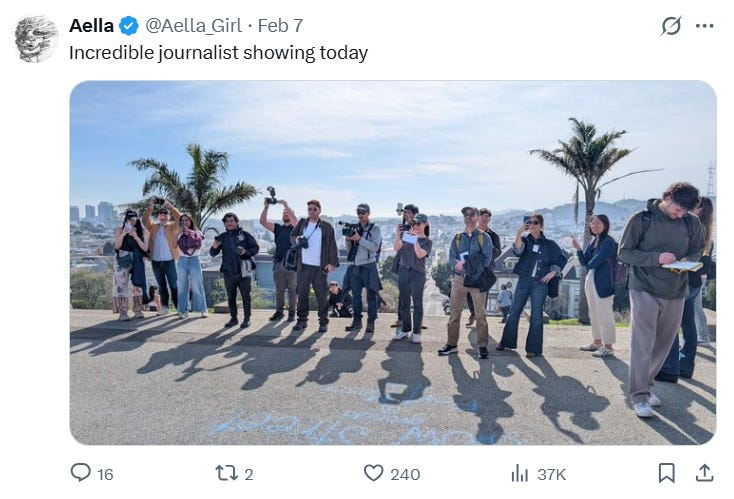
What we saw
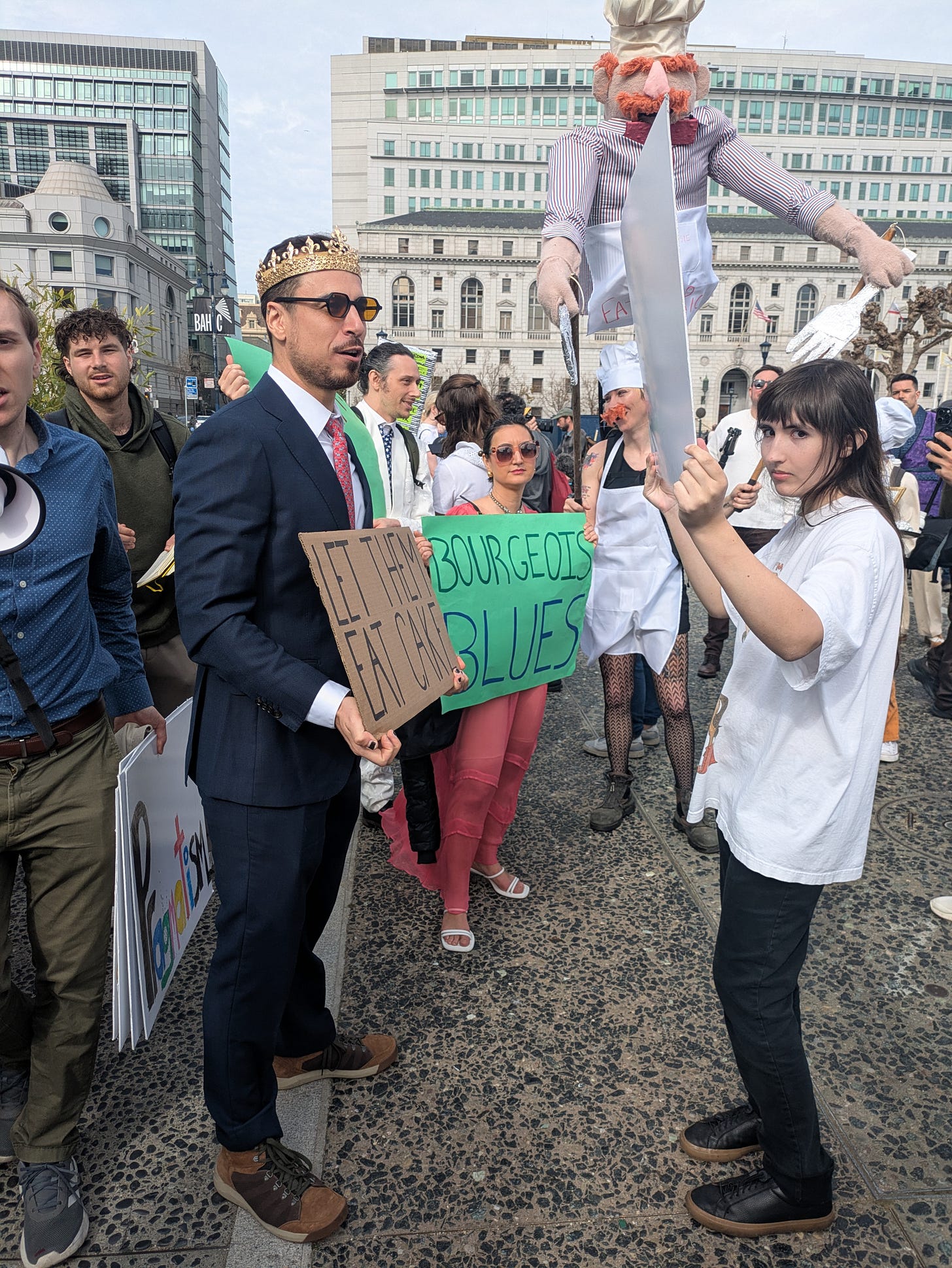
What they saw.
I believe these two photos were taken at the same place, less than a minute apart. The kneeling guy with the crown is a counter-protestor.
I counted 12 counter-protestors at the initial gathering point. It was hard to tell at first if someone was a counter protestor because the counter protestors didn’t seem to understand why one would be Pro-Billionaire and thus their signs were welcome among the protestors. For example the “Poor and Proud” and “March 4 Hundredaires” signs are sentiments that literally every Pro-Billionaire protestor would gladly endorse. But they (and a couple others) didn’t bother marching to the capital, dropping out once we started moving, which makes me think they were probably not actually there in support of the march. I think eight counter-protestors followed us the entire way, which made the march look a fair bit bigger in photos.
VI. Building Bridges
The best part of the march was the occasional opportunities to talk to the counter-protestors. Over the course of a forty-minute walk it’s hard to stay completely alienated from those you’re walking with unless you retain strong distance-discipline. One counter-protestor commented to me “I bet you can’t wait to accelerate the AIs down onto us.”2 I told him no, actually, I want them to pause all development immediately so we don’t all die. He was surprised that we agreed, saying that he didn’t expect long-sighted opinions like that from someone who was so short-term focused that he wanted to protect billionaires. This is exactly the sort of thing my Jehovah’s Witness upbringing had prepared me for! (I cannot believe that training actually came in useful!!!)
I began with “I think we agree on a lot, actually. We both want to protect the long-term future, and we think the other side is being very short-sighted and destroying the long-term future for short-term gain.” Then I launched into my opinion on The Code that has created the society we have today, and how that Code means that we will have billionaires who came by their fortunes Honorably, and that we must stand true to the Code and allow those billionaires to retain the wealth if we want to remain a Just and Wealthy society. I drew attention to the fact that we are all Stone Age Billionaires (and pointed out my sign) and that this is because we have kept faith with the Code. Our descendants can all be billionaires by today’s reckoning, if we don’t destroy the thing that let us create this level of cooperation and coordination in the first place.
He listened, and seemed to be contemplating. When he nodded and walked away, I felt like I’d managed to actually bring this idea into his consideration. Maybe there’s a seed that’s been planted there, which will grow over time.
Equally importantly, two of the highly-costumed counter-protestors were directly behind us as we talked. I believe they overheard us, because they stayed quiet the entire time, which was unusual for them. Likewise, later in the march I saw the crown-wearing counter-protestor talking with Aella, and having a similarly open-exchange discussion. I am hopeful that they all will have new perspectives on why good people might really care about property rights.
VII. The Counter-Protestors
There were about 8 counter-protestors, to roughly 25 protestors. However at least some initial media outlets tweeted that the protest was “swamped” by the counter-protestors. I’m not surprised, because the counter-protestors had a VERY outsized presence.
For starters, most of them were in elaborate costume. Fancy suits & crowns, or royal garb. One had the Swedish Chef from the Muppet Show on her back as a giant marionette, and was dancing the whole time while feeding mock human flesh to anyone who would take it. This sounds horrific in text but her vibes were great, she absolutely had the air of someone you’d love to party with. Next time I’m gonna wear something far more visually interesting. Maybe full goth gear.
More importantly, they were extremely energized. They stayed together near the front and shouted at the top of their lungs at every stoplight. The Pro-Billionaire protestors were rarely able to drown them out. The counter-protestors had fury and righteousness on their side, they were here to Smash Evil, and the rest of us were struggling to figure out how to fit Paul Graham’s nine-thousand-word essay on the Code that gave us modern society into a five-word chant.
Their chants did a good job of demonstrating (and spreading?) the mental hellscape they live in. Their favorite one was “Eat The Poor,” showing the “there’s only X amount of Stuff” fear. I tried “Don’t Eat Humans!” for a while, which was OK I guess, but not catchy.
In comparison to their chants, ours were pathetic. “Grow The Pie” just doesn’t have any emotional heft to it. It feels made-up. “Build More Housing” was good, but not directly relevant. “Property Rights Are Human Rights” requires an essay of context to understand and isn’t Inspiring out of the box. We didn’t have any unified rallying cry to respond with.
But most important of all, they had the power of social approval on their side. Maybe there were three times as many of “us” as there were of “them” marching down the street, but they had every single resident of the city on their side. The media was on their side. The cops were on their side. On any given day on any given street corner, if someone were to stand up and yell “Fuck the billionaires, kill them all!” they would get cheers from at least half the people around, and no dissent. The amount of intimidative power this gives you is impressive to watch in action. It felt like most of the protestors didn’t have the willingness to rise against that. It obviously felt very good for the counter-protestors to get to exercise that power.
VIII. Final Speeches
The worst part of the march was the period of final speeches outside the capital building. The speeches themselves were OK, the second one in particular was exceptionally well delivered. The counter-protestors, however, got to demonstrate who owned the streets and what this really means.
Initially the Pro-Billionaire protestors attempted to unfurl the large banner and give a few quick speeches in front of it. The five most zealous counter-protestors pushed their way in front of it to take up the space and prevent anyone from speaking. When the banner moved they just moved with it. At this point the protestors were kinda stuck, because what exactly are you supposed to do? Whatever in-roads we may have made chatting during the march, the counter-protestors weren’t going to listen to words right now, they were just here for maximum physical disruption. In theory we could push them aside, but by the rules of polite society that would make us the aggressors. It would give them exactly the media attention they want. It seemed that either they could just shut down the final speeches indefinitely with heckling, or they get media coverage of being assaulted by violent billionaire-lovers, and either way they win. NGL—it was legit embarrassing.
Then my friend Ben realized that this is a giant game of “I’m not touching you” for adults. Which is the stupidest dang thing IMO, but is pretty symetrical. A few of us just stood close together in a line, and we moved the speeches to the other side of that line. The counter-protestors would have to walk through us to block that speech, and we just didn’t move. When they tried to go around us we shifted to be in front of them. And they couldn’t actually touch us because that was against the rules, so this worked?? It was bizarre. It made me feel again like I have absolutely no social awareness or acumen. This is a stupid way to win a stupid game.
It didn’t work perfectly. We didn’t have any structure or leadership, no one had foreseen this, so there wasn’t any way to actually coordinate the cordon. Only like four of us actually did this, entirely ad hoc. I’m frankly surprised it was enough. Also we were actually interested in the speeches, so we didn’t keep a sharp eye on the hecklers and a couple of them edged around to get close to the speech-givers. They continued to shout heckles between lines of the speeches. At least once I turned around to nudge someone back again, and I heard the ominous line of “Don’t touch me.” There’s a small spike of adrenaline that comes with those words when you realize they are a warning that we’re on the verge of an escalation that can only benefit them. All in all it was poorly executed, like if a gay pride march had Fred Phelps with a “god hates fags” sign edging into every photo of the final speech, while yelling slurs between lines from ten feet away.
IX. How’d It Go?
IMO the march had a couple problems.
The first was that there was no unified message. Ostensibly it was about the California Billionaire Tax Act confiscating 5% of billionaire net worth. And yes, that’s fucking nuts.
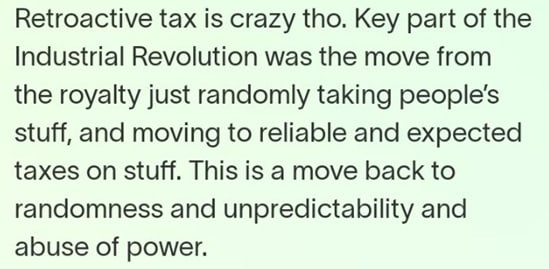
But that’s a symptom of the real problem, which is breakdown of the social code. I didn’t come here because of that one Act, I came here because, as outlined in Section 1, I’m horrified by how much of the population talks about lynching people to take their stuff, and that this is viewed as normal or good! I refused to repeat Derik’s words when he said “Thank you Billionaires.” I’m thankful to the social code that created this, not to individual men. There was a lack of unified message that made it much harder for everyone to be enthusiastic together.
On the one hand, maybe this helped. The march was thrown together with just one week’s notice and it needed to gather the biggest tent possible. If the march was just about the California Billionaire Tax Act, I probably wouldn’t have come. Since it was about the right for billionaires to exist honorably, I did.
On the other hand, the ambiguity meant that when opposition showed up there wasn’t a central unifying core that everyone could rally around. We were easy to overwhelm with just a third of our numbers.
The second was that there was no preparation. It would have been good to have everyone ready with a few chants that we could all practice before we left and really get behind. Some thought of what to do if hecklers showed up would’ve been good. Ideally there should be several people picked out beforehand, who had gathered the day before to practice linking arms to create a cordon, and were instructed in whatever is best practices when running into this sort of harassment. People that the march-leader could look to when in need of back up. Things turned out surprisingly well given that no one had any idea what they were doing!
All that being said, this was all thrown together in a week over a group chat and got a surprising amount of media coverage. I’m very pro-people-doing-things. The default is that nothing happens, and for someone to actually try something and get this going on such short notice is amazing! The world is better than it was the day before, even just a tiny bit, because a few people were willing to risk failing publicly at something hard. They cared enough to do it anyway, and maybe now a few people are a little more interested in how it is we’re so much better off today than our ancestors ever were.
We’re all Stone Age Billionaires, and it’s not because any one of us works a billion times harder at picking berries and hunting deer than our ancestors. They all worked far harder than we did, and they would weep with joy to see how rich we are. To see how few hours we need to work to feed ourselves, how we don’t wear out our bodies from grinding labor and harsh environments. We can weep with joy at how wealthy and happy our great-grandchildren will be. If we keep true to the Code of Honorable Wealth that makes this cooperation and creation possible, our great-grandchildren can all (yes all) live life as 20th Century Billionaires.
- ^
Which includes the cost of having it brought to your door within two days! But you gotta buy 2 dozen at once.
Heh.
Did billionaires give us these?
I mean, in a haha only serious way. Scientific curiosity gave us some nice stuff (like antibiotics). Government spending gave us some nice stuff (like running water). Even military spending gave us some nice stuff (like the internet). But the gifts of the rich, when I think of them, are a more mixed affair. Zuckerberg could retire today and have more money than he could ever spend, yet he keeps working, making Facebook more and more soul-destroying for regular people. What’s his motive? Lots of people at AI labs could retire today as deca-millionaires, yet they keep working, trying to make sure that their company in particular gets to kill humanity first. Etc.
That’s what people mean when they speak against the rich. You’ve set up a game where people who are really into “number go up” get to the top, and make the number go up more and more, without minding the effects on everyone else. Turn the internet into brain rot; fight a war to keep selling drugs (like the East India Company did in China); use child slave labor (like Nestle); or kill humanity.
Now, the argument PG and others make is that in real life you don’t get to choose between first and second best. The first best is always out of reach, and the true choice is between second and third best. If you don’t want billionaires getting what they want via the money mechanism, you’ll get strongmen getting what they want via the power mechanism. You’ll be oppressed and won’t even have iphones. And there’s truth to that.
But it suggests a reframing that might be helpful. For practical purposes, there’s a maximum amount of money you can spend on personal consumption: if you have tens or hundreds of millions, you should be all set. And there’s a minimum amount of money that makes you a danger to society, able to buy laws, screw over communities and so on; that number is also maybe around hundreds of millions, or single digit billions. The second number seems higher than the first. So we can allow people to essentially max out their personal consumption, thus maxing out their selfish incentive to do good things for society, while still stopping them from becoming a danger. This would also mean mandatory dilution of corporate control: when a company gets big enough to push on society, the public should get a bigger and bigger say in how it’s run, with founders and investors keeping enough control to be ultra rich but not enough to run their bulldozer over society. How’s that sound?
I have goals that benefit from having hundreds of millions to billions of dollars. So do other people. Money is for steering the world. I can use money to hire other people and get them to do things I want. “Personal consumption” is not the reason why almost anyone tries to get rich!
That’s fair: you want to have billions of dollars’ worth of “steering influence”. But you are human. Humans have not only noble motives, but base ones too. Empirically, humans who get billions of dollars’ worth of “steering influence” usually end up using most of it to get more billions. In my comment I gave examples.
Maybe you’re a special human, and going through the process of getting a billion dollars will keep you noble and uncorrupted. I don’t know; nobody knows until they actually go through it. But on base rates, I’m against any person getting billions of dollars’ worth of unchecked steering influence. Including me and including you. Hope that makes sense.
EDIT: Rereading my reply, I see it’s a bit off target. I won’t delete it, because deleting comments is a bad habit that I really should get rid of; but just saying that now I see the descriptive part of your argument too. It’s true that if people can’t satisfy their world-changing goals (or just power-hungry goals) by starting a business, they’ll go into other avenues and who knows what’ll happen. I’ll need to think about that.
The way I see it, society is basically a big ultimatum game: the rich get to steer it in whatever way they choose, and the masses can either accept what they do or smash everything and go back to the “stone age”. So that sets the terms of the ongoing negotiation. It’s hard to have something like a wealth ceiling because it’s hard for millions of people to commit to being okay with someone having $100,000,000 but blowing up the world if someone has $100,000,001.
The way I see it, life is like a game of monopoly. Those who have more power (money being one form of power) gradually have their advantage increase. The have-nots must forever spend effort and coordination to have a share of the pie at all, or see it regress to the haves by default.
But that said, I don’t agree with the “smash everything and go back to stone age” fearmongering. Communist countries, for all their terrible record on human rights, haven’t been especially backwards on science and engineering. Nor have countries with strong progressive taxation regressed to barbarism. When the weak join forces to win themselves a chunk of the pie, that can sometimes be nasty, but it isn’t necessarily, definitionally nasty. I’m convinced it can be done in a good way.
Sorry, I didn’t intend to fearmonger. I agree with pretty much everything else in this comment. European social democracies seem pretty nice, and communism isn’t necessarily always the worst thing in the world (although I usually avoid saying that on LW because it gets me downvoted). However, communism didn’t end up working out anything like the way early communists envisioned, and countries that ended up communist or social democratic had to go through specific historical events that ended up making them that way. Right now billionaires seem unwilling to make concessions because they think under the current circumstances they will win in a showdown with the public, and I don’t really see why they’re wrong. Why do you think they’re wrong?
Maybe they’ll just win. Or maybe the public can get more coordinated and get a better bargaining position; moving the needle toward that seems good.
In particular, a lot of billionaires choose to “spend” their wealth on continuing to control the company they founded. Almost all of Jeff Bezos’ wealth is “spent” on owning Amazon, for example.
How do you stand towards pluralism or democracy? There is some tension there with people having billions of dollars of steering influence but of course there is with taking peoples money away as well. Money could also be used to steer towards a more pluralistic society etc. …
Anything to read which approximately describes you view there?
When I grew up in a communist country, they taught us that there was a difference between “personal property” (like your shoes and books and things like that) which was good, and “private property” (like owning a factory) which was bad.
The line between these two was basically that “personal property” is for consumption, but “private property” is the stuff that makes more stuff, it makes the initial small differences grow, so if we don’t want it to grow out of control, we better nip it in the bud. (Only the Party, and the experts it appoints, are qualified enough to control the stuff that makes more stuff.)
I had a question that seemed obvious to me: which category does a PC belong to. I mean, you can use it to play games and chat with people, which would classify it as “personal property”, just like food or phones; or you can use it to program computer games or social networks, which would classify it as “private property”, just like the factories or newspaper companies. And it seems that the latter is more productive use of the computers, so… are you telling me that owning a computer is good, as long as I do not use it productively?
But by the time I was old enough to compose such sophisticated question, the regime was already falling apart, so I didn’t get an answer.
I think the same kinda applies to money. Give €100 000 to two people, maybe one will spend it on drugs and hookers, and the other will use it to start a new business. Someone would use €1 000 000 to buy a really big house, another might use the same money to retire early and spend the rest of their life doing something that is useful but not profitable.
I guess my point here is that the mapping of amounts of money to the kinds of action you can spend them on may be wildly different for different kinds of people.
(Also, if you artificially cap the money at e.g. 1 billion per person, the obvious solution is to split the extra money with your family and friends, e.g. by giving them insanely well paying jobs.)
This is true, but it still adds non-trivial friction, which might have significant effects on disincentivizing applying the obvious solution.
Yes, but important caveats are in order:
Individual people having billions of dollars for steering the world, while others struggling with basic needs is inherently undemocratic situation.
If you actually manage to get to a position where you have billions of dollars to spare, most of your networth would be going into optimizing Moloch’s values and not your own.
Fair, but. There is a minimum amount of money that lets you start your own space program just because you think rockets are cool. And that amount is several billion.
It sounds like under this system, Amazon would be a moderately successful online book store that was run by a squabbling mess of politicians.
Or perhaps Bezos would carefully keep his company below the limit so as to stay in control.
Power would be divided towards more smaller companies. Which would mean different perverse incentives, but maybe not fewer perverse incentives? I’m not convinced that lots of little companies is better than one big company.
seems like a job for Pigouvian taxes
The bottleneck isn’t figuring out what measures would solve any given problem of the have-nots (Pigovian taxes, YIMBY, free healthcare, trains!!) The bottleneck is politically getting these measures implemented, when the haves who control most of everything (including most media and most political donations) will fight back every step of the way. At least if they stand to lose massively from the measures, which in the case of Pigovian taxes is certainly true.
The biggest issue I see with Pigouvian taxes is that they’re computationally tricky to estimate. Who knows what downstream effect in the big chain of causality this particular person/action had! Pollution/carbon taxes are an easy exception.
Aside, a bit off topic: Even if we could compute Shapley values, Shapley values suffer from combinatorial explosion. (Things other than Shapley values or approximating them might work.)
I can’t think of spending more money than this personally, but that’s merely a failure of imagination and associated skill issues.
If you have higher ambitions — like making humanity an interplanetary species — then you’ll want more. So much more.
I think this right here is the crux of it. I doubt anyone who supports a wealth tax believes we live in a just society, and I expect them all to believe that the behavior of billionaires actively suppresses our wealth in the sense that you mean it. It looks, to them, like our current crop of billionaires are not honorably wealthy men, but trying very hard to become the new feudal lords themselves.
I think there’s a shorter path to this conclusion that the people supporting the wealth tax will find more understandable, I bet: if we pass a law to take billionaire’s stuff, they’ll use the same law to take our stuff.
I think this isn’t particularly true in the medium term, and I think most people know that. That billionaires are unpopular is what makes expropriating their stuff politically feasible.
That’s why when Robert Fico in Slovakia wanted to increase the taxes on the middle class, he called it a “millionaire tax”.
(The average voter is unbelievably stupid. The argument “it is called a ‘millionaire tax’, but in fact the law is written as an extra tax for people with monthly income between €2000 and €3000” is just met with dumb stares and repeating “but it is a millionaire tax, so it only applies to millionaires, and they already have more than they need, why are you concerned about it if you are not a millionaire?”)
This sounded a bit odd to me, as in I was surprised that you can get a tax passed that is this blatantly different from what its name states. According to this link the tax was created before the introduction of the Euro, when the amount in question would have been closer to a million in the previous currency
I agree on all three counts, but what I am talking about is the rhetorical strategy for trying to communicate the belief that it is very important in the long term to let people keep their stuff, to people who are proposing to take some people’s stuff right now.
I don’t think bad long term consequences would be hard to communicate in this instance (though it would not be easy in the middle of a protest). For example, I expect almost everyone who supports a wealth tax to also oppose the idea of corporate personhood; but these rulings started showing up in the 1800s, and the Citizens United decision showed up in 2010.
There’s a bit of line to walk so as to not misrepresent what OP is believes, but I feel like establishing a link between longer-term bad effects that billionaire tax supporters understand might be as simple as saying “Citizens United was in 2010 and. . .” gestures at things in general
Something like “They said income tax would only be for the 1%”
and the alternative minimum tax… and whatever the new thing is...
I have tried out various attitudes to billionaires over the years.
In my early twenties, as I was coming to grips with the fact that the mass of people spent a third of their lives in activities (“working”) that they don’t really want to do, I was aware that somewhere there were rich people with large amounts of money. I seem to remember that just taking their money did not cross my mind, but I thought instead of what we would now call printing money and handing it out to people, so that their choices would not be dominated by economics of survival. This would have been combined with a belief that there must be a way to organize society so that necessary things still get done, but not because someone was forced to do it.
In my early thirties, I suppose I had developed a more pragmatic attitude towards the existence of a society organized around working for money, a more nuanced attitude towards the psychology of work (e.g. that careers, or just earning money, can be psychologically fulfilling as well as actually constructive in their output), and so on, and so while I was still a transhumanist who believed in the liberation of humanity from survival-work as well as from death, it made sense to have opinions about how society should be organized under pre-singularity conditions; and I saw the logic of libertarian capitalism: people should be allowed to keep what they have earned, without arbitrary limits on how much.
However, some time after that, I noticed the idea (somewhere among Curtis Yarvin’s long essays) that property rights ultimately rely on the state to defend them, and so a philosophy which thinks solely in interpersonal terms (one citizen shouldn’t take from another), is not thinking deeply enough. If you have a state, there is a Leviathan in your society which you are relying upon in various ways, and which also in principle has very open-ended powers to reshape human affairs. A political philosophy needs to address the nature of the state and not just individual wealth, and without convincing me of any particular setup as the right one, it opened my mind to the idea that something other than 100% rights to the fruits of your labor might actually make sense.
The broader consequence of reading Yarvin, who is best known as a critic or even opponent of democracy, was not that I became an anti-democrat, but that I could tolerate societies that aren’t organized around democracy. I saw that a variety of cultures of power are possible, and that a non-democracy or limited democracy can still have its own ways of upholding rights, delivering justice, dealing with bad rulers, and so forth. This proved timely when the unipolar world order was breaking down in the mid-2010s and the universalization of western democratic forms began to look unlikely.
Returning to the BQ (the Billionaire Question), I remember deciding that one of the many differences between the United States, on the one hand, and Russia and China, on the other, is that in Russia and China, the state dominates the billionaires, whereas in America, so it seemed to me, the billionaires dominate the state. And at that time, the post-2015 right-wing populism, perhaps even in tactical alliance with left-wing populism, seemed like a way that the state might come to dominate billionaires within the West as well.
I thought this was probably a good thing, but there was one major issue that I still had: the existence of immense private wealth means that wealthy individuals can just do things that organized society will never get around to doing. Again, this mattered to me because of my transhumanism. I have seen the human race spend decades wasting the existential opportunity implied by the potentials of technology. But now we have technology billionaires, they can personally just start a space program or fund research into radical longevity. I wondered if that would still happen, if the anti-billionaire forces prevailed.
What are my attitudes now? Billionaire power seems to be a fact of life that has to be understood, if you want to navigate these final moments before superintelligent AI. I spend much more time trying to understand, thinking descriptively, than I do thinking normatively. Social structure is highly contingent, it could have been very different, but this is what we have.
I do think it’s a bit of a joke to think of billionaires as equal fellow citizens of our democracies, who are just playing the game of wealth accumulation as private citizens. Extreme wealth is extremely political, and the super-rich are oligarchs who rule from behind the scenes. The law, the political system, are just another domain in which they seek to advance their interests, like the markets and the media space. Trump’s presidency is a change within the oligarchic “system”, because a low-level billionaire managed to grab direct and visible control of the political apparatus, rather than being a behind-the-scenes donor. It’s not quite clear where that leads. Also, I think my analysis is probably a little lacking in understanding of corporate power, as a phenomenon distinct from personal billionaire power. But the rise of tech billionaires at the level of Gates, Bezos, and Musk means that corporate power itself is evolving to be more personal, anyway.
Since it is intellectually useful to be able to visualize a radical alternative, I’ll point out that the fate of Jeffrey Epstein shows you one path to a society truly without billionaires. (California’s 5% tax would just be an extra cost of doing business, it does not even subordinate the oligarchs to the state, let alone get rid of them.) As we know, Epstein was jailed, and enormous portions of his personal dealings have been made visible to the public. This happened because his non-economic activities were particularly egregious.
But if there was a political regime which decided to make just being a billionaire illegal, one can easily imagine the same thing happening to all of them, or to those who refused to give up their wealth to the new system. Maybe they would be under house arrest rather than in jail, but otherwise a similar story—their assets under new management, and their paper trail and digital communications hung out for public view. I doubt it will happen (maybe it could happen in a small country, or in a big country where billionaires are already politically subordinate), but that’s what it could look like.
“Stone Age Billionaire” is confusing, but I might have understood “We’re All Stone Age Billionaires.” It’s still under the five-word limit
Why did this get downvoted? I was initially confused by the meaning of “Stone Age Billionaire”
Why did this get downvoted??
Neither Items nor I are downvoted anymore, but why did this get downvoted?
(Serious answer: some people just have a lot of voting power, and sometimes one downvote from such a person makes it look like there’s a consensus of multiple people downvoting. I’ve learned not to read too much into it.)
If you hover over the up/down then you can see the total votes, which give you information to deliniate between 1x-7 vs 7x-1.
Or “We’re All Medieval Kings.” More accurate but not quite on point. If you look at the human development index, a composite of life expectancy, education, and income, even people significantly below developed country poverty lines would be on par with medieval kings.
This seems false to me. I have made some conscious effort to not feel hateful towards anyone or anything, and did not experience diminished feelings of love as a result of this. If anything, my impression is that it might have made me love more intensely.
I will throw my support toward a related position: Due process for all. Yes, even him.* To the anti-billionaires:
Is Brian Thompson culpable for mass murder? Great, try him in court and you even get the death penalty if you’d like. Is Luigi Mangione the one who shot him? Not yet proven beyond a reasonable doubt, if the state can’t prove it, then I support him walking free.
The system prevents trying rich people for their crimes? Reform the system. You do not want vigilantism. It will not attack only people you hate, the ones you think are the cause of all the world’s problems. Everyone has a different idea of who that is and open vigilantism means a lot of innocent people will die, including people like you!
An estimate of about 4% (1) of people executed by the state may be innocent. And this is after years of trials, appeals, and investigation! Do you think you can do better?
Love billionaires or hate them, fine, whatever, you can hate whoever you like. But flat-out advocacy for murder is not a door you want to open.
*what’s great about a non-specific “him” is that there’s so many people this applies to! Everyone will fill in their own “him”.
On the one hand I agree, on the other, I’m not sure we could’ve really hoped for a gentler warning shot. You’d be hard-pressed to find a more deserving guy to take the bullet, insofar as you hold him responsible for UHC’s policies, and the degree to which they were substantially more abusive than their competitors. And as I think most everyone here seems to realize, the backlash against the fact that none of our guardrails seem capable of restraining large companies anymore is only growing.
Then all the more reason to favor a reform to the system so that large companies can be restrained via due process. Everyone has a different idea of who the bad guys are, and many have very high priors that “they” are the ones responsible for all the problems, that “they” are unimpeded by the guardrails as well.
Tribalism makes information believable not because it is true, but because it is useful toward hurting the enemy. These feel the same from the inside. Hating UHC is a lot more justified than people on the Right hating LGBTQ+, by quite a large margin, but to give us the power to hunt down healthcare executives is a step toward giving them more power to hunt down LGBTQ+.
Oh absolutely. When I say warning shot, I mean wrt to large companies not resisting and not actively lobbying against the sorts of reforms that would let these issues get fixed without bloodshed. It was a choice by companies to dismantle or otherwise neuter substantially all of their oversight, I’m suggesting that was not a wise choice, insofar as the public no longer believes the govt is capable of stopping the misconduct, and worse, because this time violence seemed to work, and UHC did in fact back off as a result (ETA: Debatable if they responded directly to the violence vs to the open celebration of it by ~half the population).
Oh, okay! This is much clearer and I apologize for not getting your point the first time. I agree pretty much fully with this—insurance companies pushed the envelope until the pain got high enough that, sadly, a CEO lost his life without trial, and that poisoned the well and made it a lot harder on them going forward. It is debatable the exact cause of their retreat on this front, but I do agree more broadly with this.
No worries; one of these days I’ll figure out how to get the idea out correctly the first time.
From a consequentialist perspective, generalized skepticism of tech billionaires, and punitive taxation of tech profits, seems good from the perspective of passing AI regulation / discouraging AI investment.
See https://x.com/twocents/status/2020596821228388704
In particular, note the following exchange
> Interviewer: “Is there any ways you would restructure current incentives to make, to allow for, the protestors and the antiprotestors to like see eye-to-eye?”
> Pro-Billionaire Protestor: “I don’t want to see eye to eye with them! I want to destroy them. [cut, apparently to later in the same answer] All manner of socialists and communists that are motivated by jealousy, I want to wipe them off (pause) of the political spectrum. I want to make it (pause) not allowed for you to support this.”
There’s a cut here, perhaps there’s some intervening context that changes the conclusion I should draw from this exchange, but I really very strongly doubt it.
It sounded kind of… rehearsed? Not sure if I should take this is as real position.
Reads more as manic than rehearsed to me, but I’m not sure I see how the distinction matters. Usually I assume that if somebody has thought through what they want to say before they say it, they’re more likely to give their real thoughts as a result, as opposed to some reactively oppositional take. I guess there’s the Andy Kaufman defense?
(I guess I should mention, there’s at least one way that the distinction is relevant here. At the first pause I indicated, it seems like they were about to say that they want their political opponents wiped off of the face of the earth, but catch themself in time to moderate to something slightly less evil. I read this as instinctively reaching for the worst thing they can think to say about people they hate but not actually being committed to the content. If I thought this were more rehearsed, I think I would read it as at least some small percentage of desire for political genocide against the left. But this involves a bit too much speculation for my taste, I’m much more concerned with the claim I originally quoted, which strikes me as unsalvageably naive.)
I agree, it looks like a parody skit to me.
Thanks for doing this! I also find it disturbing how socially acceptable it is to call for the death of innocent people (or to actually murder them, if they’re an insurance company CEO).
If you believe that the UHC CEO knowingly pushed a model that had a 90% error rate, being programmed to almost always just (illegally, incorrectly) deny health care coverage to people who were less likely to sue, then “innocent” is a big overstatement. That’s pretty close to murdering people for money.
Similarly, I don’t think you could claim that the executives who knowingly launched the Ford Pinto were innocent.
The UHC nhPredict lawsuit has not resolved yet, and I haven’t done enough research to be confident about it one way or another. But my point is that the crux is more “are current billionaires actively getting people killed for money?”, not “is it ok to kill innocent people because they’re rich?”
“is it ok to kill people (or call for the killing or support the killing) who have not been convicted by any court and the killing does not stop any immediate physical threat to you?”
innocence is not required, it is presumed by our civilization. At question is NOT whether the victim was a bad person who we’re perhaps better off without. At question is whether anyone but a court can decide what to do about it.
It’s disturbing how socially acceptable it is to call for mob action in direct contravention of rule of law.
People call for mob action because they believe the rule of law isn’t working. At the moment the fact that nobody besides Epstein and Maxwell that was involved in their operation got charged with any crimes is a good sign that the rule of law isn’t really working well at charging people at the top.
Nobody at HSBC got into prison for laundering drug money. Facebook getting away with 25% of their profit being facilitating fraud of their customers also seems to me like the rule of law isn’t working.
Are you sure that is true?
The article you links essentially argues a strawman:
You wouldn’t persecute people who are just mentioned in an email, contact list or flight log. You would persecute those accused by the women who told the police they are victims. According to the lawyer for the victims there are at least twenty men against whom victims gave testimony.
Given victim testimony and the files we have I think it’s also would make sense to say that Epstein was running a criminal enterprise that’s subject to the RICO act. That means that plenty of employees like the pilot that was trafficking the girls to the island likely committed crimes. If you start you RICO proceedings you can offer lower level employees immunity for providing more evidence.
They’re not really calling for mob action (in almost all cases). It’s a rhetorical expression of hatred. Cf saying ‘eat the rich’ is not a serious advocacy of cannibalism.
That’s not to say though that it’s ok to call for mob action eg on social media, as it slightly increases the chance that some extremists might take it literally and act on it
When you phrase the question like this, do you think that you’ve identified a set of characteristics that, throughout history, will never lead to the wrong conclusion? Or are you making a heuristic argument?
I think that throughout history, there have probably been many “ok” killings against people who did not present an immediate threat to the killer and had not been convicted by any court. I think that even today there are probably such killings. Do you have an argument against that position or do you think that, by phrasing things in the way you have, you’ve implicitly made a sufficient argument already?
(This is not to say that the UHC CEO killing in particular was justified, of course.)
Not at all. There is no such set of characteristics. Wrong conclusions are inevitable and commonplace. Godel’s Theorems apply to all formalisms.
In the current world, the harm of unsanctioned killing being commonly accepted (and cheered) is generally a LOT higher than the harm of statistically-evil people continuing to live. So, yes, a heuristic argument: this is a loss of civilization and order, even if it might have been justifiable on some dimensions.
A tangent, but Godel’s incompleteness theorems simply show that for sufficiently powerful formal systems:
There are statements which are true, but unprovable
If the system is consistent, “this system is consistent” is such a statement.
Neither of which show that all formal systems are unsound. That is, if a statement is provable in a formal system, the corresponding property is true in all models of that formal system. So this point is not correct because of Godel (though it could be practically correct for other reasons, such as the world being complicated).
They do not apply to all formalisms, morality is not a formal system, and even if it were this is not what either of Godel’s theorems would say about it. I don’t know why this particular bit of math misunderstanding is so popular online, I suspect it’s because it enables moves like the one you’re making here (i.e. of the form “it’s impossible to justify any statement so I can’t be expected to justify my statements”).
Ah, I wouldn’t call this a heuristic argument—by “heuristic argument” I mean something like “I can’t come up with any utilitarian calculation that says the bad outweighs the good here, but I know that human brains are prone to underestimating this sort of bad, so I assume there is a calculation saying it was overall bad even if I don’t know what it is.” (Incidentally this is how I understand this situation.) If you have an argument to this effect, I’d love to see it! But to satisfy me it will need to be the sort of argument that permits killing Stalin or Hitler or Idi Amin with a pretty wide margin for error, and if it’s not I’ll make the same critique I did before.
I don’t think that’s true. Picture the average 4chan-tier internet racist who says he wants to shut down all immigration from Africa because they’re destroying Western civilization. What empirical facts do you think you would have to convince him of to get him to accept a policy with high African immigration? I don’t think this is impossible, but man, it’s pretty close.
I have had arguments with both TND 4chan posters and Eat The RIch leftists, and a recurring pattern I have observed is that when they say “I hate ‘em because X”, if you falsify X to their begrudging satisfaction, they won’t hate ’em any less. People often have beliefs that are less than fully factual, especially when vicious monkey-brain tribalism is involved.
Trusting these groups of people about their cruxes here seems naive to the point of apologia. “Oh Hitler didn’t want to kill innocent Jews, surely you agree some drastic action would be necessary if the Jews were plotting the downfall of the Reich.”
Sometimes the only appropriate response to an especially bizarre statement is “On what planet do you spent most of your time?”
I think you’re being overly charitable. I don’t think anyone knows anything about nhPredict. I think they just have a strong “CEO = guilty-by-default” prior. The closest thing to an argument I’ve seen undergirding the “eat the rich” meme soup is “X, Y, and Z billionaires are actively getting people killed” completely skipping the question of whether that’s representative of all wealthy folks, skipping to: therefore “kill all billionaires”.
“Pretty close to fraud” would be a better description than “pretty close to murdering people for money”.
I am a woman living in rural poverty.
You seem to believe that the capitalist market is truly what Frederick Hayek called a “spontaneous order” – a system that naturally emerges when people engage in voluntary trade. Prices aggregate dispersed information better than any central human planner ever could. Interference distorts it. The outcomes, whatever they are, reflect the aggregate of free choices.
Under this model, the framework outlined by Eliezer in Traditional Capitalist Values applies, and money is simply the just reward furnished by society to those who create value. Meaning that if someone becomes rich, it’s because they have created enormous value within the context of a neutral system that treats all persons and ideas with equal merit.
By this logic, billionaires are simply winning a fair game, so those who hate billionaires really just hate winners because it reminds them that they could be winning, but aren’t.
Please allow me the right to assert that I find this absurd.
I have never experienced the system as neutral. That’s not to say that others don’t, but I certainly haven’t. It’s not that I think you’re lying or necessarily mistaken – it’s entirely plausible to me that you have never been vulnerable enough to experience how harmful and destructive the system is to so many people by default. I don’t think it’s bad that you personally experience a fair system instead of one that is tilted against you, and I’m not scolding you for it. I’m just pointing out that you may want to integrate the fact that your experience is not universal if your goal is to actually understand the animosity people are feeling toward billionaires, because your underlying assumptions that these feelings are based on some kind of childish, simplistic sense that the billionaires are taking all the “stuff” is incorrect.
No market exists in a vacuum. They all exist, at bottom, on a foundation of government-enforced rules. Take, for example, property rights. What can be owned? A person? An idea? The answers to these are not part of some spontaneous order or neutral system. They are political decisions.
Furthermore, the market does not facilitate voluntary trade in all cases like you are suggesting. The idea that capitalism is somehow producing inordinate wealth via an “Honorable Code” because it supposedly aggregates free choices completely fails to account for all the instances where that isn’t true. There are myriads of transactions that occur under duress or lopsided power dynamics, or as a result of unaccountable deception which our society also rewards with wealth as long as one can get away with it. I contend that such instances are at least as numerous as fair transactions if not much more so.
This becomes very sinister in practice. In a neutral market, if the price of a luxury watch suddenly doubles, you just don’t buy the watch. In our system, when the price of life-saving insulin doubles, a diabetic person finds a way to pay for it or they die.
The executives behind Big Pharma are a perfect counter-example to your post, because their wealth is not, strictly speaking, the result of value creation even though it very much could be. Instead, it is extractive. The Sackler family did not earn their massive fortune through honest means or by creating value. They helped create the opioid crisis, actually, which I guess is arguably valuable to someone. My brother’s friends, so many people I grew up with, paid for this with their lives. Wealth, for the Sacklers, then, is devastation for others. It’s children packed and herded into the underfunded foster care system, sleeping on the floor of the DCS office, crying for parents who won’t come. It’s my niece’s father lying dead on the floor of his mother’s garage at twenty-five years old, his mother finding him there and sitting by him on the floor with a blank expression, as if carved out of stone, while an officer asks her endless questions for his report. It’s the way that she still can’t stand up for a long time after they take her son’s body away.
People don’t resent billionaires for “winning”. People resent billionaires because these individuals have amassed absurd amounts of wealth by operating the economic equivalent of a “paperclip maximizer” for capital, for profit, in which everything else of value—the social contract, public health, the environment, the rights of the vulnerable, etc—is thrown overboard with both hands in order to clear the way for capital acquisition, for ballooning profits, even though this senseless pursuit destroys everything that makes wealth worth having.
You marched because you were horrified by the social acceptance of hatred for billionaires, which you regard as an impulse to “kill the nerds” who built the modern world. Even if that were true (and it’s not), I fail to see how it would apply to a healthcare executive like Brian Thompson – the very person whose death was at the center of the march you attended.
Thompson, first of all, wasn’t a billionaire, but nevertheless he was in the category of people whose wealth came from inflicting social harm – which, I’m sorry to say, is a crowded room and always has been. This is an affront to your idealism about the wealthy, so please allow me to be perfectly clear and nail my flag to the mast on this: “paperclip capitalism” invariably destroys more value than it creates.
The success of health insurance companies is tied to profitability just like any other company. Not patient outcomes; not value to customers. Profits increase at United Healthcare when the company keeps the money it collects from policyholders instead of using it to pay out claims or provide preauthorization for requested care even that it supposedly covers.
But as insidious as it is, it’s not so easy to navigate, this whole “keeping the money” thing. And it’s particularly difficult for a health insurance company to justify since it defeats the very purpose for which the company exists as far as policyholders are concerned. Not only that, it’s far too easy to run afoul of contract law, state-level regulations, etc., to say nothing of the moral or humanitarian aspect. Therefore, any person who becomes skilled at threading that needle in a way that favors the company makes themselves indispensable to the company specifically and the industry more broadly. Brian Thompson was one of those people. It’s important to note that Thompson was not born into wealth. At the end of the day, he enriched himself by knowingly causing harm to others – by sending sick patients to an early grave in some cases, subjecting others to prolonged unnecessary misery, and plunging families into financial ruin.
Linda Peeno, a doctor-turned-activist who once worked for Humana as a medical reviewer, has testified before Congress multiple times as a former insider about how the health insurance industry harms patients when they are at their most vulnerable by doing things like delaying or denying coverage for care that is explicitly covered under their policy, issuing boilerplate “rubber stamp” denials based on stupid technicalities, dragging out the appeals process, burdening patients with paperwork requirements and other inconveniences, and so on. All of which are strategies deliberately employed by health insurance companies to avoid paying for patient care. All to save the company money. And if the patient dies in the meantime, so much the better for the company’s bottom line.
How can you believe that someone who gets rich from this is operating by an honorable code in the absence of any evidence to support this and in the face of strong disconfirming evidence? Whether or not Thompson “deserved” to be murdered is a separate issue altogether and the answer would depend on who you ask. But I can tell you that for those who regard his death as poetic justice, this feeling is not coming from a place of simplistic, primitive savagery like you suggested in this post.
The question of right or wrong that emerges from this issue is not so easy to answer. Is it ever morally acceptable to take someone’s life? And if so, when and by what means? What about Ted Bundy? Was terminating his life morally acceptable? What about his potential future victims? Did the state not have a duty to protect the public from Ted Bundy? Was imprisoning him not enough? Are the people who died as a result of Brian Thompson’s policies any less dead than Ted Bundy’s victims? Did they suffer less? Did they suffer enough? Was imprisoning Brian Thompson too much? Was taking his life enough? Has it saved anyone?
You may argue that Thompson’s policies were legal, but that’s not the same thing as his policies being defensible or non-harmful. Are the people who died preventable deaths so that United Healthcare could cut costs unworthy of our concern? Are they members of some subspecies whose lives are devoid of significance? United Healthcare was not struggling to pay its bills and could have prevented countless deaths while still maintaining profitability, so who is to answer for the fact that under Brian Thompson it did not? I’m really asking, because the people who suffered, were dragged through a traumatizing appeals process while sick, and/or died so United Healthcare could cut costs were quite literally the material that Brian Thompson’s wealth was made out of, since part of the money the company saved by not paying for their care went to his bank account instead. And yet these victims extracted not a tithe from Thompson’s social standing until the morning he himself was killed.
Like many wealthy people, this man did not become rich because he created the corresponding amount of value to society that such wealth would warrant under a fair system, so please do not piss on my leg and tell me it’s raining. He was rich because he was willing to let people die to protect a margin. If you truly value human life, then you will agree that by designing policies that sacrificed people for profits, Thompson’s wealth literally came from destroying value, not creating it.
I could go on, because the health insurance industry is really just the tip of the iceberg. The rural area where I live – heavily polluted by industry, declared a federal nonattainment zone under the Clean Air Act, limping along through everlasting economic exploitation with outdated infrastructure strained to the max, etc – is getting three new data centers soon, for example. And before you declare it a win because the large tech companies behind them will bring their money with them – ha! Not so fast. Amazon is currently building its data center from behind a shell company, a small local LLC which the tech giant formed specifically for the purpose of securing more favorable contract terms for itself – you know, as a local fledgling small business. The company’s true identity, of course, is protected behind NDAs, of course, and by the time the public realizes what happened (if indeed it ever does) it will be too late to back out of the contract. And as usual, a defenseless, troubled, preoccupied community will get shit and shoved in it while Amazon just keeps on “winning”.
Brian Thompson’s death, while certainly tragic, was also a signal. An alarm bell. People do not have an unlimited capacity to absorb harm. Wealthy people – at least, those among them who have entrenched their interests by leveraging all the political influence money can buy – seem to believe that at this point they can just inflict whatever harm upon others will be most beneficial to themselves, secure in the knowledge that no one can or will do anything about it. I’m afraid the French Aristocrats probably felt much the same way until the very moment when they climbed onto the tumbrils.
Thank you for this, I appreciate it. I should clarify that I agree with you completely, and why I do, and what that means about my original point. 🙂
First, I strongly agree that many industries, such as Pharma (and real estate) are incredibly unfair and not a level playing field at all. I think health insurance is the worst of all of these, many people have written about how the US Healthcare system somehow manages to incorporate the absolute worst equilibria of every possible system. In these cases (and nearly all similar cases) the common denominator is how much distortion and interference there is by the government. The worst parts of the economy are the ones most regulated/distorted/corrupted by the government. 🙁
That being said, like you pointed out, a government is required to set the ground rules (What is property? How are contracts enforced?). So the hope is that we can enable a government that creates a strong, well-considered foundation, without trying to take over and directly manage the market. The government needs to create a ground for the market to work on, and then stop trying to geoform it into some alien configurations, because that always just makes the ground incredibly un-level. And then the assumptions about wealth being created honorably don’t apply anymore. Or apply less in proportion to how un-level the ground has become.
That being said, I don’t hold the maximally-naive position that our world is the ideal of “capitalism is somehow producing inordinate wealth via an “Honorable Code” because it supposedly aggregates free choices.” I am pushing that this is DESIRABLE. And that we can have this! And in a number of places, we’ve managed to get pretty close!
The narrative I am horrified by is the very loud, oft-repeated position that there is no such thing as Honorable Wealth. That every Billionaire is a Policy Failure. That such people are by necessity evil and exploitative. This is extremely wrong. In a fair system, the existence if Billionaire is both expected and good. One cannot eliminate billionaires and retain a functional system. So I am pushing very hard that one can, indeed, have Honorable Wealth. And anyone claiming Billionaires Shouldn’t Exist is the evil one, for this reason.
The fact that we have quite a few places where there isn’t a level field and that normal people pay a hefty price for this is not lost on me. Those places should be fixed. And the best way to fix them is to return those landscapes to places where Honorable Wealth is once again possible, rather than requiring corruption and graft. 🙁
I’m not sure I agree with you that the worst parts of the economy are those regulated by the government, but I suppose it depends on your interests and priorities. My state offers a relaxed regulatory environment to corporations in order to entice them to establish themselves here, and to the extent that this has worked it has been environmentally disastrous. No one does anything about it because these corporations establish themselves in rural, low-income areas like mine, where no one has the resources or means to take them to court.
For companies, a lack of government oversight generally means fewer overhead costs and higher profit margins because they don’t have to pay for permitting, inspections, or safety equipment that meets a certain standard. The food industry is free to use the cheapest chemical ingredients they can get away with. Disclosure requirements that would protect public health are patchy. Companies are free to pollute the air we breathe and the water we drink and bathe in. No government oversight also means no OSHA, no EPA, etc.
I frankly don’t understand why you believe government oversight is a bad thing, so perhaps you wouldn’t mind elaborating?
I don’t think we have enough government oversight. I don’t much care about a company’s profit margins, just as they don’t much care whether their operations give me cancer. The relationship is inherently antagonistic, and that’s because *they* can’t be trusted to operate ethically unless they are forced to by the government. Which is precisely why they spend so much money lobbying in Washington and buying political influence.
I don’t think billionaires are a necessary part of the world. The world got along just fine without them prior to 1919. I don’t think there’s anything wrong with being wealthy, but I do think every dollar a person gets that pushes their bank account balance past, say, $10 million USD constitutes an obscene amount of personal wealth and should be automatically taken from them and flushed back out into the economy. If they can’t get by on $10 million, boo hoo, I don’t know what to tell them. They’ll have to figure it out. The vast majority of people who have ever lived got by on far less. There’s no excuse for letting them hoard that much wealth and evade taxes when the money is so desperately needed in the economy. Powering the economy is what money is for.
Oh wow, the inferential gap here is much greater than I expected. I cannot bridge this in the breadth of one comment. I recommend staying active on Less Wrong and ACX, and over time you’ll be exposed to all the standard evidence for the destructiveness of unchecked government interference. Economists (and by extension, rationalists) are well aware of the problems of negative externalities and how governments can correct for them, and the market failures to provide public goods and how the government can provide them. So it’s not an “all government bad” position. But the govt being what it is, all power given to it is exploited to the maximum extent to favor the powerful and the population now is utterly strangled by the tools that were meant to protect it. OSHA and the EPA are IMO pretty good examples of good ideas that now do more harm than good! There are entire books written about these things if you want me to recommend them. If you prefer bite-size chunks over time maybe follow Noahpinion or Reason Magazine?
Ah yes, the golden age of pre-1919. Returning to the economic conditions of pre-1919 in exchange for eliminating billionaires seems like just hurting everyone alive so some people can be hurt even more. If material prosperity nowadays is greater than 1919, maybe the existence of billionaires is a part of that?
Siiiiigh.
OK. Say the average founder can capture 10% of the value he creates. That’s a preposterously high amount, but we’ll use it to make the math easier. This means that once he creates $100M of value there is no reason for him to use his various gifts to create more. Any additional value he creates will get him a reputation of obscenity, and he’ll be ritually stripped of his portion of it by a spiteful populace. Why would anyone do that? I would make sure to keep my contributions to humanity very small and local, only benefiting myself and my community at most, so that I wouldn’t be in danger of helping too many people and becoming obscene.
That isn’t what money is for once we get out of the realm of personal finances. People with wealth of that level don’t use money to “get by.”
OK, yeah, this definitely says you are new to the world of economic thinking. That’s fine, it’s not intuitive. When someone is worth billions of dollars it’s not because they took a billion gold coins and buried them and now no one else can use those coins. It’s because they own a large fraction of a company that is worth hundreds of billions of dollars. They aren’t “hoarding” anything—the company is right there, doing what it does every day! Delivering products or providing services or whatever. Powering the economy is ALREADY what they are doing. In fact, the reason they are so wealthy is BECAUSE they are powering the economy in exactly the way you say you want to encourage! The reward for having powered the economy by hundreds of billions of dollars a year is getting to own a small fraction of what they built.
That’s why we advocate for NOT destroying the people who do this. It would be destroying the system that created these engines that power the economy. Powering the economy is indeed what money is for, and this is a major component of how money does that. 🙂
You’re talking down to this person (far too much, IMO; just make your arguments or don’t, and to the extent that you’re unwilling to engage, don’t fill the gap with status games), while also failing to demonstrate that you’ve taken critiques of free market capitalism at all seriously.
The idea that wealth earned in a capitalist economy reliably represents ‘value created’, in the sense we actually care about, is one of the main points of contention here! It’s something to be argued for, not taken as an axiom and used to dismiss their concerns as if they’re stupid.
Ok, thank you for the feedback. I feel I was at least no more out of line than “if they can’t get by on 10M boo hoo I don’t know what to tell them,” but I’ll try to adjust a bit away from talking down going forward.
But the dogma that there is no way to create enough value to become a billionaire honorably is exactly what I’m fighting against, so someone who takes the opposite as an axiom needs to be talked down from that point first.
I apologize profusely for upsetting you. Contrary to what your tone suggests, I have not lived my life in a sensory deprivation tank. So there is no need to lecture me. You are not being misunderstood. You are being disagreed with.
>But the govt being what it is, all power given to it is exploited to the maximum extent to favor the powerful and the population now is utterly strangled by the tools that were meant to protect it.
Yes, indeed—and who, pray tell, do you think “the powerful” are?
>Ah yes, the golden age of pre-1919. Returning to the economic conditions of pre-1919 in exchange for eliminating billionaires seems like just hurting everyone alive so some people can be hurt even more. If material prosperity nowadays is greater than 1919, maybe the existence of billionaires is a part of that?
You’re strawmanning here. I never suggested the pre-1919 world (i.e. most of history) was a “golden age” of any kind—it wasn’t. My point was that it meandered along just fine without billionaires, and the world could do without them today, too. You seem to assume that individual innovation has been the primary source of billionaire wealth, but I don’t agree with this and believe the entire premise is flawed. I think it’s a matter of historical record that billionaire wealth has mostly been amassed through extraction, corruption, exploitation of labor, elaborate tax evasion schemes, insider trading, political lobbying, aggressive corner-cutting, and regulatory capture. And just think of all the things the public never finds out about.
This is not true in every single case, and people like Chuck Feeney, Yvon Chouinard, and Hamdi Ulukaya deserve credit for setting a good example as billionaires or former billionaires. I am personally indebted to Hamdi Ulukaya for making plain yogurt ubiquitous in the US where it used to be a niche item, because it allows me to drink ayran at home without being subjected to a logistical nightmare, but the difference between these individuals and the average billionaire is that they gave their wealth to other people. Chuck Feeney only kept $2 million USD of his wealth for retirement and is no longer even a billionaire. The others have used their money to take care of their employees and fight the climate crisis.
But they are the exceptions.
I’m not denying that billionaires are innovative. They are innovative. They are also, by and large, ruthless people. Look at John D. Rockefeller, the first billionaire. He was anything but an honest businessman, and he drove countless small businesses into bankruptcy and families into destitution in his pursuit of absurd wealth, because for the vast majority of billionaires that’s what it took to become wealthy to such a degree. They may not have always liked it or felt good about it, but that’s what it took.
That’s the difference between a billionaire and a successful person who has good ideas and passion but whose personal ambitions are nevertheless balanced against their inherent concern for the welfare of others. You can be successful and still pay your employees well, pay your fair share of taxes, and limit your political influence to voting like everybody else, but then you probably won’t ever become a billionaire.
Yes, billionaires have shifted economic conditions and not everything they do is negative. They have given us technological innovations that we would not have otherwise had, at least not exactly at that moment. They have created jobs for entire sectors even if they did end up sending them overseas in order to cut costs and escape regulatory oversight here at home. They have donated to charities and built libraries, etc. But at what cost?
They have also poisoned waterways, given children leukemia, stifled competition and, by extension, innovation. They have degraded manufacturing to the point where the average person is endlessly buying things they already “owned” because their belongings aren’t built to last anymore, contributing to the climate crisis and filling our planet with discarded junk. Industry creates resources but it also uses them and creates insurmountable waste.
I could go on but of course, this is a rather contentious topic even among economists and experts, and our individual opinions are going to be shaped at least in part by experience, so we may have to agree to disagree. My community has been harmed by industry, and there is no recovering from this. People who have lost loved ones to toxic waste poisoning, or gotten ill themselves from pollution, or had their job sent overseas, or lived in hardship because the breadwinner of their family died from faulty safety equipment at work because their employer was cutting corners, etc are not so quick to regard the profiteers of their misery with kindness, because that would be stupid.
Hi, I checked out for a while, but I want to say thank you for writing this. I realize I probably didn’t deserve this much charity in reading, and I appreciate it.
I think we will continue to disagree on most points, so I don’t want to continue restating where we disagree. But I do agree that faulty safety equipment due to negligence is morally bad, and should be condemned and punished. (and approximately the same goes for pollution, and dishonorable business practices. Roughly a “what would Dagny Taggart do?” test would be an ideal that would create a wonderful world). I think the amount of such immoral acts is both claimed to be much higher than it is (they are the exceptions) and used to inflame widespread hatred using basically the genocide-style playbook which I find appalling.
Of course calls for violence are bad and counterproductive. Yet for the broader question I highly recommend this video about reasons why existence of billionaires who pay very small (in proportion) amount of taxes is economically and socially really bad.
But billionaires don’t generally pay very small amounts of taxes. They pay a very high effective rate (around 38%) and also pay a substantial portion of total taxes.
This may seem true “on paper” but in reality manipulations with stocks and loans systematically allow to avoid paying taxes on much of operations (through legal loopholes). As I understand it.
I am not ready to give elaborated answer by myself right now, but here is googles AI summary “Based on recent analysis of tax data, U.S. billionaires pay a much lower effective tax rate on their true economic income—often estimated between
3.4% and 8.2%—compared to the average American taxpayer, who pays closer to 13-14%. While they often face high statutory rates on salary, most billionaire wealth comes from unrealized capital gains (the rising value of stocks and assets), which are not taxed unless the assets are sold”
If the 3.4%-8.2% number comes from counting unrealized capital gains, which the phrase “most billionaire wealth comes from unrealized capital gains” leads to me believe is the case, then the 3.4%-8.2% number is simply a lie.
Quoted phrase is just a big simplification.
One loophole seems to be taking a loan against stocks that a billionaire owns. This way one does not receive an income which would be taxed. All while stocks can continue to give dividends and are immune to inflation. This can be googled with public statistics.
Articles like one below also partially describe what goes on with taxes in big companies like Tesla. https://itep.org/tesla-reported-zero-federal-income-tax-in-2025/
This demonstrates that Musk pays a very small amount of income tax, but the whole structure of what he’s doing sort of implies that the feds would take their cut at some other point in the chain
I’m also pretty sure it’s inappropriate to equivocate between loans and income? maybe if we had some reason to believe that musk would never need to pay the loan back, I could see it. but it would be a really bad idea to tax liabilities.
It may initially seem so, but in fact this strategy even gets called “buy, borrow, die”. In the end loan is practically closed without taxes as well, and feds don’t get their cut. Main factor seems to be that value of assets grows overtime, which hacks tax formula.
https://smartasset.com/investing/buy-borrow-die-how-the-rich-avoid-taxes
Or this explanation
One may say that such system is obviously flawed and is unlikely—but most probably it’s just a consequence of the fact that billionaires are heavily involved in law making process. (Lobbying, networking-corruption, etc)
The organizer of the march (Derik) specifically spoke about buy, borrow, die in interviews with the press, and in his closing speech, as a loophole that exists and must be closed. The marchers were not without nuance (except Annie ofc.… >.>) I’m less concerned than most, partly because it requires a low-interest environment (this was a much bigger deal during the era of 0% interest rate) and partly because “die” is a crucial part of it. Seems like a losing strategy to me on it’s face, and one that won’t last much longer as we fix aging. But regardless, this can and probably should be fixed by eliminating the step-up basis on extremely large estates.
I think you’re underestimating how clever finance people can get, or the degree to which they can turn anything into a financial instrument. Holding a loan at a low but still attractive interest rate, secured by many times the value in diverse stocks, with no and/or token monthly payment that settles only with the debtor’s estate or on default? I think they could work with that and package it up without much difficulty.
But yeah, your fix is the obvious one, don’t let people update the basis of assets tax-free at inheritance, or at least cap the tax dodge in some way.
In a nutshell, this is slippery slope argument. “First they came for the billionaires...” And I don’t think this argument works in this case.
Slopes are slippery only when people have trouble arriving to a stable coordination equilibrium without the general restriction, for instance:
Murder is illegal. Legalization of murder of people with a particular name is a horrible idea. What would prevent us from legalizing murder of people with any other name?
On the other hand, capital punishment—government sanctioned murder of some criminals—is legal in some places. Even though, it’s not a particularly good idea in its own right, it doesn’t lead to the legalization of other kinds of murder. How comes? Because we have a coordination equilibrium around the notion that only worst criminals deserve this kind of thing and only after due process.
Likewise with “taking billioneres stuff”. People who propose it—usually in terms of rasing taxes on ultra wealthy in particular—have a pretty clear cut line. People are already coordinated around the notion that billionares are not “honorably wealth” and are net negative for society. The risk that it will somehow lead to everyone ending up below the level of 16th century peasant is miniscule.
No, that misses the core argument. “Letting people keep their stuff if it was earned honorably” is a vital component of the engine. You can’t remove it and keep the engine working.
You hit actual counter argument here—“People are already coordinated around the notion that billionares are not “honorably wealth” and are net negative for society.” I agree that is the case for some billionaires, and where that is the case they should be punished and their wealth confiscated. But that must be demonstrated, it cannot simply be assumed to be true because they are billionaires.
You are simply mistaken as a matter of fact about how much unprincipled exception the system can sustain as long as it is targeting sufficiently disfavored groups without the collapse of the rule for everyone else.
I don’t care if it can sustain huge amounts, actually. It shouldn’t have this even if it’s sustainable.
If you’re now saying the truth or falsity of the core assertion that your entire argument relied on has no bearing on your actual policy preferences, I’ll take that as a win.
I’m a little confused, what do you think is the core assertion that my argument relied on?
Consider two codes:
“Letting people keep their stuff if it was earned honorably”
“Letting people keep their stuff if it was earned honorably, unless they are obsenely rich while a lot of people are still in poverty”
Whether it’s possible to remodel the code from 1. to 2. without “engine stopping running” is an empirical question about the slipperiness of this particular slope works. Your proclamation that it can’t be done isn’t actually an argument.
In fact, maybe even this framing is already giving too much ground. Are we even sure that the the initial code was closer to 1 than 2 in the first place? You never know for sure with such implicit societal contracts. It seems that at least a sizeble portion of people generalized it the second way. I don’t think we should be this quick to proclaim their perspective invalid.
The term “honorably” is really vague and up to interpretation even more so than whether we have codes 1. or 2.. There is a plausible interpretation of it where UHC CEO did not earn his wealth honorably and so his assassination was not against the code 1. In fact, it may have even improved the insentives for billionaires to be more honarable so the assassin should be celebrated for their public service.
Likewise there is not an entierly outlandish interpretation where absolute majority or maybe even all of billionaires did not earn their wealth honorably.
I agree that that would be the best course of action.
But good luck doing that in a world where a minority of people have spare billions of dollars to steer the world to their end. In practice decisions of CEOs of large corporations routinely lead to harming a great lot of people and they get very minor reprecussions for it if any.
I agree that just assuming that because someone is a billionare it means that they haven’t earned their money honorably isn’t right in principle. I don’t exactly endorse it. But I’m very understanding why people may think that in our world and I suspect that predictive power of this heuristic is impressive.
Following through to the logical conclusion of the general sentiment would stop the “engine”. Although one could probably come up with some economic/econometric model with an optimal way of taxation for effectively redistributing higher wealth concentration while still keeping wealth generation mostly intact, that is not what people usually ask for. “Billionaire” is not a specific value, it is just the current stand-in word for the outgroup. The actual pointer is to “people who have so much money I consider them to be different from my kind”. If we would just go back 50 years, when household median income was below 10 000 USD a year and property values even more depreciated, redistributing the fortune of millionaires’ fortune would seem as reasonable as billionaires’ is today.
This. “loot the outgroup” is evil behavior.
True. But there is also a kind of scaling error here.
Suppose you run a small business with one employee. You ask your employee to do something slightly risky. Most of the time it works out fine. And if it doesn’t, it’s a tragic freak accident.
Now scale up. Your business now employs millions of people. Someone is dying from the job every few days.
Any tradeoff on sufficiently large scales is going to have many lives on both sides of the equations. Which makes it very easy to paint the CEO’s as evil mass murderers if you ignore the other side of the tradeoff.
Downvoted for obviously begging the question about what the standard here is.
If ‘obscenely’ is defined as ‘whatever the largest mass can get angry about’ then you’re proposing mob justice, not rule of law, which is broadly anti-civilization and bad.
If you have an actual definition of ‘obscene’, then we can discuss what the consequences will be—are you proposing that nobody can have over $100,000 while there are people starving in Africa? A million? A hundred million? We can talk about how each of these would have historically been devastating to the growth of the world’s leading economies, that have done the most to bring people out of poverty.
I don’t think this is a fair description of what I’m doing. Which of my conclusions am I assuming?
I’m not rigorously specifying what exactly is meant by “obsenely rich” and “poverty” here, because the whole point is that people can have different generalizations of the principle and different definitions. It’s indeed the case that same of these definitions will lead to civilizational collapse. However some will not. Can we agree this much?
I’d also like to mention that while actual mob justice is bad and anti-civilization, counterfactual mob justice has a lot of civilization-building advantages. And then there are instances of what can be described as mob justice which establishes the civilization in the first place, i.e. French Revolution.
You’re slipping in the assumption that there’s a level of wealth present today that is ‘obscene’, without making any argument for that conclusion, and resting on that as a key reason why it is okay for the government to take people’s stuff. I take the common stance that inequality is not obscene (though poverty is).
That was really not what I’ve been trying to communicate here.
My point was that people can have some notion of “obscene wealth” and you would not even know about it before this mark is reached. Therefore saying that we definetely have a social contract 1. is unjustified.
I’d also like to know what do you consider weak or poorly reasoned in my point about counterfactual mobbing and French revolution. Or at the least what you disagree with.
This is how people in poor countries view people in rich countries as well. And how people in grievance cultures view the outgroup they hold a grudge against when that outgroup is doing better than them. It’s just incredulity combined with prejudice.
No disagreement here. But this doesn’t make the object level claims I’m making less true. Grievances can be justified.
I like the framing you puth forth in the paragraph containing:
I also like this counter framing (Piketty inspired):
Some musings:
Being a CEO does seem to require skills, commitment, and responsibility that normal professions do not, but it also seems to be rewarding in that it provides people a sense of adventure, fun, and meaning that normal professions do not.
I do think that there are benefits to entrepreneurs, and that most people can’t actually empathize with being a business person. I also think entrepreneurship lends itself to local-maxima-seeking effectual thinking, and that having a class of people (regulators and activists) who regulate billionaires’ sordid behavior is useful.
Per Robert Kuok’s, a Malaysian conglomerate’s, memoirs:
“As I stated, we shall never build ornate hotels, or monuments to perpetuate the memory of anyone. I have always felt that business very quickly tends toward the sordid. It may start with noble ideas, but it quickly descends to the sordid. Maybe it’s because the extremely competitive nature of business renders it so, and for you to survive you gravitate toward the sordid world. But if you are a member of the sordid world, what noble enterprise or calling are you practicing? There is nothing to create a monument about.”
I’m not sure regulation and activism are less sordid than business, though. However, SF does seem to have an unusually positive view of business, possibly due to the nature of VC.
As far as the rage that some people feel towards billionaires, I don’t feel such rage, but I’m also quite fortunate in my life circumstances. I liked Zvi’s post on rising expectations and rising requirements, which felt like it described the high-level forces involved in modern personal finance. One line that I like from the post that touches on the nature of the billionaire complaints here is:
It does seem like, at very least, something is “wrong” with our world. I don’t think people’s dislike of billionaires is empty mimesis. But I also would not endorse the idea that billionaires are the problem. I think, for one, the modern world is very complex, and most people are not equipped to deal with that complexity and rightly feel duped in many aspects of their lives (not having slack, being forced into relationships with institutions that take away their slack, making big life decisions without proper information or education, etc.).
I first thought this is real, then thought this is satire. Then I thought this is real again, then I again thought this is satire, then I stopped thinking. I upvote, but leave no comments on the object-level.
I believe that this is not satire.