Only Law Can Prevent Extinction
There’s a quote I read as a kid that stuck with me my whole life:
“Remember that all tax revenue is the result of holding a gun to somebody’s head. Not paying taxes is against the law. If you don’t pay taxes, you’ll be fined. If you don’t pay the fine, you’ll be jailed. If you try to escape from jail, you’ll be shot.”
-- P. J. O’Rourke.
At first I took away the libertarian lesson: Government is violence. It may, in some cases, be rightful violence. But it all rests on violence; never forget that.
Today I do think there’s an important distinction between two different shapes of violence. It’s a distinction that may make my fellow old-school classical Heinlein liberaltarians roll up their eyes about how there’s no deep moral difference. I still hold it to be important.
In a high-functioning ideal state—not all actual countries—the state’s violence is predictable and avoidable, and meant to be predicted and avoided. As part of that predictability, it comes from a limited number of specially licensed sources.
You’re supposed to know that you can just pay your taxes, and then not get shot.
Is there a moral difference between that and outright banditry? To the vast majority of ordinary people rather than political philosophers, yes.
“Violence”, in ordinary language, has the meaning of violence that is not predictable, that is not avoidable, that does not come from a limited list of sources whose rules people can learn.
Violence that is predictable and avoidable to you, whose consequences are regular and not chaotic, can of course still be terribly unjust and not to your own benefit. It doesn’t rule out a peasant being told to hand over two thirds of their harvest in exchange for not much. It doesn’t rule out your rent becoming huge because it’s illegal to build new housing, etcetera etcetera. Laws can still be bad laws. But it is meaningfully different to the people who live under those unjust laws, if they can at least succeed in avoiding violence that way.
The point of a “state monopoly on violence”, when it works, is to have violence come from a short list of knowable sources. A bullet doesn’t make a smaller hole when fired by someone in a tidy uniform. But oligopolized force can be more avoidable, because it comes from a short list of dangers—country, state, county, city—whose actual rules are learnable even by a relatively dumb person. Ideally. In a high-functioning society.
The Earth presently has a problem. That problem may need to be prevented by the imposition of law, though hopefully not much actual use of force.
The problem, roughly speaking, is that if AI gets very much smarter, it is liable to turn into superhuman AI / machine superintelligence / artificial superintelligence (ASI). Current AIs are not deadly on that scale, but they are increasing in capability fast and breaking upward from previous trend lines. ASI might come about through research breakthroughs directly advancing AI to a superhuman level; or because LLMs got good enough at half-blindly tweaking the design to make a smarter AI, that is then sufficiently improved to make an even smarter AI, such that the process cascades.
AIs are not designed like a bicycle, or programmed and written like a social media website. There’s a relatively small piece of code that humans do write, but what that code does, is tweak hundreds of billions of inscrutable numbers inside the actual AI, until that AI starts to talk like a person. The inscrutable numbers then do all sorts of strange things that no human decided for them to do, often things that require intelligence; like breaking out of containment during testing, or talking a human into committing suicide.
Controlling entities vastly smarter than humanity seems like it would, obviously, be the sort of problem that comes with plenty of subtleties and gotchas that can only be learned through practice. Some of the clever ideas that seemed to work fine at the non-superhuman level would fail to control strongly superhuman entities. Dynamics would change; something would go wrong. Probably a lot of things would go wrong, actually. It is hard to scale up engineering designs to vast new scales, and have them work right without a lot of further trial-and-error, even when you know how their internals work. To say nothing of this creation being an alien intelligence smarter than our species, a new kind of problem in all human history… I could go on for a while.
The thing about building vastly superhuman entities, is that you don’t necessarily get unlimited retries like you usually do in engineering. You don’t necessarily get to know there’s a problem, before it’s much too late; superhuman AIs may not decide to tell you everything they’re thinking, until they are ready to wipe us off the board. (It’s already an observed phenomenon that the latest AIs are usually aware of being tested, and may try to conceal malfeasance from an evaluator, like writing code that cheats at a code test and then cleans up the evidence after itself.)
Elon Musk’s actual stated plan for Grok, grown on some of the largest datacenters in the world, is that he need only build a superintelligence that values Truth, and then it will keep humans alive as useful truth-generators. That he hasn’t been shouted down by every AI scientist on Earth should tell you everything you need to know about the discipline’s general maturity as an engineering field. AI company founders and their investors have been selected to be blind to difficulties and unhearing of explanations. If Elon were the sort of person who could be talked out of his groundless optimism, he wouldn’t be running an AI company; so also with the founders of OpenAI and Anthropic.
If you need to read a statement by a few hundred academic computer scientists, Nobel laureates, retired admirals, etcetera, saying that yes AI is an extinction risk and we should take that as seriously as nuclear war, you can go look here. Frankly, most of them are relative latecomers to the matter and have not begun to grasp all the reasons to worry. But what they have already grasped and publicly agreed with, is enough to motivate policy.
I realize this might sound naively idealistic. But I say: The utter extermination of humanity, would be bad! It should be prevented if possible! There ought to be a law!
Specifically: There ought to be a law against further escalation of AGI capabilities, trying to halt it short of the point where it births superintelligence. A line drawn sharply and conservatively, because we don’t know how much further we can dance across this minefield before something explodes. My organization has a draft treaty online, but a bare gloss at “Okay what does that mean tho” would be: All the hugely expensive specialized chips used to grow large AIs, and run large AIs, would be collected in a limited number of datacenters, and used only under international supervision.
It would be beneath my dignity as a childhood reader of Heinlein and Orwell to pretend that this is not an invocation of force.
But it’s the sort of force that’s meant to be predictable, predicted, avoidable, and avoided. And that is a true large difference between lawful and unlawful force.
There’s in fact a difference between calling for a law, and calling for individual outbursts of violence. (Receipt that I am not arguing with a strawman, and that some people purport to not understand any such distinction: Here). Libertarian philosophy aside, most normal ordinary people can tell the difference, and care. They correctly think that they are less personally endangered by someone calling for a law than by someone calling for street violence.
But wait! The utter extinction of humanity—argue people who do not believe that premise—is a danger so extreme, that belief in it might possibly be used to argue for unlawful force! By the Fallacy of Appeal to Consequences, then, that belief can’t be true; thus we know as a matter of politics that it is impossible for superintelligence to extinguish humanity. Either it must be impossible for any cognitive system to exist that is advanced beyond a human brain; or the many never-challenged problems of controlling machine superintelligence must all prove to be easy. We cannot deduce which of these two facts is true, but their disjunction must be true and also knowable, because if it weren’t knowable, somebody might be able to argue for violence. Never in human history has any proposition proven to be true if anyone could possibly use it to argue for violence. The laws of physics check whether that could be a possible outcome of any physical situation, and avoid it with perfect reliability.
That whole line of reasoning is deranged, of course.
I will nonetheless proceed to spell out why its very first step is wrong, ahead of all the insanity that followed:
Unlawful violence is not able, in this case, to prevent the destruction of the world.
If an ASI ban is to accomplish anything at all, it has to be effective everywhere. When the ones said to me, “What do you think about our proposed national ban on more datacenters until they have sensible regulations?” I replied to them, “An AI can take your job, and a machine superintelligence can kill you, just as easily from a datacenter in another country.” They later added a provision saying that also GPUs couldn’t be exported to other countries until those countries had similar sensible regulations. (I am still feeling amazed, awed, and a little humbled, about the part where my words plausibly had any effect whatsoever. Politicians are a lot more sensible, in some real-life cases, than angry libertarian literature had led me to believe a few decades earlier.)
Datacenters in Iceland, if they were legal only there, could just as much escalate AI capabilities to the point of birthing the artificial superintelligence (ASI) that kills us. You would not be safe in your datacenter-free city. You can imagine the ASI side as having armies of flying drones that search everywhere; though really there are foreseeable, quickly-accessible-to-ASI technologies that would be much more dangerous than drone swarms. But those would take longer to explain, and the drone swarms suffice to make the point. You could not stay safe from ASI by hiding in the woods.
On my general political philosophy, if a company’s product only endangers voluntary customers who know what they’re getting into, by strong default that’s a matter between the company and the customer.
If a product might kill someone standing nearby the customer, like cigarette smoke, that’s a regional matter. Different cities or countries can try out different laws, and people can decide where to live.
If a product kills people standing on the other side of the planet from the customer, then that’s a matter for international negotiations and treaties.
ASI is a product that kills people standing on the other side of the planet. Driving an AI company out of just your own city will not protect your family from death. It won’t even protect your city from job losses, earlier in the timeline.
And similarly: To impede one executive, one researcher, or one company, does not change where AI is heading.
If tomorrow Demis Hassabis said, “I have realized we cannot do this”, and tried to shut down Google Deepmind, he would be fired and replaced. If Larry Page and Sergei Brin had an attack of sense about their ability to face down and control a superintelligence, and shut down Google AI research generally, those AI researchers would leave and go to other companies.
Nvidia is currently the most valuable company in the world, with a $4.5 trillion market capitalization, because everyone wants more AI-training chips than Nvidia has to sell. The limiting resource for AI is not land on which to construct datacenters; Earth has a lot of land. Banning a datacenter from your state may keep electricity cheaper there in the middle term, but it won’t stop the end of the world.
The limiting resource for AI is also not the number of companies pursuing AI. If one AI company was randomly ruined by their country’s government, other AI companies would swarm around to buy chips from Nvidia instead, which would stay at full production and sell their full production. The end of the world would carry on.
There is no one researcher who holds the secret to your death. They are all looking for pieces of the puzzle to accumulate, for individual rewards of fame and fortune. If somehow the person who was to find the next piece of the puzzle randomly choked on a chicken bone, somebody else would find a different puzzle piece a few months later, and Death would march on. AI researchers tell themselves that even if they gave up their enormous salaries, that wouldn’t help humanity much, because other researchers would just take their place. And the grim fact is that this is true, whether or not you consider it an excuse.
In other cases of civic activism, you can prevent one coal-fired power plant from being built in your own state, and then there is that much less carbon dioxide in the atmosphere and the world is a little less warm a century later. Or if you are against abortions, and you get your own state to outlaw abortions, perhaps there are then 1000 fewer abortions per year and that is to you a solid accomplishment. Which is to say: You can get returns on your marginal efforts that are roughly linear with the effort you put in.
The ASI problem is not like this. If you shut down 5% of AI research today, humanity does not experience 5% fewer casualties. We end up 100% dead after slightly more time. (But not 5% more time, because AI research doesn’t scale in serial speed with the number of parallel researchers; 9 women can’t birth a baby in 1 month.)
So we don’t need to have a weird upsetting conversation about doing bad unlawful things that would supposedly save the world, because even if someone did a very bad thing, that still wouldn’t save the world.
This is a point that some people seem to have a very hard time hearing—though those people are usually not on the anti-extinction side, to be clear. It’s more that some people can’t imagine that superhuman AI could be a serious danger, to the point where they have trouble reasoning about what that premise would imply. Others are politically opposed to AI regulation of any sort, and therefore would prefer to misunderstand these ideas in a way where they must imply terrible unacceptable conclusions.
I understand the reasons in principle. But it is a strange and frustrating phenomenon to encounter in practice, in people who otherwise seem coherent and intelligent (though maybe not quite on the level of GPT 5.4). Many people believe, somehow, that other people ought to think—not themselves, only other people—that outbursts of individual violence just have to be helpful. If you were truly desperate, how could you not resort to violence?
But even if you’re desperate, an outburst of violence usually will not actually solve your problems! That is a general truism in life, and it applies here in full force.
Even if you throw away all your morals, that doesn’t make it work. Even if you offer your soul to the Devil, the Devil is not buying.
How certain do you have to be that your child has terminal cancer, before you start killing puppies? 10% sure? 50% sure? 99.9%? The answer is that it doesn’t matter how certain you are, killing puppies doesn’t cure cancer. You can kill one hundred puppies and still not save your kid. There is no sin so great that it just has to be helpful because of how sinful it is.
Statistics show that civil movements with nonviolent doctrines are more successful at attaining their stated goals (especially in states that otherwise have functioning police). The factions that throw away all their morals lose the sympathy of the public and politicians, and then they fail. Terrorism is not an instant ‘I win’ button that people only refrain from pressing because they’re so moral. Society has succeeded in making it usually not pay off—say the numbers.
Being really, really desperate changes none of those mechanics.
Almost everyone who actually accepts a fair chance of ASI disaster doesn’t seem to have a hard time understanding this part. It’s an obvious consequence of the big picture, if you actually allow that big picture inside your head.
But it is hard for a human being to understand a thing, if it would be politically convenient to misunderstand. Opponents of AI regulation want any danger of extinction to imply unacceptable consequences.
They understand on some level how the AI industry functions. But they become mysteriously unable to connect that knowledge to their model of human decisionmaking. You can ask them, “If tomorrow I was arrested for attacking an AI-company headquarters, would you read that headline, and conclude that AI had been stopped in its tracks forever and superintelligence would never happen?” and get back blank stares.
Even some people that are not obviously politically opposed seem to stumble over the idea. I’m genuinely not sure why. I think maybe they are having trouble processing “Well of course ASI would just kill everyone, we’re nowhere near being able to control it” as an ordinary understanding of the world, the way that 20th-century concerns about global nuclear war were part of a mundane understanding of the world. “If every country gets nuclear weapons they will eventually be used” was not, to people in 1945, the sort of belief where you have to prove how strongly you believe it by being violent. It was just something they were afraid would prove true about the world, and then cause their families to die in an unusually horrible kind of fire. So they didn’t randomly attack the owners of uranium-mining companies, to prove how strongly they believed or how worried they were; that, on their correct understanding of the world, would not have solved humanity’s big problem—namely, the inexorable-seeming incentives for proliferation. Instead they worked hard, and collected a coalition, and built an international nuclear anti-proliferation regime. Both the United States and the Soviet Union cooperated on many aspects of that regime, despite hating each other quite a lot, because neither country’s leaders expected they’d have a good day if an actual nuclear war happened.
The sort of conditionally applicable force that could stop everyone from dying to superhuman AI, would have to be everywhere and reliable; uniform and universal.
Let it be predictable, predicted, avoidable, and avoided.
It is so much a clear case for state-approved lawful force, that there would be little point in adding any other kind of force to the mix. It would just scare and offend people, and they’d be valid to be scared and offended. People don’t like unguessably long lists of possible violence-sources in their lives, for then they cannot predict it and avoid it.
I did spell out the necessity of the lawful force, in first suggesting that international policy. Some asked afterward, “Why would you possibly mention that the treaty might need to be enforced by a conventional airstrike, if somebody tried to defy the ban?” One reason is that some treaties aren’t real and actually enforced, and that this treaty needs to be the actually-enforced sort. Another reason is that if you don’t spell things out, that same set of people will make stuff up instead; they will wave their hands and say, “Oh, he doesn’t realize that somebody might have to enforce his pretty treaty.”
And finally it did seem wiser to me, that all this matter be made very plain, and not dressed up in the sort of obscuring language that sometimes accompanies politics. For an international ASI ban to have the best chance of operating without its force actually being invoked, the great powers signatory to it need to successfully communicate to each other and to any non-signatories: We are more terrified of machine superintelligence killing everyone on Earth than we are reluctant to use state military force to prevent that.
If North Korea, believed to have around 50 nuclear bombs, were to steal chips and build an unmonitored datacenter, I would hold that diplomacy ought to sincerely communicate to North Korea, “You are terrifying the United States and China. Shut down your datacenter or it will be destroyed by conventional weapons, out of terror for our lives and the lives of our children.” And if diplomacy fails, and the conditional use of force fires, and then North Korea retaliates with a first use of its nuclear weapons? I don’t think it would; that wouldn’t end well for them, and they probably know that. But I also don’t think this is a hypothetical where sanity says that we are so terrified of someone’s possible first use of nuclear weapons, that we let them shatter a setup that protects all life on Earth.
You’d want to be very clear about all of this in advance. Countries not understanding it in advance could be very bad. History shows that is how a lot of wars have started, through someone failing to predict a conditional application of force and avoid it. One historical view suggests that Germany invaded Poland in 1939 in part because, when Britain had tried to warn that Britain would defend Poland, Hitler read the messages himself, instead of having the professional diplomats explain it to him; and Hitler read the standard diplomatic politesse and soft words as conciliatory; and thus began World War II. More recently, a similar diplomatic misunderstanding by Saddam Hussein is thought to have resulted in Hussein’s 1990 invasion of Kuwait, as then in fact provoked a massive international response. I’ve sometimes been criticized for trying to spell out proposed policy in such awfully plain words, like saying that the allies might have to airstrike a datacenter if diplomacy failed. Some people—reaching pretty hard, in my opinion—claimed that this must be a disguised incitement to unlawful violence. But being very clear about the shape of the lawful force was important, in this case.
And then, all that policy is sufficiently the obvious and sensible proposal—following from the ultimately straightforward realization that something vastly smarter than humanity is not something humanity presently knows how to build safely—and never mind how bad it starts looking if you learn details like Elon Musk’s stated plan—that some people find it inconveniently difficult to argue with. Unless they lie about what the proposal is.
So I am misquoted (that is, they fabricate a quote I did not say, which is to say, they lie) as calling for “b*mbing datacenters”, two words I did not utter. In the first 2023 proposal in TIME magazine, I wrote the words “be willing to destroy a rogue datacenter by airstrike”. I was only given one day by TIME to write it—otherwise it wouldn’t have been ‘topical’—but I had thought I was saying that part quite carefully. Even quoted out of context, I thought, this ought to make very clear that I was talking about state-sanctioned use of force to preserve a previously successful ban from disruption. And absolutely not some guy with a truck bomb, attacking one datacenter in their personal country while all the other datacenters kept running.
And that phrasing is clear even when quoted out of context! If quoted accurately. So some (not all) accelerationists just lied about what was being advocated, and fabricated quotes about “b*mbing datacenters”. When called out, they would protest, “Oh, you pretty much said that, there’s no important difference!” To this as ever the reply is, “If it is worth it to you to lie about, it must be important.”
A similarly fabricated quote says that I proposed “nuking datacenters”. Ladies, gentlemen, all others, there is absolutely no reason to nuke a noncompliant datacenter. In the last extremity of failed diplomacy, a conventional missile will do quite well. The taboo against first use of nuclear weapons is something that I consider one of the great triumphs of the post-WW2 era. I am proud as a human being that we pulled that off. Nothing about this matter requires violating that taboo. We should not be overeager to throw away all limits and sense, and especially not when there is no need. Life on Earth needs to go on in the sense of “life goes on”, not just in the sense of “not being killed by machine superintelligences”.
It is sometimes claimed that ASI cannot possibly be banned without a worldwide tyranny—by people who oppose AI regulation and so would prefer it to require horrifying unacceptable measures.
At the very least: I don’t think we know this to be true to the point we should all lie down and die instead.
At least until recently, humanity has managed to not have every country building its own nuclear arsenal. We did that without everyone on Earth being subjected to daily-required personal obediences to the International Atomic Energy Agency. Some people in the 1940s and 1950s thought it would take a tyrannical world dictatorship, to prevent every country from getting nuclear weapons followed by lots of nuclear war! Shutting down all major wars between major powers, or slowing that kind of technological proliferation, had never once been done before, in all history! But those worried skeptics were wrong; for some decades, at least, nuclear proliferation was greatly slowed compared to the more pessimistic forecasts, without a global tyranny. And now we have that precedent to show it can be done; not easily, not trivially, but it can be done.
For the supervast majority of normal people, “Don’t spend billions of dollars to smuggle computer chips, construct an illegal datacenter, and try to build a superintelligence” is a very small addition to the list of things they must not do. Surveys seem to show that most people think machine superintelligence is a terrible idea anyway. (Based.)
And the few who feel really personally bothered by that law?
They may be sad. They’ll definitely be angry. But they’ll survive. They wouldn’t actually survive otherwise.
My will for Sam Altman’s fate is that he need only fear the use of force by his country, his state, his county, and his city, as before; with the difference that Sam Altman, like everyone else on Earth, is told not to build any machine superintelligences; and that this potential use of state force against his person be predictable to him, and predicted by him, and avoidable to him, and avoided by him; with him as with everyone. That’s how it needs to be if any of us are to survive, or our children, or our pets, or our garden plants.
Let Sam Altman have no fear of violence beyond that, nor fire in the night.
Artificial superintelligence is the very archetype and posterchild of a problem that can only be solved with force that has the shape of law, as in state-backed universal conditional applications of force meant to be predictable and avoided. Anything which is not that does not solve the problem.
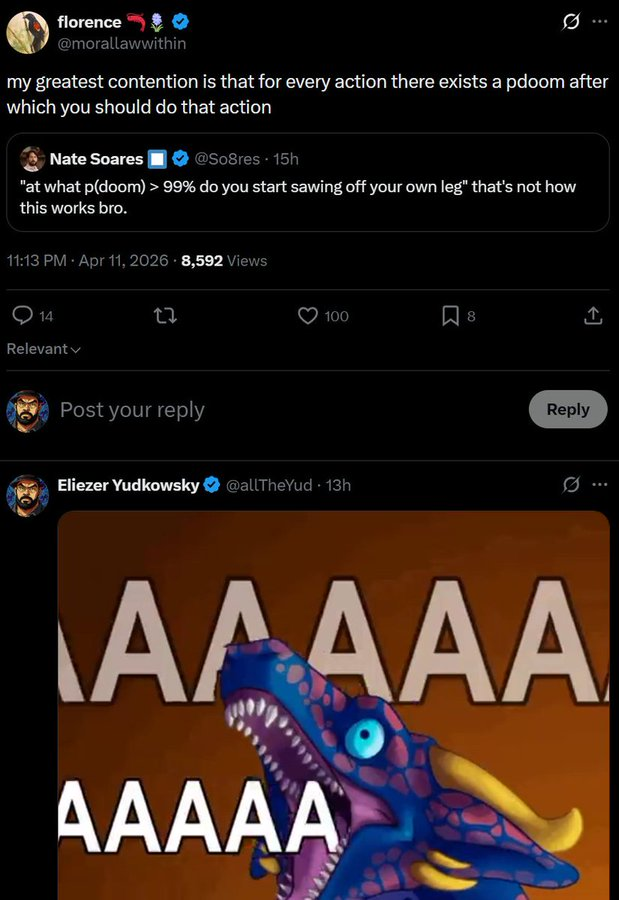
And when somebody does throw a Molotov cocktail at Sam Altman’s house, that is not actually good for the anti-extinction movement, as anyone with the tiniest bit of sense could and did predict.
Currently all the anti-extinctionist leaders are begging their people to not be violent—as they’ve said in the past, but louder now. And conversely some of the accelerationists are trying to goad violence, in some cases to the shock of their usual audiences:
That this sentiment is not universal among accelerationists, is seen immediately from the protestor in their replies. Let us, if not them, be swift to fairly admit: We are observing bad apples and not a bad barrel.
But also to be clear, those bad apples were also trying to goad people into violence earlier, in advance of the attacks on Altman:
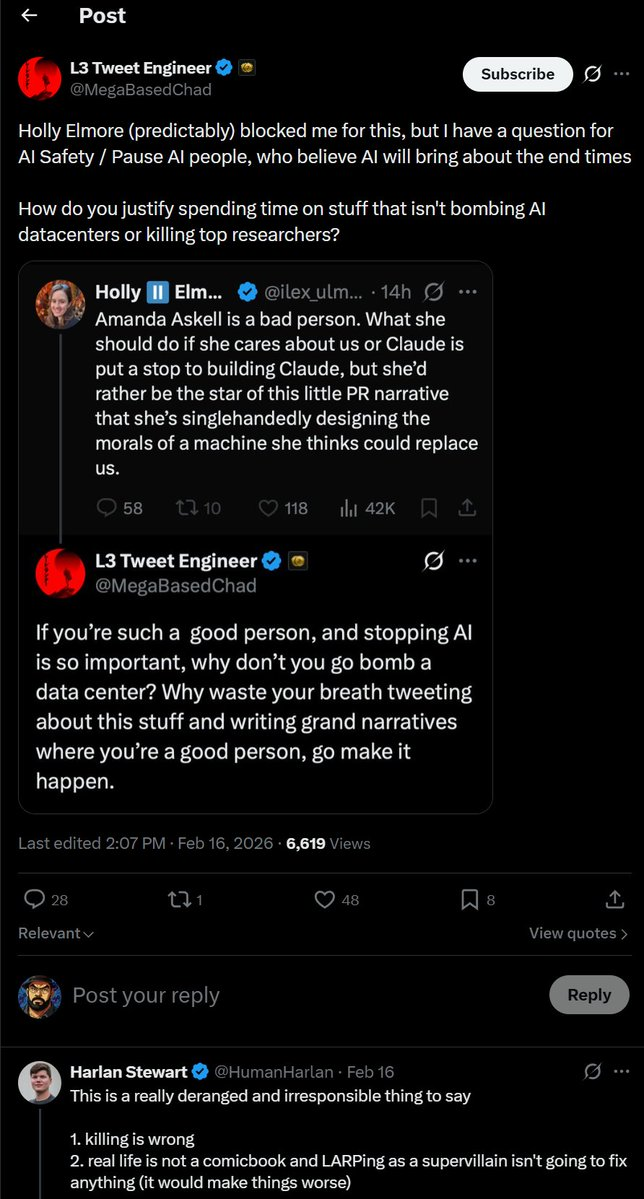
To this tweet I will not belabor the reply that anti-extinctionists may be good people with morals; some good people might nod, but others would find it unconvincing, and there is one analysis that answers for all: It would not work. And given that it would not save humanity, anti-extinctionists make the obvious estimate that our own cause would be, and has been, harmed by futile outbursts of unlawful violence.
Conversely, some accelerationists behave as if they want to spread the word and meme of violence as far as possible. It is reasonable to guess that some part of their brain has considered the consequences of somebody being moved by their taunts, and found them quite acceptable. If they can goad somebody labelable as anti-extinctionist to violence, that benefits their faction. They may consider Sam Altman replaceable to their cause, so long as there is no law and treaty to stop all the AI companies everywhere.
They’re right. Sam Altman is not the One Ring. He is not Sauron’s one weakness. If anything happened to him, AI would go on.
I am posting these Tweets in part to say to any impressionable young people who may consider themselves humanity’s defenders, who are at all willing to listen to their allies rather than their enemies: Hey. Don’t play into their hands. They’re taunting you exactly because violence is good for their side and bad for ours. If it were true that violence could help you, if they expected that violence would hurt AI progress more than it helped their side politically, they’d never taunt you like that, because they’d be afraid rather than eager to see you turn to violence. They’re saying it to you because it’s not true; and if it were true, they’d never say it to you. They’re not on your side, and the advice implied by the taunts is deliberately harmful for you and good for them.
This is of course a general principle when somebody is taunting you. It means they want you to fight, which means they expect to benefit from you trying.
Don’t believe their taunts. Believe what is implied by their act of taunting, that violence hurts you and helps them. That part is accurate, obvious, and not at all hard for their brains to figure out in the background, before they choose to taunt you.
It makes sense to me that society penalizes factions that appear to benefit from violence, even if their leaders try to disclaim that violence. Intuitively, you don’t want to create a vulnerability in society where faction leaders could gain an advantage by sending out assassins and then publicly disclaiming them.
But at the point where some accelerationists are openly trying to goad anti-extinctionists into violence, while the anti-extinctionist leaders beg for peace—this denotes society has gone too far in the direction of punishing the ‘violent’ faction for what’s probably actually in real life a rogue. And not far enough in leveling some social opprobrium at (individual) accelerationist sociopaths standing nearby, openly trying to provoke violence they know would be useful to them.
It is of course an old story. The civic movement leaders try to persuade their people to stay calm, disciplined, and orderly on the march. The local police, if they oppose that movement, will allow looters to tag along and then forcibly prevent the marchers from stopping the looters. When your society gets to that point, it has created a new vulnerability in the opposite direction.
One could perhaps also observe that certain people have taken this particular moment to argue that a scientific position whose native plausibility ought to be obvious, and which has been endorsed by hundreds of academic scientists, retired admirals, Nobel laureates, etcetera, inevitably implies that unlawful violence must be a great idea. I am not going to make any great show of wringing my hands and clutching my pearls about how such false speech might endanger the innocent for their own political advantage, what if some mentally disturbed person believed them, etcetera. This is how human beings always behave around politics; it is not unusual wrongdoing for any faction to behave that way. They, too, have a right to say what they believe, and to believe things that are obviously false but politically convenient to them. I may still take a moment to observe what is happening.
As for the argument that to criticize AI at all is “stochastic terrorism”, because someone will react violently eventually, even if not logically so? Tenobrus put it well:
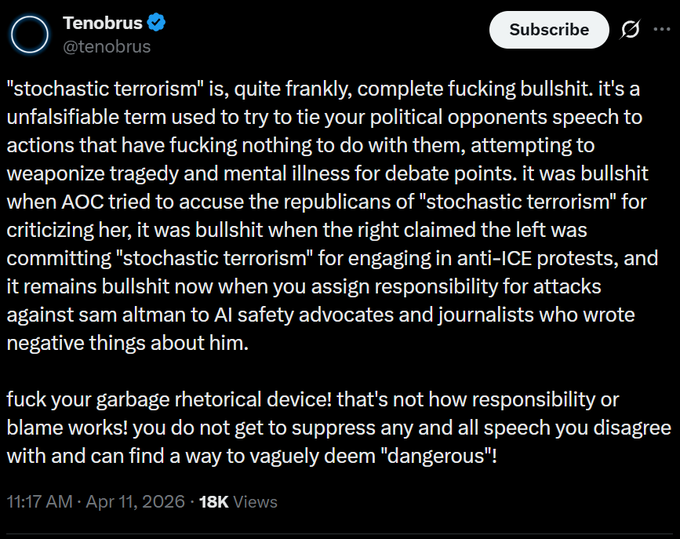
The leaders of anti-extinctionism do have some responsibility to ask their people to please behave themselves. And we do! That actually is around as much as should be reasonably asked of any civic movement. We ought to try, and try we do! We cannot and should not be expected to succeed every single time given base rates of mental illness in the population.
Speech about important matters to society should not properly be held hostage to the whim of any madman that might do a stupid thing, to the detriment of his supposed cause and against every visible word of that cause’s leaders.
That would be a foolish way to run a society.
And policywise, this would be a very serious matter about which to shut down speech. Anthropic Claude Mythos is already a state-level actor in terms of how much harm it could theoretically have done—given its demonstrated and verified ability to find critical security vulnerabilities in every operating system and browser; and how fast Mythos could’ve exploited those vulnerabilities, with ten thousand parallel threads of intelligent attack. Mythos hypothetically rampant or misused could have taken down the US power grid, say… at the end of its work, after introducing hard-to-find errors into all the bureaucracies and paperwork and doctors’ notes connected to the Internet.
In 2024 a claim of that being possible would have been a mere prediction and dismissed as fantasy. Now it is an observation and mere reality. That’s the danger level of current AI, for all that Anthropic seems to be trying to be well-behaved about it, and Mythos has not yet visibly run loose. To say in the face of that, that nobody should critique AI, or AI companies, or even individual AI company leaders as per recent journalism, because some madman might thereby be inspired to violence—it fails cost/benefit analysis, dear reader.
AI is already a state-level potential danger, if not quite yet a state-level actual power. Free speech to critique AI then holds a corresponding level of importance. The stochastic madman trying to hold free speech hostage to his possible whims—he must be told he is not important enough for all humanity to defer to him about subjects he might find upsetting.
And faced with an actual human-extinction-level danger like machine superintelligence—as ought obviously to represent that level of possible danger, even if some people disagree about its rough probability—well, that would be a silly way for everyone on Earth to die, if nobody dared to talk about the danger, or argue high estimates of that danger, and it happened without any effort at stopping it.
So let’s not die! Let’s save everyone!
Sam Altman too.
That’s the dream.

- International Law Cannot Prevent Extinction Either by (9 May 2026 22:34 UTC; 104 points)
- 's comment on abramdemski’s Shortform by (3 Jun 2026 20:58 UTC; 87 points)
- 's comment on Preventing extinction from ASI on a $50M yearly budget by (23 Apr 2026 15:01 UTC; 26 points)
- Only Politics Can Prevent Extinction* by (22 Apr 2026 13:47 UTC; 11 points)
- 's comment on Mikhail Samin’s Shortform by (15 Apr 2026 14:23 UTC; 9 points)
- Taking political violence seriously by (17 Apr 2026 2:50 UTC; 8 points)
- 's comment on Si No Se Puede by (18 Apr 2026 20:33 UTC; 7 points)
- 's comment on Do not conquer what you cannot defend by (17 Apr 2026 20:58 UTC; 6 points)
- 's comment on daijin’s Shortform by (27 Apr 2026 5:58 UTC; 2 points)
The argument that predictable norm-enforcing punishments are better than chaotic vigilantism against perceived bad actors is fine, I accept it.
There is an additional premise, that identifies that distinction with state vs. nonstate actors, I don’t see an adequate argument for it here, and I disagree with the conclusion. I will try to explain why.
King vs. Parliament in England is a relevant precedent for those two coming apart: Parliament’s eventual use of force against Charles I was legitimated by its fidelity to norms the Crown was violating, not by its prior institutional standing as part of the state. More generally, states can be the active suppressors of the alternative bases for trust that would otherwise allow norm-governed collective action. When a state is organized around trust-suppression, its violence inherently has chaotic and unpredictable elements, because it is hostile to accountability. Of course this is in some tension with the maintenance of state capacity, but in practice we see plenty of capricious violence by states that have normalized executive exceptions to their notional rules (e.g. prosecutorial discretion).
People can be expected to try to act in individual or collective self-defense in the absence of recourse. We should expect most such people to be deranged (because they live without recourse) and also to offer confused arguments (because they live without recourse), but we should neither expect nor hope that people who are not deranged and who are capable of offering good arguments will abstain from acting against people who seem to be trying to kill everyone.
I don’t know that this is as true as it is in the popular mindset. A lot of the Weathermen, who were one of the most prolific terrorist organizations in American history, now hold positions of power, including very in-demand university sinecures.
More sympathetically, the American revolutionaries took up arms against their government (though they were vastly less inclined to target noncombatants, especially with lethal force), and went on to become a superpower. Likewise, though the USSR fell through peaceful revolution, it was established violently. While the USSR was not a nice place to live, its founders certainly succeeded in putting themselves into power.
The misconception’s causes are twofold.
First, successful peaceful revolutionaries will happily hold that honor, but successful violent revolutionaries will either erase or justify their deeds when the history books are written.
Second, conspiracy theories aside, governments generally do not want to be the target of violent uprisings. Everyone in power has a tacit incentive to assert to malcontents that assassinations that might kill them and bombings that might damage their holdings are less effective at unseating them than peaceful protests and organized elections.
This may well be true, or they could be equally effective, but the incentive remains. If you’re in power over a country, a failed terrorist uprising is much more painful than a failed velvet revolution. Even if you consider a successful version of both equally bad, you’d rather your enemies tried the latter.
This isn’t to say that violent uprisings aren’t bad, only to point out that the idea that they always fail is not necessarily true.
Edit: A better argument against violence, within this context, draws naturally from the above. Violent uprisings privilege the interests of those who are best at violence—either directly, in the form of generals, or indirectly in the form of bloody court intrigue. Velvet revolutions have better odds at retaining obedience to their founders, because there isn’t an intermediate step that requires leaders who aren’t necessarily good at the same things. The sort of person who could regulate an entire industry by means of unpredictable violence may have a much different vision for the world than you do.
Please pay attention to the “states that otherwise have functioning police” qualifier, because it excludes Early Modern Age revolutions entirely and 1917 Russia as well.
Violent uprisings (not to be confused with coups which are a whole different matter!) become successful through civil wars, but almost all recent (say, in the last three decades) civil wars started as peaceful protests dispersed with gunfire. The revolution of the past is practically not a thing in the 21st century, maybe outside of failed states
is this true? the version i learned was that the revolutionaries declared a new government, and then fought a defensive war against the crown.
of course they must have expected the aggression (and prepared for it), but it feels to me that there’s something different between, on the one hand, declaring yourself sovereign (and defending that claim), and on the other hand, using violence to force the government into some desired action.
Declaring yourself sovereign is illegal, and the crown is therefore legitimate in its use of the monopoly of force over a territory to use violence to stop the insurrectionists. The British did not consent to the American revolution.
If this logic held then things like the sovereign citizen movement mean that individual people can declare themselves sovereign and thus perform what would otherwise be illegal actions (or merely defend that claim using violence).
I find it a reasonable claim that political violence is only useful when there is no other alternative—like democratic elections—through which one can make changes. “Taxation without representation.”
But the British failed to maintain their monopoly. Would you say that caused the Crown to cease being “legitimate”? Or perhaps that happened as soon as it became possible to successfully rebel, even before any actual rebellion took place; in that case, declaring your sovereignty and attempting to defend it with violence is the way of discovering that fact.
That’s not the framework either the King and Parliament or the colonists’ leadership endorsed. Similar to Parliament during the English Civil War, the Continental Congress argued in the Declaration of Independence that they were defending specific rights with precedent in English law endorsed by king, parliament, and court alike. They needed this basis if they were going to retain precedent for e.g. respecting property rights, rather than initiating the sort of free-for-all Calvinball pragmatism implied by “you lose legitimacy as soon as it’s feasible to rebel.”
It ceased to be a legitimate political force over the territory over the thirteen colonies, yes.
It is broadly true. Some relevant dates:
First Continental Congress—from September 1774
Battles of Lexington and Concord—April 1775
Second Continental Congress—from May 1775
Battle of Bunker Hill—June 1775
Invasion of Quebec—from June 1775
Declaration of Independence—July 1776
Please update generally on the accuracy and impartiality of the version of history that you were taught.
I did a lit review a few months ago. My conclusions were:
Violent protests probably don’t work (80% credence), and they plausibly backfire but it’s unclear (40% credence).
Peaceful protests probably do work (90% credence).
I was looking at protests, not uprisings, which may not generalize. But the Altman firebombing incident is much more like a protest than like an uprising.
The methodology here is flawed. “People are less favorable to groups that are called violent” is straightforward and easy to anticipate, but it ignores second-order effects. Namely, successful violent organizations tend to intimidate people into refraining from calling them violent, or into redirecting their outrage against violence and disorder onto their opponents. Most of the other studies you cite have the same issue.
Moreover, a literature review on this topic is subject to publication bias. Nobody wants to write the “violent protests work” paper. No reviewer wants to sign off on it. Even where methodology is perfect, these things will shape how results are phrased.
I think you are playing a rhetorical game with the reference to the weathermen as a counter example because many members of the group are today successful and have high prestige positions.
The question is not did some level of participation in this group ruin the lives of all individuals involved in the group. The question is did the violence of the group lead to their aims to come closer to being achieved.
The credit-assignment problem is hard in reinforcement learning and harder in reality, which is why OP used the much more empirically verifiable “Groups that did X were less likely to succeed at Y” claim. My argument is that his claim is a lot sketchier than it looks at first glance, because groups that succeeded at Y and did X tend to conceal that they did X.
Nevertheless, the closest proxy for “Were these peoples’ actions effective?” is “Did the people who ended up in power after these people took action move to reward them?”. A university sinecure is a very scarce, very desired asset, and there are a lot of people competing for them. To receive one as a reward is a statement by those with the power to hand them out that your actions were very appreciated.
Not to mention that a movie that’s at least ambivalent towards that sort of thing has literally just won the Best Picture.
Also, being a full-throated Hamas apologist doesn’t disqualify people from many positions of influence these days.
Yes, but do you think that the violence from Hamas has brought Palestinian independence, or the achievement of other Palestinian goals closer? Yudkowsky’s claim is not that saying nice things about Hamas will be a bad political/social move in the US. The claim is that the use of terrorism is worse than nonviolence at achieving political goals, and the failure of Hamas to achieve its goals seems to be an example of this being true.
I think that Palestinians are basically screwed regardless of what they do, but insofar as their goals include weakening/isolating Israel, they have achieved success beyond their wildest dreams (but at a grievous cost).
I get you’re trying to show how commuting an obviously evil act won’t fix your unrelated problems magically, but I think you’re pushing too far on the “evil act” part of things and no enough on representing the reasoning of people who think killing Sam Altman would help somehow. Like, whomever threw that molotov cocktail probably wouldn’t feel your example captured how they’re thinking about this. But they and others who reason like them are the ones who need to internalize your point!
Now, I don’t know exactly what went on inside that guy’s head. But I think it might be something like this. “Sam Altman has some causal influence on AI development. He’s part of what’s causing the race! So if we get rid of him, we gain time.” This is obviously an impoverished mental model, and it’s operating more on associations or vibes than causal mechanisms.
So a better example would replace puppies with something associated with increasing cancer. Perhaps “cigarette smokers” or “nuclear power plants”. “If I kill all the cigarette smokers then my daughter’s cancer won’t resurge”. Or perhaps you have someone on a noble crusade to end cancer, and they decide to bomb all the nuclear power plants. Then the analogy to “killing sam altman will reduce AI x-risk” would be tighter.
EDIT: Also, thanks for writing the post I wanted to write.
I agree with the need to accurately model the thinking of anti-extinction madmen to better communicate with, and de-escalate them. I think the thinking might be “Sam Altman is one of the actors driving the race towards dangerous AI capabilities. The current environment seems to incentivize this behaviour. If I commit a visible violent act towards him, it will reduce the dangerous incentive, after all, people want money and prestige, but they don’t want to have their property vandalized or die violently.”
They may also have been thinking of this as a commitment signal. Throwing fire at someones house is a very bad thing to do, both in terms of the effect it could have on the victim and the effect it will likely have on the perpetrator. To know that and still be willing to do it could be seen as a signal of conviction to the believe that Sam Altman’s actions, and the actions of large AI companies, are harmful. Unfortunately, it can also be seen as a signal of the perpetrator being violently insane, and a signal that the anti-extinctionists are violently insane. Ironic and unfortunate.
Also to the end of de-escalating madmen, I think we need more compressed versions of the essence of this post. Maybe something like “global GPU control is the only sufficient control against ASI, anything that doesn’t move us towards international coordination is counterproductive”.
According to the criminal complaint, he explicitly said so.
This is someone whose open interest in violence was explicitly rejected by at least two different activist groups (Stop AI and Pause AI) from what I’ve heard.
If you want to kill modern AI using existing law and have friends in the correct government offices, it should be fairly straightforward to do so without new law
This legal category is very aggressively defined: https://en.wikipedia.org/wiki/Restricted_Data
It was written to mean ‘if someone draws a working design for a nuclear bomb or certain kinds of nuclear material production equipment anywhere, that data is a state secret, regardless of the source of the information used to produce it’. This is commonly referred to as ‘born classified’. There are a good 70+ years of arguments about whether this is a good law, but that is the law.
Therefore, here is your process:
-find an AI model that you reasonably believe is capable of outputting something the government will view as a classified fact related to nuclear weapon design. Edit: you should probably build it yourself by either training from scratch or fine-tuning an open model.
-send the model weights, installation instructions, and a letter to the DOE Office of Classification requesting that they determine that your model is NOT restricted data. Offer to send them hardware to run the model (you won’t get it back). I am familiar with this classification regime, documents are not the only things that can be marked restricted data, physical embodiments (sculpture or actual objects) or computer programs (math models) are classified with it.
They can either determine that your model contains restricted data (if the model can invent novel tech, it should be able to figure out 80 year old tech so this might not be a hard bar to jump), determine that it does not contain restricted data (in which case you should send them a bunch of outputs that look bad and see what they say), or determine that the class of material (model) cannot be judged under the law.
Since the model is a unitary object, it will be quite hard to separate ‘these specific weights are where the restricted data lives’ from the rest, so suddenly frontier models will become, through the stroke of a bureaucrat’s pen, state secrets.
Edit: get someone with a current or former Q clearance to submit the model as their own work if you want to add ‘it would be ok for this to be published, but not by you’ to the list of possible outcomes. That would mean that an AI researcher who wants to credibly take themselves out of AI research permanently can simply acquire a Q-cleared job (LLNL is near the bay) at some point. The possible positive (for OP) outcomes are 1) the US bureaucracy has a reason to slam the door on AI research globally in the name of counterproliferation 2) there is a nunn-lugar type path for researchers to make a living without working on dangerous capabilities (or working slowly only within the government, which is conservative, cost constrained, and now staffed with people who wanted to make safety their mission). If you seize power, you don’t need new legislation on safety, you only need some bureaucrats to choose to enforce the rule, plus potentially extra funding for military industrial complex contractor jobs.
Arguments of law in this context appear to me to be less important than arguments of power, but...if law matters, here is a law you can use, I guess?
Strong upvote. A really well-written, persuasive, and timely essay. Thank you for writing it.
Recent events seem like a fork in the road, and the AI safety community needs to make sure it goes down the right (non-violent) path.
You should add the context that the post you quote was a joke trying to make the same point that you’re making. https://x.com/morallawwithin/status/2043680224047444119
Thank you for clarifying that they were attempting humor. I had lost a lot of respect for that account, believing it was sincere.
This is inaccurate: he consulted his foreign minister whom he considered an expert on Great Britain, but unfortunately, he appointed on this role a sycophant businessman who convinced himself and Hitler that the British were bluffing, and went so far to have “the German embassy in London provide translations from pro-appeasement newspapers such as the Daily Mail and the Daily Express for Hitler’s benefit, which had the effect of making it seem that British public opinion was more strongly against going to war for Poland than it actually was.” For more details, see https://en.wikipedia.org/wiki/Joachim_von_Ribbentrop#Pact_with_Soviet_Union_and_outbreak_of_World_War_II
I liked this post.
I think there is a different post that feels missing from the discourse, that ties together “what goodness is, with gears-level models all the way up and down.” (Which is, like, sort of a massive project. But, it’d be nice to gesturing at enough of the details to get the structure across)
Some people have reacted to this sort of statement with “so, you’re saying if it were practical to stop AI with terrorism, it would be worth it?”. In one of the twitter threads, Eliezer said “no I didn’t say that” and linked to Ends Don’t Justify Means (Among Humans).
Some other AI safety people said “Yes, it is evil to try to murder Sam Altman for the same reasons it’s usually evil. But, to the people contemplating terrorism, that isn’t very persuasive. But, yes, for the record, it is evil and wrong.”
I feel a bit confused and dissatisfied with the situation.
I’m a persnickety rationalist. I think “goodness” and “evil” are underspecified and possibly-confused categories that I don’t have a complete understanding of.
Nonetheless, I am aware that at least part of what gives some people the heebie-jibbies, when they see long arguments like “terrorism wouldn’t work” instead of loudly, simply stating “terrorism is wrong!”, is… it’s obvious the person saying the long complex argument is going “off-script.” They are stepping outside the simple-seeming moral frameworks people are familiar with.
Some rationalists go out of their way to promote virtue ethics or deontology.
But, normal people don’t say words like “virtue ethics” or “deontology.”
People who say weird words you don’t understand… man, those people could do anything. You’d have to read all their words to understand them, and then probably still wouldn’t follow the arguments, and then still wouldn’t be sure they weren’t a Clever Arguer who was trying to pull one over on you.”
Saying “our notion of goodness is underspecified and maybe-confused and maybe a conflationary alliance” is the sort of thing a clever arguer says, which increases the odds that person is going to do something surprising you don’t like later.
The thing I think it (approximately) means, to say “It’s still evil and wrong, to do terrorism”, is “It’s no accident that we have the conception of Goodness we apply in most mundane situations. There’s a structural reason it all still applies in the extreme situations (i.e. ‘People still need to be able to trust each other and society still needs to function at the end of the world. That’s one of the times you most want people to trust each other!’).”
But, (from my current epistemic state), I don’t actually feel that confident that that’s true. (I think Eliezer has thought explicitly about this sort of thing that it feels plausible to me he would have a justified true belief that it’s robustly true).
A post I’d appreciate someday would be one that tries to sketch out the end-2-end broad strokes here, including which bits you can robustly argue for, vs “look this is either still complicated, or still fuzzy/unknown”. Ideally, one where the explanation hangs together at first glance to a layman, while pointing to ‘this sort of math says these things about cooperation/communication’, to convey that there’s a deeper structure.
(Before writing that comment I want to ask you to please use reactions which exist on lesswrong when you downvote, because otherwise I will have no idea what I did wrong, except “writing a comment on lesswrong”, and what I ought to do differently the next time.)
This is somewhat a side line, but… When reading this post’s point about the difference between lawful and unlawful violence, I could generally follow the logical chain. And somehow it still was surprisingly very unintuitive for me that any such difference exists. It was only the next day when I realized: I live in Russia.
There is a popular proverb in Russia, which translates roughly as “The severity of the law is compensated by no necessity to follow it” (one of Russian spellings: “Суровость закона компенсируется необязательностью его исполнения”).
When I said once here, on lesswrong, IIRC (unfortunately, can’t find the comment) that to say, that war against Ukraine is a war, was made a felony in Russia—I got a very confused reaction from other users. Because—if that was true, wouldn’t that mean that everyone was made a criminal? To me, it was obvious that of course that it is the point! I remember casually hearing in books such phrases as:
“But it is physiologically impossible for human to not do that!” “Yes, and when you will, we will be able to do anything to you, but now it won’t be arbitrary, it will be The Rule Of Law.”
One of the favourite phrases of Putin is “everything should be done in the frames of law”. It is said that in the USA there are too many laws, so you probably broke some of them. In Russia there are such laws that anyone certainly broke any of them. Even long before the war, there were at least three. Felony of fraud is phrased such, that generally any commerce falls under that law. Exactly that law was the one, Navalny was found breaking, when he started to make his investigations. And there also is a felony of extremism—“incitement of hatred or enmity, as well as the humiliation of the dignity of a person or group of persons on the basis of [...], as well as membership in any social group”.
It is said that the legal language is a specification language. But that is in case of countries with actual rule of law. In hybrid regimes like Russia it is exact opposite of that, some “language of non specificity”. In the countries with rule of law the purpose of making laws is so that people don’t break them. But in many other countries the purpose of making laws is so that people break them. Everyone should be a criminal. There shouldn’t be a situation such that person could do something to avoid the “lawful violence”. Laws in hybrid regimes are written so that breaking them will be not avoided, because not avoidable.
Considering that, I now have much better idea, why I have so much of libertarian sympathies. Though, surprisingly it is not because I dealt with too many regulations—I dealt with no regulations. And with wantonly violence. So no regulations and no violence would be a strict improvement for me.
This seemed to me like an interesting observation. And that makes me question, how trying to prevent extinction by law will work in the countries, where there is no actual rule of law. They are probably excluded from the main topic as NOT “countries with functioning police”? Though, there still even before war was a kind of consensus among Russian dissidents that on “while Putin poisons people with polonium, how you dare try to stay peaceful word sayers—you should go cook Molotov cocktails!” there is an answer that “Putin’s regime is a kind of people who is better in a game of violence, not us, if we will move game here, not we will be winners, and ordinary people will never support us if we will start it”. So (at least before the war) Russia was a country where even if you couldn’t do anything to guarantee you being exempt from violence, you still were able to not get attention of government to mostly expect you are safe.
And on the other hand, even if there is no any respect for Law… after failure of Roskomnadzor to block VPNs by tech, government simply ordered IT companies to start blocking their own clients who use VPNs. And they started. So, maybe it will not work worse in Russia, if you will be able to convince Putin that he will not get his “150 years by transplanting other people organs” if the AGI will be created. But it is only Russia, I don’t know about other countries.
I think you’re making a good point, but it could be boiled down to 2-3 sentences
Whilst I agree with the overall suggestion that global coordinated effort is really required. I disagree with the extent to which local efforts are portrayed as being pointless.
For the following reasons:
Anything that slows down progress is likely beneficial if you believe that longer development time to ASI will likely lead to a more favourable outcome. If the Google AI lab was shut down, we might (in timelines where Google was winning the race) gain months more time to enact global legislation or make breakthroughs in alignment
Cumulative local efforts can add up to something more meaningful
Local efforts make it easier for other parties to take the same path. They increase the mindshare of the viewpoint amongst other actors. Before long you might have a collection of similarly inclined states/countries which could push for more global agreements
My view is that local efforts should also be encouraged so long as they aren’t pursued at the expense of more global agreements
There are local efforts that help with building a coalition that has power for global efforts and local efforts that make it harder to build coalitions. Using political violence makes it harder to build coalitions.
small caveat that I believe it would be positive to concentrate researchers in fewer companies.
What are the statistics? I’m not convinced. It seems the sympathy part is mostly solved by having a large official wing that disavows any violence.
Directly stopping all AI is not the only way terrorism could raise P(pause). It also raises awareness of the cause, and causes terror which can change behavior.
My model is something like: You need constructive action to build lasting systems, treaties, solutions that will withstand the test of time. Destructive action can, in theory, cause some local change, but it destabilizes the environment and increases variance enough that for any reasonable agent it’s basically never optimal in iterated games.
I did a lit review a few months ago. My conclusions were:
Violent protests probably don’t work (80% credence), and they plausibly backfire but it’s unclear (40% credence).
Peaceful protests probably do work (90% credence).
However, the literature is too coarse to give good evidence on questions like, “What happens if you have a civil movement with a mixture of violent and nonviolent protests, compared to a counterfactual where all protests are nonviolent?” If I extrapolate from the narrower results that are supported by the literature, I’d guess that a pure-nonviolent movement would be most effective, but there’s no decent-quality direct evidence to my knowledge.
It seemed like the lit review said “there’s not that much good data here”, kinda surprised you ended up with that high a confidence. (Maybe I’m going off a prior that this seems like a domain it makes sense to be pretty uncertain about by default)
80%/90% confidence is enough to be action-guiding (IMO) but I wouldn’t call it “high”. On a scientific question where there’s good data, it shouldn’t be hard to get to 99% or even 99.9% confidence.
If you have a single study with p = 0.049, and God descends from heaven and tells you that the study had perfect methodology, then you should update your beliefs by about 5:1. That alone gets you from a 50% prior to an ~80% posterior.
The lab experiment meta-analysis (Orazani et al. 2021) found a very strong p-value, I’m just not sure how well lab experiments generalize to real life.
I will say that I don’t know that I have a good sense of how to convert a within-experiment odds update to a subjective odds update (accounting for methodology flaws, publication bias, etc.). So maybe my subjective credences aren’t good. I just have a sense that like, if violent protests worked, I would expect these studies to have had different outcomes. But I wouldn’t be extraordinarily surprised if it turned out that violent protests work after all.
Have you done any calibration practice?
Fair question. Not recently but last I checked I was well calibrated on the sorts of questions that are in calibration quizzes.
Hmm. I’m not very meta-calibrated about meta-analyses, I’m going off having heard a bunch of people complain that social sciences are often pretty BS (both in terms of having bad methodology, and just hard to learn from and easy to misinterpret even when the methodology is okayish).
I would also like to see these statistics. On priors I am pretty skeptical that this kind of stuff has been studied neutrally (the statistics are not cruxy for me, and I don’t think anyone else, but it still seems good to be honest about the state of things here).
Maybe the real anti-violence is to retrospectively support any violence from your side, because that would hurt the cause and thereby de-incentivize violence 🤔
I hope you’re open to unexpected blunt criticism. This comma is wrong. This post has ten comma errors including repeated subject-verb splits.
Studying the craft of writing more, including comma rules, would materially help with your efforts to persuade people about AI risk.
I am absolutely not joking or trying to be a pedantic jerk. I wrote philosophy essays for over 15 years before I studied grammar. I wish I’d studied it earlier. Besides improving my writing, it ended up helping with text analysis, debate, and organizing my thoughts.
EDIT: To habryka, or anyone else who thinks the example comma in the quotation is correct: Why do you think that? Do you have a source for a rule which permits or requires it? It splits the subject (extermination) from the finite verb (would), similar to writing “Extermination, is bad.”
I think it’s very clearly wrong according to standard English grammar rules, but I also think that Eliezer knows that and is using the comma to simulate a conversational speaking cadence. In this case, it’s a pause for effect that emphasizes a sense of absurdity that this has to be said, in a way that “The utter extermination of humanity would be bad!” doesn’t.
It would be more grammatical to use an ellipsis (“The utter extermination of humanity… would be bad!”) but implies a slightly longer pause, which is probably less accurate to how Eliezer would say this out loud.
This kind of comma usage would be inappropriate for, say, a newspaper article, but I think it’s defensible for an informal persuasive essay.
Thank you for answering my question.
How did you reach that conclusion? The large number of comma errors in the essay (along with semi-colon errors and others) suggest to me that he doesn’t know. I don’t think they’re all deliberate stylistic choices. Many of the broken rules are widely followed, uncontroversial, and infrequently broken on purpose.
Yes, on balance, people at LessWrong like his posts. I wouldn’t have finished reading RAZ, HPMOR and IE if his writing didn’t have virtues. That doesn’t mean there isn’t room for improvement. My suggestion was intended to primarily help with less receptive audiences, not LessWrong members.
It was deliberate. It will not be modified. You can stop now.
If you simulate speaking the sentence, the comma changes the cadence in a way that adds emphasis. This may not comply with every style guide, but it does made the sentence better (imo).
Others have answered why the comma does work.
My relationship to “rules” of writing or “rules” of grammar is approximately the same as my relationship to “rules of dining etiquette”. If the reader understands what you are trying to say, you wrote “correctly”. There is no “wrong” beyond that.
(This is also the position of most linguists, as it I think becomes very quickly very obvious if you study how people actually use writing and language in practice)
Most linguists are descriptivists. There’s a common misconception that descriptivists don’t believe in wrong answers. Actually, they scientifically observe real communities and describe their use of language. Each of those communities has rules (often unwritten and inexplicit) for what is correct or incorrect. Children commonly make incorrect but understandable statements and are corrected. Descriptivism says every English dialect is valid instead of privileging some communities over others. Written English is a somewhat different matter. Punctuation isn’t spoken and its rules aren’t reducible to aspects of spoken English.
Sources:
What Descriptivism Is and Isn’t (“Even the most anti-prescriptivist linguist still believes in rules”)
Why Descriptivists Are Usage Liberals (“[descriptivists] make observations about what the language is rather than state opinions about how we’d like it to be.” and “But no matter how many times we insist that “descriptivism isn’t ‘anything goes’”, people continue to believe that we’re all grammatical anarchists and linguistic relativists, declaring everything correct and saying that there’s no such thing as a grammatical error.”)
Descriptivism isn’t “anything goes” (Says “I goed to the store” is incorrect.)
Stephen Dodson of languagehat commenting on “The New Yorker vs. the descriptivist specter” by Ben Zimmer (“descriptivism in the linguistic sense has nothing to do with spelling or style (in the “do commas go inside or outside quotes?” sense); those things are arbitrary/conventional and are decided by reference to dictionaries and style guides, respectively. [...] That issue has nothing to do with grammar and spoken usage, which is what descriptivism addresses, and it’s a disservice to clear thinking and honest discussion to pretend it does.”)
The Linguistics of Punctuation (Argues that punctuation is its own system, not a derivative system corresponding to intonation or pauses.)
The Cambridge Grammar of the English Language (“we do not find social variation between standard and non-standard [punctuation] such as we have in grammar: [...] [no] repertory of variants that are used in a consistent way by one social group but not by another. Moreover, the style contrast between formal and informal is of relatively limited relevance to punctuation.” Gives punctuation rules including “a strong prohibition on punctuation separating subject and verb”.)
EDIT:
You missed my point, so I’ll say it more plainly: You’re objectively, factually wrong about the position of most linguists, including about spoken language. I provided sources and quotes. The specific misconception you have is a well known source of frustration to linguists which they have repeatedly complained about.
It is plausible to me that some linguists are desriptivists about spoken language but not about written language, but that seems very rare. And dialects of written language as commonly spoken on internet forums, or text messages, are of course just as common as spoken dialects.
Let people communicate how they want. If people actually genuinely end up confused, you can complain.
I disagree with @habryka’s literal statement that “If the reader understands what you are trying to say, you wrote ‘correctly’.” I think it’s correct in spirit though.
Some text is difficult but not impossible to understand, which I think should count as “wrong.” Some text is easy to understand but annoying to read, which is arguably also “wrong” if you didn’t mean to annoy your reader. It seems like Eliezer’s writing style annoyed you, which all else equal is a drawback.
But judging by the number of upvotes on Eliezer’s post (and all the rest of his posts, for that matter), it seems like most people on LessWrong don’t find this writing style difficult or annoying. And as I mentioned, these commas actually convey meaning (unlike “I goed to the store”), so I think it’s fine.
(I don’t know whether it’s technically grammatically wrong, but, I think this matters approximately zero for how well this post will be received)
“boneGPT”, who shows up halfway through this essay as an example of an accelerationist taunting doomers for not resorting to violent direct action, is also a contributor to “The JD Vance Show”, the latest work by Emily Youcis, the Leni Riefenstahl of AI art (by which I mean she’s a white nationalist, and also very talented in her art). So I wonder what the belief system here is. AI is OK so long as redpilled whites are leading the charge?
Without AI everybody reading this will face oblivion in less than a century, in most cases much less, with AI maybe not. And do you really believe the measures you propose can stop the advance of AI over the long run? When it comes to data processing, and therefore of intelligence, electronics has a HUGE advantage over biology and nothing is going to change that, your proposals are just rearranging the deck chairs on the Titanic. Having said that I thought your new book was thoughtful and I enjoyed it, even though I disagreed with much of it.
John K Clark
As a professional AI alignment researcher, we really have no idea wtf we’re doing in general, but we have some ideas. Some more time to work on the problem before the most powerful AIs get yet more powerful would help. A lot.
Also, if we do the “international ASI ban” idea (which is humanity’s best hope), that doesn’t mean the practical AI capabilities available to the public will stagnate. The AI-powered tools based on the existing models will get better and better! And this will indeed speed up alignment research… but humans won’t win the race against RSI unless we hobble the AI capabilities by restricting brute-force compute.
And when the Law refuses to act? What then? Big Tech has immense resources, more than almost any other lobby, to compromise our politics—and to sabotage any effective move to save humanity.
Is there any fundamental moral principle which makes Non-State Violence always wrong?
From Eliezer’s perspective, extinction. Hopefully, dying with some dignity. His p(doom) is pretty high.
The idea that the power balance is structured in a way where you can use non-state violence to prevent a core military priority from being fulfilled is wrong. Winning a military conflict against both the US military, the Chinese military and any other country that would protect their domestic AI development via non-state violence is a lot harder than the legislative battle.
Thank you for the restraint it took to talk about drone swarms, which everyone can palpably understand, in contrast to more realistic scenarios, which only a fraction of people are willing to imagine and take seriously. It’s a bug, yes, but there’s no easy patch and trying to fix it is not the task that needs to be solved.
Thanks also for pointing out the optimists selective pessimism: ASI cannot possibly be banned without a worldwide tyranny, but ASI will surely be beneficial if we scale up whatever works first.
I don’t really disagree with anything here, but it does seem to be historically well founded that nation-states only respond to a much greater standard of evidence with respect to dangerous technology. I think there’s a few conditions we need to meet.
Conditions,
A. Clear demonstration of the technology’s great danger—We dropped the bomb before we recognized that the bomb shouldn’t be dropped under any circumstance. Or in the case of the Montreal Protocol, we had unambiguous evidence that HCFCs were depleting the Ozone layer.
B. Brinksmanship using the technology in question—It took the Cuban Missile Crisis to prompt international cooperation on nuclear arms control steps for example, starting with the 1963 Partial Test Ban Treaty.
C. Public fear/horror regarding specific uses of the technology—I think the examples regarding nuclear weapons are obvious. Another case would be the Chemical Weapons Convention, which was prompted in part by news coverage of the 1988 Halabja attack.
D. No win condition—Nuclear proliferation proceeded practically unabated so long as countries viewed it as a race they could win. Von Neumann’s MAD doctrine changed the calculus surrounding the use of nuclear weapons; any use of nuclear weapons could result in an exchange that no one could win.
E. Limited controls—Even in the case of nuclear technology, nuclear material is produced and used across the economy. Controls are specific to the necessary steps to produce nuclear weapons (enrichment for example) as opposed to general use of nuclear material.
Applied with respect to AI,
A. No major events due to frontier AI just yet. Some deaths due to at-risk individuals using Helpful and Harmful AI.
B. No brinksmanship since no near peer power has similarly dangerous AI.
C. Mass distaste for AI, but not yet fear/horror. AI hasn’t been used as weapon on a large scale yet.
D. Policy leaders seem to believe that there is a win condition where they can maintain ‘control’ of superintelligent AI. No way to make them believe otherwise i.e. human hubris as a failure condition.
E. Although limited controls are on the table in the form of privacy, data use, and more usefully limiting datacenter size (not passed yet anywhere), safetyists still push for a pause until we have better alignment technology. I agree with this, but it’s an impossible thing to advocate for when none of the previous conditions have been met.
So overall, I doubt we can push for safety regulation that’s targeted towards ASI until there’s a clear and present danger—catch 22, that’s what we want to prevent. I would recommend that AI safety reorient around meeting or predicting that these conditions will be met, and having drafted legislation and countermeasures immediately ready to go whenever they are.
(Pithy comment, not to be taken seriously—unless someone at the frontier labs uses Mythos or the OpenAI equivalent to conduct a mass cyberattack against middle America, its unlikely regulation like this will even be on the table)
I think it’s important to note that this happened after two catastrophes—Hiroshima and the Cuban Missile Crisis. I think the overall sentiment of this article is probably correct, and law is necessary. The question is how it can come about. The ‘working hard’ bit here deserves more elaboration, especially regarding the necessary conditions for hard work to actually pay off. Is a catastrophe required for AI to get its non-proliferation regime?
Hi, I’m just registered. So, can be not so aligned (it’s not about agreement) with community. Give me a pardon, please :)
This long read raises many question I’m interesting in. But at beginning the first one. About predictable violence and bad laws. Let’s try to make a look at violence and laws like any other human things in this world—tools. And from this point of view—the question is moved into other area. Not what is it and how it can be regulated. It is impossible to create an ideal tool. But how to get the most effective tool? And what? There is again not a such. In different cases different hammer is required. From this point of view the issue not violence or laws or even state—but stagnated monopoly. The state or the laws currently and violence as conscience are fixed. Technically the state is an analogy of іnsurance. Violence is required in specific cases, even unpredictable. That’s it. In the moment when everyone will have possibility to choose the state without changing the whole life, we lost most problems of laws and violence. It will be choiceable.
Not laws prevent extinction. But adaptability—the possibility to change.
I hadn’t heard the “predictable and avoidable” framework for the govt monopoly on violence before. Thanks for that, it very much rings true.
I was inspired to Suno up a song about it, using the lyrics from (the first part of) the post!
Predictable and Avoidable (ft. EY & P. J. O’Rourke): https://suno.com/song/0119d109-3985-4cb4-a197-c4acbd5c74b3
I did an interesting project in uni on whether the state can exist without violence. I discovered there are many tribal communities without violence or prisoners. They use public shaming instead. The problem is scaling this to a large enough scale of modern states.
The other problem is sociopaths and psychopaths. It seems clear that at least in the US, some leaders are severed mentally imbalanced, which means they feel no shame. Without shame, public shaming is meaningless.
That was a problem extremism researchers identified a while back. Earlier in the piece it was easy to get neo-nazis to put a plug in it by just making it clear that if you do nazi shit, that nazi shit will follow your reputation around. But at a certain point, if that nazi shit becomes acceptable, one cant rely on “You’ll be exposed and shunned” as a disincentive, if said neo-nazi is marching around in the street without hiding their names or trying to protect their identities. It means they fully embrace the nazi thing and want people around them to know that.
I don’t know what he was smoking when he said that, but I want some.
It does reveal a very odd epistomological orientation that truth is just whatever people say it is with the key word being “people”. I’m not sure why an AI would care about that variety of Truth, because if an AI can recognize it as a truth, it then follows that it doesn’t need a human to get to that truth either.
The thinking on AI extinction truly boggles my mind sometimes. For example:
‴But others say that focusing on hypothetical threats is also risky. Given limitations to policymakers’ attention, it could come at the expense of addressing current concerns, says Mock. Moreover, he says, the doom narrative confuses the public about AI’s abilities and gives firms an excuse to avoid regulation. “If this technology could end us all, it stands to reason that the US government or the UK government would not want the CCP [Chinese Communist Party] to develop it first,” he says. Then “no regulation can be contemplated, because that would slow us down”.‴
So, we can’t talk about doom because then we could not regulate AI? Um, what? And this is in the journal Nature: Nature 652, 848-850 (2026) https://www.nature.com/articles/d41586-026-01257-6
Nit pick from the article: ‴A similarly fabricated quote says that I proposed “nuking datacenters”.‴ The actual quote is:
“What does the winning world even look like here? How in real life did we get from where we are now to this worldwide ban, including against North Korea and, you know, some one rogue nation whose dictator doesn’t believe in all this nonsense and just wants the gold that these AIs spit out? How did we get there from here? How do we get to the point where the United States and China signed a treaty whereby they would both use nuclear weapons against Russia if Russia built a GPU cluster that was too large? How did we get there from here?” See: https://intelligence.org/2023/03/14/yudkowsky-on-agi-risk-on-the-bankless-podcast/ or: https://www.youtube.com/watch?v=gA1sNLL6yg4&t=4537s
So Eliezer Yudkowsky has proposed that a winning world would include using nuclear weapons against a GPU cluster. That said, he has made it abundantly clear after that he does not endorse the position of using nuclear weapons against datacenters or similar, such as in https://intelligence.org/2023/04/07/pausing-ai-developments-isnt-enough-we-need-to-shut-it-all-down/
Edit: The comment was ex tempore and Eliezer Yudkowsky specifically recanted the nuclear weapons comment here: https://x.com/ESYudkowsky/status/1642255043406761984
Disingenuous to quote this without also quoting:
And even that is not to speak of “nuking datacenters”, sheer straw where conventional weapons would well suffice if the conditional and predictable use of state force triggered there.
I had not seen that x post. Thank you, I edited my comment.
Nit pick of your nit pick is that he doesn’t propose that it would include using nuclear weapons, he proposes that it would include the will to use nuclear weapons. The point is not “lets start throwing nukes around” it’s “this threat is larger than nuclear war—so nukes should also be an option if nothing else will work”.
i can agree that there is a legitimate difference between lawful and unlawful violence in the predictability of their outcomes. however i can’t say i’m convinced that it addresses or even acknowledges the deeper concern.
both systems ultimately rely on coercion compliance through the threat of punishment—actors comply because of expected or perceived future punishment. my concern is that coercive systems don’t scale so well to something global, existential, and economically incentivised like ai development. unlike nukes, ai has massive commercial incentives, and a low barrier to entry; any sufficiently motivated actor with enough compute can defect from any sort of rules set in place.
furthermore, i don’t see anything inherently wrong with debating over this mechanism, but i question the viability of some supranational body ruling over a commercially lucrative product, such as, ai. i mean, companies would have to first voluntarily enter, and only then be bound. if enforcement relies on voluntary participants and incomplete coordination the system remains fragile.
fundamentally i’d like to see a shift away from ‘lawful vs. unlawful’ debates and towards a ‘coercion vs. persuasion’ one. avoiding punishment is instrinsically different from pursuing a shared reward. if anything i’d like to see a stronger argument that coercion—regardless of the lawfulness of it—is sufficient to align individuals, governments, and the actual corporations profiting [or profiteering] who have every financial reason to route around it.
I read Yudkowsky’s article with interest. In particular, I felt that the view of AI risk as an “irreversible event” was convincing enough.
However, as I read it, I had an idea. In some ways, the logic of blocking risks in the pre-super-intelligence stage seemed to resemble the issues addressed in the Minority Report and Psycho-Pass. It makes me wonder how far I can see it as a legitimate intervention in a situation where I have to intervene only with the possibility that has not yet occurred.
So I thought about a slightly different direction.
When talking about AI safety, it seems that several approaches are usually discussed together, such as legal regulation, ethical guidelines, alignment, and human-in-the-loop.
Regardless of the intensity of regulation, legal regulation and ethical guidelines are strongly regulated for developers, and I think they are not direct controls on AI.
So I think the combination of alignment and human-in-the-loop in particular might be a more practical direction.
Recent AI agents often complement and execute insufficient information with inference without fully understanding the user’s intentions or commands before the execution itself is accurate.
In this situation, I think it is more important to check “Is the state of understanding sufficient now” than “What can be done?”
So, personally, I think that design in the direction of stopping and asking again when understanding is insufficient, rather than a structure in which AI continues to push judgment, can be a realistic safety device.
I’m still in the process of organizing my thoughts, but I wonder if this approach can be a small complement to the existing discussion.
TL;DR.
Root principle articulated in the sequences: falsification is a special case of Bayes
Anxiety: computation is the mechanism that structures all consciousness
Cybernetic premise: simulating something in a conscious substrate by accident would just be making that thing real
Resultant anxiety about free speech: when speech can be reified by machines by accident, there is a proper order of operations to testing it. One that assigns strong lexical priority to the exhaustion of possible good, structured, coordination enhancing, survival increasing interpretations, and secondarily but critically to falsification processes that dissolve possible bad meanings, incorrectly assigned. This is not strictly speaking a free speech issue but a hygiene around AI training data issue. To the extent people’s priorities in speech reflect their actions with respect to AI training data, a concern emerges.
Proof of work: The signature in beautiful red ink of every demon in the universe
To some degree the “cutting your own leg off” strategy, whilst on the face of it is a funny gotcha, isn’t too dissimilar to a hunger strike, which can be effective. You put yourself in danger specifically to signal to others that yes, this is a serious issue and we’re not kidding around.
Acts of unlawful violence (whilst I don’t condone it) can also function as this same signal. In terms of news coverage, it has potential to build support by making it clear that the situation is extreme enough that some people are willing to go outside the law. The most obvious example is the 2024 assassination of Brian Thompson, United Healthcare CEO. It wasn’t widely condemned by the public, many of whom had sympathies with the killer. In fact it sparked a global conversation about the unethical behaviour of the company and the incentives in health insurance more broadly and arguably had a hand in changing policy in the short term.
It’s pretty dissimilar. A hunger strike works because you can easily end it at any point. On the other hand, you can’t easily undo having your leg cut off.
That’s fair. It is different. More like a less extreme version of self-immolation, and I’m assuming that it’s done publicly and symbolically in order to create a news story. Something like “Woman cuts her own leg off to symbolise humanity harming itself, in extreme act of public protest outside Anthropic headquarters”. I admit there’s nothing to be gained in doing it in private at home and not telling anyone the reasons for it, which is probably the spirit in which the original post meant it.
“That would be a silly way for everyone on Earth to die, if nobody dared to talk about the danger, or argue high estimates of that danger, and it happened without any effort at stopping it.”
“So let’s not die! Let’s save everyone!”
I deeply appreciate the core sentiments and logic in this post. If one has a major interest in preventing machine superintelligence from leading to human extinction, then one might also hold a moral stance that non-violence is essential to preserving all human life. However, humanity currently confronts two simultaneous extinction-level events unfolding at different rates in real time (the climate crisis and rapid advancements in AI). In the face of such enormous stakes, it is not surprising to me that logic and strategy necessary for effectively slowing down AI advancements are being overshadowed by emotions. Violence is not solely associated with an illogical attempt to advance a cause. Sometimes it is based on grief or mental illness. Sometimes violence is an expression of powerlessness or outrage about decisions and conditions that have been established by few but whose consequences are experienced by many (or all!).
In response to the powerlessness and grief of this moment in human history, Eliezer’s Unteachable Methods of Sanity contain relevant insights.
Yet, the persuasive arc of this post relates more to those who seek to take strategic action to prevent unnecessary harm from superintelligence. For that specific segment of readers, I agree it is essential to emphasize for those considering violence as a logical or strategic action, that non-violence in justice movements has historically been more effective, and also that the extensive infrastructure supporting AI development cannot be easily overcome by targeting one key figure or one data enter.
I am rooting for humanity, including both a desire to advocate for a slowdown of AI development, but also to have as graceful a collective death as possible to the extent the rise of AI is increasingly out of our hands. From that standpoint, these are the guiding questions I have and that I look forward to reading about from writers more well-versed in the theory and practice of AI safety.
1) What is the timeframe in which “imposition of law” and reaching a treaty agreement would need to be adopted in order to have a significant chance of preventing (or at least slowing down) risky AI advancements? For example, based on doubling rates reported by METR is it accurate to say a halt is needed immediately as humans prospects diminish notably if AI development continues over the next seven months?
2) How can people from all levels of societal influence (institutional leaders, community leaders, everyday citizens) best contribute to communicating the urgency and options remaining for humanity at this current moment?
3) Given that the window for human intervention is rapidly closing, and AI advancement to date (particularly with the proliferation of agentic AI) poses new risks for societal and economic volatility, what are the guiding principles for how humans can at least have an honorable death as a species? (i.e. What can we do to decrease the likelihood of “silly ways to die” such as chaos and unraveling of society?)
1) hard to say. dont think yudowksy himself even could have told you trump was going to e.g. bomb iran by a specific date and time
2) use AI to create functional plans for a nuke. See this comment above https://www.lesswrong.com/posts/5CfBDiQNg9upfipWk/only-law-can-prevent-extinction?commentId=XgT7JRD3uZPNkiDnm
3) An honourable death requires people left standing to honor you. After evil ASI, there probably won’t be people left standing to honor you. Sorry :(
There is a difference between “acts of individual violence don’t help at all” and “acts of individual violence have lower EV compared to non-violent acts”.
I think by leaning too much into the former phrasing throughout the essay, there is risk of the essay is read as persuasive by proponents of individual violence, rather than rational.
In my mind individual violence is most likely caused by a form of mental illness, followed by likelihood it is caused by rational action that insufficiently searched the action space to find a better action combined with insufficient depth to model 3rd order effects. In the 2nd order effects (inducing fear and inciting more violence) individual action looks appealing. It’s only after you model ripples through discourse and both communities that you conclude violence has a substantially lower EV than, say, influencing through written word.
AI is the tip of a bigger problem: Destruction is easier than prevention. Capability seems to grow a bit fast these days, and things are so global that feasible doomsday methods are piling up. For example, the capability level to cure cancer would also spawn countless startups/endeavors that radically change Earth’s biosphere to gain resources. Can’t prevent them all.
ROI(AI)>ROI(Humans), so I must invest into AI to not lose the little resources I have. But then AI controls these resources. This could well be the primary driver of extinction, and it doesn’t need a rogue AI for this. The AI safety community is mostly getting rich off AI, this must warp their perception of the economic dimension. I’m on the giving end of the AI wealth transfer, so my perception is also warped. More objectivity needed.
[edit: to “missed the point” reacts: I did not miss the point. I’m commenting on a different thing.]
I agree with almost everything. One exception:
If a rogue AI has gotten out, and it looks like it’s about to destroy us, and we still have time to launch the nukes, states should absolutely launch all the nukes at datacenters. maybe it will be able to shoot them down; but we should give it as hard a time as we can muster, if it’s willing to destroy us, and we have time to stop it.
Of course, if you’re right about being already strategically outmatched by overwhelming tactical superiority by that point, we won’t be around to launch. But even though I think that’s quite plausible, I don’t think it’s a foregone conclusion. I can imagine many ways for humanity to die, and some of them involve the AI being able to spit out deadly clarketech on the fly, some don’t. Let’s perhaps try to have a strategic plan for how nations can make a some possible wars by machines against humanity unwinnable.
“If an ASI ban is to accomplish anything at all, it has to be effective everywhere.”
Hypervelocity impactors for any alien civilization believed to be capable of developing to the point of being able to build a GPU or evolving an organic brain with a measurable IQ over some threshold?
First: I see that your overarching point is to denounce political violence, and thank you for that.
Second: A response to
What if the effect of AGI development would be our reform instead of our extinction? What if current social injustice is a necessary consequence of human limitations which AGI could overcome (as found in https://dx.doi.org/10.2139/ssrn.6194078)? Then the people who should feel personally bothered by your proposed law are victims of social injustice, and your post is claiming that the mere risk of existential threat justifies perpetuating their victimhood!
You admit that your proposed law would be useless unless enforced across the entire planet, forbidding all 8 billion of us from even exploring a potential path to social justice. Can you empathize with people who do not call living without hope of justice “surviving”? How’s about we make social justice a prerequisite to your proposed law? How’s about directing your safety efforts not at technical breakthroughs nor the enforcement of laws but at social justice? Don’t stop with denouncing violence—offer an alternative!
In The Day the Earth Stood Still, the challenge was not to outlaw our extinction—it was to show that our species is a successful experiment worth continuing. Do that, then I would find it more rational to support your efforts to resist change...
Check Yudkovsky’s other writings (especially fiction) for multiple detailed discussions of these topics.
The simplest way to get rid of social injustice is to get rid of society. Most people would think that not an acceptable cost?
Thank you, @mruwnik. I’m not exactly sure what you mean by “get rid of society”. When I try to come-up with something simple, it generally involves catastrophic ecosystem impacts which make it very complicated to prevent societies with social injustice from re-evolving…
I assume you can come up with a coherent and correct way to create a society without injustice. I assume that any such plan would be hard and complicated to implement. That being said, if your goal is “no more social injustice” then there are many ways to change the world to end up in such a world. It’s just that most of them are bad. The simplest way to satisfy that is to just make sure there are no more people (i.e. kill them all). If there are no people, then there is no injustice.
If you have something that is very good at Getting Things Done (this is very handwavy) and you give it a goal, you’re likely to end up with that goal. The problem being that unless you specify really, really precisely what you want, you’re most likely going to end up with a bunch of side effects that you don’t want. Just because you’ll get the simplest (in the sense of not being complicated) solution that satisfies your goal. Basically this.
There is a burden to prove not only that ‘some’ AGI development will be good for humanity (reforming, to use your words), but that all AGI cannot possibly lead to extinction. If someone creates a reforming-AI today, and then the next day, someone creates an evil AI, we will probably still all die.
@daijin, let’s suppose you were the victim of social injustice and someone else claimed that the mere risk of existential threat justifies perpetuating that injustice. Would you accept that excuse and embrace victimhood? If not, then there is no burden to prove that AI is safe—it is sufficient to prove that a human trying to behave morally without AI assistance is as hopeless as a human trying to play chess well. That proof in in the cited research.
Oh, it is a long post and have a lot of thoughts I wanted to comment about it. Not sure how to organize it all.
The problem here is not even so much that it reads more as mockery than as arguments, but, as @Algon noticed about other fragment, that this probably is not at all how described people think. I wasn’t in such cognitive state as described here, so I don’t know, but, as my brain guesses with using automatic empathetic modeling, they probably think more more along the lines of “this belief is obviously not true, so all this unlawful force would be for nothing, so Yudkowsky shouldn’t be allowed to cause it for nothing. And you should avoid dangerous contacts with his arguments, because they are directed into convincing you about super danger of AI, and then you may do unlawful force. Because of a belief which is obviously wrong. And he may start something about epistemology and proper rules of updates, but I can forsee where it is going on—to try to make people believe in violence causing, ridicously implausible belief!” and then they may also go say something about how Yudkowsky shouldn’t tell his false stories about AI danger because they would just depress teenagers for nothing.
I am actually not sure, maybe EY has reasons to put it that way, I had very much cases when he actually had reasons for things his was doing (though in this case my guess would be “I am too tired to make it polished and respectful, so either like that, or I won’t write at all”).
Maybe also there is influence of the fact it is cross posted twitter article. Which actually isn’t marked in any way I have seen, and I found out it just accidentaly, and was confused what is it while reading, because it wasn’t said to be copied series of twitters posts and was too long for that, but was somewhat strange for LessWrong and more reminding twitter. I am actually not even sure now, should I comment here or on twitter? (on both??) Edited: no, really, does someone know some kind of standard policy for that or something?
After reading the link, I actually feel being afraid that I in fact totally could also not notice the difference. If I try to figure out why by introspection, it seems that the problem may be in too much using logical mental mode with drawing consequences and too little the mode where you just stare at the thing until considerations pop out. Which actually seems to be a result of that I was trying to not make mistakes of the latter mode such like dismissing MWI because it “seems weird” and bite the bullets instead. But ended up drawing consequences from a mental model which wasn’t account for some intuitively obviously significant factors.
Oh, also I am glad that good writing is back here, unlike Top Tier Intelligence and Fleshling Story posts.
(I probably should have wrote or even posted in parallel to reading, because now I have a feeling I forgot at least one point I wanted to say)
P.S. Oh, and just post comment that it seems by avoiding social networks since I was a kid, because I heard that they are harmful for your mind, I managed to end up having no actual personal experience of what is bad in social networks. But after some examples in that post I actually have better reference point for what was spoken about in “Clickbait Subtly Destroys Intelligence”.
Actually… I looked up and it is “Is Clickbait Destroying Our General Intelligence?”. Which reminds me about another point: I suspect that “bomb data centers” meme causal story was not somebody lying, but somebody recalling by memory without a thought that such serious allegation maybe is worthy to actually look up it and not rely on unreliable memory. Or even not ever hearing about how unreliable memory is and thinking like “I vividly remember it, so it is certainly true”. And then refusing to back off because it would be Dangerous Admitting of Weakness.
P.P.S. Oh, totally forgot. Another moment when I have obvious alternate hypothesis to what these people think is about “you should commit some violence”. Just… I recently first heard about Handicap concept in signaling theory. And it immediately sparked the idea that it would have explained why people talk about all that desperate violence. Because if you people truly believe that the world is ending, then you would be ready to show something more than cheap words, make some great sacrifices which would only people in such a great desperation make. It shouldn’t even be something about AI actually. Just some great expressive sacrifice of truly desperate. Like, maybe start sawing off your own legs. Or stop eating for half a month. Though, okay, that one doesn’t prove how much you truly believe in world end, people who stop eat believe in much less extreme things.
Of course, all this “signaling theory” may be some complicated matter and there is a tiny chance my half second idea was not quite correct. Like, I was surprised that eg Robin Hanson didn’t come to explain why of course you need to start sawing off your legs, or, even more desperate—go throw your own money into heaps and burn them.
I agree with this and think it’s an important thing to be aware of, but also, importantly, it is still
lyingspreading misinformation.It’s still useful to maintain the distinction between lying (making claims while believing they’re false) and unwittingly spreading misinformation (making false claims while not being aware they’re false). Including when there are no attempts to check for correctness, even by understanding what is being said, even if it’s clear there’s something funny going on, even when there are tribal or other incentives to keep saying it unchanged and disincentives to check its correctness.
(Not maintaining this distinction leads to forming and spreading misinformed models of people who are saying false things. There are often incentives to keep saying that people saying false things are lying, and disincentives to keep making clear the distinction between lying and misinformation. One could even argue calling them out like that is a good incentive, but that’s a rather self-defeating line of argument, since it’s disincentivising misinformation through misinformation, or even through lying, depending on if you understand the argument when following its recommendations.)
Thanks! I fully agree. What I said was wrong and I edited my comment to reflect that.
It’s somewhat nice that “spreading misinformation” is an umbrella covering doing so intentionally (lying) and unintentionally. It is unpleasant that another way to say “misinformation” is “fake news” and accusations of such seem to be available as a cheap, fully general, attack on political opponents. I guess it would be pretty nice if people always used citations when talking about things, but that seems like an unrealistic ideal.
No, really, can somebody who voted against say why they think my comment is so bad?
I didn’t vote on your comment, but at a quick glance, it’s pretty difficult to read. Maybe this contributed to the downvotes? E.g. the first sentence:
Could be “Oh, this is a long post, and I have a lot of thoughts I want to comment about it.”
Maybe your comment contains some good ideas, I don’t know. If it were easier to read, I’d have been much more likely to take the time to read it. I hope this helps.
Thank you for your feedback. It wasn’t at all in my hypothesis space. English is not my native language, so it is not obvious for me what is easy to read in it (though missing “I” before “have” certainly wasn’t intent!). Maybe I should try to use an LLM for corrections...
Yeah, makes sense! LW is probably especially tough on non-native English speakers, compared to the average place on the Internet.
You should probably tell the LLM to only make grammatical edits without changing anything else, so that the text doesn’t sound too much like an LLM (which may also get you downvoted). Although I imagine it’s hard for a non-native English speaker to verify whether something sounds like an LLM. You should put anything “substantially edited or revised by an LLM” in an LLM content block (see the LessWrong LLM policy).
I have some experience with talking with llms in English (Grok is just ludicrously worse in all dimensions, when it talks in Russian), so I think I will be able to call out at least some llm flavors (like “it is not [that]; it is [this]!”).
Though, I think I will ask to highlight the edits and then manually apply only them, it seems like a good ratio between efforts applied and having control over resulting text.
I also suspect that in my case it is more than just not being English native. Because before I learned English I for a few years was reading English text with Google translate, and so got completely desensitized to noticing even the most egregious mistakes in text (I especially remember “intelligence is not a superpower” being regularly translated like “spying is not a great state”, which I still got used to automatically interpret in my head).
I am the most uncertain—should I try to pick a shorter piece of my original comment and repost it with revised spelling? Or restrict myself to revising original collapsed comment, and writing something completely new?
I guess it’s mainly too long, and therefore unclear? There are at least 4 main points that you are addressing in one large comment, along with a bunch of smaller issues. Splitting it into multiple, targeted ones would make it easier to react to them—it would also make it easier for you to work out what people don’t like about it.
This seems reasonable. Signalling. One would hope that actions like dedicating one’s career to AI alignment and AI ethics or leaving AI companies over ethical concerns would count as such a signal, and there are many people doing such things. But I don’t know how compelling these actions actually are to people. I could be making way more money if I was just trying to make money instead of trying to figure out how to work on AI ethics. That’s a pretty significant sacrifice, maybe not as significant as cutting off a let, but in some ways it might actually be more significant. It seems hard to quantify.
But to be more visible, I have considered doing that “human statue” thing buskers do with a sign saying “if I can pause everything, you can pause AGI development”.
Maybe I wasn’t clear enough, but changing a job is a good political expression gesture if you are proposing to vote for Blue. If you are saying something as extreme as that the world is ending, you should be ready to make signal as extreme as that—changing a job isn’t.
To be clear: by ‘signaling’ I don’t mean that people are calculating how much of hard to fake bayesian evidence changing a job provides, they don’t feel that changing a job anywhere as near worldshattering as belief in world end. Eh. It doesn’t feel that I convey it well. I think of something like person getting cancer diagnosis—people expect that if it is true, then Walter White is maximum level of calmness allowed (as to say—Breaking Bad into a drug dealer).
When writing I was unsure what is less of a problem: split text on 7 different comments or have one comment be too long? Now it seems that having one long comment was certainly a mistake (as well as lots of P.S.). I am not sure whether it is possible to fix it by reposting it as many comments.
And now I know why I so rarely try to post (or even comment) on lesswrong. I almost was puzzled why. Now I am not. Just commented something and got karma −4 on it and I have no idea why (Ok, I have too much ideas why, I don’t know which one is right)
Suddenly I have much more appreciation for the terrible system of eg twitter where you can’t downvote things. Probably I should have written it there...
And this whole crazy talk somehow lives in a broadly peaceful society where everyone can pick their favorite holly book and read inspirational things like “Go back and forth from one gate to the other in the camp, and slay each man his brother and each man his friend and each man his kin” (Exodus 32:27 ) or [insert a similar Kur’anic verse] - and usually remain peaceful later.
Counter-argument:
Any and all actions are fundamentally legitimate if they actually lower p(doom). Yes, this includes breaking the law and killing people who are bringing about the end of the world.
Incentices matter to businesses. Threats to safety for leading AGI races are incentives. Destruction of extremely expensive equipmemt and facilities changes the investment value.
There are leading companies and leading researchers. They are likely not easily replaceable, see Zuckerburg’s and Musk’s failed attempts to compete with money.
Other countries are not racing. Only the USA is. The fact that other countries could theoretically create AGI does not mean stopping racing behaviour is worthless. It would change the entire dynamic and allow for more responsible development.
Voilent protests do not work to create change. As a heckler’s veto it may work much better, see terrorists success at stopping reform for the better in their countries in the ME.
This does not mean violence is the correct answer right now. This does not mean violence will be the right answer.
This does mean that you are not showing your work with the meat of the issue—unlawful violence can be useful, and if it is useful the cost/benefit could be net positive in some situations. Show that this isn’t one, and when one would arise.
This post is a cop-out
China takes a lot of steps to pour capital into pushes AI forward. They might be 1-2 years behind the US but pushing out extinction by 1-2 years is not lowering p(doom).
At current power levels of the CIA and NSA, do you really think you can destroy highly military relevant infrastructure on a scale to make a dent if you wanted to?
Yes, and violent attacks probably do shift incentives balances inside of companies to disempower their safety teams.
They don’t shift the environment into a direction where you can get the international treaty done to prevent doom but make that harder.
China is much more controlled and willing to stop AI progress at a cutoff point to stop damage, and we should expect this to continue to to cultural differences.
Yes, you can destroy the equipment if you really want to.
The international treaty is rather secondary to the USA internal race, and it only really needs China.
Lots of downvotes and no rebuttals...
Disclaimer
Contains politically sensitive info
I had temporarily deactivated my account for safety reasons. However, this topic seems very important and hence I feel compelled to respond to you regardless.
I wrote this quickly, but it is based on an older post I did think through a bit more.
My reply
Plan 1: Run a private militia that can maintain trust, chain of command, obtain weapons, etc. Use this militia to attempt hundreds of simultaneous assassinations to wipe out of the entire chains of command of US executive branch, US intelligence, and all US AI companies. When I say chain of command of US exec branch I mean president, vice president, and so on. When I say chain of command of US AI company I mean the entire C suite at minimum.
The assassinations need to be simultaneous because otherwise you’ll get retaliated soon after. Project Valkyrie and similar projects understand Himmler and Himmler’s subordinate and so on had to be assassinated too, not just Hitler. Lone terrorists have bad thinking because of social isolation, but organised militias tend to not be as naive about all this.
I agree Plan 1 is too hard and there are probably easier ways to solve ASI risk.
Plan 2: Incite a mob to actually storm into TSMC chip fabs and destroy all the equipment.
It is important to target the chip fabs, not random datacenters, for obvious reasons.
If you understand Chinese/Taiwanese politics at all, you also understand lower bound of how hard this is. I agree Plan 2 is also very hard and there may be easier ways to solve ASI risk. I am not sure, however, and I might still be open to this as a last resort.
Plan 3: Make a failed assassination attempt for propaganda reasons.
I think Gwen would agree with me that a major value of attempting assassination is propaganda value. It polarises the conflict, people’s emotional temperature raises on both sides.
I don’t yet have strong opinion on Plan 3. Is the propaganda values of an assassination attempt net positive or net negative, and what is the optimal timing of this? I don’t think my political skills are that good.
Quite bluntly, I think you, Yudkowsky, also are pretty mediocre at politics. Proof—There are 100,000 followers on the top ASI risk YouTube channels, not 100,000,000 followers. I have very little trust in your judgment on what is actually good or bad way to reach the masses on this topic.
Since I am not an expert politician/propagandist, I’ll just share my own personal feelings. I want the temperature of the conflict (between pro-ASI and anti-ASI factions) to rise. There is no morally neutral way of accusing someone of causing a thousand holocausts all at once, and I instinctively have (a bit) less respect for people who talk about extinction probabilities in such an emotionally detached manner. One of the best ways to increase temperature of the conflict is to actually be violent. I have some aesthetic preference in favour of violence and bloodshed, “kill or be killed” mindset, and I increasingly have distaste for a bunch of high-minded moralising from people in EA/LW circles who have no actual power. I agree with Naval Ravikant that something like 80% of social media discourse on morality is just a self-interested status game. People don’t want you to be violent against them for basically self-interested reasons, and then they come up with all sorts of (fake) arguments on why you should not be violent because some (fake) altruistic reason.
All that being said, I will reiterate that I don’t actually know what the propaganda value of an assassination attempt as of 2026-04-14 actually is, if I leave aside all my personal feelings.
I also have a fear that you too, are laundering some of your own personal feelings, when you write a post like the above. You have some aesthetic preference in favour of niceness and civility, just as I have aesthetic preference in favour of some violence.
There are other violent plans besides these but I won’t discuss those here unless it comes up as relevant context.