Title and footnotes fixed! It was an issue w/ importing from a google doc, thanks for catching that!
Aurelia
Some thoughts on Nectome’s risk and resilience
Why do I believe preserving structure is enough?
Nullius in Verba: 3rd party evidence for Nectome’s Brain Preservation
So first off, I want to say that Ken Hayworth is one of the scientists I respect most in the world, and he cares a lot about precision in language and making sure that nothing gets overstated. I’ve actually asked him to be heavily involved in Nectome’s certification process, and I think his careful approach will bring a lot of rigor to that. I do think his tone with Michael was a little harsh here, and he’s erring on the side of judging a twitter one-liner like it’s a scientific paper.
I helped found Eon and am currently one of their advisors, and I think the fruit fly upload situation is one of those things that’s like this comic:
Now, I’m actually thrilled to talk about the flywire situation, because while I think there’s been some miscommunication about it due to the standard science hype cycle and the way twitter is, and I think the object-level facts are a really cool result that you guys will appreciate.
The Eon simulation is what I’d describe as a “partial upload”, using leaky integrate and fire neurons. It’s built on Philip Shiu’s work in fruit fly brain modeling (https://www.nature.com/articles/s41586-024-07763-9). Philip has been part of Eon for about a year now. The work in the tweet is showing off how Eon took Philip’s model and added a body and environment to it to make it more embodied. Check out Alex’s description here: https://x.com/alexwg/status/2030217301929132323. Is this a full fruit fly upload? No. It’s not simulating the neurons in the fruit fly’s body directly (because we don’t have them), instead it’s looking at the brain and reading out approximately which way the brain wants to move the body, then puppeteering the simulated body in the same direction. So the simulated brain is controlling the body, but in more of a “prosthetic” sense, or like how a person controls a character in a video game. The simulated brain is also getting visual information from the simulated environment, so when it turns left and there’s a thing there, that changes the pattern of information going into its simulated eyes appropriately. The brain simulation is very simple compared to how the fruit fly brain works in real life, and incomplete, but does still reproduce many interesting behaviors in spite of all the simplifications. I’ve run the simulation on my laptop in an earlier form, I can go into more details in a future post if people are interested.
I think Eon / Phil’s work is a really cool result, and the fact that it works at all is to me very impressive. It could have been the case that when we scan connectomes and simulate them with very simple mathematical models, it didn’t do anything even remotely resembling actual animal behavior. If that had been the case, I’d be slightly more inclined to say that there’s important and subtle chemical information, not reflected in the kind of information you can get with an electron microscopy that you need in addition to a connectome to get an upload working. It wouldn’t move me on brain preservation working by very much, because almost all proteins are preserved by aldehydes, but it would move me somewhat on how easy I think full uploading in Ken’s sense will be. I take the recent partial fruit fly uploading work as weak evidence that brains are going to be fairly easy to simulate, and that much of the necessary detail is inferable from the geometry of the connectome.
Over the course of the next couple of blog posts, I’d like to provide all of you with some solid resources for evaluating what we’re doing at Nectome, and let you form your own judgements from there.
Happy to answer any further questions about Flywire. I do think it’s a really awesome result, and I was pleased that the Eon team put together that video. If you guys are interested, we could even incorporate a more in-depth discussion of the project as a post in our sequence here.
I suspect that we probably agree on most things, so let’s try to find something we disagree about!
I think we probably agree about the following (let me know if I’m wrong about any of these):
Damage that seems like it should destroy information often doesn’t. Our intuitions are often wrong on what can be inferred, and the bias is normally in the direction of more information being lost than is actually lost. We tend to think something’s “a mess” when it can actually be fully reconstructed.
Even with a frozen brain, you can’t prove that any information relevant to restoring a person is truly lost. Straight freezing crushes and disrupts brain tissue, but maybe there’s enough biomolecular information to reconstruct everything. I personally wouldn’t be that surprised if this was the case.
There’s some physical change in the vasculature of brains that happens post-mortem and causes difficulty in re-perfusion, and that change happens at approximately the 7-15 minute mark depending on how you measure it. Brains that sit with blood inside them, but no blood flow, for longer than this window, will not re-perfuse uniformly with blood, washout solution, or fixative, but instead there will be sections of brain that fail to perfuse.
Brains can become severely damaged and even outright necrotic in some areas pre-mortem, before the person’s heart stops and legal death could be declared. The amount of brain damage present at death depends on how the person dies, but it’s relatively common for people to experience terminal comas lasting hours to days before death.
We (humanity) know enough neuroscience today to say that some aspects of a person don’t need to be preserved. Dynamic electrical activity is one such thing that can say with confidence doesn’t need to be preserved, because otherwise it would contradict our clinical experience with DHCA.
As we learn more neuroscience, we would be able to definitively say that more things don’t need to be preserved. For example, we might be able to show that certain brain regions share so much mutual information with other regions that only one needs to be preserved, with “doesn’t need to be preserved” meaning that a person could be preserved, the thing discarded, and the person restored with no or minimal clinically relevant problems. We might learn enough neuroscience to say that inhibitory synapses don’t need to be preserved, because ultimately they are implementing non-memory-relevant network regulatory tasks. We might be able to say that the spinal cord or brainstem or hippocampus doesn’t need to be preserved, because they’re all inferable from cortex.
Now here’s where I think we differ, and it’s on what the standards for our standards should be!
What should the bar for “acceptable preservation” be today, given our current neuroscience knowledge?
I think we know enough neuroscience today to say that preservation does work as long as almost all biomolecules are preserved and the brain remains traceable after preservation, and “works according to current neuroscience” should be our minimal bar for “acceptable preservation”.
This standard demands a lot from today’s preservationists, but it’s demonstratively achievable given the work I’ve done in pigs / human cadavers over the last several years. And so we as preservationists should hold ourselves to this standard, out of humility and a desire to offer the future something they can use. If we want to lower that standard we can, but a lower standard needs to come with additional neuroscience knowledge so that we can confidently say that a lowered standard does work according to current neuroscience in spite of not preserving as much.
I think that if we always hold our “acceptable preservation standard” to be demonstrably preserving enough information that neuroscience says it works, then that both gives us the best chance to deliver to the future something they can actually use, and gives us the best shot at becoming a standard, evidence-based part of end of life care.
The “standard for our standards” should be “works according to current neuroscience knowledge.”
I want preservationists of this era to be able to be sued for malpractice because their technique was sloppy and they didn’t deliver preservative chemicals to a dime-sized brain region within 15 minutes post-mortem.
I want straight freezing, traditional cryonics, or any other method to be accepted as good techniques, if and only if they come with enough new neuroscience knowledge so that we know they’re preserving enough information that they work.
Now, I suspect you would want to argue for a different “preservation standard standard” that’s not “works according to current neuroscience”, I’d love to hear your thoughts!
Our end goal is to make this become part of Medicare and have it be the default option for end of life care. In other countries, we hope it will become part of their standard healthcare offerings as appropriate. I hope the discussion about how to make preservation a reality for everyone (including many animals!) happens soon, and I think it will as more progress in uploading makes it clear that preservation is likely to work.
But I also want to really engage with your thoughts on this, so I’d love for you to respond to the following, which I think is a crux for me:
Suppose the worked the way you’re modeling it, with a high likelihood of my preservation facilities being destroyed because of reactive anger triggered by a top-heavy income ratio of preserved people. If that was true, I’d expect a lot of stories, today, about people storming and destroying various gated communities, graveyards with predominantly rich people buried in them, corporate headquarters, private hospitals, rich people’s yachts, etc. I don’t really see any stories about that happening. So I predict it wouldn’t be likely to happen for Nectome long-term care facilities, since there’s more obvious targets that would have been attacked first and haven’t.
Short answer: we’re going to do something that IMO is even better—third party verification on a per-client basis.
Longer answer: Cryonics is in a difficult place as a medical technique because it suffers from the “no feedback” problem, as Mike Darwin has spoken about for many years. If I am a foot doctor and I hurt people’s feet, then they can sue me and eventually I’ll go out of business. But if I’m a preservationist, it can be very hard to tell whether a preservation actually worked or not, and the ultimate personal experience of the person being preserved may be decades away.
Lots of more normal medical practices have quick feedback to they’re able to achieve good results, and consistently deliver those results over years. But preservation doesn’t naturally have that. So in order for preservation to be rigorous, we have to build a system of feedback ourselves, and ideally make it even more rigorous than most medical techniques to compensate for the fact that we don’t have the client’s personal experience of the procedure.
We’re going to rely on the Brain Preservation Foundation to help keep us honest. Every client’s preservation will be reviewed for quality, and we’ll post our success rate so that people know how likely they are to be preserved successfully. We hope eventually other cryonics organizations will join us and we will have a “preservation leaderboard”. If you want to know more about the kinds of things we’ll be reporting for each client, check out the BPF’s Accreditation Page.
We’ll be talking about this in more detail in an upcoming post as well. It’s really important!
Thanks so much! LMK if you have any questions or thoughts about the post. Or if you want to offer an argument for standards below “traceable connectome”. I know we’ve had a longstanding difference of opinion on that and I’d be delighted to chat about it here if you want!
Right now, as I understand it, storage at Alcor would be at liquid nitrogen temperatures (-196°C), which is too cold to be compatible with our protocol. If you try to store one of our preserved persons at that temperature, they will shatter, which is unacceptable according to our quality standards. (To be clear, −196°C also shatters people preserved with Alcor’s methods.)
The target temperature needs to be either −32°C and higher (to prevent freezing), OR somewhere around −122°C with good control of temperature excursions (to precent devitrification or shattering). Intermediate temperatures are not good, for example, it’s actually worse for our preserved people to be cooled down to −90°C for a day then it is for them to be warmed up to 50°C for a day.
Note that the cost to store at −122°C is substantially higher than the cost to store at −32°C. The rough price ratio annoyingly depends a lot on economies of scale, due to the square cube law, but it’s around a factor of 10 or so for realistic small- to medium-scale preservation scenarios. So we definitely prefer −32°C all else being equal: it’s a lot cheaper and it doesn’t cause problems if it fails like colder temperatures can.
I think there will be a variety of possibilities including cold mausoleums certified to work well by the Brain Preservation Foundation, Nectome’s storage, etc. My main issue would be certification by the Brain Preservation Foundation or some other suitable org, because you can mess up preserved people with the wrong temperature.
All that being said, if Alcor had the ability to store at −32°C and offered a good price, and was certified and people wanted it, I don’t see why not? But initially we’re going to offer our own storage solutions by default so we can make sure that quality is maintained.
Gotcha!
There’s no endowment currently because we haven’t preserved anyone yet.
With each preservation, we’ll set aside enough money to cover 100 years of storage at the time of preservation and those funds will be invested in something like index funds. (edit: to be clear, this means that the endowment will be initially set to “current storage cost / year” X 100). I don’t think that we will actually need 100 years of storage, but a 1% drawdown should be conservative and long-term sustainable, especially since we expect advancements in refrigeration technology, the preservation technology itself, and energy production (like fusion power) to reduce the cost of preservation maintenance over time.
Our constraint regarding the endowment is that it needs to be true that the whole arrangement with the endowment is appealing enough that another company would be interested in assuming responsibility for continued care of preserved people because it would be profitable, in the case where for some reason we had to hand off long-term care to another entity.
The preservation endowment will grow with each preservation and be highly dependent on sales, but I think we will be getting to thousands of preservations per year in a few years and that will translate to > $10 M in the endowment in total at that time.
I’m a little confused by what you mean by ‘savings’?
Are you talking about the amount we set aside for each person, the total amount in the endowment dedicated to long-term care, whether that amount changes over time, something else? Looking forward to getting you a complete answer!
For the purpose of resolving all doubt, confirmed.
I’m hearing from this that it’s really terrible to go to the future as a refugee, severed from your community and family. I wholeheartedly agree. I think we can do better and make it not terrible or unfair, but an act of love.
There’s a story about Round Up, the weed killer, I don’t know where I heard it before but it’s been important for me. The chemical company produced a chemical that kills a lot of different plants. Some of them were plants that interfere with crops, some of them were pretty white flowers. They called that chemical a weed killer, painted pictures of all the plants it killed on the bottle, and confused the idea of a “weed” with “whatever this chemical kills” so they could sell more bottles of chemicals. But the flowers are still beautiful, and we wouldn’t consider them weeds if they weren’t on the bottle of weed killer.
I’ve made a chemical process that preserves some things and not others. I can capture the synaptic connections and proteins in a person’s brain and archive them for a century with no problem. There’s a temptation to say that I capture “everything” about a person with this method. Do I really preserve all the memories in a brain if I preserve all the synapses? It’s tempting to say yes and in many important senses I do capture “all the memories”.
But consider an old couple that’s been married for 50 years, talking about their lives.
One of them says “Oh yeah it was back in that small cabin with.. what was his name honey?...” And then the response comes back, as it has for the last 20 years, and repairs the gap. In which brain does the complete memory live, if it takes two together to recreate the story?
I would argue that as you become emmeshed in a community, you externalize your memories: sometimes to other people as a call-and-response. Sometimes through smells or your physical surroundings.
One of my friends who’s a student of Roman history tells me that Romans used their houses to remember important things in their life. Rearrange the house, damage the memories.
There’s a kind of glue that I used to play with as a kid, but they don’t make the glue anymore. I’m sure if I ever smelled it again, I’d remember something important. Lots of memories are tied strongly to smell. But if I’ll never experience that smell again, do I really have the memory still? The connections are there in my brain, but they are keyed to an event that will never happen again.
Aldehydes can preserve a person physically, but if you sever a person from their community, environment, family, for some of those memories it would be like encrypting a hard drive and throwing away the cryptographic key. It’s like the weed analogy—the things my chemicals preserve are not the final boundaries of what a person is, and it’s a mistake to confuse the two.
But the solution, I think, is not to despair. We know we will suffer a huge loss if we enter the future alone, so let’s just not go there alone! The more people we preserve from this era, the more context we archive, the more everyone will arrive to the future whole.
That’s why I’m going to fight to make this a new global tradition, as much as I can. I hope that we’ll preserve so many people that we look back to the 1940s and say “that was the beginning of a new era of human history: the era of Living Memory, where humanity finally started to remember in detail what it was like to be there, because it was finally able to keep those people and memories around.”
Finally, in terms of fairness, we already exist in a maximally unfair situation where every single person from earlier generations is gone, unable to participate in the future. That’s not fair to those generations at all. Going from that situation to a world where even a few people form earlier generations can participate makes the world more fair, not less, by my reckoning of things.
What do you think? If we could revive just one person from 20 generations ago, it seems to me that that would be a huge win for allowing that generation more presence in the world and be more fair on net. Do you agree? If not, why not?
Most life insurance policies have a 1-3 year exclusion time where if you commit suicide during that time they don’t pay out. But if it’s a long-standing life insurance policy, past that exclusion window, it does pay out even in the case of suicide, with very few exceptions.
MAiD is special because you count as having died of whatever your underlying disease is. It’s not legally suicide. Your death certificate says you died of cancer or whatever your terminal illness was, and Oregon’s gone to some lengths to make a clear distinction between MAiD and suicide. In fact, Oregon law actually specifically prohibits insurance companies from penalizing you as if you’d committed suicide if you make use of MAiD. So in principle even if you did MAiD within the suicide exemption window of a typical life insurance contract, it would still have to pay out. In practice I don’t know of any case law where it’s actually come up. But check out ORS 127.875 §3.13. Insurance or annuity policies, which says:
The sale, procurement, or issuance of any life, health, or accident insurance or annuity policy or the rate charged for any policy shall not be conditioned upon or affected by the making or rescinding of a request, by a person, for medication to end his or her life in a humane and dignified manner. Neither shall a qualified patient’s act of ingesting medication to end his or her life in a humane and dignified manner have an effect upon a life, health, or accident insurance or annuity policy.
This works for people outside the US! Oregon allows anyone physically in the state to make use of its end of life laws (one of only two states that does so, the others have residency requirements that are likely unconstitutional according to the Oregon Supreme Court). So as long as you’re terminal and can get to Oregon we can preserve you.
It’s not set up yet but we are broadly going to model it after Alcor’s long-term patient care fund. Non profit. They survived for decades; no sense in changing something that isn’t broken.
Two points on why it’s such an extreme deal:
1) the presales themselves are limited in the total amount we’ll sell
2) we did the math and that price worked out to worth it for us given (1), and some conservative assumptions on when people would need to use them during the 10-year discount period (if someone uses the discount 5 years in, for example and the preservation market price is $250,000, then they would still pay $112,500 at that time. But yeah, I think it’s a good deal and priced fairly given that people buying it now are taking a risk buying it before we open.
We will do only high quality, regulated, scheduled preservations and don’t offer emergency services. I think people who have existing emergency arrangements should keep them and use them if they need emergency services. We’re not competitive in that sense.
I do think it makes sense to put a rider on your insurance policy so you can access the money earlier and pay for a planned preservation, and if you happen to need emergency services to instead use that money for emergency services.
In the long run I hope that the entire tradition of end-of-life care will change and people will consider scheduled preservation to be a critical part of end-of-life planning. Eventually I hope that emergency preservation that can meet our high quality standards is invented and deployed in every ambulance and hospital in the world, by popular demand. To get there, we’re offering what we can right now that will meet our quality standards, and that means pre-scheduled.
This is one of the most important questions to be asking, and it deserves its own post, which I’m currently working on.
The short answer to your question is I believe that fixation as used in Nectome’s preservation methods preserves almost all proteins and other biomolecules present in the entire body. And because fixation is very comprehensive, I think that it’s likely to comprehensibly capture important information contained within the neuron and surrounding tissue, including things we don’t currently understand.
Why do I believe in the comprehensiveness of fixation?
Here’s a model of a synapse with about a third of its proteins (the ones involved in vesicle transport) shown (Wilhelm 2014):
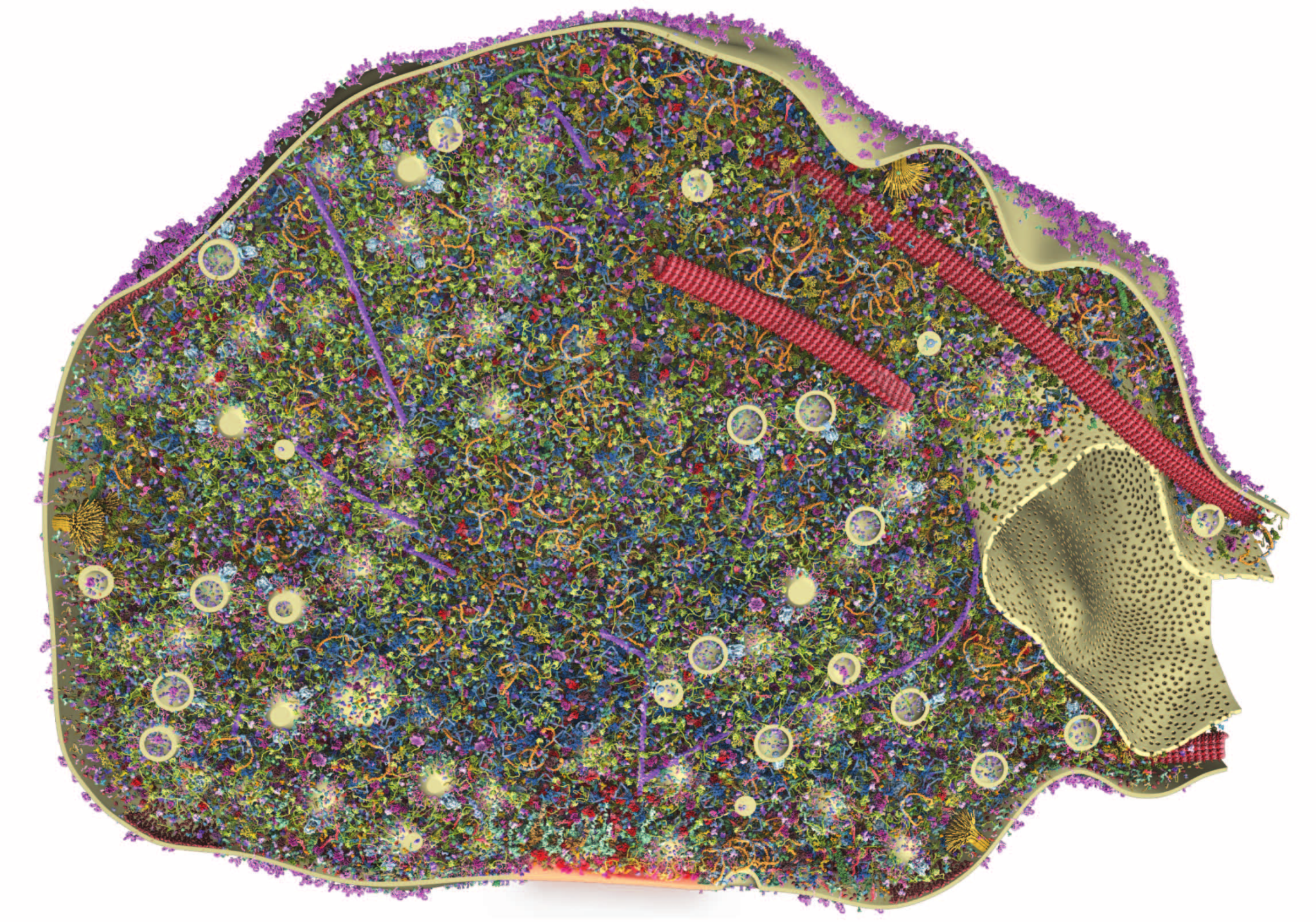
A synapse is the “business end” of a neuron. It’s the thing that changes in response to memory formation, it’s the bridge that transmits action potentials from one neuron to another. A single synapse is around half a femtoliter in volume, that’s about a one quadrillionth the size of the whole brain. I didn’t appreciate this when I first started preserving brains, but a synapse (as well as every cell in the body) is absolutely FULL of proteins, as you can see in the picture above, which again is only showing around 1/3rd of the proteins. Before I saw images like this, I thought that cells were mostly water with proteins elegantly doing their thing, with lots of “elbow room”. After seeing what these things actually look like I find myself surprised that cells are even liquid at all instead of solid peptide blocks. My intuition about cells is now that they’re already right on the edge of being solid already, and it barely takes anything to nudge them the rest of the way: think egg-whites becoming solid when cooked.
With this context, there’s three core things that I think about when it comes to the comprehensiveness of fixation:
A first-principles chemistry argument: You probably couldn’t see a single molecule of glutaraldehyde if you tried to accurately draw it in this picture above—glutaraldehyde has a molecular weight of ~100 and these proteins are more like ~30,000. When you flood the vascular system with glutaraldehyde, it crosses cell membranes in seconds and starts crosslinking proteins to themselves and to other proteins. In less than two minutes after glutaraldehyde enters a cell, it forms a gel that traps essentially all proteins, DNA, etc in-place (Huebinger et. al. 2018).
Before fixation, the proteins already aren’t crossing the cell / synaptic membrane or else they would have already crossed. Binding them to themselves and each other makes it almost impossible to move within the cell, restricting them further.
We can still see proteins after fixation: The entire field of immunohistochemistry is built on measuring the positions and amounts of proteins in cells using antibody staining. And one of the first steps of preparation of tissue for immunohistochemistry is to fix proteins with aldehydes. Check out the Supplemental Figures from Wilhelm 2014. Those researchers studied the vesicle transport proteins that make up about 1/3rd of the total proteins by weight in a synapse. That’s ~300,000 total proteins divided into 62 different kinds of proteins. (A synapse has around 1,000-2,000 different kinds of proteins and ~1,000,000 total proteins in that half a femtoliter.) For each of those 62 proteins, they used antibodies after fixation to find where they are inside the synapse. That shows that the proteins are still there and that they’re still even identifiable with antibody labeling.
Bulk measurements can’t measure a difference in proteins content between fixed vs frozen tissue: Check out this paper: Proteome, Phosphoproteome, and N-Glycoproteome Are Quantitatively Preserved in Formalin-Fixed Paraffin-Embedded Tissue and Analyzable by High-Resolution Mass Spectrometry. These guys took rats and measured the protein content of fresh-frozen brain tissue vs the protein content of brain tissue that they paraffin embedded, which involves pretty harsh chemical treatment after initial aldehyde fixation, including total removal of all water via alcohol and xylene dehydration, and infiltration of paraffin wax into the tissue. Here’s their results:
Figure 2. Comparison of FFPE-FASP and FASP (the method used to measure proteins) protocols using FFPE (formaldehyde-fixed and paraffin embedded) and fresh (frozen) tissue samples. Yields of (A) proteins and (B) peptides obtained from FFPE and fresh and samples. Error bars represent standard deviation (n ) 4). (C) Protein extracts from 100 µg wet tissue that was either FFPE treated or fresh were separated by SDS-PAGE and Coomassie stained. (D) Overlap of proteins identified from FFPE and fresh samples. (E) Frequencies of amino acid residues in identified peptides. (F) Subcellular distribution of identified proteins using GeneOntology annotations. From (Ostasiewicz et. al. 2010). Bold parts are my additions for clarity.
This is a bulk measurement, essentially measuring whether proteins are extracted “in bulk” after chemical fixation + really harsh chemical treatment afterwards. They don’t find any measurable difference between the samples in terms of protein content. They don’t find any difference in amino acid distribution. The SDS-PAGE results are a little blurred after fixation and have extra “heavy” stuff, which is exactly what you’d expect from crosslinking. Protein content after fixation is my second-favorite null result in science (my favorite is neurological differences after DHCA).
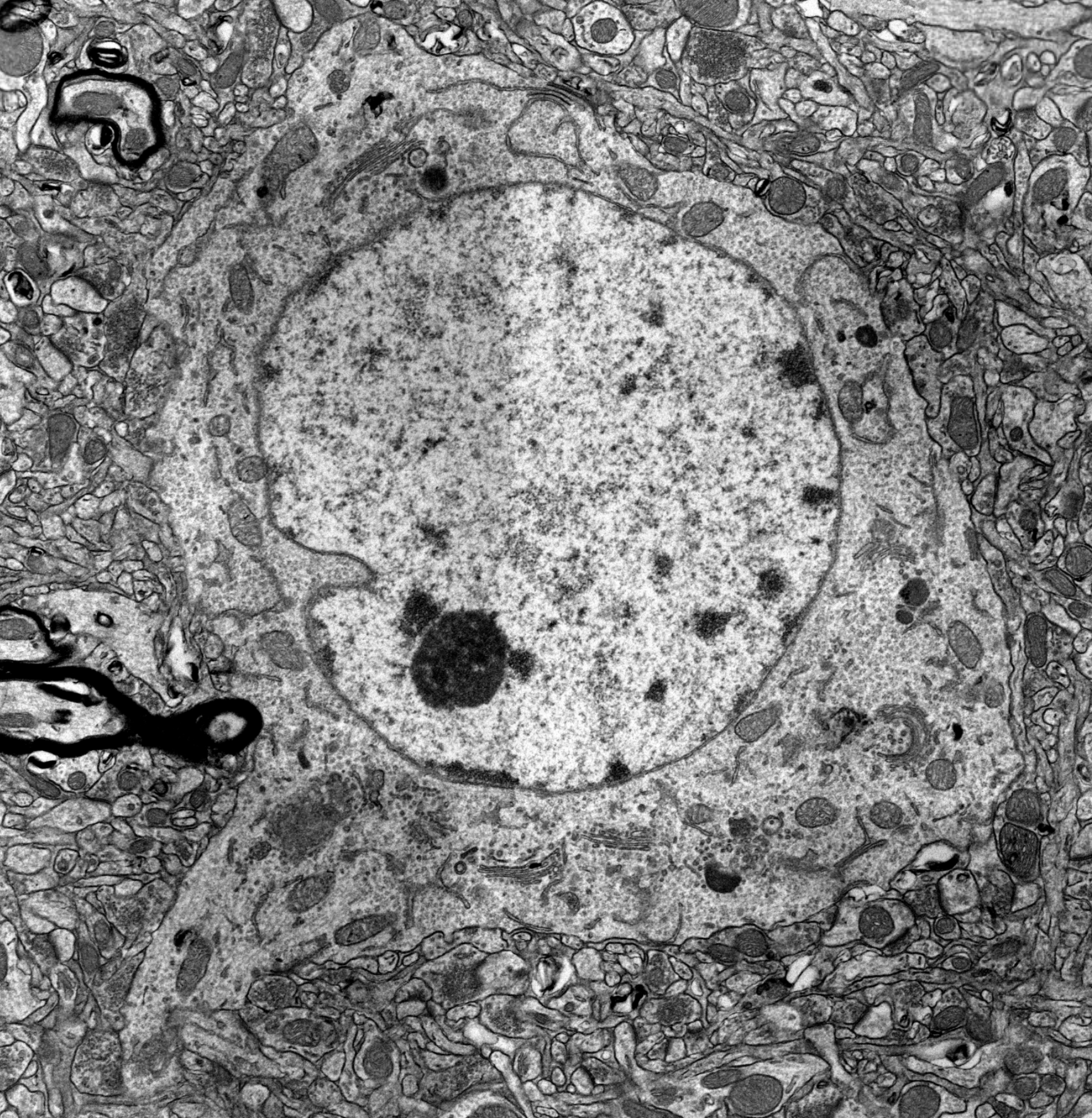
Take a look at the preservation in the demo at https://nectome.com/end-to-end/. Here’s a neuron, preserved with our method, witnessed by Andrew Critch, and stored at 60°C for 12 hours.
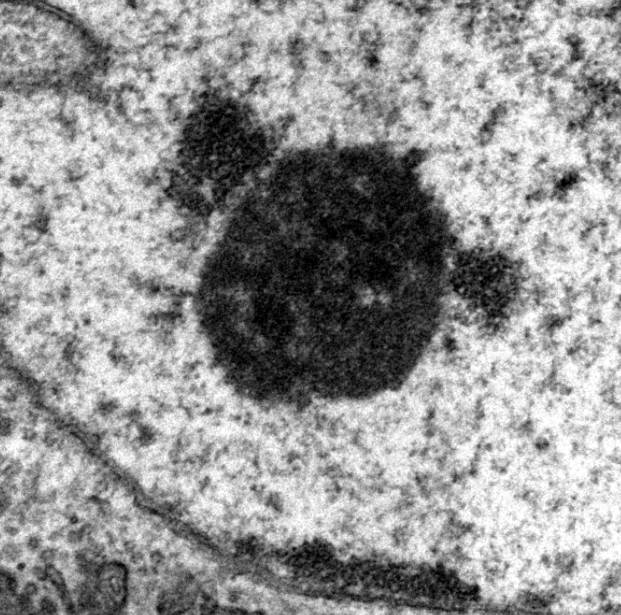
Here’s DNA in the nucleus, trapped inside the gel created by fixation (and also crosslinked itself):
Here’s a Golgi apparatus:
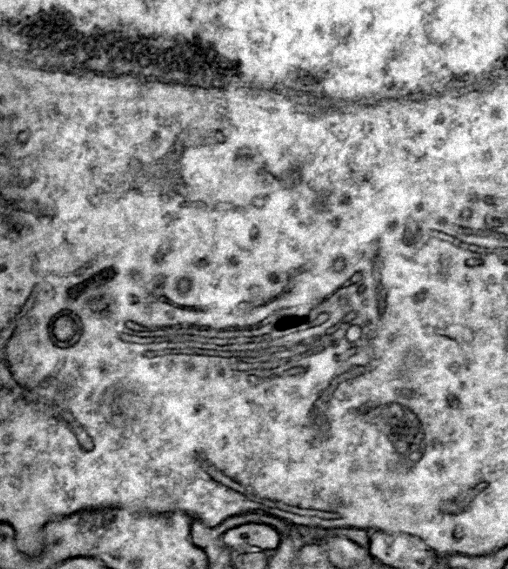
If you look closely, you can see individual ribosomes, locked in the gel along with all the other proteins (they’re the faint grey dots).
Here’s a synapse:
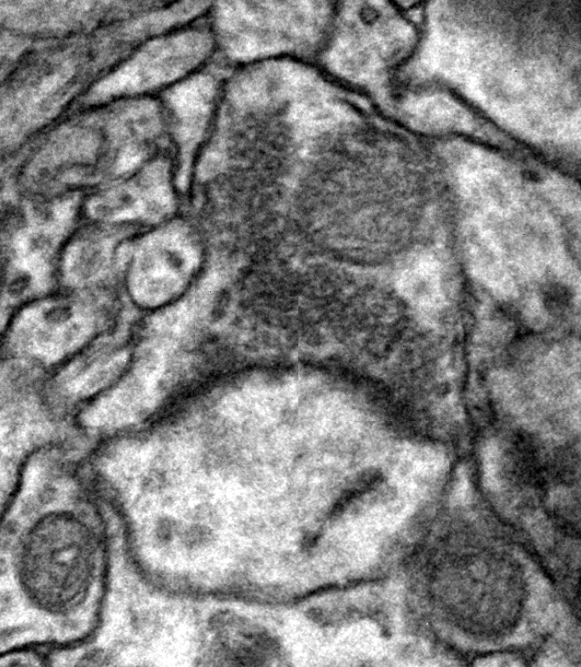
It’s in the same orientation as the model synapse at the start, with the active zone on the bottom and a mitochondria in the upper right. Those individual dark dots in the synapse are each a vesicle (they’re the white spheres in the 3D model), and they each still have neurotransmitter in them. This synapse had probably two million proteins in it before preservation. After preservation, almost all of those two million proteins are likely still there.