Far-UVC is something people have talked about for years in a “that would be great, if you could buy it” sort of way. Coming soon, once someone actually makes a good product. But the future is now, and it costs $500.
Many diseases spread through the air, which is inconvenient for us as creatures that breathe air. You can go outside, where the air is too dilute to spread things well, but it’s cold out there, and sometimes wet. You can run an air purifier, but cleaning lots of air without lots of noise is still the world of DIY projects. Ideally you could just shine some light, perhaps in the 222-nm range, which would leave people alone but kill the viruses [1] and bacteria. Yes, let’s do that!
Last year if you asked “if far-UV is so great, why isn’t it everywhere?” one of your answers would be:
There are very few providers, and hardly any of them sell an off-the-shelf product. You usually can’t just buy a lamp to try it out—you have to call the company, get a consultation, and often have someone from the company come install the lamp. It’s a lot of overhead for an expensive product that most people have never heard of.
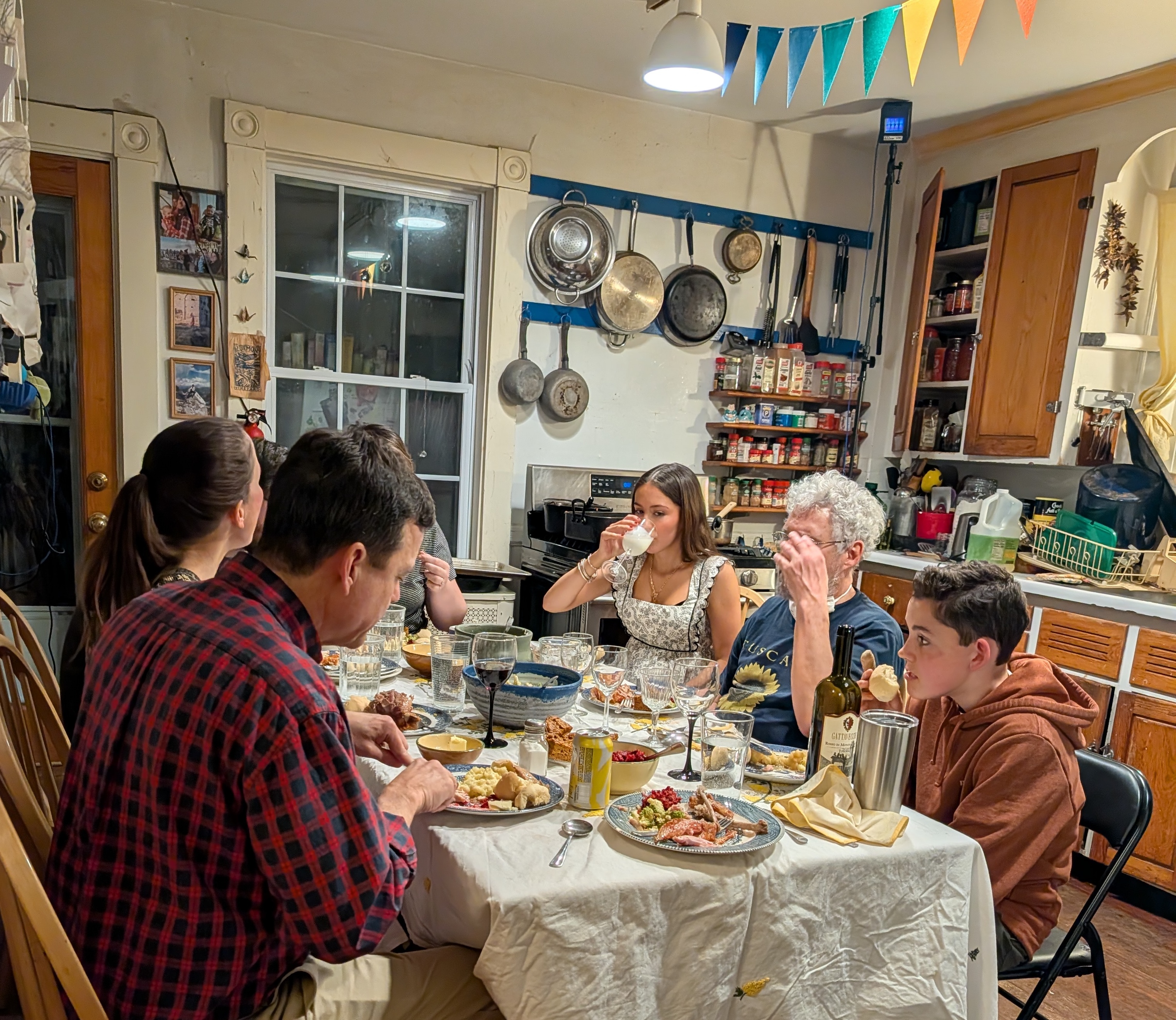
This has changed! You can buy an Aerolamp for $500, shipped. Proudly displayed at Thanksgiving:
Here are four silently cleaning a whole lot of air at a dance I help organize:
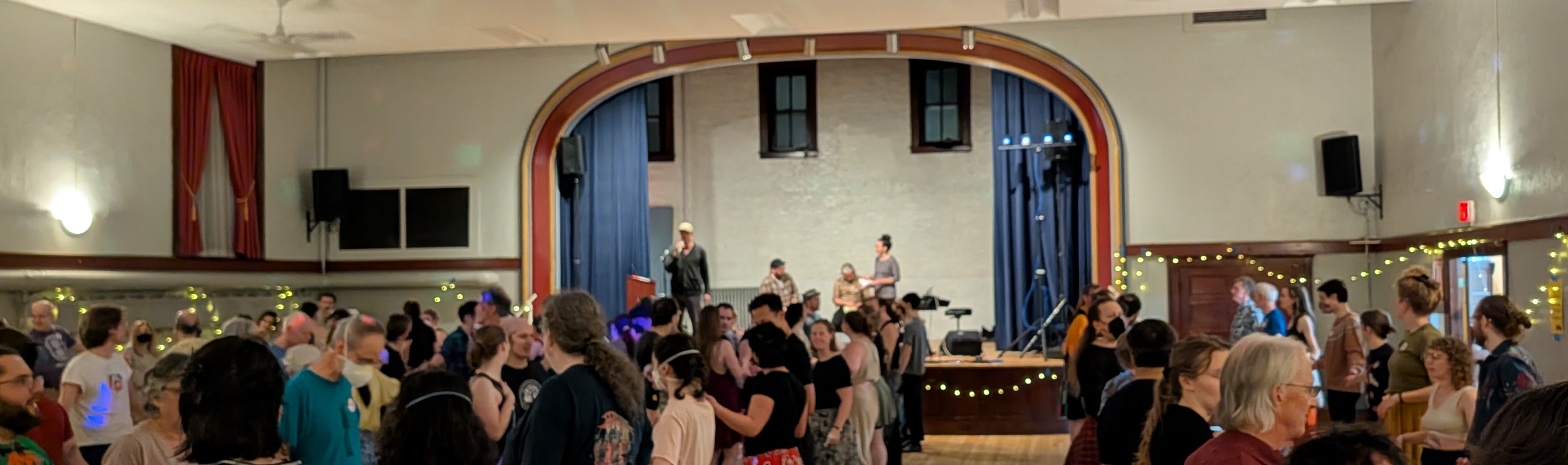
At $500 this is out of (my) Christmas gift range, but I think we’re now at the point where dances, churches, offices, rationalist group houses, schools, etc. should consider them.
(I have no stake in Aerolamp and they’re not paying me, I’m just very excited about their product.)
[1] Ok, yes, I know viruses “can’t be killed” because they’re “not
alive”, but far-UVC causes them to become unable to infect and
replicate which is close enough to “killed” for me.
https://www.nature.com/articles/s41598-025-09241-2
I hadn’t seen that study, thanks for sharing! I’ve added it to faruvc.org, and added a warning that people shouldn’t consider 233nm LED sources as equivalent to 222nm KrCl sources.
If safety is a concern for such sources, is it worth considering placing the lights so they mostly shine on the space above people’s heads?
If you place the lamps so they’re only above people’s heads you can use 254nm bulbs, which are much cheaper (they’re essentially standard fluorescent lights with UV-transparent glass and no phosphor). People have done this for a long time in places like TB wards, but you do need to be pretty careful about placement to ensure your 254nm UV really is only shining in the space above.
An upper-room 254nm system with the required expert installation is not going to be cheap or accessible. The bulbs are cheap—the systems are not, because the safety margins are much tighter.
You can use 222nm lamps as an upper-room system just fine—you can set it up yourself without worrying too much about overexposure. A lot of people do just because it’s simpler to stick the lamp on a high bookshelf instead of mounting it on a swivel head and tilting it downward. It works fine! Makes the system a bit more dependent on vertical air currents to work well but the efficacy hit is pretty minor. There aren’t zero risks but I sure prefer it to a 254nm overexposure.
(Disclosure: I am a cofounder and part-owner of Aerolamp)
Is there a quantification of the effect of this on skin microbiome as of now? I would not like to kill all of the bacteria on my skin.
viruses are much more vulnerable than skin bacteria, although that doesn’t rule out microbiome damage entirely.
That’s a good point, given basically every respiratory illness you’d come across in the first world is viral.
If everybody is wearing clothes (which I expect is the case for at least 2⁄3 of the events organized by LessWrong users) then UV exposure will be limited to face, neck, hands, arms, and lower legs.
I expect that hands, neck, arms, and legs will be rapidly re-colonized by bacteria from the torso, upper legs, feet, etc, just from normal walking around. The face is the main area I’d be worried about, since I’d expect it to have a slightly different microbiome than the rest of the skin (I think it’s oilier, hence acne) and it’s going to be pretty maximally exposed to the UV light. Having thought about the problems I’m less worried than I was before.
I’d keep a small eye out for acne/eczema/dry skin on people’s faces after being exposed to this, just in case.
(Of course the ideal method is to have the UVC light internal to your air conditioner/heater unit, which is already circulating the air, so you can blast everything passing through that with enough UVC to annihilate any and all pathogens in the air, but that requires retro-fitting to AC units and stuff. Still, would be cool to see Aerolamp partner with some AC/heater company in the future.)
The effect isn’t instantaneous, right? Is a moment in the HVAC system enough to kill them?
To get equivalent protection this way you’d need to cycle your air through your HVAC much faster than you likely currently do. Which would be noisy!
And if you’re cycling the air much faster then you need much more UV in the duct to get enough exposure time. And then you have to maintain the lamps inside a dusty vent...has its uses but it’s operationally tricky and there are tradeoffs.
>acne/eczema/dry skin on people’s faces after being exposed to this
UVA and UVB are used to treat eczema, not sure if UVC has any effect.
Do you not feel obligated to tell people that such lights are present, in case they have a different assessment of the long-term safety than you do? I remember how ApeFest caused eye damage with UV lights.
I do think that’s a good idea, yes:
Before deploying them at the local contra dance we announced a trial. Afterwards we polled attendees (only one person in 200 didn’t like the idea), and announced deployment. Now it’s listed on the website, along with information on our mask requirements and glycol vapor usage.
Before setting one up at Thanksgiving I also wrote to my relatives, linked them to faruvc.org, explained why I thought this was a good idea given my aunt’s immunocompromised status, and asked if anyone had objections.
I had one set up at the EA dinner we hosted last night, but it wasn’t in the main room and I told people about it. I’m planning to announce before the next one that we’ll have it in the main room.
It sounds like it was UV-A (“blacklight”): “Yuga carried out the investigation with Jack Morton Worldwide, the event agency that produced this year’s ApeFest. Together, they ‘determined that UV-A emitting lights installed in one corner of the event was likely the cause of the reported issues related to attendees’ eyes and skin.’” This would have been visible as a deep purple glow that makes things fluoresce, so the problem is probably not that attendees didn’t know UV-A was present but instead that attendees should be able to trust organizers to keep things like this to a safe level and the organizers didn’t do that.
Interesting.
About glycol vapor, I might personally go with propylene glycol rather than triethylene glycol.
Why?
EG = ethylene glycol, PG = propylene glycol
PG vapor pressure is such that you could potentially just leave open bowls of it instead of needing a vaporizer device.
PG is probably equally effective at disinfection.
PG should have somewhat lower toxicity.
PG is used sometimes in foods as a humectant so it’s relatively available.
About toxicity, tri-glycol is safer than EG because EG is partly metabolized to glyoxal which can permanently form cyclic compounds inside cells. PG is preferentially metabolized to lactic acid before the secondary OH is oxidized, which is why it’s safer, tho yes you could get a small amount of methylglyoxal, so there is that issue, tho methylglyoxal is at least less reactive than glyoxal. The concern I have is that eg, ethoxyethanol is metabolized to ethoxyacetate which is somewhat toxic, and oxidized tri-glycol might be analogous. Note also that ethers eventually get oxidatively cleaved. I’m simplifying a bit here obviously.
Yes, there have been studies, but toxicity studies use high doses in mice to get obvious effects, and then we assume that much lower doses in humans don’t have subtle long-term effects, but the effect of tri-glycol would be limited by the rate of metabolism, and the tri-glycol itself should be safe.
This is great!
What do you think of UVC lamps that you just kind of stick into a hole in your HVAC intake ducts? Some of them are really cheap, most seem to be 254nm, no idea if any are any good. Would be really convenient if it works well.
Putting lamps in ducts is not very different from putting filters in ducts; but with the downside that I’m a lot more worried about fraudulent lamps than filters. I guess it’s easy to retrofit a lamp into a duct, whereas a filter slows the air; but you probably already have a system designed with a filter.
The point of lamps is to use them in an open room where they cover the whole volume continuously.
And I guess having the UVC in ducts doesn’t disinfect surfaces in rooms, so you’d need a separate solution for that.
What is the relative cost between Aerolamp and regular air purifiers?
For regular air purifiers, ChatGPT 5.2 estimates 0.2€/1000m3 of filtered air.
From the Aerolamp website:
And ChatGPT estimates 0.02 to 0.3€/1000m³ for the Areolamp—quite competitive esp. given that it is quieter.
In general, the longer your sightlines the better UVC does and vice versa. While air purifiers are a cost per amount of filtered air, UVC depends on how much air the beam can go through before it’s (mostly) absorbed by the wall / ceiling / floor / people.
In some previous discussions of far-UVC, on LessWrong the idea was to let the far-UVC light be focused on the space above people’s heads so that you clear a lot of viruses in the air while not directly going on people’s skin. Aerolamp on the other hand seems to advocate to place the lamps in a way where they directly shine on people’s skin.
The FAQ of the website seems to lack a question on the impact on the skin mircobiome and especially that of the face as it’s exposed the most.
If someone deploys a lamp in a way that put them constantly under the affect of direct far-UVC light on the face, doing before/after skin microbiome testing for the face might be a good idea.
Link? That sounds like “upper room” UVC, which is longer wavelengths (ex: 254nm), not far-UVC (222nm).
Hey there,
Have you run irradiance/dose simulations to see how one single lamp actually behaves?
The output value being incredibly low, and based on the Square over Distance rule, most of the room is actually not getting much. I get that this lamp is meant for air cleaning, but this is really far-stretched, as I cannot see how the air is directed to the area under the lamp, and even if so, hours are required to actually reach proper log-reductions of common microorganisms with such a small mount of UV-C light.
The safe limits for humans (in the US, in Europe it is significantly lower until there is enough evidence to change that) is significantly below values that molds require to be reduced by a 99% factor.
It looks good on paper, but I am afraid that besides the “wow-effect”, figures and data will not show this as having any significant impact. Especially when compared to 254nm. For 500$, it is possible to get an upper-unit not directed at people, that will have a UV-C output tenfolds higher than the 222nm.
UV-C light is not just on or off, it takes time and proper doses to reach effect. IN HVAC ducts, there are several kW of UV-C lamps installed just for a standard cross section. This is not because it is not efficient, this is because there are only a few seconds to disinfect the air that is passing along the lamps.
Sorry to be the bearer of such news, but 222nm seems to be rising based on very thin air (no pun intended).
The output value is low, but not that low? I’ve run simulations with https://illuminate.osluv.org and it really looks pretty good to me. For example, in an 8ft x 12ft room with a 9ft ceiling, an AeroLamp DevKit in one corner at the ceiling pointed at the opposite corner gives you:
The effective CADR varies by pathogen, but the median of these estimates is 400 CFM which is pretty good (far better than any air purifier that is similarly quiet).
(And it does better in rooms with longer sight lines, so this room doesn’t show it at its best.)