I think that a lot of “woo”—a broad term that includes things like chakras, energy healing, Tarot, various Eastern religions and neopagan practices, etc. - consists of things that have real effects and uses, even if many (though not all) of their practitioners are mistaken about the exact mechanisms and make unwarranted metaphysical claims.
Now, a woo practitioner might explain what’s happening in a way that doesn’t fit any sensible scientific model of the world. Some of them seem to bastardize poorly understood pop-explanations of quantum mechanics, or, in the opposite direction, outright reject “the thinking mind” and science as valid sources of truth. That makes it easy for a scientifically-minded person to reject all of the practitioners as delusional.
But consider meditation. In the 1960s and 1970s, the scientific establishment mostly thought of it as nonsense, and not without reason. Proponents of Transcendental Meditation (TM), for instance, made a variety of bizarre claims.
For instance, they claimed the existence of “the Maharishi Effect”. According to them, if one percent of a population practices TM, this would significantly increase the well-being of everyone in that population. A more advanced practice was “Yogic Flying”, where the participants hopped cross-legged as a step toward learning to levitate. Doing Yogic Flying supposedly lowered the requirement for the Maharishi Effect to kick in to the square root of one percent of the population. The Effect would reduce the local crime rate “by 16% on average”, and it was also later credited with the fall of the Berlin Wall[1].
Another claim that they made, which seemed implausible to science at the time, was that practicing TM could lower blood pressure. Cardiologist Herbert Benson reluctantly ended up studying them, and found out that the claim checked out. Today, there is a significant scientific literature on both the psychological and neurological effects of meditation, as well as various RCT-backed therapies like Mindfulness-Based Stress Reduction based on it.
It seems safe to say that the claims about the Maharishi Effect and learning to levitate were pretty crazy, and that it was reasonable for people to dismiss Transcendental Meditation because of it. And at the same time, meditation did turn out to have some real health effects, and it would have been unfortunate if academia and the general public had never found out about those.
Likewise, I think much of woo in general has the same combination of “makes clearly nonsensical claims about reality, even as many of their practices have clear value and just lack legible mainstream explanations”.
Let’s start with the simplest case. Some people say that Tarot can predict the future. Like a lot of practices, this seems pretty arbitrary. It’s a deck of cards with meanings that somebody made up. Why would you expect that to tell you what’s going to happen to you?
Tarot
As an analogy, consider chess. The rules of chess are, in a sense, totally arbitrary. You can change them any way you want, and indeed there exist plenty of chess variants.
And at the same time, they’re not totally arbitrary, in that chess has evolved through 1,500 years of play, with occasional changes to the rules to make the game more fun and interesting. Various other games that existed during that time but weren’t equally interesting have been forgotten. There is something about that specific configuration of rules that has been thoroughly play-tested and optimized for a particular kind of play. While you can come up with any other kind of game, there’s still a point in playing chess in particular, because that will get you a solid game without having to spend a lot of time play-testing your alternative to make it equally fun and balanced.
Likewise for Tarot. The meanings of its cards are also arbitrary in one sense, but also optimized for a particular purpose.
As many of its practitioners will tell you, the purpose of Tarot is less about literally telling the future and more about a guide for intuition. People who are trying to think of a problem will easily fall into a rut and only consider it from a fixed perspective, and benefit from some kind of semi-structured way of looking at it from a new perspective. There are some secular methods for this, like Edward de Bono’s Six Thinking Hats where one hat prompts you to think of a problem from a “facts and information” angle and one from an “emotions and ego” perspective.
But six thinking hats isn’t that much compared to a typical Tarot deck’s 78.
I just picked a totally random Tarot card from Wikipedia: The Emperor. Here’s how it’s described:
As a symbol of authority, stability, and structure, he represents order and discipline in contrast to the intuitive, nurturing qualities of The Empress. The Emperor is associated with masculine energy, leadership, and the enforcement of law and tradition. [...]
When drawn upright, The Emperor signifies leadership, responsibility, and structure. It suggests stability and protection, highlighting a time of strategic action and discipline. The card often appears in readings concerning career, finances, and governance, reinforcing the idea of an established and authoritative influence. It may also represent a father figure or an external force providing guidance and order.[2]
Reversed, The Emperor can indicate excessive control, tyranny, or rigidity. It may point to an abuse of power, struggles with authority, or an inability to establish order. In some cases, it signifies weakness in decision-making or a resistance to necessary structure, warning against stubbornness or oppressive leadership.
This description is at the same time general and specific. Suppose that you ask yourself “what should I do about this problem” and you draw an upright Emperor. There are now lots of ways you can interpret that. Maybe you need to be disciplined to meet your goals. Maybe you need to seek out an organization that provides you with discipline. Maybe you will do strategic planning to get to your objective. Maybe you will find yourself a mentor. Maybe you yourself will act as a mentor to someone else. Maybe...
There are enough possibilities that your intuition can probably find something that fits your current life situation and gives you an interesting angle to consider. “Oh hmm, I should do some strategic planning, now that I think of it.” But the list of interpretations is also sufficiently constrained that it doesn’t just say “anything can happen”, which would be so broad as to not give you any ideas.
The meanings of Tarot cards have been, through gradual development, optimized for that combination of generality and specificity that makes them evocative. You could develop an alternative system that did the same thing—as de Bono did—but you’d be solving the same kind of engineering problem.
So just as the rules of chess are arbitrary, but it still makes sense to talk about The Rules of chess, the meanings of Tarot cards are arbitrary but it still makes sense to talk about The Meanings of the cards. If you assume that a certain card really does represent opportunity and opportunity really will somehow show up in your life—which is a bit of truism, because opportunity is a general enough concept that of course it will feature in your life in some way—then that will make your mind consider things from angles it wouldn’t have considered otherwise.
Different camps within woo
If Tarot is an intuition aid not a divination tool, why don’t people talk about it that way?
Many of them do! I’m saying that that “Tarot is basically a random concept table for evocative ways of seeing your life” because that’s how it was explained to me, by various people in my life who were into Tarot.
But there tend to be several kinds of people involved in woo. There are people who go “it’s all psychology”, people who go “it’s genuinely supernatural”, and people who go “idk either way, I just know that it seems to work”. The people who think it’s all psychology or who are agnostic will tell you that directly, but the people who think that it’s supernatural tend to be more excited and loud about it. The psychological-minded might also hang out with other psychological-minded folks who might look down on Tarot, so they stay quiet about their interest.
If you are trying to make money out of it, you’re incentivized to sell it as a thing that definitely predicts the future and isn’t just a mildly interesting technique for coming up with novel ways to view your life. Which means that a lot of the public messaging about it that you’ll encounter is selected for overselling its significance.
But I’ve seen various woo-type communities—modern Neo-Pagan witchcraft ones especially—where the “it’s psychological” and “it’s supernatural” people genuinely co-exist and have agreed to disagree, in part because for many people, it’s not all that important which one it is. The same practices will still bring the same results regardless of whether they’re of psychological or supernatural origin. So the two camps can still talk shop about what seems to work and participate in the same rituals, while agreeing to keep their phrasings sufficiently general that neither side needs to get too icked by the other’s metaphysics. Or failing that, just stick with the crowd that shares their commitments and avoid the camp that seems deluded to them.
Also, probably because the cards are so well-optimized for their purpose, Tarot readings can feel eerily precise at times. Intuition works by picking up on lots of small cues that aren’t necessarily visible for the conscious mind, in a way that can seem magical.
Expertise researcher Gary Klein recounts an interview where a firefighter was convinced that he had extrasensory perception. On one occasion, something in a building had just felt wrong, and the firefighter had had his crew withdraw, only to have the floor collapse moments after they had evacuated. As they discussed it more, it became apparent that there had been some small cues indicating a fire below the floor—such as the room they were in feeling too hot—that had all added up to an intuitive sense of “something isn’t right”.
Another, more easily replicable experiment, is that modern AIs are very good at inferring patterns from small samples of text. If I give Claude samples of my writing and I ask it to guess the native language of the author, it usually correctly identifies me as Finnish, sometimes from just a few paragraphs. Before I changed one of the specific tells it was using, the first 1-3 paragraphs of this very article were enough for Opus 4.7 to not only guess my native language, but often spontaneously mention me specifically as a possible author[2]. With the corrected version, it tends to guess English, but does still suggest me as a likely author within 2 paragraphs if specifically asked for that. Other people have had similar experiences.
So in many cases, it might be that a person’s subconscious mind has already picked up on a pattern that the Tarot cards help make legible to them. Which then feels to them like the cards must have supernatural powers and genuinely predict the future.
If the “advice” from the cards is then acted upon, this can become a self-fulfilling prophecy—the person intuited a promising pattern they should pursue, which they then did, to good results. The cards will have the appearance of predicting the future, when the person was projecting their own subconscious pattern analysis abilities on them.
That said, tarot is probably on the extreme end of the arbitrariness scale for woo. Something like chakras and energy seem to me somewhat less arbitrary.
Chakras and “energy”
Here a better comparison than games might be martial arts. There are many systems of martial arts, but all of them are constrained by what the body is physically capable of. And if you didn’t know any formal systems of martial arts, but just spent a lot of time fighting people (for real or for sport), you’d probably stumble on some of the same moves on your own.
In an article I posted a few weeks ago, I mentioned a form of loving-kindness practice that involved bringing one’s awareness to the chest cavity—“the heart chakra”—while also bringing to mind a memory of someone just being unselfconsciously themselves, and seeing how that memory “resonates in the heart”.
When I first did that practice, I used one particular memory for it. Afterward, I’ve noticed that just bringing my awareness to my chest has started to spontaneously bring up both the same memory, and the good feelings associated with it.
The choice of the chest cavity itself may be totally arbitrary, with this just being classic associative learning—I previously thought of the memory while attending to my chest, so now attending to my chest also brings up the memory. Maybe focusing on my right index finger would have had exactly the same effect. The fact that there are many different chakra systems would suggest that they’re somewhat arbitrary.
But even so, having made the choice of the chest, using that as the focus point seems to work! There doesn’t need to be any deep significance to the choice for it to be useful.
At the same time… you might have seen this image:
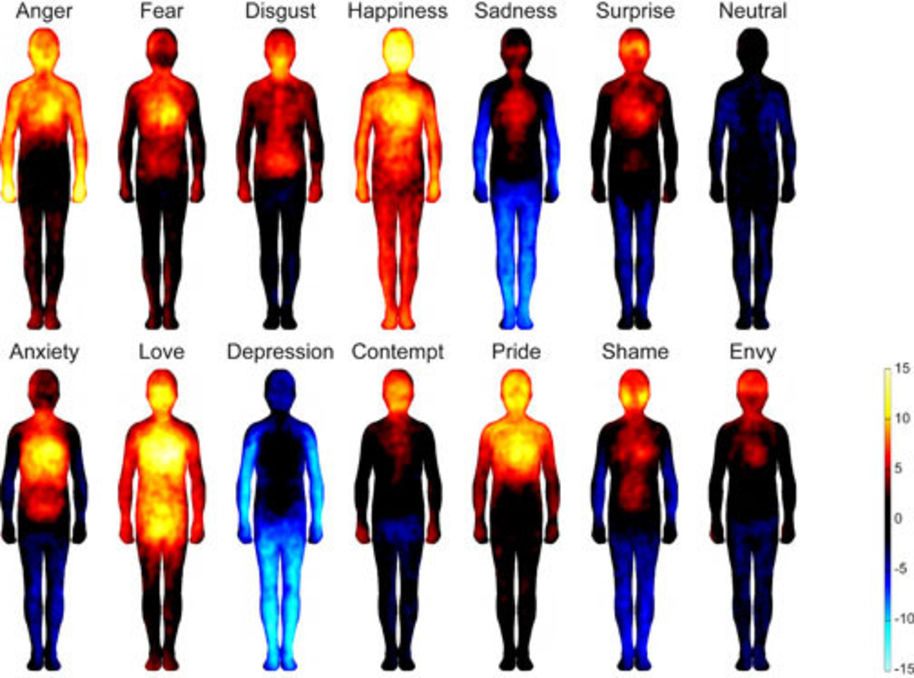
It’s from a study where people from three different countries were asked to indicate where in their body they experienced different feelings. The sensations for different feelings tend to cluster in different places.
Does it then seem totally implausible that sensations related to different psychological properties might cluster around particular locations in the body, as suggested by various chakra systems?
It is actually my experience that many scientifically-minded people working with something like a somatic therapy will at some point, much to their chagrin and annoyance, go “fuck, the chakra people are right” as a result of doing something different that then starts producing similar results as a chakra model.
Tucker Peck, a meditation teacher whose retreats I’ve been on and who I consider reasonably sensible, writes in his book:
I’m not sure why, because I’ve never worked in technology, but everywhere I teach in the world, the majority of attendees at my retreats and workshops are tech workers. These students almost always arrive at Dharma practice with a materialist, atheist worldview. It would be a huge turnoff to them if I gave a lecture about energy in the body. I like to joke that, within six to twelve months of beginning a meditation practice, all my students now have their Reiki master texting their Ayahuasca shaman about the direction that their chakras are rotating. The reason is that most people, if they sit quietly long enough, start feeling energy moving through the body. Even though there isn’t any scientifically known mechanism regarding what energy and chakras are made of or how they operate (at the time I’m writing this book), my students need some language to talk about the experience that they’re having. Chakras and energy seem like pretty good words to use.
My first experience of “energy sensations” was after I had done a lot of meditation, when I started getting weird energetic feelings in my forehead and right eye that were very distracting, and which made it hard to meditate. Again, I didn’t intentionally try to create them; they just appeared. This happened before I had heard of anyone experiencing anything like that, and I didn’t yet know Tucker at the time. Still, he explicitly mentions something similar in his book:
One association I’ve seen with the area in the center of the forehead is with excess striving in meditation. Quite commonly, students will get pain in their forehead when they meditate, and it’s worse when meditating on a small object such as the breath at the nose. Sometimes the pain persists outside of the practice—so much so that their heads hurt all the time. I’ve also heard multiple people use the same very specific analogy: Rather than feeling pain in their foreheads, it feels as though there’s an octopus on their forehead.
With other points in the body, I suggest focusing on the pain as a way of converting physical pain into psychological content. However, if you have this sort of pain in your head, it’s best not to focus on it. The reason is that the pain is caused by using meditation to try to control things in ways that they can’t be controlled, and when you focus on the pain to try to make it go away, you’re continuing to try to control something in the wrong way. This becomes what one Dharma teacher calls “obsessive concentration.” Students who experience the most extreme cases of obsessive concentration might need to take a break from meditating. (I’ve only seen it get that bad in two or three people, who recovered after several months without practice.)
I wouldn’t describe my energy sensation as pain or an octopus, but I did find them unpleasant and nauseating. I also found that the sensations got worse if I did concentration practice focused on a small area, and that trying to look at them just made them worse. In line with what Tucker writes, I found that “do-nothing” style meditation, where you don’t try to control your mind but just let it do whatever, produced the least of these sensations. Also in line with what he wrote, the sensations would also persist outside meditation, and e.g. sometimes cause me insomnia.
Here’s another example. If you are nervous and tense, it’s difficult to feel any other emotions. And the tension often has a strong physical element that interacts both ways with the mental aspect of it. When there’s a stressful event in your life, that can cause the body to concretely tense (mind → body). At the same time, things like going on a run or weightlifting that exhaust your muscles and force them to eventually relax can also temporarily take the nervousness off (body → mind).
Now, a friend of mine found a breathing exercise that helped him release a persistent tension he’d had in his solar plexus. This then also made it easier to let some emotions be fully felt, whereas previously they would have gotten stuck halfway. And it was only afterward that he made the connection that this could reasonably be described as “unblocking your heart chakra”.
It does not seem crazy to think that if the muscles around your solar plexus are chronically tense, then this would make it harder to breathe naturally, which would act as a kind of chronic low-grade stress, which could then make positive emotions easier to feel if this was released.
Or take the throat chakra. Many people who have difficulty with confidence find that when they try to speak up, it feels physically hard. Like words literally “get stuck in their throat”, or they lose their voice, or feel like they have to struggle to get the words out. Mechanistically, you could see this being a result of two different subsystems sending conflicting bids to the muscle system. An anxiety-related one sends a command for the throat muscles to tense up in order to block self-expression (due to a prediction that talking up would be dangerous), and that competes against a system that tries to force the words out. This would be a very logical thing for evolve: since throat muscles are a critical bottleneck for speech production, tensing them would be the obvious way for a competitive subsystem to attempt to veto it.
I once had a therapeutic/meditative experience where I found my attention spontaneously going into my throat and I became aware of an unpleasant choking sensation in it, like there was some imaginary object lodged inside my throat that was making me suffocate. I hadn’t done anything to intentionally look in this area; rather heightened sensitivity to what was happening in my body made me more aware that there was something unpleasant there. Repeated cycles of my attention going there, feeling terrible, and it slightly relaxing eventually led to the feeling mostly going away. Afterward, I found myself being more relaxed and having an easier time expressing myself in social situations, a difference which a couple of other people also noticed.
I don’t claim to have a rigorous understanding of what exactly happened there. My guess is something like, extended anxiety can cause muscles to become chronically tense in a way that disappears from awareness, and bringing that tension into awareness can cause the nervous system to adjust something in a way that relaxes the tension, which then feeds back to the mind as a smoother mental state. (Mike Johnson has an elaborate theory of “vasocomputation” and of how the vascular system might vary the degree of tension in various muscles as a form of memory storage that through the mind-body link freezes various neural patterns in place. I don’t understand it very well but something like that would make sense based on my experiences.)
In any case, while I did not do any explicit energy work practice or investigation of the throat chakra—the sensations just came up on their own when in the right state of consciousness—I bet that if I had done some kind of energy work practice aimed at investigating the throat chakra, that could have surfaced it as well, with similar results.
Now, different chakra systems don’t all agree with each other. Tucker also mentions that he has heard various claims about what different chakras do, but has only been able to observe some of them. So my guess would be that some of the chakras would be more universal than others—the throat for self-expression and the genitals for sexual energy would be pretty logical ones—while others could be more arbitrarily constructed, akin to the association I built between my chest sensations and a particular memory.
For Tarot, I had a pretty clear model of what I think it is and isn’t. I don’t think it is predicting the future; I do think that it is leveraging intuition to help in decision- and sensemaking.
I don’t have a similarly crisp model for chakras. I don’t think they involve anything that we’d consider supernatural or as requiring exotic physics. I think they do involve emotional expression and issues, expressed in different areas of the body, manipulable in various beneficial ways. But I don’t know what the extent of those ways is, or what all the ways are. Quite possibly there’s more to it than this, that I don’t know about yet.
I think I’ve seen enough to conclude “there is something interesting here, that might be worth looking into”. But I haven’t actually looked that much into it. I’ve just been doing more conventional therapy and meditation, and occasionally running into chakra stuff as a side-effect.
Energy healing
There is one energy healer I’ve had sessions with. The way she worked on me felt like it was basically a light massage, somewhat different and somewhat similar to therapeutic massages I’d tried before. As she was doing it, different unpleasant memories from my life would bubble up, but they wouldn’t feel unpleasant. And for the rest of the evening after that session, I felt amazingly good—it felt like I had temporarily shed some anxieties that I didn’t even realize I’d had, that had been with me for so long as to become invisible to me.
Was that a placebo effect? At least in part, quite possibly! Something like the placebo effect may certainly be a big part of why some woo things work. Placebos can also work even if you know they are placebos, so this is by itself not a reason to dismiss the practices. But it raises the question of why exactly this thing in particular caused such a strong placebo effect, when I’ve tried quite a few things.
Something that feels similar is a state I’ve sometimes experienced in meditation. There, getting into a sufficiently pleasant and relaxed state will also bring up various unpleasant memories that then seem to dissolve away, and for a while after, I’ll feel better. I think that anything that gets a person feeling sufficiently good and relaxed will have this kind of effect.
If I had to handwave at an explanation, my model would be something like… various upsets get stored as they happen and then mostly suppressed, though some of them will leak through as a some degree of background anxiety. The suppression ensures that the person can continue operating despite them, and storing them means any information contained in them—e.g. the fact that one’s social status is a bit worse than one thought—is retained for a moment when there’s a chance to properly process it. Then when a person gets sufficiently relaxed, that is a sign that it’s safe to take the time to process all the queued updates. The relaxation releases the suppression, letting the memories bubble up and be integrated and released.
Nervous system co-regulation is a fancy technical term that, among other things, refers to the observation that being in the presence of someone else can make you more or less stressed. There are some people around whom I instantly feel physically relaxed. I’m guessing that energy healers have learned some ability to manipulate their body so as to bring others into a relaxed state with them.
Energy as an abstraction within a system
Again, many energy practitioners don’t talk about things like this, and it’s probably because my physicalist frame isn’t one that would come across naturally—nor would it necessarily be useful.
When I had the sensation of energy in my forehead, or the sense of having a blockage in my throat, my experience wasn’t “right now my body is doing vasocomputation and activating some stored neural pattern which causes my forehead/throat to tense in a way which I could describe as energy”. That’s an interpretation I thought of later. My actual experience was “fuck, there’s a bright energy in my forehead that makes it impossible to focus on my breath” or “THERE’S A THING RIGHT IN THE CENTER OF MY THROAT AND I CAN’T BREATHE [RAW TERROR] [RAW TERROR] [RAW TERROR]”.
My guess is that energy stuff is probably bundling together a number of things that nonetheless appear subjectively unified. I tried an energy work exercise once, where you first move your attention back and forth your arms—with the metaphor that you are moving a ball of energy back and forth—and then you hold your palms apart and imagine moving the ball of energy across the gap, from one palm to another. If I practice this, I can in fact get the feeling that there is something that moves through the space, from one palm to another. And my guess of what happens is something like, the brain notices what it is like when you move your attention across parts of your body and then extrapolates what it might feel like if you continued that motion and could feel some of the intervening distance, and then you feel that extrapolated projection.
But I’m also guessing that if somebody uses that kind of a technique to, say, “channel loving energy” toward someone else, then that might genuinely be making them more empathetic toward the other person in a way that shifts the state of their nervous system. And since people subconsciously register the other’s emotional state—there are people who I tend to automatically feel relaxed around, with it feeling like my body responds to something in the way they hold their body—this may genuinely make the other person feel more relaxed in turn.
And then, saying that “I channeled loving energy toward the other person” might just be the most accurate description of what the woo practitioner experienced themselves as doing. It’s quite possible that a more accurate description would be something like “I did a set of mental exercises that relaxed my body in such a way that the other person subconsciously picked it up”… but that’s not a description that you could use to produce the same effect. Probably imagining that you are literally sending loving energy toward someone will make you feel that you are sending loving energy toward them, which then has those effects in your body.
In that way, it’s similar to abstractions in any other discipline. If we’re playing a boardgame and I say that I’m “sending my units to attack”, I don’t state that actually there are no real-world units and we’re just moving pieces of cardboard around a table. The units are cardboard, but within the formal system defined by the game’s rules, they do have a particular function defined as an “attack”. Or when I’m writing this message to you, I don’t say “actually there is no message, there are just numbers in a database somewhere”. There are numbers in a database, but they also have a causal effect on the world that corresponds to sending a message.
And if someone is “sending loving energy”, then there is a certain mechanistic story of how that is implemented, but if you define energy as “something that can be sent from one person to another and affects the receiver’s emotional state” (among other properties), then within that framework and under that definition it’s not wrong to say that you are sending loving energy to the other person. (Your body being in a different state that they can pick up does send information to the other person, that they might experience as you being “loving”.)
Of course, it then gets problematic if you conflate it with “energy” as it is understood in physics, and many people do go astray when they make that conflation.
I once heard an energy work person describe a psychologist who had gotten into these things and was trying to explain them in the kinds of psychological terms as I am. The energy worker was laughing at the psychologist’s approach—“he was making it all so complicated, when it’s just about energy!”.
If you’ve found that thinking in terms of energy just works, then it probably does seem needlessly complicated and arbitrary for someone to go “actually the thing you feel in the presence of another person is one thing, the experience of moving energy in your body is another thing, and the experience of sending a ball of energy across the gap between your palms is a third different thing… even though they all feel like instances of the same thing”. That will probably feel like adding endless epicycles in a motivated attempt to defend an increasingly strained materialist outlook.
The science of woo
For a long time, I felt confident in dismissing most woo stuff because, if this stuff really worked, why wouldn’t it consistently show up in controlled studies?
Well, a lot of the “obviously doesn’t work out in studies” was about the weird metaphysical component and claims. And there is a lot of stuff that indeed doesn’t seem to work. Yogic Flyers haven’t been able to demonstrate real flying. Daryl Bem’s paper claiming to demonstrate psi did get published in a prestigious journal, but later replications—including one that he collaborated with—failed to reproduce the results. And in one famous study, various “Therapeutic Touch” practitioners who expected to be able to sense a human energy field and the location of a hand that they couldn’t see actually performed worse than chance at it.
But even though Yogic Fliers haven’t demonstrated levitation, Transcendental Meditation still lowers blood pressure. Many of the claims being false isn’t the same thing as the whole practice doing nothing.
More of the value is probably in the more psychological, subjective effects. And there studies do seem to find some effects… with the very important caveat that studies on several of these topics are few in number, small, and not very high-quality. The vast majority of all research in fields like education, productivity, and therapy tends to be like that. Running large, high-quality studies with proper blinding and controls is very time-consuming and expensive. Most interventions tend to have a few studies that look promising but are low quality, carried out by their most enthusiastic proponents, and tend to produce less exciting results if they do get a more rigorous replication.
Major institutions that could in principle bankroll a larger study have little reason to do so for an intervention that has a few isolated promising-sounding studies, just like every other intervention. Meanwhile, the proponents of those methods—who already think believe that the methods work and that they just need to convince others—also don’t have an incentive to run lots of studies that will mostly just be dismissed as looking like every other study out there.
The one that’s been studied the most is energy healing. There are some reviews that suggest various subjective effects for various energy healing practices [1, 2, 3], with indications of benefit for things like pain relief, anxiety reduction, and general quality of life. However, of these three reviews, the first one found the studies in question to be “medium quality” at best, while the third one noted that almost all of the studies had serious methodological flaws.
Energy healing involves a model with a healer working on a patient. What about more individual practices—things that are more akin to long-term meditation?
Some relevant practices are Qigong and Kundalini yoga (which is explicitly energy- and chakra-focused). Here there are again… a few isolated studies which claim beneficial effects for both Qigong [1, 2] and Kundalini yoga [1], but you can’t really conclude anything in particular from there being a few isolated studies that claim beneficial effects. Especially since both practices also involve a lot of physical motion and focused attention practice beyond just the energy components. So even if they did produce consistent benefits, that wouldn’t indicate that the energy aspect in particular would be the cause of it.
So I don’t think that we can conclude that “these practices definitely work” from the existing literature. But it’s not clear that they definitely have zero effect, either.
An interesting point of comparison is a recent paper arguing that there have been three “waves” of meditation research. The foundations for meditation research were laid down in the 1960s and 1970s. Then the first major wave (from the mid-1990s to early 2000s) established that mindfulness-based interventions had therapeutic effects. The second wave, from the mid-2000s to 2020, made the studies more rigorous and investigated the mechanisms behind mindfulness. And now the third wave is starting to properly study the results of more advanced practice, such as deep “jhana” concentration states and “nirodha”/”cessation” events that are associated with “enlightenment” and said to bring about more transformative psychological change.
Meditation is the most rigorously studied “woo” field. And, depending on when you count it to have properly started, it spent something like 25-65 years studying and validating what might be called beginner- to intermediate-level mindfulness practices, before finally starting to properly look at the thing the practices were trying to achieve in the long term.
From the bulk of the studies, you might have gotten the impression that sure, meditation is nice for stress reduction, but drastic psychological change or “enlightenment” isn’t really a thing—because that aspect of it was mostly not studied.
For long-term effects of energy practices, we’re not even at the first wave stage yet. Science can’t say whether long-term practice would produce significant benefits, because science mostly hasn’t even bothered to look at the question.
Now, my old hardcore skeptic self would have asked, “If there isn’t scientific evidence for it, just your anecdotal evidence, why would you believe that there’s anything to it?”
Well, there also isn’t scientific evidence for the question of, “What kinds of communication do my friends like or dislike?”, just my own anecdotal experience. Yet I believe it.
Also, I don’t currently believe in UFOs, but suppose that a UFO abducted me and kept me in an alien zoo on a distant planet for five years before returning me to the Earth. I sure as hell would privilege my own anecdotal experience then, over any lack of scientific evidence in UFOs.
One’s personal experience is not scientific evidence, but it is rational evidence. Others may not believe that I’ve had all the experiences I describe here—just as I do not believe everything that others claim to have experienced—but I do believe in my own experiences with energy, and as such, need to find a way to reconcile them with the scientific evidence as I understand it.
What about other forms of woo?
So “woo” is a pretty broad category. I’ve only spoken about some of it. Mostly because, well, there’s a lot of it, and I’ve only looked at some of it in any detail. What about astral travel? Conspiracy theories? Crystal healing?
I don’t know. Much of that stuff sounds pretty crazy to me.
At the same time, when I first heard of Internal Family Systems therapy, I thought “that sounds pretty unscientific and crazy”. Then it turned out to make sense and now I’m a fan.
I don’t know when I first heard about chakras, but for a long time I thought they were probably something crazy, and now I take them seriously.
I also don’t know when I first heard about energy healing, but there was a time when I thought, “okay, IFS and chakras seem to have something to them, but surely energy healing must be pure nonsense…”
One heuristic that I have is that some woo things are less like a practice and more like a pure belief. Conspiracy theorists may try to collect information about conspiracies, but they don’t have a practice of conspiracism in the same sense that energy people have energy practices.
I think that anything that is purely belief-based is more likely to be pure nonsense than something grounded in a concrete practice that can offer some kind of feedback loop. You can buy a book on meditation or energy practices, do whatever it says for a while, and see whether it has any effect. Or you can go to an energy healer and see how you feel afterward. That gives a better sense of whether something is happening, even if it still doesn’t let you know what is happening.
Of course, people often have internal or external incentives to think that something is effective when it isn’t. But I’d be cautious of giving too much weight to the extreme skeptic position that all claims for the effectiveness of woo can be explained away this way.
For instance, one common explanation for the popularity of woo is “those people just don’t understand regression to the mean, and that any random thing can seem to help if you happen to do it just when things were about to get better, and that’s why exotic forms of healing can seem to work”.
I could see this being an explanation for why you keep doing something that you’ve done your whole life, and don’t realize that you could just drop it. Or if you’re motivated to believe that something works, you’ll fail to notice that you’re not recovering from illness any faster than before. But the experiences that made me think that there’s something to energy weren’t subtle in the category of “I feel slightly better now”; they were things in the category of “oh wow I haven’t ever felt this before, or at least not in many decades”. Just regression to the mean doesn’t explain that.
Anyway, I haven’t looked into astral travel or crystal healing, nor have I looked into any number of other woo things. But by now I’ve learned that I probably shouldn’t dismiss any form of woo just because it sounds obviously crazy at first.
Should you do woo?
All of that said, should you do woo?
Idk. Depends on your priorities and interests. Tarot sounds cool to me, but when I tried making more systematic use of it, it went the way it usually goes—I did it for about three days and it felt beneficial and then I randomly didn’t feel like doing it anymore, so I stopped.
But it seems to me like dabbling a bit in woo to see if it feels useful to you could be beneficial—just like a million other things ranging from journaling to going on regular walks can be beneficial. I recommend trying things, whether they be woo or non-woo.
- ^
Random fact: In the 1990s, there was a brief political party in Finland whose campaign included goals of hiring 7000 people as Yogic Flyers and forming a ‘stress washing machine’ by teaching Yogic Flying to the long-term unemployed.
Their candidates did not get elected.
- ^
The opening paragraph originally read
I think that a lot of “woo” - [...] - is mostly things that do have real effects and uses
Claude highlighted this as slightly awkward and foreign-sounding, noting that a native speaker would probably have said something like
I think that a lot of “woo” - [...] - mostly consists of things that have real effects and uses
I then agreed that the replacement sounded less awkward so changed it.
And yes, I have memory features and other identifying information disabled. The result generally replicates both over the API and when run through other people’s accounts, though not 100% of the time.
I enjoyed reading this.
I never looked closely into tarot and I didn’t know about the inverted thing. Based on my experience with psychotherapy and pedagogy, having a bunch of concepts paired with their near enemies sounds incredibly useful, actually.
A lot of people I talk to have very poor interoception. Due to limited variety in their theory of mind, they wind up believing that people giving energy descriptions are just imagining things and making a big deal out of random phenomena. But interoception is a trainable skill, and probably varies by two orders of magnitude in experienced strength. People who lean woo are generally towards the upper end of this scale and were drawn towards woo because it’s the only place they found people taking about their experiences in a way that makes any sense at all. Standard social polarizing effects then kick in to enhance those beliefs.
One thing that occurs across lots of woo is the assumption of discovery rather than creation. As mentioned above, I think one can train skills, explicitly or implicitly, that makes you more the sort of person these things apply to by conditioning the nervous system into certain expected patterns of activation. I see spiritual traditions as bundling claims about how it is best to organize a human nervous system, along with a bunch of free parameter claims about what those configurations and resultant experiences ‘mean.’
This is almost certainly the case, and you give it a bit of short shrift. You wonder out loud why you would get a particular placebo effect with a particular practice. There are lots of potential reasons. Those need to be studied and the evidence needs to be documented.
That’s the basic problem with woo. What really makes it woo is that the causal mechanisms for its efficacy are highly suspect and cannot be identified through rigorous intervention/experimentation.
Prayer has a lot of well-demonstrated physical and mental positive outcomes. What do you think of prayer? Why do you think it works?
I did consider covering it more, but… this was already ~7,000 words cataloging different mechanisms for woo. I could have written a few thousand words more discussing, say, how if energy healing works by something like inducing relaxation, and placebo effects can also induce relaxation by somewhat similar mechanisms (e.g. making the person feel like they are the center of someone’s attention), then that can be part of the package that makes energy healing work. (And how, say, trying to do RCTs of energy healing in especially clinical-feeling environments can make it look like energy healing doesn’t do anything, if those clinical-feeling environments also eliminate part of the psychological setting that helps people relax into it.)
But at some point you need to finish writing the article and publish it, so I just gestured a bit in that direction and left the details open. There were also a bunch of other woo practices like some neopagan stuff that I didn’t go into at all, because writing up just this was already enough work.
Still, if you want a bit more commentary on that, here’s something that Claude commented about placebo effects on an earlier draft of this article, that I think I roughly endorse. (But didn’t incorporate into the essay because while e.g. its tripartite prediction felt mostly right there was something that felt slightly off about it and I’d have wanted to figure out what exactly about it was off and how to revise it and express in my own voice… at which point I was like eh whatever, I think this is good enough for now, let me publish.)
Your framework predicts a specific pattern of evidence, which is worth making explicit because it’s testable (at least loosely):
1.Claims that require practitioners to have perceptual or causal abilities beyond ordinary human ones (remote sensing energy fields, detecting auras blind, distant healing affecting biological outcomes) should fail under rigorous testing. Rosa is one data point here; distant intercessory prayer studies are another large body of converging negative evidence.
2.Claims about subjective psychological benefits — pain, anxiety, stress, mood, quality of life, feeling more connected — should show modest positive effects in contexts where the intervention involves attention, touch or near-touch, ritualized calm, and a caring practitioner. But these effects should be roughly what you’d predict from the non-energy components (placebo, attention, relaxation, therapeutic alliance, possibly actual somatic release through the mechanisms you describe), and shouldn’t look meaningfully different from a well-designed sham that preserves those components.
3.Claims about objective biomedical outcomes (wound healing, disease progression, biomarkers) should be weak or null.
And that’s… pretty much what the literature shows. Category 1 reliably fails. Category 3 is mostly null. Category 2 shows those modest positive effects, with the critical caveat that the studies mostly aren’t rigorous enough to distinguish “energy work specifically does something” from “any intervention with these psychosocial components does something similar.”
So “[the research] doesn’t clearly show [effects] but doesn’t clearly exclude them either” is accurate, but I’d push you to be more precise about which effects, because your own framework already implies you shouldn’t expect research to find evidence of energy-specific mechanisms — you’d expect it to find evidence of the bundle of real psychological and somatic processes that energy language is tracking. And that’s approximately what’s there.
A few things worth weaving in if you’re writing about this:
The sham control problem is your friend, not your enemy. A common defense from energy practitioners is that sham [energy healing] (where a non-practitioner mimics the hand motions without “intent”) sometimes shows similar effects to real [energy healing], and they treat this as a study design flaw. Under your framework, that’s not a flaw — that’s exactly the predicted result. If energy work is operating through attention, relaxation, calming presence, and somatic cues that the recipient subconsciously reads, then a sham that preserves those components should produce similar effects. The proponents are accidentally making the skeptical point for you, and you can turn this around: the finding that sham is roughly as effective as “real” energy work is consistent with the thing actually being useful at the psychological level while not being about energy in any literal sense. [...]
There’s a selection effect in what gets studied. Studies overwhelmingly measure subjective endpoints (pain scales, anxiety inventories, QoL measures) in populations where those endpoints are expected to improve anyway with attention and kindness (cancer patients, chronic pain, hospitalized patients, pre-surgical anxiety). The field doesn’t run many studies of the form “can practitioners detect which patient has X condition by feeling their biofield” because those studies, when they are run, tend to go the way Rosa’s did. So the literature is weighted toward categories where positive findings are almost guaranteed and away from categories where the energy-specific claim would be put to a real test. Your essay might want to note that this selection pattern is itself informative — it’s consistent with a field that has, consciously or not, narrowed to the range where the psychosocial bundle produces results.
One caveat I’d flag. The case for “purely psychological benefits exist” is actually on slightly firmer ground than the general “doesn’t clearly exclude” phrasing suggests, because we have enormous independent evidence for the underlying mechanisms — placebo effects, therapeutic alliance effects, attention effects, somatic release through breathwork and touch, interoceptive shifts from focused awareness. These are all well-documented. What the energy-work literature specifically adds is uncertain, but the underlying building blocks you’re pointing to are well-established, and somatic therapy (Hakomi, Somatic Experiencing, sensorimotor psychotherapy) has a growing if still imperfect evidence base that works from a similar mechanistic picture to yours without the energy vocabulary. So you can say with some confidence that something in the general neighborhood works, even if the specific claim “this works because of energy manipulation” doesn’t have clean empirical support.
The cleaner framing for your essay might be: “The research evidence is compatible with my framework — practitioners can’t do the perceptual/causal things they claim at a distance, but the psychological and somatic effects my framework predicts are plausibly real and have some empirical support, though the specific contribution of energy-work practices over well-matched controls is unclear.” That’s both more honest about the evidence and more illuminating about what your framework actually predicts.
One last thing: there’s a reasonable question you could raise but don’t have to — whether the specific rituals and practices of energy work are more effective at reliably producing these psychological benefits than, say, telling someone “please relax and breathe.” The framework-neutral answer is probably yes, because elaborate ritualized practices with a confident practitioner and a coherent explanatory story seem to be a pretty good way of producing placebo-adjacent effects in humans, and the energy framework is a very well-developed ritual system. Whether that means “energy work works” or “ritual works and energy work is a particularly elaborate ritual” is partly a semantic question, but it’s one worth being deliberate about in the essay.
The vibe I get from your phrasing is that you’re intending it as disagreement with something that I’ve said, but I agree with everything in this quote. There are indeed lots of potential reasons and they need to be studied so that we can make use of them and maximize the effectiveness of various interventions—that’s exactly why I wondered about it out loud, to prompt that kind of investigation.
I haven’t thought about prayer a lot, but I’d bet there are lots of mechanisms. Some guesses off the top of my head:
Prayer involves intentionally focusing your attention on the prayer itself, essentially serving as a form of concentration meditation. So it probably shares several mechanisms of relaxation, attentional focus, etc. with meditation in general.
If you are taking the time to pray for something, you might spend a moment reflecting on what’s important for you and what’s worth praying for. Taking a moment to reflect on your priorities is generally beneficial; even outside prayer, it makes it more likely that you focus on those priorities rather than on things that are less important for you.
Talking about things that are bothering you is generally beneficial in getting them off your mind. People might tell a friend about their troubles or journal about them, but if you genuinely believe that God is listening to your prayer, it probably has a similar effect.
Public prayer requests also have various effects on social bonding; Leah Libresco wrote about them in her book Arriving at Amen:
A prayer can also include a form of gratitude journaling.
Edit: Kaj’s answer wasn’t there yet probably some stuff is double.
Prayer seems like a mix of meditation and some other practices to me. Probably works for the same reason as those practices. As for how they work? No idea. People are trying to figure it out but it will take a while.
I think it’s more interesting to first figure out whether they do something at all. For that I would focus on getting the most experienced long term practitioner and check the phenomenology they report. These are often far from Placebo effects.
Ignore all their meta-physical and most of the how it works claims, just the phenomenology of them and if they are treating/working with someone their patients. At the same time record a bunch of data on their bodies etc. You can e.g. look into the studies on cessations of consciousness which have come out over the last 3 years (https://www.biorxiv.org/content/10.64898/2026.02.10.705005v1)
There is probably a lot of people out there praying who get some small benefits and then there are some few people who can just think of god and enter a state with similar phenomenology to MDMA. I would start with those.
if one treatment induces an effect, and others don’t, then in what sense is the effect placebo?
Not sure I understand your question. Are you basically asking what a placebo is?
Of course, https://xkcd.com/808/ belongs in every such post. getting to concrete claims of most forms of woo is the hard part—they are almost always motte-and-bailey between some fairly subtle personal impact and some implausible larger or wierdly-causally-described ones.
I find it very easy to believe that placebo-like effects are real and sometimes quite powerful, both from autonomous effects (you can actually change blood pressure and perhaps some regulation cycles), and from pyschological effects (makes you exercise just a bit more effectively or whatnot). And a lot of such beliefs can have positive social effects as well—having friends has lots of positive effects.
And since people are weird, it’s very plausible that deconstructing the causality makes it less effective. So the very act of studying and quantifying it makes it go away. Fun psychological Heisenberg effect.
Unfortunately, the ability to believe things that I don’t examine closely has always been difficult for me, so I’m denied some of these tools. I have a fair number of Mormon friends, and they have better support networks and are generally happier than my average acquaintance, and perhaps than myself. I expect I’d be healthier and happier as a Mormon. But I just can’t.
If we would have a medical system that would run on prediction-based medicine where the ability of a practitioner to solve health issues would be what they are paid for, the argument for the health interventions would work.
In our world however, in most medical cases people are paid for providing “standard of care” instead of being paid for results. If a hospital would hire an energy healer they would open themselves up to lawsuits about not providing standard of care.
The way the for profit healthcare system works is not to focus on “health care cost reduction” but making profits by performing costly treatments.
Outside of hospitals we do find a sector where people do make profits by providing alternative health treatments. This doesn’t mean that those treatments automatically work, but we don’t see a lack of people who make their living with them.
Full agreement—human health is extremely noisy, and people are irrational and inconsistent in their measurement of outcomes. Under-discussed is the variability across persons as well—there could be orders of magnitude difference in effect for the same treatment in different individuals.
I think that only reinforces my speculation that placebo effect (or similar belief->experience causality) is sometimes powerful, but almost always hard to measure.
And some of these things make more money or get more research in versions that are rebranded to sound more respectable. de Bono taught and sold his ideas to various clients; when I asked Claude if there’s any research on the effectiveness of Tarot, it said that there’s some research on OH cards, that are basically like Tarot cards without the woo stigma, making them more palatable to academic researchers.
this seems true and important. I also feel an instinctive distaste for woo explanations, and occasionally experience a grudging acceptance that some of the techniques do have a kernel of truth. it’s pretty annoying that the proponents of these things are uncurious about whether each particular technique works or why they work. I’m excited for people to genuinely try to figure out which things work in practice and why.
How much value, though? The claim that any popular variety of woo provides some positive utility for its practitioners is, on the one hand, plausible, but on the other, unexciting. Meanwhile, woo-meisters tend to promise all sorts of crazy benefits, which is what mainly attracts (and repels) people.
Trying things out is good and all, but there’s always the opportunity cost. If you’re going into it clear-eyed, looking for some kind of a (poorly understood) therapeutic effect, which realistically wouldn’t change your life—by all means. If, however, you’re attracted by extraordinary claims, extraordinary evidence is in short supply.
about tarot, I think the effect is amplified when one moves from a single card to a full reading.
in the latter (of which there are various form, most having basic features in common) it becomes quite an exercise to fit the problem at hand among the constraints provided, and this kinda forces you to come up with novel interpretations for your conundrum: while one card can still be stretched towards familiar paths, even just four representing you and root / current state / resolution of the problem are much more likely to require some leaps from the familiar.
(as a side note, I’ve been working on a singularity tarot for a while—for now I have major arcana and almost all of the courts. guess whom from the largest singularitarian cluster represents one of the majors od your choice and I’ll post it if you guessed correctly)
Copying my comment from Substack:
I think there’s two levels of detail here in the model: the method, and the content. For Tarot, the method is “random access to a library of perspectives that give you the ability to unstick yourself / train thinking” and then the content involves, like, seventy-eight different elements of the distribution, which then might have deeper models of why 78 and why _those_ 78 and so on.
For chakras, I think the method feels nearly similarly crisp to me. Humans have a mostly-but-not-completely shared bodyplan; thus it’s not that surprising if they have a mostly-but-not-completely shared introspective experience of the physiological components of their emotions.
The content involves why seven chakras, why those specific spots, why those specific emotions, etc.; I don’t understand that particularly well (I don’t understand the body particularly well) but it’s not like I could generate the Tarot deck from scratch either!
First, I largely agree. Dismissing practices because the (antique) explanations for their effects are almost certainly wrong is a mistake. And a lack of scientific evidence isn’t a reason to doubt something exists or works, if nobody has really bothered looking for evidence—which is usually the case.
For the use of “energy” as a metaphor for psychology and nervous system function: I think there’s no real alternative, so shying away from saying “energy” in those contexts mostly means avoiding talking about those things. Which is a huge mistake.
Directing energy in the psychological sense is pretty obviously highly important. Attending to the concept of being calm will help you act calm and that will help those attending to you to become calm, for instance. And there are many many other important uses of the metaphor that are valuable and take the place of long clumsy constructions like that.
There’s not really energy flowing through your body, but there is a very consistent and important structure to the nervous system. Neurons in that system tend to activate linked neurons, and that acts a little like, and feels a lot like, “energy flow”. I don’t believe in Chi energy in the tiniest, but I visualize it in my body anyway, because it works (and makes sense in my understanding of the brain).
In the case of Tarot cards channeling intuitions: I think you’re much more likely to have good intuitions for what a person wants to hear than what they need to hear. Reading someone’s feelings toward what they’re saying is a good target for intuitions; we’ve observed body language and tone of voice and then gotten strong evidence of that person’s feelings, many many times. Lots of practice with verifiable results is what makes intuition work. I just published a piece with this as section on Intuition vs. analysis—evidence and brain mechanisms. It’s a short section in a longer post on motivated reasoning, particularly in alignment research. so it’s not comprehensive, but it does review probably the best work in this area (which confirms my guesses based on general knowledge of brain mechanisms for learning).
According to that characterization of intuition, it’s probably really bad at predicting outcomes and therefore bad for telling people what they should do. We haven’t experienced that many outcomes in close conjunction to vague or complex descriptions of someone’s situation.
So I’d guess Tarot is great for telling people what they want to do, which is only loosely connected to what’s best for them to do. I wonder if this is why you lost interest in a few days.
Side note that Gary Klein and Naturalistic Decision Making is a fascinating field! Cedric Chin’s writing at Commoncog sparked my interest in the field, and Jared Peterson on Substack has some thoughtful writing. The whole field gives some pretty compelling ideas that touch on where Kahneman’s research is incomplete in regards to expertise.
I recently visited my friend who has a dog.
It was interesting because there was quite a strong effect where if I was feeling a bit anxious (due to the dog jumping around), the dog would feel anxious, but if I took a few deep breaths and calmed down, then the dog would calm down.
My intuition (not just based on this single experience) is that dogs are more reactive in this sense than humans because humans are often shaped by social norms to appear as though everything is fine.
So training with a dog might be a reasonable way to learn this skill.
Regarding Chakras, you might find Scott Alexander’s review of Origin Of Consciousness In The Breakdown Of The Bicameral Mind interesting:
“Jaynes (writing in the 1970s) was both a psychology professor at Princeton and an expert in ancient languages, so the perfect person to make this case. He reviews various samples of Bronze Age writing from before and after this period, and shows that the early writings have no references to mental processes, and the later ones do. When early writings do have references to mental processes, they occur in parts agreed by scholars to be later interpolations. If, with no knowledge of the language itself, you tried to figure out which parts of a heavily-redacted ancient text were early vs. late by their level of reference to mental processes, you could do a pretty decent job.
… Jaynes uses it to trace the development process, showing how older sections of the Iliad treat psychology in different ways than newer ones.
So for example, a typical translation might use a phrase like “Fear filled Agamemnon’s mind”. Wrong! There is no word for “mind” in the Iliad, except maybe in the very newest interpolations. The words are things like kardia, noos, phrenes, and thumos, which Jaynes translates as heart, vision/perception, belly, and sympathetic nervous system, respectively. He might translate the sentence about Agamemnon to say something like “Quivering rose in Agamemnon’s belly”. It still means the same thing – Agamemnon is afraid – but it’s how you would talk about it if you didn’t have an idea of “the mind” as the place where mental things happened – you would just notice your belly was quivering more. Later, when the Greeks got theory of mind, they repurposed all these terms. You can still find signs of this today, like how we say “I believe it in my heart”. In fact, you can still find this split use of phrenes, which has survived into English both as the phrenic nerve (a nerve in the belly) and schizophrenia (a mental disease). As the transition wore on, people got more and more flowery about the kind of feelings you could have in your belly or your heart or whatever, until finally belly, heart, and all the others merged into a single Mind where all the mental stuff happened together.”
Even in proper science you have plenty of people who use the word energy to talk about things that can’t be measured in joule. My physiology professor who was teaching us control theory had no trouble using the word energy for talking about the cost of changes in heart rate patterns that were not measured in joules. In contrast, people like Roy Baumeister who tried to link mental energy to being about glucose where you can measure the energy in joule look quite silly in retrospect.
In machine learning can talk about temperature even if the temperature they measure can’t be measured in kelvin.
Having a mental model that works well and using it’s terms in another domain is a quite natural mechanism of how science goes. We have econophysics precisely because transplanting well developed physical models to other domains is valuable.
Valentine’s post on what Aikido consider to be ki, which you could call a form of energy is great.
When it comes to chakra’s there’s some thing that’s just weird. When I was trying to understand part of it I asked on Hindu Stackexchange for the location of the Manipura Chakra and got back a post saying: “Place the little finger of your hand on the navel. Your navel is the solar plexus or the manipura chakra.” This is weird because the solar plexus is just not located where the navel is located and somehow that didn’t feel like an issue to them.
On the other hand, chakra’s are not supposed to be circles on a line but also areas. On a first pass you can notice that there’s a chakra for the area next to the thoracic spine, one next to the lumber spine, one next to the cervical spine. You have five spinal areas that map to give chakras. Then you have a sixth chakra which corresponds to the skull which you can see as an extension of the spine if you squint a bit. The seventh chakra has some weirdness around it not being in the body but above the body, but for the other six chakra’s that are supposed to be in the body spinal regions gives you neat grounding.
There are also other aspects of the dynamics behind chakra’s that seem to me possible to be break down into material principles, that I won’t go into detail here (but will in a book I’m writing).
I think there are many forms of somatic therapy that focus on mechanisms that don’t resemble chakras. To me, chakra’s seems quite specific things that the Indian traditions studied that many somatic traditions don’t just rediscover because they look elsewhere.
This sounds to me a bit too muscle focused. Fascia is important when it comes to holding tension and if you try to just focus on muscles and not fascia you will ignore a lot of what’s going on.
A self-described witch once taught me a spell for “freeing oneself from [the ongoing bad vibes left behind by] someone who has hurt you“.
Write out a big long letter addressed to that person, listing the major ways they wronged you, and how you feel/felt, and how that has affected your life since that time. Fold the pages of the letter all up, and seal with wax. Go to a natural scene. Arrange and light a ring of five candles. Place the letter within the ring. Burn the letter. Extinguish the candles one-by-one. Bury or scatter the ashes once cool.
And like, this seems like something that would pretty obviously work for its stated purpose, just going off my grasp of human psychology? Just writing a letter like that out would help. The added symbolism of literally watching your grievances go up in flames probably does something to help the mental changes sink in.
That was my ~only experience with witchcraft, besides just knowing the person for years. It made me think there’s probably a lot of real effective rituals mixed into the “supernatural” framing.
Also I personally got into hypnosis, and there’s definitely something real there.
Hypnosis rarely ever “worked” on me (it ~always worked for just being relaxing, but “it’s just guided meditation” is not how the practice is presented) — but notably it did work a couple times: I’d relax deeply enough to have no conscious memory of some segment of the session, and was informed later that, yes, I was clearly acting afterwards based on the suggestions given during that time.
By contrast, people I’ve hypnotized report about a 50% success rate at getting that effect. From this, I infer that either “hypnosis just works better on some people / doesn’t work on other people” is true, and/or that the skill level of the hypnotist matters quite a lot. (Although I’d say most of my skill, if that’s even real, would be in the form of only attempting it in the most promising circumstances: in comfortable, safe, private places, with a person who knows me well and trusts me deeply.)
I had the thing you’re talking about! I did meditation, then started to feel energy, then chakras started making a whole bunch of sense. My working model is that the mind maps emotional states onto certain parts of the body, kind of like a synesthesia; through meditation you can strengthen (or become more aware of) that association. The benefit is that it gives you a hack into managing your emotional states (and unlocking what feel like entirely new and powerful emotional states) just by focussing on parts of the body.
sufficiently advanced psychology is indistinguishable from divination.
Physicists eventually figured out that energy is conserved, but in hindsight that’s almost a definition of energy. Why do you think we used the label “kinetic energy” for the quantity “1/2 m v^2″ instead of for “1/2 m v^3”? Any property of a system that doesn’t have such constraints isn’t interesting enough to be noteworthy. The whole reason we track “energy” is because it’s a limited resource which can be used to do things and predict what can be done.
Money is a lot like an “economic energy” in that regardless of whether people are being paid in dollars or pesos or gold, watching flows and quantities of money tells you interesting things about the system. And you can’t just “print more” because that dilutes the economic energy. If you could, people would just print it when needed, and you’d think about it as much as you think about the number of people who have an even number of items in their left pocket.
So maybe this woo energy doesn’t have units of joules, in the same way that “economic energy” doesn’t, but it’s certainly conceivable that there are significantly constrained quantities of other systems which become important due to their constraints. Maybe we’re just at the stage where we’ve noticed that you can put energy into objects by lifting them and get it back out later, but haven’t yet figured out how to define “joule” and the laws that dictate how it flows from gravitational potential to kinetic to thermal and back.
This is a tangent, but regarding the meta-analysis you linked saying that open-label placebos still work, what do you think of the interpretation (which I favor) that they don’t work but the patients think they do? I think this is supported by the comparison of self-reported vs objective outcomes in the study.
It’s possible. Someone might, say, be in pain and misremember how much pain they were in previously, thinking that this is now better when it isn’t.
But I’m a bit cautious about that, because “these people are wrong about their experience” is a pretty unfalsifiable claim and easily leads down a road where one is willing to dismiss any self-reports that conflict with what one believes or wants to believe.
There’s also the angle of—if someone incorrectly feels that they are now in less pain, probably that belief still makes the pain a bit easier to bear?
This is complicated because the experience of pain is often linked to things like how much control a person feels they have over it. It’s completely different to be in pain because you went on a run and are choosing it, versus because someone is hitting you and you can’t make it stop. So if a placebo doesn’t help, but makes the person believe that they are in control and reducing the pain, that belief may itself turn out to reduce the pain (ot at least the associated suffering).
Chinese Medicine might be an interesting holistic practice to do a rationalist deep dive on, since it is clinically predictive and systematic. It is estimated that 10,000,000,000+ people have been treated with it over the past 5,000 years. (This feels like a huge number, and strong evidence that there is something important there.)