Philosophy has a weird relationships with skepticism. On one hand, skepticism is a legitimate philosophical view with no good arguments against.
On the other hand, it’s usually treated as an obviously wrong view. An absurdity which, nevertheless has to be entertained. Skeptic arguments and conclusions are almost never directly engaged with. Instead, they are treated as bogeymans that would somehow destroy all reason and, quite ironically, as justifications for dogmas.
Consider how Descartes arrived to a theistic conclusion. Whatever the observations, it’s always possible that those are just illusions imposed by evil demon. Which means that no observations can be fully justified. Unless… there is a God that prevents evil demon from his misdeeds.
Now, as I’ve already mentioned in another post, the addition of God doesn’t actually help with the issue. Shame on Descartes for not figuring it out himself! But this isn’t the only mistake here and Descartes is far from only famous philosopher who fell for it.
Emanuel Kant came to the conclusion that there is no way to justify the existence of space and time with observations, as space and time are prerequisites for any observations in the first place. Therefore, they have to be justifiable “à priori” in a matter, suspiciously resembling cyclical reasoning:
Unless “à priori” justifications are true, space and time are not justifiable. But space and time has to be justifiable[1]. Therefore “à priori” justifications has to be true.
Both Kant and Descartes argued for a bottom line that they’d wishfully assumed. That skepticism is ultimately false. And therefore, whatever required for this assumption to be true has to also be true:
Unless X is true, we have no way to defy skepticism. And we really want to defy skepticism. Therefore X has to be true.
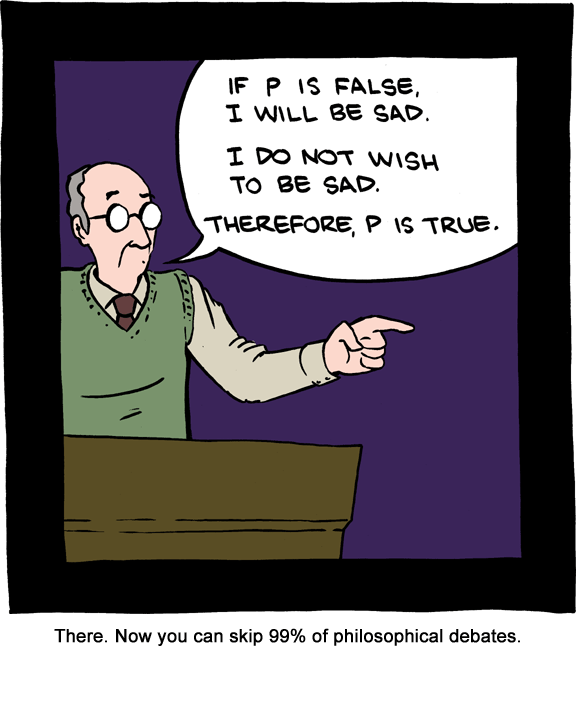
Now let’s not dunk on the poor giants whose shoulders we are standing on. They made silly mistakes, true, but someone had to, so that we knew better. The lesson here is to actually know better and make new, more fascinating mistakes arrive to the right answer instead.
We can even see how this kind of reasoning makes some sense with the ultimate goal of adding philosophy up to normality. It seems normal that our knowledge is justified. It intuitively makes sense. While skepticism is weird. If we can’t be certain in anything, including our reasoning techniques, how comes we can know anything whatsoever? How can we build technology that works? How can we distinguish truth from falsehood at all?
And so most philosophers are really into certainty. It’s deeply entangled with the view that philosophy (or at the least some part of it) is a separate magisterium that lies beyond the empiricism of sciences, providing a certain foundation for it and all our knowledge. Where science deals with probabilistic knowledge and uncertainties, philosophy is the domain of synthetic/fundamental/pure reason/necessary truths.
Indeed, in my salad days, I was thinking among the similar lines. However, as with many such common wisdoms, it’s enough to just start questioning them from the height of our modern knowledge, to see the cracks:
If the brain has an amazing “a priori truth factory” that works to produce accurate beliefs, it makes you wonder why a thirsty hunter-gatherer can’t use the “a priori truth factory” to locate drinkable water. It makes you wonder why eyes evolved in the first place, if there are ways to produce accurate beliefs without looking at things.
When pushed to grapple with the question of how all this certain knowledge providing justification for itself and all our other knowledge is supposed to work, many philosophers would vaguely gesture towards mathematics and say: “Like this!”
This is ironic for multiple reasons.
First of all, most people, philosophers included, do not really understand why math works the way it does and what exactly it means. So invoking math as an example is not an attempt to answer a question while pointing at a direct gear level model, instead, it’s an attempt to hide one confusion into a yet other one.
Secondly, math is an extremely rigorous reasoning about precise matters, while philosophy is a vague reasoning about poorly defined matters. It’s, of course, very flattering for philosophy to claim the status of being math-like. But actually expecting to get the benefits of rigor, without putting any of the work required for it is quite naive.
Thirdly, math is merely a truth preserving mechanism, a study of which conclusions follow from which premises for a certain definition of “follow”. It’s generalized conditional knowledge, not fundamentally free from the uncertainty but merely outsourcing it to the moment of applicability. As a result math can’t actually prove anything about real world with perfect confidence. A mathematical model may be making confident statements conditionally on all the axioms being satisfied, but whether or not the reality satisfy these axioms is an empirical question.
Neither math can justify itself. There is a deep uncertainty in it’s core, which makes it much more similar to empirical knowledge, than we could’ve initially though. So even if philosophy was as rigorous as math, it couldn’t be a certain foundation for all our knowledge.
So maybe, just maybe, we can for once try a different approach. To try and add skepticism to normality instead of constantly dismissing it. After all, science is the normality to which we would like philosophy to be adding to. And science seems to be doing pretty well even though it’s based on merely probabilistic knowledge.
Engineers building rockets do not sweat about Cartesian Demon and yet the rockets seem to works fine. If something is good enough for building rockets maybe it’s good enough for our reasoning in general?
So give skepticism a try. You may be surprised how much everything will make sense afterwards.
- ^
There is an extra level of irony here that, among other things, Kant has “à priori” figured out that space and time are absolute, which we now know not to be the case.
Comment withdrawn.
“This statement is a false”—is a paradox.
“This statement is unprovable”—is not.
We can say that both are self-defeating if we want to, but that doesn’t really change anything.
Let’s just say that Kant didn’t see that coming. He essentially made a very confident prediction about the nature of space an time that was later shown wrong.
I think this is exactly fair. It’s true that philosophy has some excusable complications preventing it from achieving the same rigor as math. But then one shouldn’t claim this rigor for philosophy and be very careful when comparing philosophy to math.
I don’t need to presuppose that some elaborate theory like platonic mathematical universe is wrong, when I have a simpler account for it’s evidence.
And what exactly do you mean by real here?
It means that it’s conditional knowledge, exactly what I’m talking about.
Comment withdrawn.
But what does it mean to “give skepticism a try”? I would think the challenge is not in simply being skeptical (and in fact, just being equally skeptical of everything is IMHO even more silly then being equally trusting in everything) - it’s being properly calibratedly skeptical, with incrementally reduced levels of skepticism as more evidence “for” is accumulated, and increased skepticism given more evidence “against”...
Yes you are thinking in the right direction.
I’ll make a separate post about how exactly skepticism adds up to normality. For now it’s an invitation to try to figure it out yourself.
Do you distinguish skepticism from humility? I’m pretty well aware that I don’t actually know anything for certain, and Bayes proponents are always saying there is no 0 or 1. At the same time, for most things, my best decision-making seems to have come from taking my perceptions at face value.
This is the normality that skepticism is adding up to. Probabilities, not certain knowledge.
You can be somewhat critical about your perceptions and even hold in your mind the possibility of evil demon.
The classic problem with (Pyrrhonian) skepticism is that it’s a fake position. That is, where skepticism claims to say that something can’t be known, the claim that something can’t be known is itself a claim to know, and thus skepticism is just a special case of claiming to know but where the particular knowledge rejects knowing the matter at hand. Thus skepticism isn’t really any different, fundamentally, than claiming to know something, it just tries to hide this fact and shrink it down to a single claim, which doesn’t solve the epistemological problems involved so much as move them around.
There’s a more casual kind of skepticism that’s quite good, though, which is to be suspicious of the supposed validating of claims. To want to check the details of arguments for oneself. That kind of skepticism is quite useful!
It’s with great regret that our language doesn’t make a clean distinction between these two kinds.
Yes, however a version of skepticism that claims that nothing can be known for sure/justified beyond any doubt doesn’t have this problem.
Figuring out/refining the right kind of philosophical skepticism that would add up to normality is a bit of a challenge, but it’s not that hard, really. But this require to do the first step—to stop dismissing skepticism out of hand.
But how much is this still properly skepticism, then, instead of justified uncertainty?
The point of the exercise is to add skepticism to normality. Skepticism is the starting point. Justified uncertainty is the goal. The journey between the two is the exercise.
Which version of scepticism? Even the article you link to concedes there is,at least one form of scepticism that’s refutable through self defeat.
If extreme scepticism is self defeating, and certainty is unobtainable, then what you are left with is moderate scepticism—AKA fallibilism. What you need to try is the right amount if the right kind of scepticism.
If the world is weird, I wish to believe that the world is weird.
The goal is to add up to truth.
If normality means supporting all your intuitions, then you are going to have to disbelieve much science and maths.
If it means something else …what?
Something can work in some contexts, but not in in others.
Empiricism doesn’t work for things you can’t see, eg:-
Modality, Counterfactuals, Possible versus Actual.
Normativity, Ought versus is.
Essence versus Existence, hidden explanatory mechanisms.
A priori truth could have a naturalistic basis. Many organisms can instinctively recognise food, predators, rivals and mates. But even the broadest evolutionary knowledge must that operate within the limits of empiricism .. not the “invisibles” I mentioned. And of course it is a rather different kind of apriori knowledge than analytical kind, based on language and tautologies.
Space and time don’t need to be justifiable, because they are not propositions. they are aoriori, but not apriori propositions. They are, for Kant, preconditions for having any experience, and therefore apriori. Geometric truths are apriori propositions. They need justification, which for Kant, is the apriori nature of space.and time—for humans.
I think you meant Euclidean.
Note that no claim is made that space is Euclidean in itself. The tower of.justification is only rooted in the operation of human perception.The
Kantian issues about how much of what we perceive is out there, and how much how.much our form of representation are still live, and crop up within science. Just looking doesn’t solve them, because you can only look from within the mind-world relationship … you can’t look at it from the outside.
What does that mean?
″ Almost all contemporary epistemologists will say that they are fallibilists”
https://iep.utm.edu/fallibil/#H1
Half of science lies beyond the empiricism of science.
ETA
On the other hand, maybe it isnt. There’s no guarantee. Maybe forms of reasoning that depend on visible feedback about whether something happens or works can’t extend to areas where there is no such feedback—areas like “what is the ultimate nature of reality”. There is no direct test for correspondence-to-reality. So truth is different to usefulness.
The usefulness cluster of concepts includes the ability to make predictions, as well as create technology. The truth cluster of concepts involves identification of the causes of perceptions, and offering explanations, not just predictions. Usefulness corresponds to engineering, truth to philosophy, and science straddles both. Usefulness corresponds to phenomenal, truth to noumena.
The usefulness cluster corresponds to scientilfic instrumentalism , the truth cluster to scientific instrumentalism. The truth cluster corresponds to epistemological rationalism, the usefulness cluster to instrumental rationalim. Usefulness corresponds to practice, truth to theory.
Truth is correspondence to reality , which is not identical to the ability to make predictions. One can predict that the sun will rise without knowing what the Sun really is. “Curve fitting” science is adequate to make predictions. Trial and error is adequate to come up with useful technologies. But other means are needed to find the underlying reality. One can’t achieve convergence by “just using evidence” because the questions of what evidence is, and how to interpret depend on one’s episteme. One also can’t because ruling out empirically reconfirmed theories generally doesn’t leave you with a single candidate.
Science straddles both. Science is not just a matter of making predictions, it’s a matter of of answering “how” and “why” questions, of finding explanations. That can’t be done by stamp -collecting observations … It requires the conscious and creative conjecture of explanatory hypotheses, something beyond empiricism.
I think you’ve just answered your own question more or less.
We are in agreement here. And if you read to the end of the post you’ll see the answer to your question:
I’m sorry I’m not going to spend time untangling this confusion in the comments. I hope that if you keep reading my posts you’ll eventually have enough insights to figure this out for yourself.
Their existence and properties are proposition.
That’s too, though I was mostly hinting to relativity.
Curious how our understanding of things that some people may assume are beyond observations are then happen to be changed by scientific discovery, isn’t it?
That’s nice. Though the key words here are “contemporary” and “epistemologists”.
There are still minor nuances with fallibilism like the fact that people still manage to be confused by the possibility of Cartesian Demon, but I’ll get to them in time.
I have, and I still haven’t seen a definition of normality.
It’s general.relativity that implies non euclidean space.
Not once you realise scientific discovery isn’t pure empiricism.
So where are the philosophers obsessed with certainty? In the past, or in other departments?
This feels similar to what I was exploring in this post.
A few thoughts on dispelling illusions imposed by evil demons:
Invoking the anthropic principle makes me uncomfortable. I feel it is an unfinished concept, but I suspect there are vastly more instances of the experience of having the memory of temporal events in worlds where there are indeed temporal events than in worlds lacking temporal events. This lends evidence decreasing the likelihood of particularly pernicious demons, but indeed, it doesn’t disprove them and it is not based on solid ground.
Setting aside that uncomfortable argument using deduction based on assumptions about the set of possible worlds, if everything I observe is a demonic illusion, I admit defeat, and so I gain more utility by focusing on the worlds where I expect my actions can, in principle, lead to more utility.
A similar principle applies to trusting my tools of logical analysis. First, I try to subject my tools of logical analysis themselves to logical analysis to improve my confidence they should work well. There is a long tradition of people attempting to do so. But ultimately all of this rests on using tools we already have. We could search for new tools, but how would we evaluate their effectiveness? We would need to use our existing tools. So there is no escaping the need to rely on our existing tools.
Math is a branch of deductive reason which is a branch of philosophy ;^p
I commend you for feeling uncomfortable about it.
Kind of, but consider how much defeat do you actually need to admit?
https://substack.com/@apeinthecoat102771/note/c-117316511
I’ll be talking more about Münchhausen trilemma in future posts.
Before engaging more I should note I don’t really know what the “sceptic” stance is, other than just being dubious of things. If you think I should be more informed please point me at resources.
From your linked post:
I like this. This is a good point. I think there’s still unstated nuance but I like noticing the way the scope of demonic illusions must creep far outside of any capability we are aware of.
Not so.
In the world model of the “naturalistic universe”, it feels right to assume the existence of a past and future that give my memories, past experiments, and future plans real context. A reality illusion demon would provide no such assurances. Perhaps it dreamed of this single moment, having fully fabricated the past and with no plan of further exploring the future. In this case, my plans to perform future tests and make a nice cup of tea gain me no real utility since the demon will not be emulating me in the future where I can see the results of those tests or enjoy that tea. That is the sort of demon to which I say “ok, whatever, I’m just gonna assume you don’t exist because if you do you clearly break and control all my attempts to influence reality in any way.”
I wasn’t aware of the term “Munchhausen trilemma”. It’s a good term. Thanks!