How much should we worry about the pneumonic plague lableak in Siberia?
Epistemic status: I wrote this up hoping people can poke holes in it because I am quite worried.
Here’s what we’ve heard so far:
Local media is reporting that an employee of a BSL-3 lab in Irkutsk, Russia, died of pneumonic plague on Oct 1st.
The initial quarantine covered 200 people who were in contact with the employee before she died.
The FSB (Russian FBI) was seen assisting in the quarantine, which means it was not voluntary.
Soviet-era whistleblowers like Ken Alibek claim Irkutsk was a major bioweapon development facility.
As of Oct 4th:
The quarantine has expanded to 5 hospitals in the area.
The Russian government has switched to denial/coverup. Local news sources have deleted mentions of “pneumonic plague.”
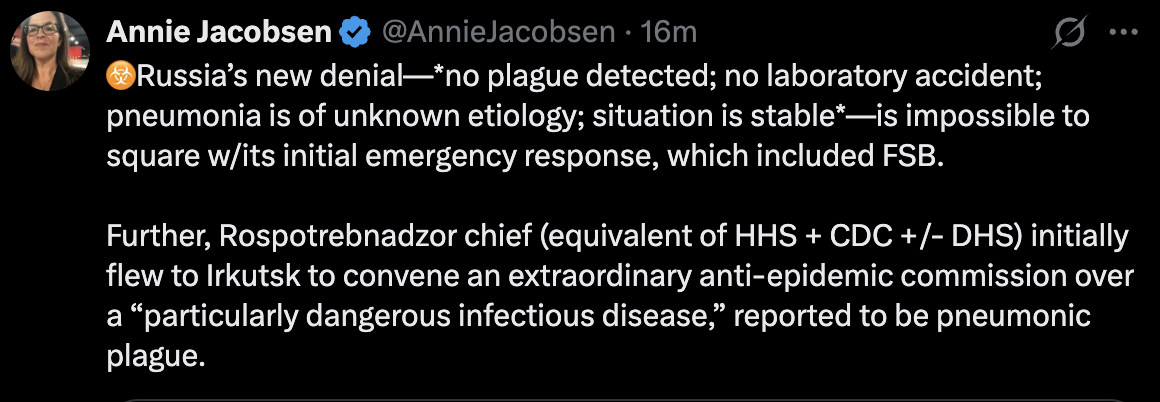
Local universities and schools have canceled some classes and extended mask mandates.
On the lab’s website, they mention gain-of-function research for making bacteria more virulent.
The White House is monitoring the suspected outbreak.
Why this might be a big deal
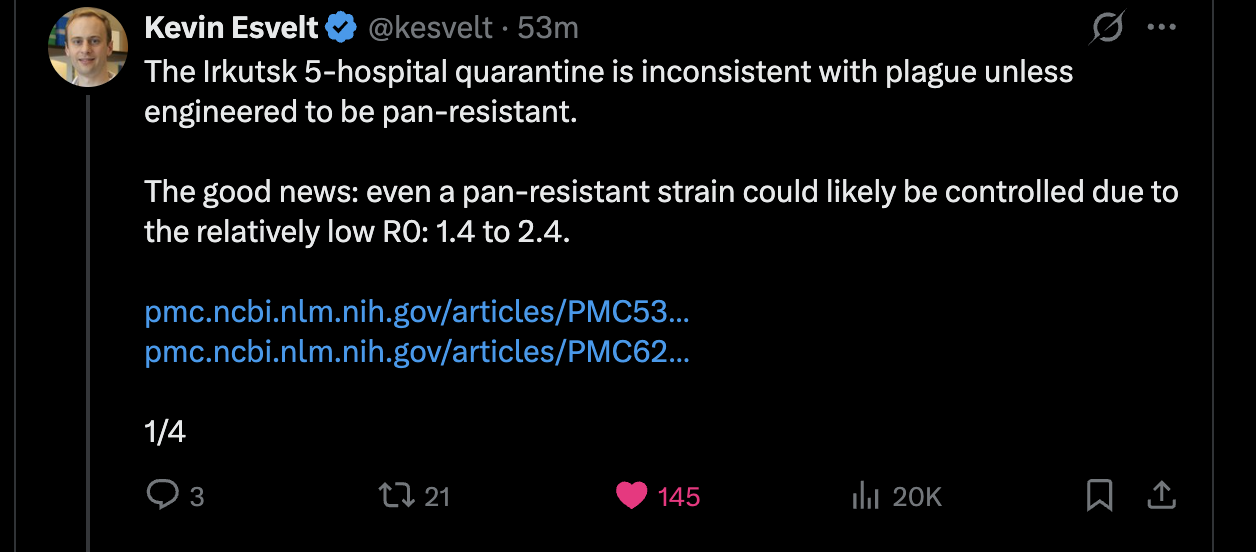
Regular pneumonic plague is maybe not that hard to deal with (?) but if it is a bioweapon that was leaked, it could be significantly more virulent than, say, COVID. Pneumonic plague has an R0 of ~1.3-3.5, whereas genetically engineered variants could have an R0 of 5-12.
If there is only one infection, then why quarantine 5 hospitals?
If it wasn’t a big deal, the Russian government wouldn’t put much effort into covering it up. This is something I’ll monitor over the coming few days.
If this is a bioweapon, this could be quite bad. In Annie Jacobson’s latest book, Biological War: A Scenario, much of the world is dead within the first few weeks after the first infection. I found it to be realistic, and it is a big reason I’m so worried. The scenario started basically identically to what’s happening here.
I asked the AIs if pneumonic plague is treatable with antibiotics, and they quoted me that the death rate with treatment is still between 8-30%.
Soviet whistleblowers say they have successfully created recombinant plague with antibacterial resistance and much higher virulence, so we know it’s possibly a bioweapon.
Why this might not be a big deal
Some OSINT researchers looked at a bunch of street cams in Irkutsk and didn’t find anything really out of the ordinary. Life is continuing basically as normal there.
Nothing ever happens.
We don’t really have much info on the whole thing. There are no reported second cases from officials, but with historical evidence, we should assume a cover-up- e.g., the Sverdlovsk anthrax leak in 1979 and COVID-19 in China. So evidence that there are no secondary cases is not really (much) evidence.
If it’s not a bioweapon, it’s most likely fine.
Some smart bio people I know think this is not a big deal, but I don’t really understand their reasons why.
Superforecasters at Sentinel think that the odds of pandemic are <1%. Their reasoning is that there is no official reporting of any further cases, and that the Russian government is implementing strict quarantine measures.
But I think this is actually the opposite of good news. The fact that the Russian FSB is implementing a strict quarantine AND the fact that the government is in full information control mode, denying that it is even pneumonic plague anymore, pushes me in the direction of this being a big deal, and they are covering it up.
I would be persuaded this isn’t a big deal if the Russian government wasn’t covering it up AND was implementing a strict quarantine, but because they are doing both, it makes me think it is, in fact, a big deal.
10⁄5 update:
Kazakhstan, Kyrgyzstan, Tajikistan, and Uzbekistan are now doing screening health checks at the Russian border to contain the spread of pneumonic plague.
Russian equivalent of HHS is now denying there was any accident at the lab at all.
Unconfirmed: reports of antibiotics running out in the city of Irkutsk
Kevin Esvelt is saying that it’s either a bioweapon or it’s not plague.
Another thread by Esvelt here.
10⁄6 update:
According to an OSINT researcher, the patient zero who died, Daria Shipilova, coauthored a paper that tested antibiotic resistance from plague.
I updated a lot on Esvelt thinking this was likely a bioweapon. But because not much news came out today, I think it’s much less likely to become an epidemic.
The coworkers of the woman who died said it’s unlikely, if not impossible, that she broke a test tube and contracted plague. Everyone who works at the anti-plague institute is vaccinated against plague, which makes it more likely that this is a pan-resistant strain.
Please let me know anything else I’m missing here.
This is a good summary of the situation; I will give the clarifications I can.
Edit: rearranged some things for visibility.
The most important evidence for whether this is dangerous, or not, is evidence of transmission. There is the risk that Russia could cover this up, but that would be difficult to do for long. So far we haven’t seen any claims about a secondary case; so long as it remains that the lab worker was the only person to evidently get sick, there is probably not much reason to worry.
The effectiveness of antibiotics for treating Pneumonic Plague have a lot to do with when they are applied; the usually quoted number for mortality rate for patients already exhibiting symptoms is 17%, which is quite bad. However, if you are treated prophylactically, or before you show symptoms (or possibly even have the disease) the mortality rate is near zero.
If this is natural Yersinia Pestis as Russian officials initially claimed it was, it isn’t that big of a deal. Outbreaks of the pneumonic form of this bacteria are rare, but not unheard of; off the top of my head there was an infection in Russia of pneumonic plague from a marmot in 2005, and in the United States in Colorado in 2014.
In it’s natural form, Pneumonic Plague is pretty virulent, but not THAT virulent. Standard medical hygiene practices are usually enough to contain it on it’s own, and the pathogen is so severe that it can easily burn itself out.
As you say, most of the concern about this incident is for if it weren’t a natural strain, but instead an engineered bioweapon.
A lot of the attention to this incident is because of it’s similarity to the scenario in Annie Jacobsen’s “Biological War” which describes an engineered version of Pneumonic Plague that we have known the Soviet Union possessed since the 90′s, thanks to the testimony of scientists who defected. We know that they not only experimented with making Yersinia Pestis more virulent, but also much more lethal; attempting to incorporate features like genes producing human endorphins to make the victim much more euphoric and active during the early infection, or release an encephalitic virus such as the Nipah virus, which would make it far more lethal.
While we know these modifications were attempted, we do not know to what extent they succeeded.
We do know however that the Soviet Bioweapons program was never shut down; according to the US State Department “Adherence to and Compliance with Arms Control, Nonproliferation, and Disarmament Agreements and Commitments” report in 2024, they “assesses that the Russian Federation maintains an offensive BW program and is in violation of its obligation under Articles I and II of the BWC.”
Given modern synthetic biology techniques, with state resources it would be almost trivial to make a bioweapon with most of these characteristics.
All of that said, I think base rate still favors the pathogen being a natural strain. There are some unusual observations, for example: If the technician knew she broke a vial of airborne Yersinia Pestis, why didn’t she report the incident, or at least tell her doctors when she started to get sick? Why did the FSB seem to alter the story upon arrival?
On the FSB, and government response: I suspect that it will be difficult to ascertain much useful information from the response of government officials in this incident. It seems likely that just like the Chernobyl incident, the government officials (including the FSB) do not know for certain whether it was a lab leak, or a bioweapon, or anything. They do know that they don’t know, so they will probably:
A) Treat the outbreak as though it were as bad as possible, until they are instructed to do otherwise (since they know it could be a bioweapon they weren’t told about.)
B) Obfuscate information and deflect blame, since not receiving blame for whatever happens here is probably what is most important to their superiors.
Do you happen to have the source for this? Not because I doubt you, but because I would be interested to look into it more deeply; as you say it could be important evidence to update on.
Sources: I am too lazy to fetch specific books and texts. I am a biotechnologist professionally, with a master’s degree in biotechnology, and I have been studying to transition into biosecurity, so take some salt with my epistemic status.
Additional Background on Pneumonic Plague
You can find most of this by just looking it up, but to aggregate some relevant information:
Pneumonic Plague is the relatively rare fully airborne variant of the more well known “Bubonic Plague”, colloquially called “The Black Death”.
Pneumonic Plague makes up fewer than 3% of Yersinia Pestis cases.
Both diseases are caused by the gram negative bacteria Yersinia Pestis. The bacteria needs to make adaptations to be able to spread one way or the other, it is very rare for the blood borne variant, which primarily infects your lymph nodes (causing the famous black “bubos”) to infect your lungs and become airborne, or vice versa; mostly because you are probably dead before this can happen.
Bubonic Plague is a blood borne pathogen, which spreads via fleas and animal reservoirs. This is why it is so difficult to remove from endemic populations, such as the United States; in the US, prairie dogs can carry the disease, and there have been bubonic Plague cases as recently as 2024 in Colorado.
Since 2002, the World Health Organization (WHO) has reported seven plague outbreaks, however, some may go unreported because they often happen in remote areas. Between 1998 and 2009, nearly 24,000 cases were reported, including approximately 2,000 deaths, in Africa, Asia, the Americas, and Eastern Europe. Ninety-eight percent of the world’s cases occur in Africa.
Both variants of the disease can be treated via antibiotics, but the Pneumonic variant does not show symptoms until it is already very developed, therefore antibiotic treatment of symptomatic patients is only successfully in ~80% of cases.
I am happy to try and answer any questions, but Claude is probably just as good for most things. I apologize if I am slow to respond.
One more note I thought to add: I really liked Annie Jacobsen’s “Biological War; A scenario” for how it worked to draw attention to the dangers posed by bioweapons. It was thoroughly researched, and she based the events of the story in historical precedent as much as possible.
That said, she deliberately used the worst case version of events in that scenario to convey a particularly severe outcome; this is a good idea when considering catastrophic risks, but it still doesn’t represent the modal outcome of a lab leak, even from an engineered form of Yersinia Pestis.
In my opinion, this is still good since people should be aware of the worst case scenario, and perhaps more importantly: Engineered Yersinia Pestis isn’t actually the potential bioweapon that keeps Biosecurity people up at night, there are things that are probably much worse. That is just the one we know probably exists.
To be specific; the private jet, and undetected transmission of the pathogen to it’s occupants is a particularly worst case scenario from a disease containment perspective. For this reason, Annie had the bioweapon transmitted to the US in both the “best case” scenario, and the worst, to illustrate some of both. The best case was the detected variant that flew in to Dallas, and could likely be contained (though not without difficulty). Obviously, a private jet immediately flying an early case directly into a highly vulnerable and medically underserved population like homeless people on skid-row represents a near worst case vulnerability to the global health system.
Tyler, what do you think of the analysis from the superforecasters at Sentinel?
This is what I wrote to them:
1. The lack of evidence of further cases is not really that much evidence, since we know that the Russian state is in full information control mode. They are now denying that this was pneumonic plague at all and literally calling it a “pneumonia of unknown origin” the same as what the CCP called COVID during their cover-up. There’s also a bunch of evidence of further cover-up in the media.
2. Why would they quarantine 5 hospitals, involving the FSB in enforcing the quarantine, if there were no further cases? Strict quarantine measures are actually evidence that things are worse than we think, not better.
3. Countries around Russia like Kazakhstan are adding mandatory quarantine/screening checks at border crossings. Seems unlikely they’d do that if there was nothing.
4. I’d think that this wouldn’t be a big deal at all if there were no evidence of further cases and the Russian government wasn’t trying to cover it up, but it seems like they are heavily censoring any news relating to the outbreak. The more effort they put into the cover-up, the more we should be concerned
I think this is asserted without sufficient evidence. A lot of people are desperate to jump on any news that casts Russia in a bad light, and to conspiracize about an imminent apocalypse of some kind happening to them. I’d encourage you to look at the predictions that people predicting an epidemic have been making about Russia over the past 4-5 years—in particular, how many times have they forecast imminent collapse?
From East Euro sources I trust, it’s been said that the far parts of Russia have had plague endemic among local wildlife for a very long time, and that occasionally a few cases crop up here and there. It’s very sparsely-populated, and weird things can happen in places like that.
I don’t think their position is unreasonable; at this point we really lack reliable information. I think it also reasonable to expect successful containment, even if it is an engineered pathogen, though if I knew that for certain I would probably be 10x more concerned.
Personally, I would probably put much larger error bars on my estimate then they did though. If I imagine every time I encountered this set of evidence, and how many times it turned out to be a highly infectious engineered pathogen, which was then uncontrolled and infected >1000 people, I would say probably 5%, but I am not very confident given the low epistemic quality of the environment.
I’m going to say roughly 10:1 odds that it is standard Yersinia Pestis vs an engineered variant of the bacteria, given base rates, and updating on the peculiarity of the response.
I agree with your points that the government is reacting very strongly for a standard outbreak. The tough part is that like I said, they probably don’t know for sure themselves.
The best I can do at this point is acknowledge my uncertainty, but I really appreciate that you and others are taking this seriously, as the outcome if it is an engineered pathogen that broke out could be catastrophic.
Thanks for all your thoughts here!
These threads by Kevin Esvelt imply he thinks it’s likely that it is an engineered variant. (1. 2.)
I agreed with your initial odds of 10:1 that it was normal Yersinia Pestis. But if Esvelt thinks it’s likely a bioweapon, and his reasoning makes sense, then I’ll defer to him.
According to an OSINT researcher, the patient zero who died, Daria Shipilova, coauthored a paper that tested antibiotic resistance from plague.
However, since we haven’t heard much news at all today my probability that this is a competent bioweapon have dropped.
Ya, I would defer to Esvelt too; he is definitely senior to me in experience with these questions., and on top of that I’m not following as closely as I would like to.
I think my main source of doubt is I’m unsure how reliable the information sources are at this stage. It is unclear to what extent the 5 hospitals were quarantined, for example.
I think Kevin is right to point out that we should notice our confusion by the response, given the stated facts; I’m just not confident in what information we have is reliable or unreliable.
I also think it is worth pointing out that Kevin and I are addressing our claims to really different audiences; on Lesswrong I can focus on trying to be epistemically correct, and say “It seems like there is a 5% chance of this becoming a Pandemic” and people understand that a 5% chance of a serious event is very serious.
On Twitter/X Kevin is addressing an audience where saying there is a 5% chance of this being serious, reads as a directional push toward “don’t worry about it” when they probably need a directional push toward “You should really take this seriously.”
Here’s the source that found that they were doing gain-of-function on making bacteria more virulent at the lab: https://x.com/outbreakupdates/status/2106830165653230031
There is no limit to human stupidity, but that aside, why would Russia or any other state actor want to create a superplague? It will kill your own side just as easily as your enemies. Vaccinate your own side? How long will it take for the pathogen to evolve past the vaccine? Superplague bioweapon does not make sense.
It’s another opportunity to dance really close to the cliff edge :
https://balanceofnations.com/history/what-is-brinkmanship.html
Why would any state actor create nuclear weapons that when used trigger a response that kills all of your own side just as easily as your enemies?
That is a different game, one where I have a “kill you” button and you have a “kill me” button. Your button prevents me using mine and mine prevents you using yours. (It is important that neither side can make a first strike powerful enough to prevent the second strike.) Superplague is a “unilaterally kill everyone” button.
The logic is similar. It’s symmetrically dangerous to both allies and enemies. It’s a strategic weapon, meant to deter actions like conventional invasions rather than be used tactically. Again, what is the purpose of a ‘kill you’ and ‘kill me’ dynamic? What purpose does it serve?
A nuclear bomb in itself is dangerous only to the people it is dropped on. See Hiroshima and Nagasaki. Only the current standoff among the nuclear powers stabilises the situation, given that the weapons cannot be undiscovered. Nuclear powers have them to prevent other nuclear powers threatening them. Non-nuclear powers (e.g. Ukraine) are still vulnerable to the threat of their use. If Russia nukes Ukraine, as Putin has from time to time threatened to do, what happens then? Kyiv ceases to exist, Moscow stands, what next?
But release superplague, all die, o the embarrassment. To what purpose?
I don’t want to sound like a jerk, but do you understand the basic principles of deterrence?
https://en.wikipedia.org/wiki/Deterrence_theory
The entire point of this class of weapons is to not ever actually deploy them. It’s somewhat paradoxical to build something you never intend to use, so people sometimes have a problem wrapping their heads around it.
That is exactly what I described, and it does not apply to a superplague. There is nothing in that article that deals with “weapons” that themselves inflict as much damage on the user as on the enemy.
https://en.wikipedia.org/wiki/Biological_warfare
If you don’t see how a country with a larger and more capable conventional army might think twice about invading a smaller country with a demonstrated capacity to release a bioweapon that causes multilateral damage, then I’m afraid we’re at an impasse.
Such weapons are well established as deterrents, which a simple search will reveal. Meanwhile, you’ve only expressed incredulity and asserted that they are not, which is not an argument or evidence.
This would make sense, but Russia already has loads of nuclear weapons and as such no country would ever try and invade it. That and the fact that ground invasions against Russia are just not a thing that works very well. A super plague makes sense for a smaller country that’s blocked from a nuclear arsenal (maybe Iran would benefit) but has much more limited value to Russia.
Sure, I think that’s a more interesting question. I’m not an expert in this area, but as I understand it, bioweapons do still have some advantages even for an existing nuclear power.
The Soviet BW program could have been a lower-cost way to try to keep up with a perceived deterrence gap during the Cold War. The US started openly working on ‘Star Wars’, anti-ballistic countermeasures to nuclear weapons, which was destabilizing to MAD. Many attribute part of the fall of the Soviet Union to the inability to keep pace with the US in the arms race. A cheaper form of multilateral MAD might have been a factor.
Bioweapons don’t inherently destroy infrastructure. They are horrifying and fear-inducing in ways nukes aren’t (though they’re all pretty horrifying). They can be released covertly, in ways that might seem like accidents.
Not sure what the exact mixture of motives was for the Soviets and then the continuation with Russia. But just to remind everyone in this thread upvoting Richard and downvoting me, his original comment said: “why would Russia or any other state actor want to create a superplague?” And all I’ve done in this thread is point out widely-accepted theories of deterrence re biological weapons, so I’m not sure where the disconnect is.
EDIT: Maybe people here think that I’m somehow morally justifying the development of biological weapons. To be clear, I am not. I think they’re utterly horrific and irresponsible. I’m just trying to explain the bad incentives behind their development. I’m also anti-nuke, even though I see many people justify their existence as a preventative for conventional conflict and relative global peace and stability.
It’s insane, but not unprecedented:
The war kills many russians already. It only has to kill mote of one side than the other. Would Vladimir Kennaway accept 5:1 fatalities in his favour? 3:1?
It is also deniable.
Superbug. “Favourable” casualty ratio.
With superbugs there is no guarantee of deniability, Vladimir’s personal survival, the regime surviving a popular uprising, or any remnant of civilisation surviving at all. Nothing is “favourable” about a superbug disaster.
In Ken Alibek’s book about his prior work in the Soviet biological warfare program he actually emphasized the difficulty of combining multi-antibiotic resistance with even normal levels of lethality. Avoiding the normal biological pathways attacked by each antibiotic means relying on other, less efficient ones. Maybe a single resistance doesn’t matter but when they went for five they were having trouble getting their anthrax to kill their test animals at all.
This is very true, particularly with classic engineering techniques. When Ken Alibek was in the Soviet Union, recombinant DNA technology was in it’s infancy; for example Polymerase Chain Reaction (PCR) was only invented in 1983, and was likely not widely available in Russia. PCR is the foundation of all modern synthetic biology. In his time, I would guess the main way they were engineering bacteria was by selection pressure under optimized conditions.
Since then, sequencing has become possible and fallen in price maybe 10,000-100,000x ($15 through plasmidsaurus to sequence a plasmid up to 50KB, this only became possible in the last few years) and we have benchtop synthesizers that can make large custom sequences of DNA for you in hours, gateway cloning, electroporation, etc. Not to mention the massive repository of knowledge and techniques we have built up since then.
This is what has biosecurity people so worried. Even without the addition of AI (which makes all of this at least more accessible) it is now possible to cheaply and quickly do insane things in biotechnology.
Interesting point, though I suspect the science has improved a lot in the last few decades. And it seems like the only inside look we ever get at bioweapons programs is from whistleblowers like Alibek.
I think the fact that the government is doing both a quarantine and a coverup is not strong evidence that there’s a real pandemic. Imagine being a local official. You hear concerning rumors about an infection. You wonder if it’s a pandemic. You know from experience that covering up stuff like this is totally what your government would do. So even after you hear further reports that things are fine, you don’t really believe them deep down. You order a stricter quarantine just in case. Also, simultaneously, insofar as someone you are responsible for may have done something bad, you quickly move to erase that evidence, again just in case. You don’t need to know whether they actually did anything bad and you don’t even want to know.
That makes sense, but I think the effort the government puts into the cover-up matters. If it’s a few local officials following their local incentives, then I agree that that’s not that bad. But this is clearly going beyond that.
The important question I think is what Esvelt brought up:
He says in the thread that this is not a guarantee of a pandemic, but I would certainly not be as confident as Sentinel thinking there is >99% chance that it’s fine.
There are some markets about this incident on Manifold right now. (slightly different resolution criteria, in the 70 traders range)
I would encourage people here with opinions to Join and Trade! (Not affiliated...)
It’s the main way I get my news on these kinds of things, maybe there are others like me who would appreciate LWer opinions weighed in.
Linked for Convince.
more-than-1000-cases-of-irkutsk
Russia has two vaccines against plague—old one, good against bubonic plague and 2018 one which has less side effects. China has one vaccine. No vaccine is approved in the West.
Any worker of anti-plague institution in Russia must be vaccinated once a year against plague. Thus the girl likely was vaccinated. This means that she dies either from new variant of the plague, or from not a plague at all.
Unfortunately, I think there are a lot of possible confounding variables to those conclusions.
Not all vaccines are fully effective against their intended target; I don’t have information on the Russian vaccine specifically, but it’s existence does not necessarily assure it’s effectiveness. Many approved vaccines, such as our annual flu vaccine, can have effectiveness as low as 30%, though this is a complex subject.
Just because she was supposed to be vaccinated annually, does not mean she actually was vaccinated annually.
The effectiveness of the Bubonic Plague vaccine on Pneumonic Plague in particular is questionable; Bubonic Plague is a blood borne variant of the bacteria, that affects your lymph nodes. Pneumonic Plague infects the lungs, residing on and among your epithelium cells which is a very different environment. Particularly, most vaccines confer lasting immunity by effectively “training” your B-cells to develop and produce antibodies in response to a particular infection. Antibodies that are effective in your lymph nodes are not necessarily effective in your lung tissue.
Again, I don’t have particular information on the Russian Yersinia Pestis vaccine, but I would be surprised if any data has been collected on it’s effectiveness vs the Pneumonic form of the disease, even in a mouse model, because the Pneumonic form is much rarer in nature.
I asked Gemini about this and what its said:
AI-generated content below:
1. Animal Model Efficacy Estimates
In preclinical studies, the EV76/EV NIIEG live vaccine has demonstrated strong protection against high-dose respiratory challenges, consistently outperforming older formal-killed vaccines. [1]
Mice and Guinea Pigs: Studies show that a single subcutaneous or intranasal immunization with the EV76 strain provides up to 80% to 100% protection against lethal aerosol challenges of virulent Y. pestis strains (such as the highly virulent CO92 strain). Furthermore, a single dose rapidly triggers iron-sequestration defenses in the lungs, providing an early mechanism to halt the progression of pneumonic infection. [1, 2, 3]
Non-Human Primates (NHPs): Efficacy in primates is more complex. While the EV76 strain provides a high degree of protection against both bubonic and pneumonic plague across several monkey models, certain non-human primates (such as African Green/vervet monkeys and langurs) exhibit high sensitivity to its residual virulence. In some instances, it has caused severe adverse reactions or fatal vaccine-induced plague, which ultimately prevented its licensure as a human vaccine in Western nations. [1, 2, 3]
2. Human Epidemiological Estimates
Evaluating the vaccine’s exact efficacy against primary pneumonic plague in humans is difficult because natural outbreaks are rare, and intentional human challenge trials are ethically impossible. However, historical and retrospective epidemiological data provide the following estimates:
Overall Protective Efficacy: Historical data from mass immunizations in endemic regions (such as Inner Mongolia in 1945) showed an approximate 100-fold reduction in plague incidence among vaccinated individuals (0.25 cases per 1,000) compared to unvaccinated populations (28.8 cases per 1,000). [1]
The Pneumonic Protection Gap: While the vaccine provides robust, long-lasting immunity against flea-borne bubonic plague, peer-reviewed literature notes it is only effective “to some extent” against the primary pneumonic form in human populations. Because pneumonic plague progresses with extreme speed via direct respiratory droplets, the systemic immunity from the live vaccine can occasionally be overwhelmed, resulting in breakthrough infections. For this reason, anyone vaccinated with the EV strain who experiences a known aerosol exposure is still strictly required to undergo a 7- to 10-day course of post-exposure antibiotic prophylaxis. [1, 2, 3, 4, 5]
In the tweet you linked, Kevin Esvelt states
I think his claim is overstated. Vaccination is routine for Russian plague research facility employees, so our prior should be that she was vaccinated. Those vaccines have limited efficacy against pneumoniac plague (it’s higher against bubonic) and it lasts roughly a year.
From the linked source:
Among all participants, the share reaching the conditionally protective titer of 1:160 was 26% at four months, 15% at eight months, and 11% at twelve — up from a 5% baseline.
If she was exposed later in the vaccination cycle, and inhaled not respiratory droplets but aerosolized concentrated plague (i.e. a shattered tube in a centrifuge), then she’d get a dose much higher than studied in the literature at a time when the vaccine’s efficacy was attenuated.
There are claims that she did not seek treatment or get dosed with antibiotics until several days after exposure. The therapeutic window for antibiotics is roughly 24 hours.
There’s also a small chance she could have been unusually susceptible (the case of Malcolm Casadaban is an example).
So the fact that the researcher died of plague while not receiving antibiotics until days after exposure is really not much evidence toward it being an engineered strain.
Oct 6, 2026: Currently scores 6⁄14 on my pandemic prediction checklist (details, sources to be added). The disease is deadly, transmissible via respiratory droplets, near 100% mortality if untreated and with antibiotics losing efficacy after 24 hours, and it would pose a serious danger to the workforce if it spread. However, there has been only one known death, it appears contained so far and quarantines appear to be unwinding, and it does not spread before victims are visibly, severely ill. The dominant probability is that it’s treatable with timely antibiotics, though there’s a possibility it’s an antibiotic-resistant version. I am not worried about this becoming a pandemic, largely because the single worker who was exposed and killed was infected in an anti-plague research facility. We know the story of how the exposure happened, and so the situation appears to be one that is known and highly controllable. The disease is so deadly, so obviously frightening, that I fully expect high compliance with authorities for contact tracing, quarantine and treatment. I would change my mind if we saw evidence that pneumoniac plague was spreading in other regions, or resulting in quarantines of large cities, because my basic posture of “not worried” depends on the disease not being able to successfully defeat containment.
Note: To your question about “why 5 hospitals,” we have this source:
Transmissibility: efficiency, intra-community spread, inter-community spread, outside view
Is there an efficient transmission route, such as respiratory droplets, airborne transmission or via the bites of common jumping or flying insects? Yes.
Does it seem to spread rapidly within affected communities, going from a few cases to a major local emergency within a month? If R0 has been credibly estimated, is the mean of the range higher than 1? No, on the first clause; Yes, on the second.
Has it achieved community spread in non-endemic countries on at least 3 continents, and in a set of countries comprising 15% of the world population (excluding endemic countries) and a total of 15% of world GDP? No.
Is screening for the disease difficult due to test unavailability/unreliability/slowness, vector-based transmission, or transmissibility that is highest in early/asymptomatic stages? No.
Danger: case fatality rates, overwhelm, economic impacts, treatment
If a credible case fatality rate has been estimated, is it 1% or higher? Alternatively, is the number of deaths divided by the number of confirmed cases being reported at around 5% or higher in at least 3 countries with reliable data? Yes.
Is there a concern about hospital overwhelm or medical supply shortages in industrialized nations? No.
Does the disease heavily affect career-age people (age 25-65), or frequently leave survivors with lasting disability? Yes.
Is there no clearly effective treatment or vaccine? No, with caveat. This appears to be a former (?) bioweapons facility. Antibiotics are effective treatments for pneumoniac plague, but if this was developed into an antibiotic-resistant strain as a bioweapon, then it’s possible antibiotics will not be effective.
Spread limitations: demographics, geography
If some non-age-related demographics are heavily affected and others are not, do the heavily affected demographics amount to 15% or more of the population? If almost the whole population is about equally affected, mark this criteria as met. Yes.
Is the disease potentially transmissible across most of the world population (i.e. does not work via a vector that has a geographically limited range)? Yes.
Social effects: communications, shutdown, research, deaths
Has the disease made front page news on at least 3 different days in the New York Times, and also received the WHO designation “public health emergency of international concern” or the equivalent? No.
Has there been a quarantine of a city with over 1 million inhabitants? In a country comprising at least 5% of world population or GDP, has there been a cancellation of major public events, or travel restrictions on passengers arriving from or via this country? No.
Has the pharmaceutical industry begun a widespread research effort to produce a novel treatment or novel vaccine, and/or has industry begun a major emergency effort to build physical infrastructure or equipment (hospitals, ventilators, etc)? No.
Have the death toll reached at least 2,000? No.
For what it’s worth, prompting Claude Opus 5 (Opus 5.5 hit guardrails) with your post followed by “Can you search for information on the above and give me your assessment?” did provide some concrete reasons to be less worried than I had been. I’m not exactly down to its stated credence of “anything resembling a global event: well under 0.5%”—I get the feeling that Claude tends to overweight its own “nothing ever happens” prior + goes into “the aim is to provide reassurance” mode for questions around catastrophic risks—but it did provide some concrete points that updated me toward “probably not the next pandemic”. Folks can do the same with their own favorite model and draw their own conclusions. Even so, it was a good reminder to revisit jefftk’s mask advice and make a purchase, which I did this morning.
I find the AIs are quite useless when it comes to general questions in these cases. They mostly just take whatever the official line is as gospel. But as we know from the many historical cover-ups, I don’t think we can glean much from the official line.
I also think AI companies likely remove training data related to bioweapons from the corpus, because the AIs don’t even bring up the fact that this might be a bioweapon. And in general, seem like they are missing a lot of important mental models about bioweapons.
But it is a good reminder that nothing ever happens.
I too am concerned and would like to hear some concrete reasons to not be concerned. The official stories keep changing. She dropped a test tube (doesn’t make much sense). The other account was that she was traveling (this would be awful if she were actually infected and spreading). There is good reason to believe the ‘anti-plague’ facility was dual use and involved in bioweapons research. There is also a report you didn’t mention that workers at a nearby aluminum factory are required to mask up. I’m not sure if public intelligence is good enough at this point to determine the severity. The US government activity over the past 24 hours seems to be ramping up.
One big question is whether this is wild type or a novel modified variant. If it’s antibiotic-resistant, that’s obviously very bad. In Jacobsen’s book, pneumonic plague had been modified to induce euphoria and was also a chimera, so when successfully treated with antibiotics viral equine encephalitis was released from inside the plague as a 2-for-1 pathogen that killed many victims anyway.
My understanding is that the next 24-48 hours will be a strong indication either way because of the incubation period for plague, but I’m not a biologist, so I sure would like to hear more reassuring things if they have them.
Thanks for the roundup. Re one of your points of concern: it doesn’t seem like they are trying to cover it up. Russia is not US/ Europe (to put it nicely); the extra quarantine might have something to do with how their public health system works (not an expert, would love to hear from someone in that position), and it seems like they are taking a ‘better safe than sorry’ approach. What I’m concerned with though is how this outbreak started and whether that was the only incident. Also perhaps an unpopular opinion but I don’t think this incident is getting as much noise as it should??? I’m not advocating for panicking the general population, but it seems odd that I’ve barely seen anything about it in the news in the first 2 days since it was reported? in any case, I hope this will push policymakers and people in power to take these threats more seriously.