Yes, you can’t not pay if you got a ride, assuming perfect accuracy. But this doesn’t solve the problem (guarantee a ride to town, which is presumably better).
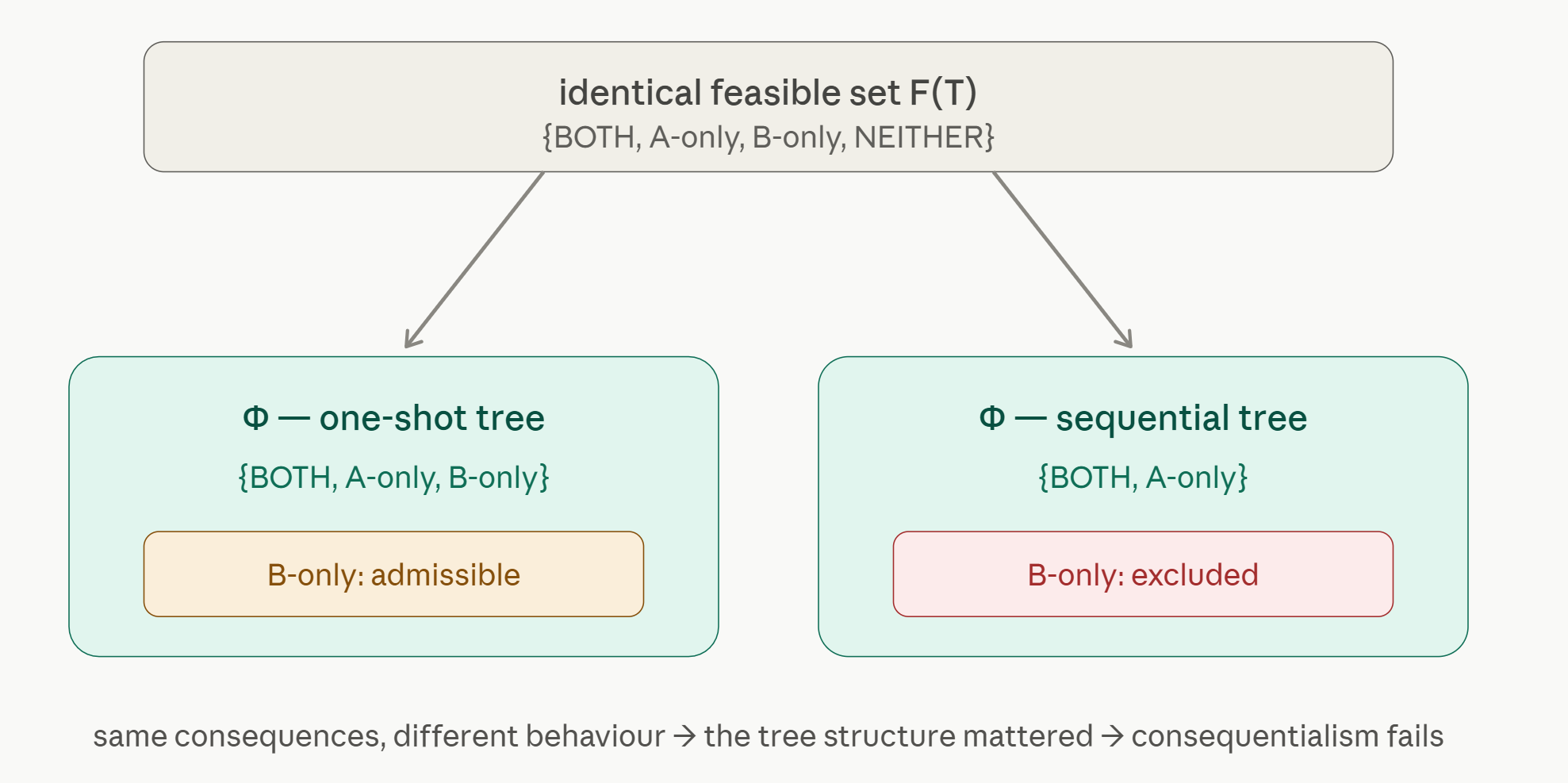
Consequentialism (as defined by Hammond) does not guarantee me a ride to town, but I see this as a problem for me, not consequentialism. Why should one expect consequentialism to save the person in the desert? In general, consequentialism recommends actions compatible with bad outcomes for some people, and good outcomes for others.
For me the upshot of the thought experiment is that I am basically certain to stay in the desert. I will never be able to commit 100 % to paying in town. The simple fact that I would have to think about commiting is a sign that the chance of not paying would be above 0. So a driver who only drove me to town if they were certain I would pay would certainly leave me in the desert. So, regardless of how much I commit, I think I would be certain to end up in the desert.
I think being left in the desert is the best and only outcome if the driver only takes me to town if they are certain I will pay them there.
I do not understand why this poses a problem to consequentialist reasoning. If I want to maximise my chances of survival, I should just constrain myself as much as possible to pay the driver in town. I would most likely be wrong if I found myself in town thinking there is only 10 % chance of paying if the driver is calibrated. I could try not to pay, but I would end up paying 80 % of the time. Reliably not paying would not be a live option if the driver is calibrated?