TL;Dr: 10g/day of glycine for 6 months has significantly improved my sleep quality and tolerance for sleep deprivation.
My dear friend, have you heard of the Vitamin?
The Vitamin has been foretold in ancient legends as the deliverer of all who suffer mysterious ailments. The Vitamin has been foretold on … Tumblr:
Unfortunately, I can’t tell you what your Vitamin will be, but beyond all reasonable expectation I found mine in the shape of the simplest amino acid—Glycine is in almost everything you eat, your body makes it too, and still you might not have enough.
I’d like to pretend I deeply researched this uncommon health intervention before gallivanting off to Nootropics Adventure Land, but actually I just regularly prompt every new AI model with my whole sleep dealio cause oh-my-god could I please just need less sleep already?
Shoshannah’s Sleep Dealio—TL;Dr: Healthy Long Sleeper
You know how some people are genetically blessed to only need 4-6 hours of sleep? They are the extremes on a bell curve where most of us sit around the 8-8.5 hour mark.
Guess who lives on the other side of that bell curve?
Indeed, the healthy long sleepers—a breed so rare that everyone will assume you are depressed or deficient in something.
Except all my tests come back fine—more than fine. So damn fine that the sleep doctor was absolutely over the moon when he informed me the reason I need 10 hours of sleep a night is cause I have the brain waves of a 10 year old (on a sleep EEG).
Presumably this has some sort of benefit, but who knows.
Then one day, Opus 4.6 was released, and I was very sleep deprived, as happens to me frequently. 8 hours of sleep will do that to you me.
And so I again dumped my medical history into this new Claude and … lo and behold—our lord and savior emerged:
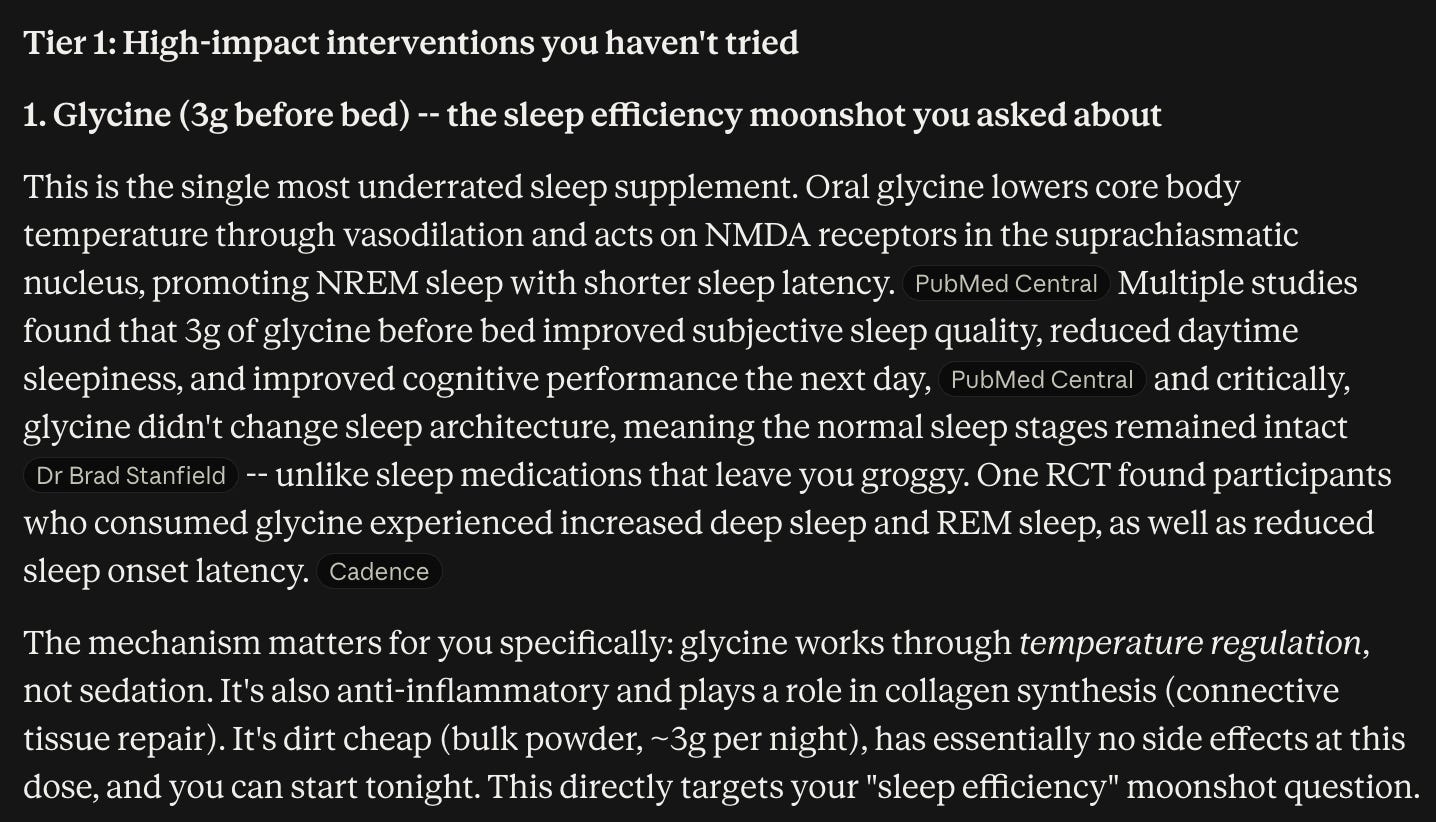
Opus 4.6 has a special place in my heart ever since 10 minutes ago when I looked up which Claude gave me the advice that changed my life
So I ordered glycine the same day. And then promptly forgot about it.
Sleep deprivation, not even once about 40-80% of my life.
Then a few days later an essay titled “Is fever a symptom of glycine deficiency?” goes up on LessWrong.
Oh boy was that a strange read.
You know who had a fever?
24-year old me who had been a vegetarian for 2 years, and ended up with 3 solid months of fever. I got my blood tested every which way to Sunday, and the doctor could not find any deficiencies nor any other causes of fatigue, fever, or any other f-word.
Now 3 months of fever sucks, and I was sleeping much of it, and eventually I was like … you know … I could … maybe … try … the obvious thing and reset my diet and eat loads of meat.
After 2 weeks my fever went away and I felt great. I’ve been a very conflicted carnivore ever since. After reading that essay, I looked up sources of glycine, and guess what? Various meat products are absolutely stacked with it.
So after reading that I grabbed my new pills, and took them, and …
My body and mind flooded with an overwhelming sense of relaxation and ease. It was so much I could hardly move. It’s like I got hit with a fluffy relaxation and well-being hammer.
This probably won’t happen to you. This probably doesn’t happen to anyone. But it happened to me and it made Claude so worried to boot, bless their heart.
To me it felt too good to overly mind, and over the course of a couple of weeks I got used to the effect, and now I just feel a pleasant sense of relaxation in the evening shortly after taking my dose.
Some nights I lie tossing and turning in bed, till I realize I forgot my glycine. I swear by the power of the God of Availability Bias, that’s how much it helps!
Anyway, unfortunately, I still need 10 hours of sleep.
But.
First of all, sleep deprivation hits me a lot less than before, and actually taking my 10 hours feels a lot better. Glycine has made sleeping pleasurable and good for me. And consequently, my mood is much improved and my energy levels are higher. Claude and Chat tell me this is to be expected.
And yet I cannot overstate how much glycine has helped me. It has been the number one best drug I’ve ever taken by a mile, barring … antibiotics. Antibiotics are strictly better. But you know. They do keep you from literally dying and stuff. Pretty stiff competition there.
Anyway, it’s been 6 months now, and the effects have lasted.
Glycine is clearly my Vitamin. To the point that my friends have sent me this:

And this:

And honestly, if someone tells me about a problem vaguely sleep or stress related, I will sit there biting my tongue till my willpower eventually takes a hike and I whisper softly:
Have you tried glycine?
If you want to give it a whirl, it’s easy to find online. I take 5 grams with breakfast and 5 grams with dinner. If you try it, let me know how it goes in the comments. Maybe it’s someone else’s Vitamin too.
I think modern medicine (including diagnostics) has a woefully inadequate concept of “deficiency” centered around specific disease states. Similarly to dietary recommendations, there’s a very big gap between “what does the body need to even function” and “what promotes optimal functioning.”
Dietitians are pretty good about, e.g., recommending fruits and vegetables even though on a pure Deficiency Model there is no reason to eat fruit rather than a multivitamin. Fruits and vegetables are good for you even if you have no deficiencies.
That’s true, and a good counterpoint, thanks. As I understand it, long term interactions with a dietician are supposed to involve some degree guided iterative experimentation with a focus on individual goals and symptoms. IDK how significant that is in practice, or many people receive that level of care? The few dieticians I’ve personally met haven’t really seemed deeply knowledgeable in the sense of being able or willing to think outside standardized advice in conversation, unless they have some particular hobbyhorses, but that’s a very small anecdotal observation.
I would entirely not count on a multivitamin over fruits and vegs, for the same reason I got sick being vegetarian while still being high enough on all nutrients people talk about with vegetarianism
I think whenever someone is considering cutting a common food group from their diet, they should track their own responses and experiment around a bit on what works for them, and recognize that they are taking a risk regardless (which can be worth it)
I disagree that modern medicine has an inadequate concept of “deficiency.” Insofar as we are bad at making recommendations for optimal function v.s. curing disease, it is because it is harder to gather evidence for the former: smaller effect sizes, more variance between people, and so on.
You second sentence, I agree with. Your first, sentence, I don’t.
And I don’t mean to imply that the traditional concept is even a mistake. It’s probably the best we could have done, as a matter of historical process. The field of ‘how a human body works’ is just too complicated for a human mind to hold, and doctors’ time and expertise are too expensive to put in enough time and effort to actually solving the full, general problem of personalized health optimization.
I’m hopeful AI can help. A few conversations with last year’s LLMs about my own health (in which I tried my best to avoid leading prompts and not direct too much) led to the AI independently suggesting many of the same practices and interventions I’d arrived at after a decade of personal experimentation (many of which my doctors had been skeptical of), refuting a few others, and suggesting a few extras to try. Overall success rate well above chance, overall evidentiary support much lower than medical practice would ever accept.
I still vividly recall the horror on my medical friend’s faces when I first enthused to them about the possibilities of personalized medicine (by which I had in mind teaching your own immune system to fight your cancer cells, etc). They are in a constant war against woo, and understandably focus on treatments that have at least some proven effect across as wide a cross-section of the population as possible.
That’s interesting. Cancer immunotherapy has been in development within the medical establishment for decades at this point—I interned in an academic immunology lab in 2004, working on a small related project, and it was hardly new then. Seems like the least horror-inducing example you might have picked.
Edit to add, way back in 2015 I had a conversation with a biologist coworker about the future of medicine, and she brought up personalized medicine. My first response back then was, almost verbatim, “Ok, so when I go the the doctor in 2050 and she pulls up a copy of my genome and my latest microbiome scan, is the conversation more about ‘Given your health and biology, you should make these lifestyle changes’ or ‘Given your health and lifestyle, here are some interventions we should consider.’” Her response was, “Oh good, you already know how this story goes.”
The idea that we wouldn’t have personalized medicine in the future was just not a possibility we thought likely enough to discuss.
Per my recent post, Don’t be the vitamin B guy, I am compelled to ask if you have done a blinded test of glycine. Given how dramatic you claim the effects to be, it should be easy to validate your results. I’d be happy to suggest a more detailed methodology if you are interested.
If the effect is placebo, then I do not want to disturb it right now and lose the benefits. I hope my write up was candid enough about the various cognitive biases and experiential benefits I’m getting, that people will interpret it as such.
I’m open to testing it at some later date when I can more easily afford to lose whatever amount of placebo effect I may be under (which I do believe may be 0, but I also believe introspection cannot access this accurately)
What setup would you suggest?
PS: I did wait with reporting on anything till 6 months later, exactly because I wasn’t sure what anyway should be inferring from my personal experience being this extreme. But the effect surviving this long has been enough a signal for me that I felt comfortable sharing a candid account.
You seem worried that finding out the effect is placebo will make it stop working, but this is at least partially a matter of attitude. Would it not be empowering to know you can improve your life so drastically just by believing in it?
But I do understand your concerns. Here is the methodology I suggest, based on similar experiments I’ve run on myself. I tried to make it as specific and actionable as possible.
Preparation:
Decide what you plan to measure during your experiment, and prepare any equipment, including a spreadsheet to track your data. At minimum, I recommend a smartwatch to monitor sleep, plus self-reported mood and energy at designated points throughout the day.[1][2]
Decide how many days you are willing to run this experiment. Call this number 2n.[3]
Get small ziploc bags, sticky notes, a pencil, powdered sugar,[4] and size 000 gel capsules.
Repeat n times: fill 10[5] gel capsules with 10g of glycine, write “G” on a sticky note, fold the sticky note so you cannot read it, and place it in a ziploc bag with the 10 capsules.
Repeat n times: step 2, but you fill the capsules with sugar and label the sticky notes “P” instead.
Place all ziploc bags in a designated bin.
For the next 2n days you run the experiment:
Each morning, randomly select a ziploc bag from the bin.[6] Remove the sticky note, label it with the date, and set it aside. Take half the capsules.
Gather any scheduled data throughout the day, such as recording your energy level.
During the evening, take the other half of the capsules.
Try to be consistent about when you take measurements. Depending on your schedule, it might make sense to run trial days only on the weekdays.
Some alternative options:
Consider deciding beforehand what statistical tests you will run to adjudicate the final data
If you expect that glycine supplementation will have significant compounding effects over several days, you can instead design the trial to assign yourself to a whole week on placebo or glycine at a time
You can include a 1g or 5g/day arm to test for a dose-response relationship
Figure out exactly what data you plan on gathering beforehand so you don’t have to change anything on the fly. Taking freeform notes is always a reasonable addition, but it can be harder to interpret this data.
There are lots of options. For example, you can include a reaction time and/or a dual n-back test, if you think you’ll stick with doing those every day and you expect to see a signal, but if you’re anything like me you will quickly lose interest. Design an experiment you will actually carry out. The bottom line is that if glycine works as well as you think it does, there is something you can measure that will prove this.
I recommend at least n=10, though I would do n=30 or more. You can (ask Claude to) estimate how many data points you need to gather given your predicted effect size and your threshold for statistical significance.
Or placebo substance of your choice. When testing nootropics, I typically use caffeine as an active placebo, but I don’t have a specific recommendation for glycine.
I find that size 000 capsules can hold about 1g of powder, and you’ve been taking 10g per day, but obviously the number of capsules does not actually matter.
If you find that you can visually distinguish the placebo pills from the glycine ones, you will have to close your eyes while taking or interacting with the pills. This may seem annoying, but I’ve done this before and it’s not that bad. It’s for science.
Thanks!
The procedure makes sense to me but I won’t have this reach my priority queue in the next year or longer. Also my days are far too variable for this to work over shorter time spans. Appreciate the thought though!
I’m confused. You said glycine has very noticeable effects, such that you forgetting to take it has obvious impacts on your sleep later that night, so why would variation in schedule make it impossible to detect its effects?
Also, you can just run trials over enough days that it averages out. I had extremely inconsistent schedules through many of my self-experiments and still found statistically significant interventions.
I got inspired to run a self-experiment with glycine based on this and prev posts about it. Pls share tips/methodology suggestions!
See my response to Shoshannah.
I found a different sleep-related Vitamin. Unfortunately, I can’t tell you what it is. I got a SpectraCell test and then started taking everything the nutritionist said I should take based on those results, simultaneously. So it’s probably one or more of those. But I went from often needing as many as twelve hours of sleep to something more like nine, sometimes less, and falling asleep is easier too.
I may have first come across the Vitamin meme through you :)
Also glad you found yours!