My journey to the microwave alternate timeline
Cross-posted from Telescopic Turnip
Recommended soundtrack for this post
As we all know, the march of technological progress is best summarized by this meme from Linkedin:
Inventors constantly come up with exciting new inventions, each of them with the potential to change everything forever. But only a fraction of these ever establish themselves as a persistent part of civilization, and the rest vanish from collective consciousness. Before shutting down forever, though, the alternate branches of the tech tree leave some faint traces behind: over-optimistic sci-fi stories, outdated educational cartoons, and, sometimes, some obscure accessories that briefly made it to mass production before being quietly discontinued.
The classical example of an abandoned timeline is the Glorious Atomic Future, as described in the 1957 Disney cartoon Our Friend the Atom. A scientist with a suspiciously German accent explains all the wonderful things nuclear power will bring to our lives:
Sadly, the glorious atomic future somewhat failed to materialize, and, by the early 1960s, the project to rip a second Panama canal by detonating a necklace of nuclear bombs was canceled, because we are ruled by bureaucrats who hate fun and efficiency.
While the Our-Friend-the-Atom timeline remains out of reach from most hobbyists, not all alternate timelines are permanently closed to exploration. There are other timelines that you can explore from the comfort of your home, just by buying a few second-hand items off eBay.
I recently spent a few months in one of these abandoned timelines: the one where the microwave oven replaced the stove.
First, I had to get myself a copy of the world’s saddest book.
Microwave Cooking, for One
Marie T. Smith’s Microwave Cooking for One is an old forgotten book of microwave recipes from the 1980s. In the mid-2010s, it garnered the momentary attention of the Internet as “the world’s saddest cookbook”:
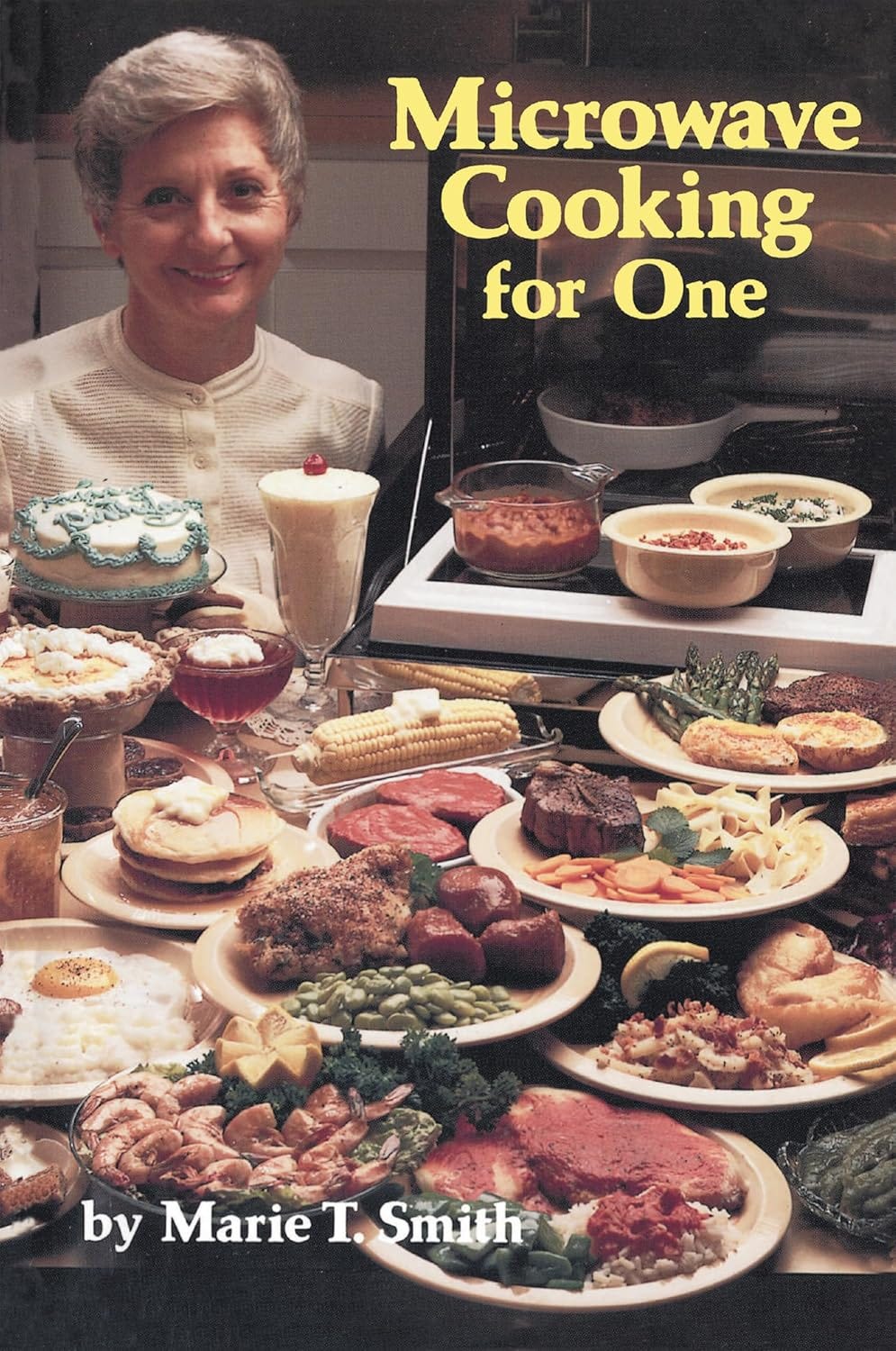
To the modern eye, it seems obvious that microwave cooking can only be about reheating ready-made frozen food. It’s about staring blankly at the buzzing white box, waiting for the four dreadful beeps that give you permission to eat. It’s about consuming lukewarm processed slop on a rickety formica table, with only the crackling of a flickering neon light piercing through the silence.
But this is completely misinterpreting Microwave Cooking for One’s vision. Two important pieces of context are missing. First – the book was published in 1985. Compare to the adoption S-curve of the microwave oven:
When MCfO was published, microwave cooking was still a new entrant to the world of household electronics. Market researchers were speculating about how the food and packaging industries would adapt their products to the new era and how deep the transformation would go. Many saw the microwave revolution as a material necessity: women were massively entering the workforce, and soon nobody would have much time to spend behind a stove. In 1985, the microwave future looked inevitable.
Second – Marie T. Smith is a microwave maximalist. She spent ten years putting every comestible object in the microwave to see what happens. Look at the items on the book cover – some are obviously impossible to prepare with a microwave, right? Well, that’s where you’re wrong. Marie T. Smith figured out a way to prepare absolutely everything. If you are a disciple of her philosophy, you shouldn’t even own a stove. Smith herself hasn’t owned one since the early 1970s. As she explains in the cookbook’s introduction, Smith believed the microwave would ultimately replace stove-top cooking, the same way stove-top cooking had replaced campfire-top cooking.
So, my goal is twofold: first, I want to know if there’s any merit to all of these forgotten microwaving techniques. Something that can make plasma out of grapes, set your house on fire and bring frozen hamsters back to life cannot be fundamentally bad. But also, I want to get a glimpse of what the world looks like in the uchronia where Marie T. Smith won and Big Teflon lost. Why did we drift apart from this timeline?
Out of the frying pan, into the magnetron
Before we start experimenting, it’s helpful to have a coarse intuition of how microwave ovens work. Microwaves use a device called a magnetron to emit radiation with wavelengths around 5-10 cm, and send it to bounce around the closed chamber where you put your food. The idea that electromagnetic radiation can heat stuff up isn’t particularly strange (we’ve all been exposed to the sun), but microwaves do it in an odd spooky way. Microwaves’ frequency is too low to be absorbed directly by food molecules. Instead, it is just low enough that, in effect, the electric field around the molecules regularly changes direction. If the molecules have a dipole moment (as water does), they start wiggling around, and the friction generates plenty of heat.
As far as I can tell, this kind of light-matter interaction doesn’t occur to a noticeable degree anywhere on Earth, except in our microwave ovens. This is going to be important later: the microwave is weird, and it often behaves contrary to our day-to-day intuitions. (For example, it’s surprisingly hard to melt ice cubes in the microwave. This is because the water molecules are locked in a lattice, so they can’t spin as much as they would in a liquid.) Thus, to tame the microwave, the first thing we’ll need is an open mind.
With that in mind, let’s open the grimoire of Microwave Cooking for One and see what kind of blood magic we can conjure from it.
The book cover, with its smiling middle-aged woman and its abundance of provisions, makes it look like it’s going to be nice and wholesome.
It’s not going to be nice and wholesome.
Microwave cooking is not about intuition. It’s about discipline. The timing and the wattage matter, but so do the exact shape and size of the vessels. Smith gives us a list of specific hardware with exceedingly modern names like the Cook’n’Pour® Saucepan or the CorningWare™ Menu-ette® so we can get reproducible results. If you were used to counting carrots in carrot units, that has to stop – carrots are measured in ounces, with a scale, and for volume you use a metal measuring cup. Glass ones are simply too inaccurate for where we are going.
The actual recipe section starts with the recipe for a bowl of cereal, which I am 70% sure is a joke:
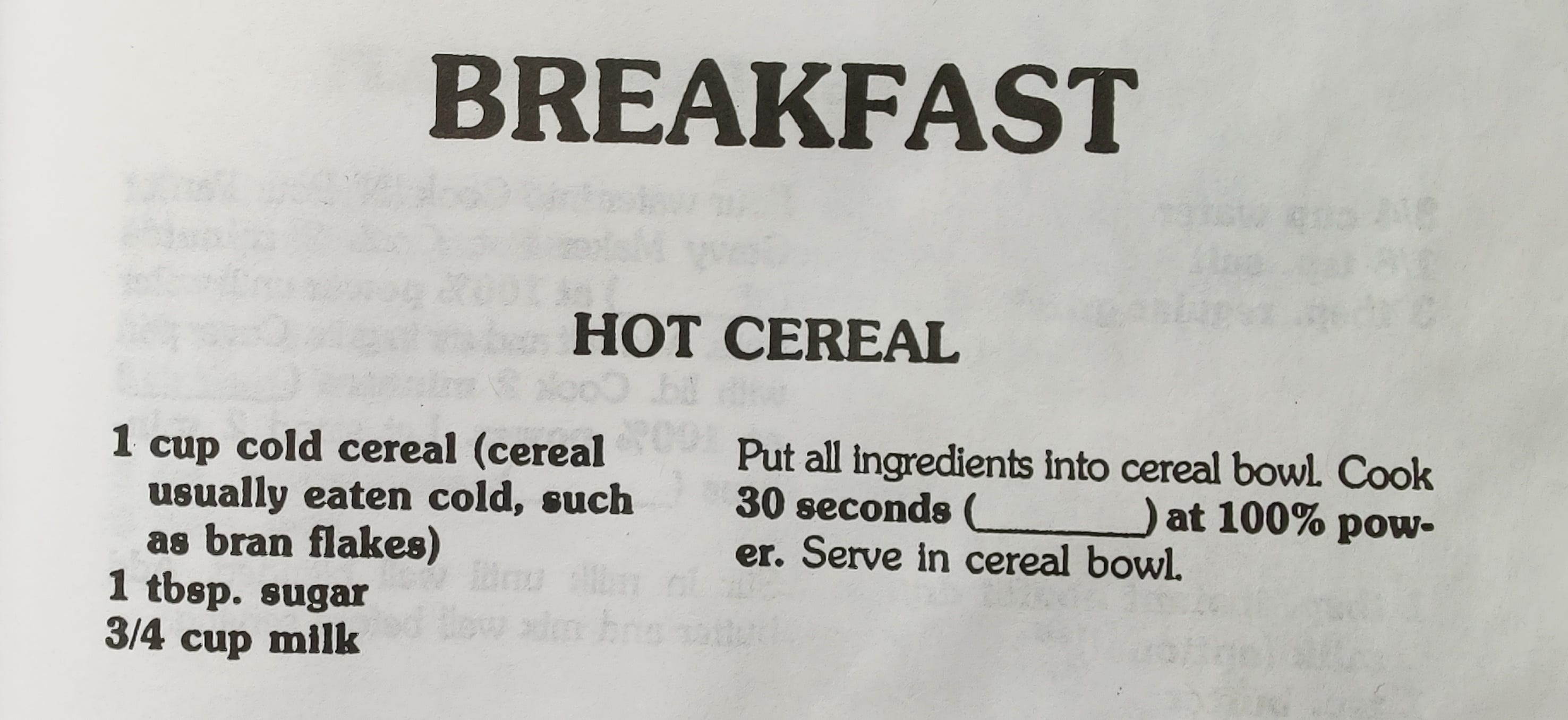
Whenever a cooking time is specified, Smith includes “(____)” as a placeholder, so you can write in your own value, optimized for your particular setup. If your hot cereal is anything short of delicious, you are invited to do your own step of gradient descent.
A lot of recipes in the book involve stacking various objects under, above, and around the food. For vegetables, Smith generally recommends slicing them thinly, putting them between a cardboard plate and towel paper, then microwaving the ensemble. This works great. I tried it with onion and carrots, and it does make nice crispy vegetables, similar to what you get when you steam the vegetables in a rice cooker (also a great technique). I’d still say the rice cooker gives better results, but for situations where you absolutely need your carrots done in under two minutes, the microwave method is hard to beat.
But cardboard contraptions, on their own, can only take us this far. They do little to overcome the true frontier for microwave-only cooking: the Maillard Reaction.Around 150°C, amino acids and sugars combine to form dark-colored tasty compounds, also known as browning. For a good browning, you must rapidly reach temperatures well above the boiling point of water. This is particularly difficult to do in a microwave – which is why people tend to use the microwave specifically for things that don’t require the Maillard reaction.
But this is because people are weak. True radicals, like Marie T. Smith and myself, are able to obtain a perfectly fine Maillard reaction in their microwave ovens. All you need is the right cookware. Are you ready to use the full extent of microwave capabilities?
Tradwife futurism
In 1938, chemists from DuPont were trying to create a revolutionary refrigerant, when they accidentally synthesized a new compound they called teflon. It took until the early 1950s for the wife of a random engineer to suggest that teflon could be used to coat frying pans, and it worked. This led to the development of the teflon-coated frying pan.
In parallel, in 1953, chemists from Corning were trying to create photosensitive glass that could be etched using UV light, when they accidentally synthesized a new compound they called pyroceram. Pyroceram is almost unbreakable, extremely resistant to heat shocks, and remarkably non-sticky. Most importantly, the bottom can be coated with tin oxide, which enables it to absorb microwave radiation and become arbitrarily hot. This led to the development of the microwave browning skillet.
In the stove-top timeline where we live, the teflon-coated pan has become ubiquitous. But in the alternate microwave timeline, nobody has heard of teflon pans, and everybody owns a pyroceram browning skillet instead.
I know most of you are meta-contrarian edgelords, but nothing today will smash your Overton window harder than the 1986 cooking TV show Good Days, where Marie T. Smith is seen microwaving a complete cheeseburger on live TV using such a skillet.
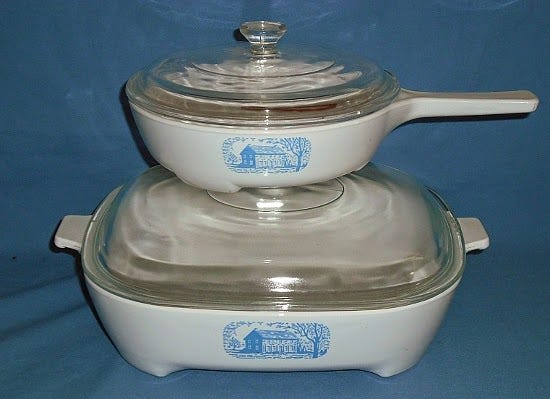
I acquired mine second-hand from eBay and it quickly became one of my favorite objects. I could only describe its aesthetics as tradwife futurism. The overall design and cute colonial house drawings give it clear 1980s grandma vibes, but the three standoffs and metal-coated bottom give it a strange futuristic quality. It truly feels like an object from another timeline.
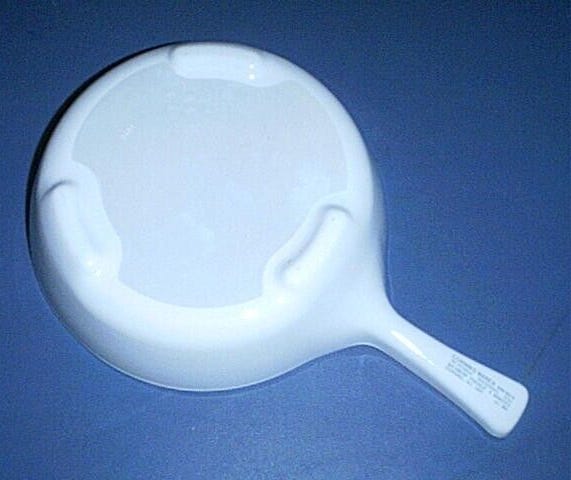
The key trick is to put the empty skillet alone in the microwave and let it accumulate as much heat as you desire[1] before adding the food. Then, supposedly, you can get any degree of searing you like by following the right sequence of bleeps and bloops.
According to Marie Smith, this is superior to traditional stove-top cooking in many ways – it’s faster, consumes less energy, and requires less effort to clean the dishes. Let’s try a few basic recipes to see how well it works.
You’ll microwave steak and pasta, and you’ll be happy
Let’s start with something maximally outrageous: the microwaved steak with onions. I’d typically use olive oil, but the first step in Smith’s recipe is to rub the steak in butter, making this recipe a heresy for at least three groups of people.
The onions are cooked with the veggie cooking method again, and the steak is done with a masterful use of the browning skillet.
I split the meat in two halves, so I could directly compare the orthodox and heretical methods.[2] The results were very promising. It takes a little bit of practice to get things exactly right, but not much more than the traditional method. The Pyroceram pan was about as easy to clean as the Teflon one. I didn’t measure the energy cost, but the microwave would probably win on that front. So far, the alternate timeline holds up quite well.
As a second eval, I tried sunny-side up eggs. On the face of it, it’s the simplest possible recipe, but it’s surprisingly hard to master. The problem is that different parts of the egg have different optimal cooking temperatures. Adam Ragusea has a video showcasing half a dozen techniques, none of which feature a microwave.
What does Marie Smith have to say about this? She employs a multi-step method. Like with the steak, we start by preheating the browning skillet. Then, we quickly coat it with butter, which should instantly start to boil. This is when we add the egg, sprinkle it lightly with water, and put it back in the oven for 45 (___) seconds. (Why the water sprinkling? Smith doesn’t explain. Maybe it’s meant to ensure the egg receives heat from all directions?)
Here again, I was pleased with the result – I’d go as far as saying it works better than the pan. With that success, I went on to try the next step of difficulty: poached eggs.
Poached eggs are my secret internal benchmark. Never in my life have I managed to make proper poached eggs, despite trying every weird trick and lifehack I came across. Will MCfO break my streak of bad luck?
Like for veggies, the egg is poached in the middle of an assemblage of multiple imbricated containers filled with specific amounts of water and pre-heated in a multi-step procedure. We are also told that the egg yolk must be punctured with a fork before cooking. (What happens if you don’t? The book doesn’t say, and I would rather not know.)
The recipe calls for 1 minute and 10 seconds of cooking at full power. Around the 1 minute and 5 seconds mark, my egg violently exploded, sending the various vessels to bounce around the walls of the oven. And listen, as I said, I came to this book with an open mind, but I expect a cookbook to give you at least enough information to avoid a literal explosion. So I wrote “LESS” in the “(____)” and never tried this recipe again.
The rest of the book is mostly made of variations of these basic methods. Some recipes sound like they would plausibly work, but were not interesting enough for me to try (for example, the pasta recipes primarily involve boiling water in the microwave and cooking pasta in it).
All in all, I think I believe most of the claims Smith makes about the microwave. Would it be possible to survive in a bunker with just a laptop, a microwave and a Cook’n’Pour SaucePan®? I think so. It probably saves energy, it definitely saves time washing the dishes, and getting a perfect browning is entirely within reach. There were failures, and many recipes would require a few rounds of practice before getting everything right, but the same is true for stove-top cooking.
On the other hand, there’s a reason the book is called Microwave Cooking for One and not Microwave Cooking for a Large, Loving Family. It’s not just because it is targeted at lonely losers. It’s because microwave cooking becomes exponentially more complicated as you increase the number of guests. I am not saying that the microwave technology in itself cannot be scaled up – if you really want to, it can:
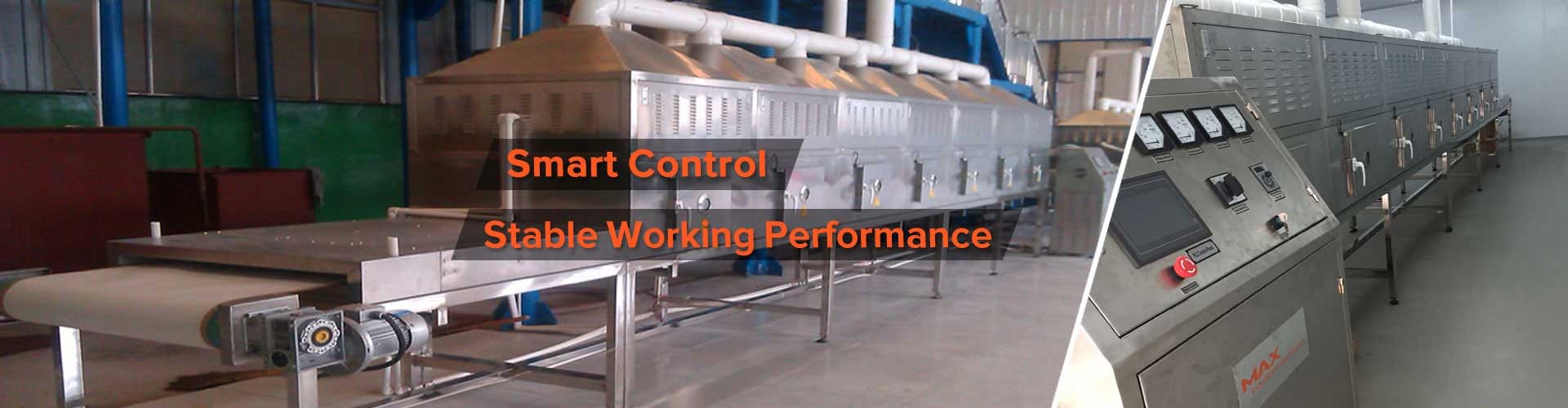
you are not a true pro-natalist
But these industrial giant microwaves are processing a steady stream of regular, standard-sized pieces of food. Homecooking is different. Each potato comes in a different size and shape. So, while baking one potato according to MCfO’s guidance is easy and works wonderfully, things quickly get out of hand when you try baking multiple potatoes at the same time. Here is the sad truth: baking potatoes in the microwave is an NP-hard problem. For a general-purpose home-cooking technology, that’s a serious setback.
The weird thing is, the microwave maximalists of the 1980s got the sociology mostly right. People are preparing meals for themselves for longer and longer stretches of their lives. Women are indeed spending less time in the kitchen. The future where people cook For One – the one that was supposed to make the microwave timeline inevitable, arrived exactly as planned. And yet, the microwave stayed a lowly reheating device. Something else must be going on. Maybe the real forking path happened at the level of vibes?
Microvibes
To start with the obvious, the microwave has always been spooky, scary tech. Microwave heating was discovered by accident in 1945 by an engineer while he was developing new radar technologies for the US military. These are the worst possible circumstances to discover some new cooking tech – microwave manufacturers had to persuade normal civilians, who just watched Hiroshima on live TV, to irradiate their food with invisible electromagnetic waves coming from an object called “the magnetron”. Add that to the generally weird and counterintuitive behavior of food in the microwave, and it’s not surprising that people treated the device with suspicion.
Second, microwave cooking fell victim to the same curse that threatens every new easy-to-use technology: it became low-status tech. In Inadequate Equilibria, Eliezer makes a similar point about velcro: the earliest adopters of velcro were toddlers and the elderly – the people who had the most trouble tying their shoes. So Velcro became unforgivably unfashionable. I think a similar process happened with microwaves. While microwave ovens can cook pretty much any meal to any degree of sophistication, the place where they truly excel is reheating shitty canned meals, and soon the two became inseparable in the collective mind, preventing microwaves from reaching their full potential for more elaborate cuisine.
Third, compared to frying things in a pan, microwave cooking is just fundamentally less fun. I actually enjoy seeing my food transform into something visibly delicious before my eyes. But microwave cooking, even when done perfectly right, gives you none of that. You can still hear the noises, but not knowing what produced them makes them significantly more ominous. Some advanced recipes in MCoF call for 8 minutes at full power, and 8 minutes feel like a lot of time when you are helplessly listening to the monstrous anger of the oil, the stuttering onions’ rapid rattle, and the shrill, demented choirs of wailing pork ribs.
With all that said, I do think Microwave Cooking for One is an admirable cookbook. The recipes are probably not the finest cuisine, but they’ll expand your cooking possibilities more than any other recipe book.[3] What I find uniquely cool about Marie T. Smith is that she started with no credentials or qualifications: she was a random housewife who simply fell in love with a new piece of technology, spent a decade pushing it to its limits, and published her findings as a cookbook. Just a woman and a magnetron. You can just explore your own branch of the tech tree!
Let’s not oversell it – if your reference class is “tech visionaries”, maybe that’s taking it a bit too far. If your reference class is “Middle-aged Americans from the eighties who claim they can expand your horizons using waves”, then Marie T. Smith is easily top percentile.
- ^
To illustrate the fact that things can get really hot in a microwave oven, here is a tutorial for smelting metals in the microwave. You just need a graphite crucible and very tolerant roommates.
- ^
For maximum scientific rigor, I should have done a blind comparison, but I didn’t – in part because I’m lazy, in part because asking someone else to do the blinding feels like breaking the rules. It’s microwave cooking For One. I must face it alone. It is my journey.
- ^
My main complaint with Microwave Cooking for One is that it doesn’t have an entry for “birthday cake”. Come on Marie, you had one job.
This feels like a throwback to the LW of yore in an excellent way. Bravo.
Update, I have purchased a microwave grill pan and consumed a grilled cheese. It works well. I’m looking forward to running experiments.
On reflection, I am somewhat sad that people find Smith’s book worthy of mockery. It feels a bit like a microcosm of the mockery of rationality in general. Sincere person runs lots of experiments with new tech to see what’s possible. Tries to render this available to others. Lol what a low status dumbass. :(
This point hits even harder watching the linked video of her demonstrating her recipe. She’s earnest, she’s done an absurd amount of hard work, scientific-method-style research, and compiled her findings for people she’s trying to help more easily feed themselves.
I get the cheap shot from the title, because on first blush… it’s objectively a “saddest timeline” cookbook, if you will. But the actual contents (and the point of this post) are interesting and well thought out. Just bought a copy myself, and only half jokingly for my wife!
I kept expecting the article to pivot into how this illustrated some fascinating principal of how to reduce catastrophic risk. Was very pleased to be wrong. What a wonderful post.
One of the most fun LW posts I’ve read in a while, thanks a lot for writing it!
My general philosophy on cooking is “if it can’t be cooked it in the microwave, then I ain’t cooking it”, so this post is right up my alley!
I’m guessing you never tried to cook eggs in a microwave before. The exploding egg problem is relatively well known. The typical solution is to puncture the egg to release the steam that builds up between the white and the yolk, since that’s what causes the explosion. They even sell special dishes for making poached eggs in the microwave.
Also, pasta is incredibly easy to cook in the microwave. Again, they sell a special dish for it, which is basically just a long plastic rectangle so you can cook long noodles. Shorter noodles are also allowed. The main challenge is keeping the thing from boiling over, which can be achieved with a combination of salted water, oil, and not trying to cook too much at once. Pasta will cook in water that’s not at a roiling boil, though it takes longer, but the end result is about the same.
Rice, potatoes, carrots, and lots of other things are also quite easy to cook in the microwave. Even fish is pretty easy to cook in one, although I don’t recommend it because it makes a lot of fish smell (unless you like that).
At one point in Italy at the height of the methane price peak due to the Ukraine war there was a physics professor who went on TV saying you can cook pasta very well by turning the gas off once the water boils and just letting the pasta sit there for a few minutes with the lid on, the water doesn’t lose heat. Which is 100% true! He was still kinda made fun of because it sounded to some like he was telling people to suck it up and get used to the new prices.
I’ll just leave this here:
If We Insulate Our Houses, Why Not Our Cooking Pots? | LOW←TECH MAGAZINE
What an incredible website
I completely agree with the title of the linked article. I consider an old blanket-sized towel to be an essential kitchen item. So many things can just be brought to boiling, then left on the still hot stove but with heat turned off, and covered with (a lid and) a blanket and they either become ready within 20 minutes, or in the worst cases need one more round of the same process (e.g. beans in a pressure cooker). I’ve also read somewhere that you can save up to 40% of the used energy just by using lids while cooking, and while I’m not certain about the exact number, the ratio is definitely right.
Another underused energy saving item are heavy curtains and shutters. Windows are the weakest point in the insulation of buildings and covering them at night does help a fair bit.
Curated. I have recently significantly increased my probability that I will be living alone for the foreseeable future, and so I found this post personally timely and inspiring. I would love to see more explorations of abandoned tech timelines in future posts. I appreciate that without this post, the internet may have only ever seen Marie T. Smith as the lady on the cover of the saddest cooking book ever. It is right and good that there should also be some public treatment of her heroic and groundbreaking experiments in the culinary arts.
The idea of coating the bottom of the pan with tin oxide reminds me of attaching iron to the bottom of a pan to make it work with induction stoves. Microwaves are more flexible in that you could put the tin oxide in an arbitrary shape, such as a wok, while induction requires the ferrous component to be close to the “burner,” but induction stoves seem like a pretty good compromise, covering the advantages you mention.
Does Smith talk about any device with a complicated distribution of receivers? I recently encountered a sandwich press that goes in the microwave. This could be unfolded to lie flat, but I think it was intended to be microwaved folded, heating both sides of the sandwich. What else exists? When I search “microwave accessories” I just find things that don’t absorb microwaves. Is there some other search term? Related products on amazon leads to what seem to be modern microwave skillets, largely flat.
Microwaves deserve more love! A few more notes on the subject:
David Chang and Priya Krishna’s 2021 cookbook, Cooking at Home, has an entire section on microwave cooking, and it is very good.
Everyone should know how to fiddle with the power settings on their microwave. It is actually very easy to microwave soup (and other goopy things, like lentils) without it exploding. To do so, microwave it at 40-50% power for 5-6 minutes.
I like steaming vegetables in the microwave if I’m then mixing them into other foods like pasta or butter chicken. To steam vegetables, put them in a covered bowl with 2-3 tablespoons of water at the bottom, and microwave on high heat for 5-8 minutes depending on the size of the vegetable. Let it rest a few minutes to cool down. Be careful when removing the cover, as the steam that escapes will be very hot.
I have never managed to poach an egg outside of the microwave but I have poached hundreds using one. When you do so with a new-to-you microwave, you explode two to three eggs as sacrifice to figure out what to dial in, and then you can enjoy perfectly poached eggs going forward. Best of all the only mess you make is a mug that you put in the dishwasher.
With my current microwave the setup is:
1. fill a mug (ideally one with a narrower, curved bottom) halfway with water and microwave it on high for 2 minutes.
2. take egg from fridge and crack it into the hot water. swirl it around a bit to avoid it sticking to the bottom.
3. microwave at 5 power for 55 seconds.
4. let it cool/continue cooking in the mug for 2 minutes.
There is some interesting relatively recent development in the microwave cooking technology. Here is some read.
Using multiple transistors and a phased array antenna with food sensing allows for very even, precisely controlled heating. After about 10 years of development, this technology is still not competitive, so for now it represents one of those dead tree branches. Well, it is still technically alive and has a chance to revolutionize cooking yet again.
I laughed so hard through most of this, good writing!
I did order a microwave browning dish based on this post and look forward to experimenting. Missed opportunity for an affiliate link or Kickstarter, because I’d totally have given the money to you.
Microwave cooking is a little odd, the non-thermal effects are not super well understood, but could be significant: https://pmc.ncbi.nlm.nih.gov/articles/PMC9607893/ Using a browning dish means you get all the known issues with cooking with fire, plus all the non thermal microwave effects.
For poached eggs, the method I like the most is the sous vide stick and eggs in shell. Not perfect, but a good enough effort/quality tradeoff for me.
The browning dish seems to work as advertised, but it has not become a regular appliance. Some people in the thread mention the air fryer. I found a countertop combisteam (with the air fry option of course, the brand is FOTILE) can do everything I want better.
I am sad to admit that I have yet to make a better chicken than the one I get by sticking a whole chicken into the combisteam and using the ‘chicken’ setting.
Velcro has clear downsides, it can’t handle dirt on what is usually the dirtiest place on your body, and nobody wants loose shoes.
Microwave requires people to follow the programs to a T or know enough about the tools and the foods they eat and the portions in order to avoid over/under heating (in other words it requires too much precision). Many people cook by taste and MW doesn’t allow you to do that. The utensils for MW is likely the last of your problems, you can use ceramic, clay, pyroglass all quite common. In the past you didn’t have pre set programs, and frankly even today they aren’t that useful. The safety standards for microwave are higher than ovens, and anyway many still come with radiating plates just like normal ovens if you want to make the surface crispy. A large microwave oven is impractical considering you need specialized cookware of the right size to cactch the waves. MW doesn’t allow you to dry foods as easy as a common oven, the box usually gets stuffed with vapor, or smoke. The tech is just not competitive enough vs radiating ovens, not by price, not by features, not by ease of use. The reason they are only good at reheating 1 portion foods is because that’s their all around niche. 2T motors are still the standard when it comes to 25/50c instead of 4T.
Air friers seem to have a brighter and crispier future.
Source for the “meme from LinkedIn”: https://x.com/waitbutwhy/status/1367871165319049221
Yeah I didn’t know it was from there. I feel embarrassed now.
Sorry, it wasn’t my intention to make you feel bad.
I’m noticing that, on the original on X, there are very few branches on the left part of the coloured line.
You can make a reasonable approximation of cake in a microwave by mixing self raising flour, sugar, a bit of milk, maybe a dribble of vegetable oil, and maybe an egg into a paste. For smaller quantities, just use a coffee mug. For larger amounts, a borosilicate casserole dish works fine. If in doubt, keep opening the microwave and poking it with a spoon every minute or so until cooked.
For reasons relating to the large amounts of energy needed to boil water, compared to the energy needed to heat water to boiling point, also perhaps the tendency of microwaves to not be absorbed so much by more dried out regions of the cake, this recipe is fairly resilient to variations in cooking time and quantity.
This can be made using 1 mug and a couple of teaspoons in a few minutes.
The “mug cake!” Yes, I remember making these when I was on keto. They are good.
I would venture that the problem is not the microwave, it’s that this is not a natural set of methods for humans. I expect my hypothetical circa 2045 household robots to handle a lot of cooking in ways that maximize efficiency beyond what this human would want to bother with.
The problem with the idea of cooking in a microwave for one person isn’t the word “microwave,” but the idea of ”for one person.” I live alone, and cooking is generally a pretty bad idea anyway. It’s a little cheaper, but the balance is generally in favor of prepared meals or cafes. In the USSR, there were even plans for apartments without kitchens. This concept largely failed due to the catastrophically low quality of public catering in the USSR. If you have a family, you need a full kitchen. If you live alone for a decade, ideally you’d have good cafeterias near your home that are frequented by more than just poor workers. In fact, this has been resolved by the availability of decent prepared meals in supermarkets. Overall, if the cheapest accommodations weren’t hostels or dormitories with a shared full kitchen, but rather micro-apartments with only a microwave, cooking in them would make sense, as it would save even more compared to cafeterias.
It feels like you might be over-thinking the NP-hardness of the baked potato problem here. We regularly cook 4-6 baked potatoes in our microwave, skin-on. Jab a fork in them a few times before placing them in the oven and setting it to roughly 20 minutes. If your microwave is a bit fancier, you press the “baked potato” button and it measures the off-gassing accumulation of steam as the potatoes cook and adjusts the cook time automatically. This method works shockingly well for totally cromulent baked potatoes.
Similarly, the microwave is absolutely our secret hack for corn on the cob: dampened paper towel laid over a bunch of ears of corn, shucked, or… just unshucked corn tossed in there. It just works. It works well. It works at scale. And it works WAY faster than boiling a giant pot of water and water-logging your corn.
Marie Smith was ahead of her time, but I just bought a copy of her book because of this post, and had similarly never heard of a microwave browning skillet before. Fascinating!
Separately, while you mention you don’t know why the water is called for in the eggs, she actually explains it in that linked Good Day! video “it keeps the egg from exploding or breaking or causing a problem”:
Excellent post, thank you! You have given me permission to do weird things with my microwave and you have to accept that this is the timeline in which you now inhabit.
It kind of reads like the author hasn’t actually tried living on microwave-only cooking, just visited it as a charming art installation.
I’m skeptical a 1900–present alternate timeline converges on “mostly microwave” for very mundane reasons. Microwave cooking punishes vibes-based seasoning; in normal cooking you can course-correct using browning, smell, sizzling sounds, or by poking the food. In a microwave, the feedback loop is basically “looks damp” → “still damp” → “suddenly lava.”
You’re also required to think about rotational symmetry before dinner. The “many potato problem” is not a thing in pan-world. And rearranging food mid-cook involves oven mitts, steam burns, and a small ritual with the double-glass-bowl setup (you want a reservoir of water to not touch the food).
What recipe would you recommend for someone who doesn’t have a microwave browning skillet? I’d like to try it, but I don’t want to purchase a skillet until I’ve tasted the potential myself.
The thing where you put carrots in a cardboard plate doesn’t require a skillet
Years ago, I learned/discovered that you can just kinda bake various veggies in a microwave: potatoes, sweet potatoes, carrots, parsley, pumpkin, even onion and garlic (beetroot is doable but more problematic because it requires more time, and/or needs to be chopped more finely).[1]
Prepared in this way, they taste (to me) mostly ceteris paribus better than boiled in water, or steamed, and almost on par with baking.[2]
Whenever I mentioned to someone that “hey, btw, you can just do potatoes or carrots in a microwave”, they rolled in disbelief. For some reason (oops?), it never occured to me to look around on the internet whether this is or was popular in any corners of the world. Reading this post was thus quite satisfying to me.
I don’t remember what made me try it. Plausibly, the same sort of curiosity that made me blend bananas with black beans or add spinach to my oatmeal (surprisingly good!).
Although at the times when I ate a lot of this stuff, I would at some point get bored and want differently prepared vegetables.
I absolutely need to say this first: the reason I started reading this post was because I thought it had something to do with Steins;Gate. Can I really be blamed when the words “microwave” and “alternate reality” are in the same title? But I’m not disappointed, honestly.
The velcro comparison is the thing I keep turning over. Because you’re right that the early-adopter effect killed the microwave’s status, but I think there’s something even more brutal going on underneath it: the technology actually requires a Marie T. Smith to work. Like, it needs a true believer who spent a decade calibrating timing slots per individual potato to get good results. The gas stove is almost infinitely forgiving by comparison. You can throw an oddly shaped piece of chicken at it while half-watching television and get something edible. The microwave, at least the version in this book, demands you weigh things in ounces and preheat empty skillets and basically treat dinner like a chemistry practical. That’s a lot to ask of something marketed as a convenience device.
So maybe the microwave didn’t lose on vibes so much as it lost because the person who figured out how to make it actually work couldn’t figure out how to make it work for the average, lazy human.
Also the poached egg explosion is clearly the best part of this post. Writing “LESS” in the blank and moving on is the only correct response and I respect it deeply.
I’m not convinced. The things we do without thinking about it to get good results from conventional cooking (preheating ovens, boiling water before adding pasta, ensuring nothing burns to the bottom of your pot, planning how steam will interact with the food as it cooks) just seem so normal to us we don’t notice.
Fair point, and I’ll give you that conventional cooking has more hidden complexity than it looks. But I think the type of precision matters more than the amount.
A stove keeps you in the loop the whole time. You hover, you adjust, you smell something going wrong and you act. My friend has this line about how there’s a difference between making things happen and things happening to you, and honestly that’s the whole stove vs microwave debate right there. With a microwave you’re basically delegating to a sealed box and finding out the results afterward. By the time you have feedback, you’re already past fixing it.
Thirty extra seconds and your poached egg is shrapnel. That’s not a complexity you can feel your way through. It’s a complexity you just lose to.
I do think you’re right about being more in the loop with some conventional methods (ex: frying pan on the stove) but much less so with others (primarily the oven, but also pressure cookers, or anything where lifting the lid will let out steam and ruin it).
This seems false – I think it’s normal for modern people to use microwaves for things like oatmeal, refrigerated leftovers, potato flakes, melting chocolate and butter, and heating water for tea. I personally grew up using the microwave for quesadillas and apple slices as well.
Addendum: Without any special tools, the microwave is also great for roasting nuts.
Pretty good for tempering chocolate too, provided you have a decent thermometer handy.
I currently live somewhere with just a microwave and hotplate, so this is intriguing to me. One question—when Marie says “100% power” in a cookbook from 1985, do you need to tone it down somewhat for modern microwaves?
In the TV show appearance linked in the post, she specifically recommends buying a 700 watt model.
In my experience, I always had to cut down the cooking time by 3⁄4, otherwise things were overcooked.
This was a super fun read! Especially with the recommended soundtrack.
I recently found some vegan pork buns that are ready after 4 minutes in the microwave. They come in microwave safe plastic, that kinda looks like a cup holder from a fast food place. You fill the bottom with a little bit of water before putting them in.
On the day my partners and I discovered them, we ate both packets in one sitting, then went back to the store and bought another 5 packets, and ate another 3 that day. Microwaves are incredible! People need to know this!
New here, and I’m just getting used to the platform. This post was the first post I ever read fully in my 30-ish minutes on here and… wow I can already tell I’m going to spend a lot of time here. Microwave Cooking for One is definitely a survival book I’d need if we ever need to start living in underground bunkers for… some reason. Bravo. This is good.
Ooh, I’m another person that loves cooking with the microwave! And if you’re really tryhard I can additionally suggest that you get yourself a “dumb” microwave with only knobs as well as a smart plug—you can then create scripts (I use HomeAssistant) where once you tune in the specific timing you can power cycle the microwave to emulate running it on arbitrary effect. Example:
My recipe for bulgur & lentil [stew]:
1. In a large bowl with a lid: Add 1dl of bulgur, .5dl red or beluga lentils, twice the amount of water, some salt and other spices to taste.
2. Put the effect and timer to max
3. invoke the script (voice, or a smart button, etc), which then does:
1. Turn on power to the microwave for 8.7 minutes
2. loop 28 times:
1. Turn off power for 23 seconds
2. Turn on power for 7 seconds
3. Sends a notification to my phone and flashes my ceiling lights to notify me that it’s done.
I then add frozen veggies, tomato sauce & oat cream and microwave it manually for a few more minutes, to have a perfectly adequate bowl of food with barely a minute of active effort.
It took a fair amount of experimentation to settle on the timing of everything, and temperature management is critical to avoid boiling over yet run at a high enough temperature that you minimize cooking time. I can only imagine the power if the market had good smart microwaves where I could hook into steam sensors...
The process of their starting to wiggle around is already heat. Friction of molecules rubbing against each other is not required. That they are not all wiggling in near-perfect synchrony is enough. That could maybe be considered kind of friction-like, but A) that’s not what we normally think about when we say ‘friction’, so it’s misleading to use it for that, and B) it doesn’t happen after the wiggling around or in response to it; it’s just the way the material reacts to that kind of radiation.
Now, if it were long-wave radio, that would be a lot more like what you describe—you’d get electrical currents, and those would produce heat by friction. But just making water molecules reorient is a direct heat-generating activity.
Great article, very interesting to read. I cook a lot in the microwave. For potatoes, I peel about 3-4 potatoes, cut them into four long slices of equal size, and place them in a jar with a capacity of about 500 ml. Then I add about 50 ml of salt water, close the jar, and shake it well so that all the potatoes are well coated. I open the jar and leave the lid loosely on top (lid can be metal, as long as it has no sharp corners, Don’t close the jar!). Then I put it in the microwave for about 5-6 minutes.
The air frier is the eventual heir to the vision. It’s oven physics with microwave form factor.
I don’t think we can talk about microwaves without mentioning the Sharp Carousel Multiple Choice. According to Technology Connections, the unit uses a steam sensor to detect food doneness, and adjusts the wattage accordingly. This dramatically reduces the amount of guesswork needed when (re)heating many dishes.
I wonder what MCFO would look like with something like this in mind. I imagine you could remove a lot of the supervision MCFO asks for, so it goes from waiting for 8 minutes to see if you need it longer, to just putting it in and coming to when the bell rings.
Fantastic article! Pairs well with this great video about another relic of that lost timeline:
https://youtu.be/UiS27feX8o0?si=djwS628fEiA3FEnJ
It really feels like there should be more ways to get value out of a microwave. I might try the veggies trick honestly, it sounds like it could be really convenient. Do they come out as if they were steamed?
really enjoyed the read. certainly gives me a nudge to experimenting more with my microwave and not just for decarboxylating NBoc-DMT. recently got a plastic steamer for veggies—essentially just a tupperware with some vent ontop and an inner basket—and i really like the speed you can steam with it, even beats my beloved instant pot. but the scale-up issue is real.
Thank you for this delightfully surprising and interesting post!
When I reheat leftovers- especially dense foods like lasagna that have fatty (cheesy) outer layers, I find that 30% power-level works best to heat food to the center without burning/dehydrating the bits on the surface. Otherwise, heating at full power without ruining part of the food leaves the middle cold, leading to a fractured eating session that could be avoided with the extra step and a bit more patience with an extended timer.
This is the most informative and most amusing thing I have seen all week. Well done.
The water sprinkling is for uniform heat. I do this in a traditional pan + lid for eggs
I initially thought of an idea, where prepackaged microwave meals had an RFID chip in them, and smart microwaves could read the chip to get precision cooking instructions, and execute on them. But that sounds like it’d be hard to coordinate across manufacturers.
But then I thought, now that intelligence is cheap, we could just have an AI do it? Put a camera and other sensors in the microwave, and then a small embedded AI trained to modulate the microwave just so based on cooking cues, or even an IoT connection to a frontier model, making calls to an API every second or so to adjust the cooking.
And it turns out, people are working on putting AI in microwaves and monitoring and adjusting the EM field precisely! So, perhaps the microwave future will be here, eventually, but powered by AI.
I had this book, this was a wonderful read, thank you. My mother had a copy when it was new and I read it, liked it, cooked a few meals from it and then forgot about it. In 2010 I inherited a copy the book from my mother-in-law and found it fascinating again. I learned a few cooking techniques from it, but not nearly as many as mentioned here.
My wife thought it was pure rubbish—probably because it belonged to her mother—and tossed it. A loss I still regret. You really can do more with a microwave oven than just reheating meals and making popcorn.
Reading this makes me want to find another copy—and not show it to my wife.
In New Zealand, many meat patties are cooked only on the outside, and one of the recommended methods of cooking is a microwave—I never saw that in the US.
I need instructions for finding a microwave browning skillet in a non English speaking county, where Corningware might not have existed.