The Mirror Test Is Complicated
The Mirror Test is kind of like Hitler. In any discussion of animal cognition, somebody is going to bring it up. The conversation usually goes like this:
A: So, most animals can’t recognize themselves in the mirror
B: Which animals specifically?
A: Oh, dogs, cats, betta fish, monkeys, that sort of thing. Anyway as I was saying, those animals can’t. But some smart animals can recognize themselves in the mirror.
B: Such as?
A: Well, chimpanzees and orangutans for a start.
B: Makes sense
A: Not gorillas though, at least not always. But dolphins and elephants can!
B: Yeah, those animals are smart as well
A: Magpies can, though crows cant.
B: Sure, ok
A: And cleaner wrasse can as well.
B: The uhh, finger-sized fish? You sure?
A: Yeah. And also ants.
B: What.
What?
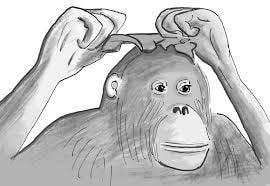
Frans de Waal drew this picture of an orangutan putting lettuce on her head and then actually got it published in a real journal. Based.
What do we actually mean by the “Mirror Test”
“The mirror test” elides a bit of a distinction between different kinds of test. There’s lots of things you can do which look like “put an animal in front of a mirror and see what happens” and they give slightly different answers.
Sometimes, an animal will just treat its reflection as a same-sex conspecific (i.e. a member of its own species and sex) which usually means trying to fight the reflection. This typically goes poorly, but is slightly funny to watch. This is generally considered a failure.
Other times, an animal will behave differently in front of its own reflection, compared to how it would behave with a same-sex conspecific. Monkeys typically behave a bit weirdly. But are they recognizing how a reflection works, or just wondering why they’re being copied?
The gold standard is the mark test. Put a white mark on an elephant’s face, without it knowing. Then put it in front of a mirror. The elephant will clean the mark off its face (and won’t do this if you just pretend to mark them). This is considered pretty damn strong evidence that the animal “gets” a mirror.
This works for magpies as well (which groom themselves with their feet) and orangutans, which have hands. You may see a problem with it already…
The Complicated Ones
The mark test specifically requires animals to actively groom themselves. Some animals just don’t care. Pigs, for example, are very smart and can use mirrors as a kind of tool, but since they don’t care about having a mark on their faces (nor could they really do anything about it (no hands)) the mark test is basically inconclusive.
Bottlenose dolphins will look at the mark in the mirror, but again, they don’t have any way to groom themselves, so how would we know if they really got what was going on.
Then there’s some interesting cases: gorillas can kinda figure out what’s going on but they’re also super aggressive. Monkeys will use a mirror to groom an area they’re already investigating, but won’t groom a mark they didn’t know was there.
The Unbelievable Ones
In that I struggle to believe them.
Cleaner wrasse are finger-sized fish which feed on parasites found on larger fish. They have a kind of grooming-like behaviour, which consists of rubbing themselves against a rock in order to dislodge a parasite. They do this when marked and presented with a mirror. Huh.
Then it gets, well, unbelievable. Apparently they can, having seen their reflection once, remember their own appearance. They demonstrate this by showing the fish a photograph of itself with a mark on it, to which the fish responds by performing its grooming behaviour. Huh?
The authors also show that the fish don’t respond this way to altered photos of other fish, and manage to isolate the effect to the face of the image by creating composite head/body images with marks!
And some ants also passed the classic mirror test with flying colours: grooming themselves only when marked, and when placed in front of a mirror. They specifically groomed themselves when the mark was in a location that was visible in the mirror, and not when it was on their backs (the ants were walking around on top of the mirror). They only groomed the appropriate parts of their body, and only when the mark was a visible colour.
The most baffling thing of all, however, is the fact that when re-introduced to their original ant pals, the marked ants were often murdered!
Making Sense Of It All
What cognitive mechanisms allow an animal to pass the mirror test? Well, they have to:
Notice that their reflection behaves differently to other same-sex conspecifics
Map their own sensorimotor responses onto the reflection, and notice that it behaves like their own body
Have a model of the world which contains a map of their own body, and figure out that they’re looking at a map of their own body
Connect the mark on the image to the mark on their own body
Actually care enough to engage in grooming behaviour
This totally makes sense for chimpanzees. They have complex, flexible interactions with other chimps, so can easily notice that their reflection is behaving differently to a normal same-sex conspecific. They almost certainly have a mental map of their own body, and can map it to the mirrored reflection.
Some people, like Eliezer Yudkowsky, have used the mirror test as a proxy for self-awareness, but I’m not sure it’s slam-dunk. Self awareness is about modelling one’s own mind, whereas the mirror test only really requires an animal to have a model of its own body.
Let’s go back to the cleaner wrasse: I think it’s kind of interesting that the main test we use (will an animal clean itself) is being passed by an animal whose job it is to clean! This can’t be a coincidence! Their brains are highly specialised to recognise other fish’s bodies, and locate and remove remove parasites from them.
On the other hand, there’s an even crazier explanation. Cleaner wrasse are constantly in a game theoretic problem with their “client” fish, which are often large and predatory. The smaller wrasse could easily be eaten by the larger fish (if they caught them) yet the wrasse will often swim into their mouths to clean their teeth! Maybe the cleaner wrasse are using logical decision theory, which requires them to have an understanding of the location of their own cognitive algorithm in the world.
Ok, so the cleaner wrasse are probably not using logical decision theory, and neither are the ants. While cleaner wrasse do seem to have an intricate social structure, revolving around politics between individual bands, this isn’t quite the same as how chimpanzees work. Ants definitely don’t have complex social interactions: their social interactions are about as simple as it can possibly get.
Overall, I’d guess that the mirror test isn’t that good as a test of the kinds of self-awareness that (might) really matter for things like consciousness. You only need a map of your own body, not one of your own mind, in order to pass it.
Editor’s note: this post was written as part of Doublehaven (unaffiliated with Inkhaven)
◆◆◆◆◆|◆◆◆◆◆|◆◆◆◆◆
◆◆◆◆◆|◆◆◆◆◆|◆◆◆◆◇
You are telling me this unbelievable result with suspiciously high success rate with the ants hasn’t been reproduced in 10 years? This experiment shouldn’t even be this hard? If you are a bright high schooler or undergrad with a microscope, I am happy to pay you $100 if you end up reproducing this.
There’s further discussion here including the comment section. No one found a smoking gun, but one of the two authors was also lead author on this other paper that is obvious BS.
Okay, I’m considering doing this. One thing I definitely won’t do, however, is maintain an entire colony in the ‘lab’ instead of just doing some ant-napping. I assume that that’s fine?
Yes, that is fine! :)
Feel free to cut any other corners where you see fit. Posting video of the ants during the experiment (just with some phone-camera), seems valuable though.
It has been 2 months! Are there any results? I strongly support this initiative :)
I suspect XelaP will post them here in the comments if and when he does. Also let’s increase the bounty to 500USD.
Excellent post, but I roll to disbelieve that this is fully true about cats and dogs. I accept that the average cat and dog fail it. But our pets vary widely in intelligence. I used to dog sit, and there were definitely a few, maybe the top decile at most, that used mirrors as tools (for example, if I spoke to them while they were facing the mirror, they’d look at my reflection instead of me). I never tried the mark test with them.
ants readily become sapient at the slightest provocation, it spreads like a meme, and it’s disastrous for the colony.
(joking!)
HPMOR:
...at first. The problem was that Draco had also asserted that Parselmouths could send snakes on extended complex missions. And if that was true, then Parselmouths had to make snakes persistently intelligent by talking to them. In the worst-case scenario that would make the snake self-aware, like what Harry had accidentally done to the Sorting Hat.
And when Harry had offered that hypothesis, Draco had claimed that he could remember a story—Harry hoped to Cthulhu that this one story was just a fairy tale, it had that ring to it, but there was a story—about Salazar Slytherin sending a brave young viper on a mission to gather information from other snakes.
this was the inspiration, of course! though it seems the ants have found a different equilibrium...
Literally a plot point (with ants!) in the Wandering Inn
Haven’t read the original wrasse paper, but my understanding is that what made it a “pass” was that when presented with the mirror, the wrasses would clean their own bodies, rather than attempting to clean the wrasse in the mirror.
Overall, that finding pushed me in the direction this post argues; i.e. that it’s decent Bayes evidence in favor of self-awareness, but far from a slam-dunk.
An old facebook thread had Eliezer argue that being able to identify others with mirrors is cognitively easier than self identification—that it only requires a visual transform on the sensory input instead of correlating your volition with the sensory input to deduce that you are looking at yourself. You also don’t usually see yourself. I think this argument is fairly likely correct—and I strongly disagree with his belief that some sort of cognitive reflectivity is a part of what consciousness/experience/qualia really is.
This is also relevant for Anthony’s comment about dogs and cats.
Why do you find this baffling? A man comes to your tribes cave, and by the color of the skin on his face you know he is not the friend who disappeared yesterday. Your tribe has been raided by other tribes in the past. You cannot speak, because you are ants.
Why is it so surprising that they get murdered? Also notably they don’t get murdered if the mark is on like the back of their head.
In the past, one person has brought up the cleaner wrasse thing with me as a kind of proof that sentience must be widespread among even the least intelligent animals. That paper seems to do experiments like showing the fish a photograph of itself where it has a mark on it’s belly and then observe the fish “scraping” its belly (touching the sand of the aquarium) -- despite not having a mark on its body. This seems obviously different from the regular mirror test and it’s unclear if these fish even have such good visual abilities of non-moving objects. And they seem to believe in their paper this proves an even higher ability of self-recognition (so while chimps can only recognize themselves when they move the fish can just recognize their own body from a photograph, like a human could). “This is largely because explicit tests of the two potential mechanisms underlying MSR are still lacking: mental image of the self and kinesthetic visual matching. Here, we test the hypothesis that MSR ability in cleaner fish, Labroides dimidiatus, is associated with a mental image of the self, in particular the self-face, like in humans.”
I don’t even have to spell out how the priors look here, but this doesn’t even seem theoretically possible? How’d the fish know what it looks like? I mean the simplest explanation is that they just use a small sample size and the fish just randomly started doing that. It also doesn’t seem to me that the fish really spent some time studying it’s photograph, could just be a case of letting the camera roll for a while until the fish once swims by the photo and then touches the sand a few times:
I can see its reflection in the left wall of the tank, so maybe it can too. In that case, it could learn to recognise its reflection in the obvious way (this image moves exactly as I do) and then mistakenly identify the photograph as a reflection. Also, fish are bendy and have wide-spaced eyes, so it can probably see parts of its own body when it turns.