The standard recommendation on time out duration is one minute per year of age, often capping out at 5min. In my experience (n=3, not independent) this is much longer than needed; I typically do about a minute regardless of age. The important thing is that the punishment is predictable and immediate, not that it’s strong.
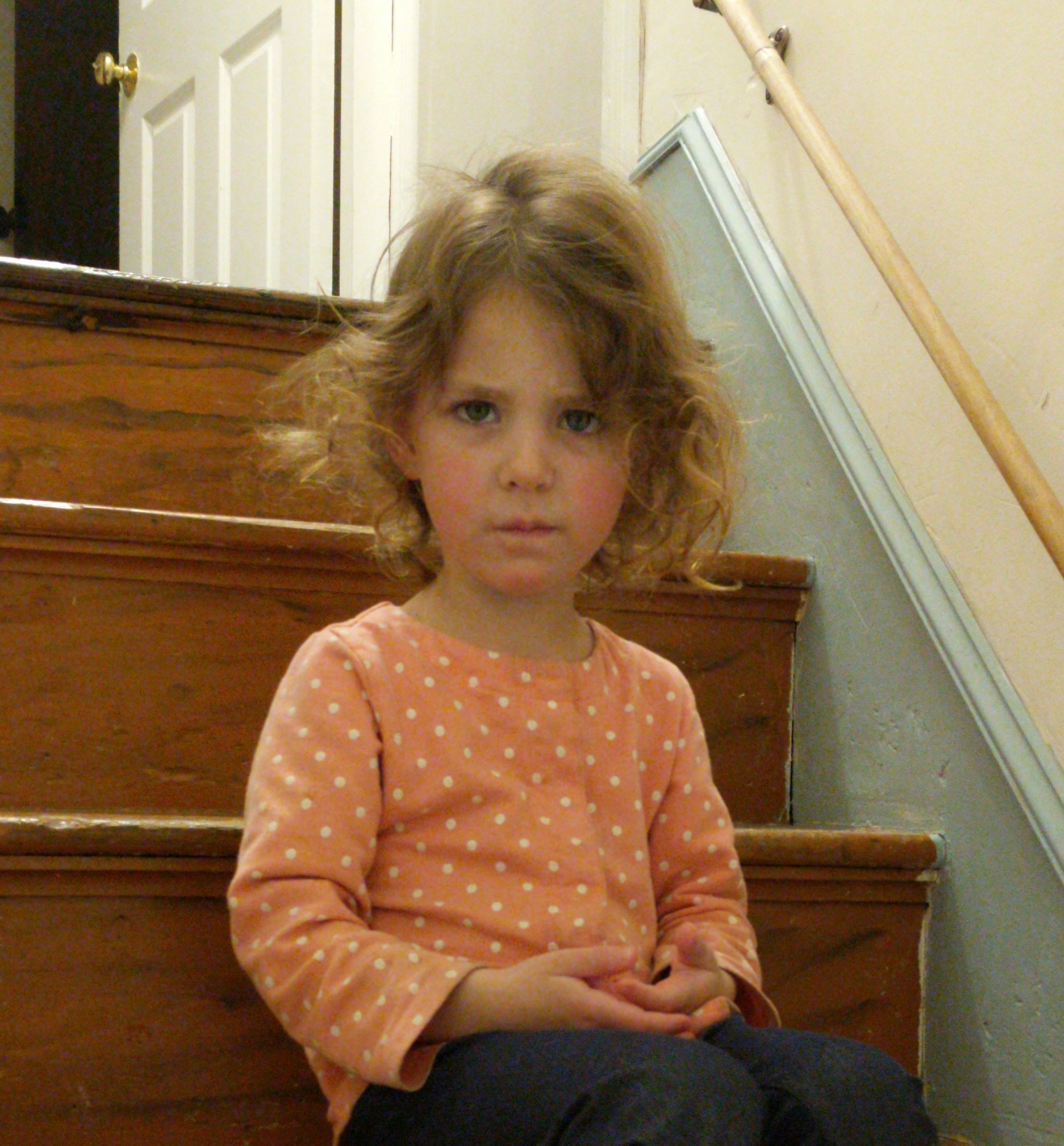
We typically put kids in time out in three ways. The most common way is when we count to three but they still don’t listen:
Anna: Lily, get out of my room.
Lily: You said Nora could be in here, so I can be too.
Anna: Dad!!
Me: If Anna says you need to get out of her room, you need to get out of her room.
Lily: This isn’t fair.
Me: That’s one.
Lily [huffs]
Me: That’s two.
Lily: [huffs]
Me: That’s three; time out.
We don’t usually get all the way to time out. Typically “that’s one” would have been enough: it shows that we’re moving from our normal mode of interaction to “actually this is just something you just have to do.”
Another way kids will go in time out is in persisting after a warning:
Nora: [throws a toy wildly in the living room]
Me: No throwing indoors. If there’s any more throwing that will be time out.
[short time passes]
Nora: [throws another toy]
Me: That’s time out. No throwing.
I wouldn’t count in this case because there’s no ongoing activity to stop, and they were already on notice that doing more would be time out.
Finally, someone might go in time out with no warning if they do something sufficiently egregious, like escalating to violence:
Nora: You’re a stinky face!
Anna: [whacks Nora]
Me: That’s time out. No hitting.
In each of these cases, however, they might only spend a minute in time out. What seems to be important is that the time out is a consistent, clear, and immediate signal of parental disapproval. It doesn’t need to be particularly unpleasant in itself; knowing that I’m unhappy with them seems to count for a lot.
Other thoughts:
Time out is having to sit on the stairs. While they’re in time out we ignore them. They can’t bring toys or books with them, and it’s pretty boring, which is part of why it works.
-
Julia adds that this extends to the cats:
There’s a rule “don’t interact with people who are in time out” which I’ve now started enforcing for cats too. One of our kids spends timeout snuggling the cat if at all possible, and loudly exclaiming over the cat so as to convey she’s enjoying it. I’ve now started coming up, telling the cat “[name] is in time out, so we’re leaving her alone” and carrying the cat away.
If they went in time out because they were refusing to do something, they do still have to go do that thing after. This is a kind of forfeiting ill-gotten gains.
If they’re clearly upset I’ll have them stay in time out until they’ve calmed down.
Simple separation is often enough. If the kids are fighting I might ask one of them to leave the room.
I often see parents give commands they don’t really need to, where they could instead let the kids work it out or decide that it’s not important. If there’s nothing to enforce it can’t lead to a time out.
I do need to be careful: if I ask them “are you going to clean up this game before moving on to the next” then it would be wrong for me to threaten them with time out if they said no.
We started doing “zero-second” timeouts. The kid must go to their room, enter, and close the door, and then they can come right out. Resisting arrest is a “felony” (time jumps to age-in-minutes), and it’s such an obviously trivial imposition that the kids seldom push it over a 0s timeout, but it demarcates a behavioral line for them to observe and interrupts the momentum of many misdemeanors. (There are other felonies, like hitting; 0s timeouts are for, like, being kinda rude.)
How did you get them to accept the time-out in the first place?
We started from a young age, so this was something they learned pretty quickly. If I was going to be doing this with a new kid, I would explain to them that we were going to be starting a new system what it meant when I started counting and what I would expect from them in timeout. I’d make sure they understood it before I needed to use it the first time.
If they were leaving timeout I would watch them so that I could correct as soon as they got up. If they persisted I would probably either (a) sit with them and keep them there or (b) visibly use a timer that I reset every time they got up. Not having done these, though, I don’t know how well they’d work.
I never got things like timeout to work for my older children. That could be on me. It could be their temperaments. I did use small immediate feedback as advised by Kazdin (see Book Review: Kazdin’s The Everyday Parenting Toolkit) and it was not for lack of patience—one time sitting for an hour on a sidewalk in Pisa. Different way work for different combonations of children and parents I guess. Things turned out fine. It is often a lot of learning and adaption stacked on top of each other. And you can have fun. See Shoshannah’s Bed Time Quests & Dinner Games for 3-5 year olds