Is Progress Inevitable?
Over the last 200 years, society became steadily more liberal. Serfdom and slavery were largely abolished, democracy exploded and most women and children are free from violence. Redistribution is widely practiced and the median person is far richer, healthier and freer than ever before.
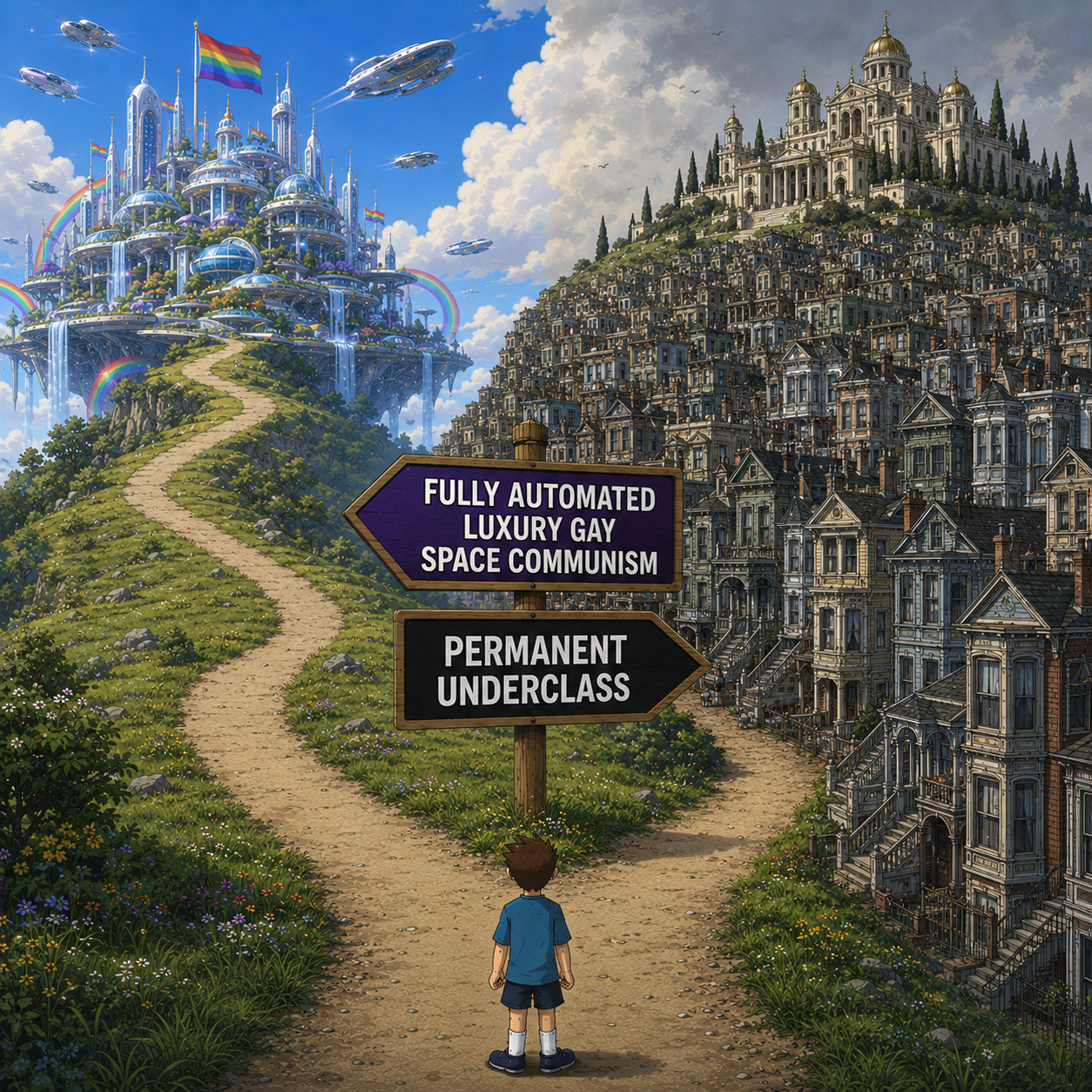
Some neighborhoods in San Francisco already look like the hill on the right
We see this progress at the generational level: people are less racist than their parents. We also see it on the historical scale: in 1512, public torture, marital rape and slavery were acceptable and practiced widely, now they are largely morally repulsive and very rare. Peter Singer calls this phonemana: “Moral circle expansion”. MLK said “the arc of the moral universe is long, but it bends toward justice”, and Moldbug cynically wrote: “Cthulhu may swim slowly. But he only swims left.”
Of course there were setbacks along the way, like the Armenian genocide, the Stalinist purges or the Maoist cultural revolution, but in general, progress is strong and liberalism is winning. The rate of “liberal progress” might even be accelerating.
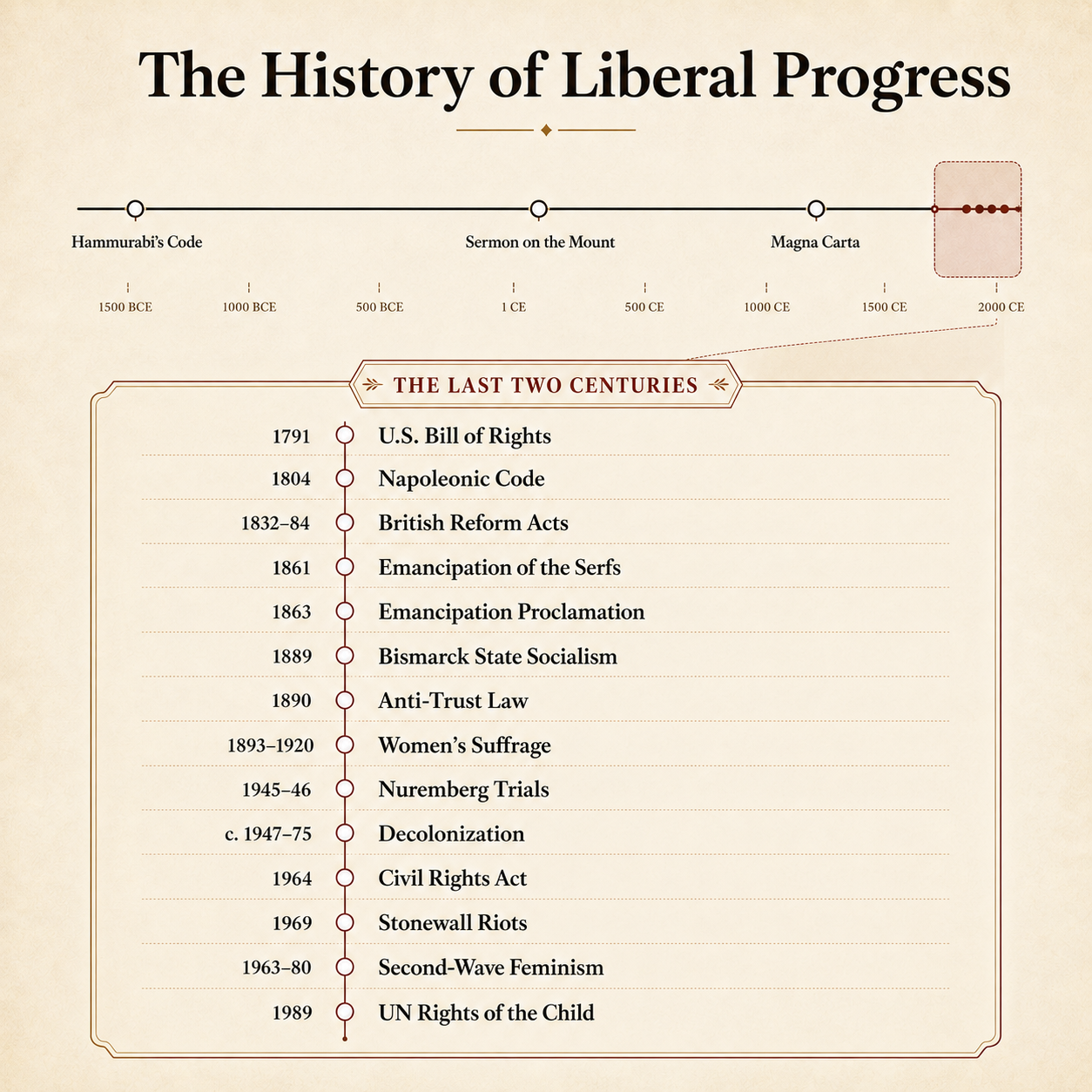
incomplete list
Why is that?
Why is society getting more liberal? There are many explanations. I find the “mainstream economics” one to be by far the most compelling. It goes something like this:
Institutional Selection
As the economy gets more sophisticated and dependent on human capital, “being good” becomes more advantageous. Universalist moral codes, impersonal trust, and individual rights produce cultures that cooperate more effectively at scale. States that adopt liberal institutions tend to prosper and dominate.
Free people are more productive than slaves and serfs. Free speech leads to better ideas. Free markets and fair rule of law lead to innovation and economic growth. Happy and engaged masses win wars. Women rights are good for productivity. Happy and educated kids become more productive adults. Fair international trade is better than extractive conquest. Economic mobility and meritocracy improve governance.
This is the story of the 19th century (aka Pax Britannica) and the 20th century (aka Pax Americana). The last two centuries have many cases where local elites push through liberalization reforms after getting their asses kicked by the West. Most famously: the Meiji restoration, the Perestroika and Atatürk’s reforms.
Not all countries are liberal democracies. Why is that? Economists talk about the “resource curse”: resource rich countries are typically authoritarian oligarchies. If the elites get their power and money from resources, they don’t need to “invest” in their people or infrastructure. Poor, uneducated subsistence farmers are easier to control! Elites in such countries get stuck in a local minimum: investing in the populace has a long and uncertain “payback period” and might backfire, oppressing the people and extracting minerals has immediate ROI. People and elites in liberal democracies are mostly fine with this. I think that’s the strongest argument for the institutional selection[1] view
Will the trend continue?
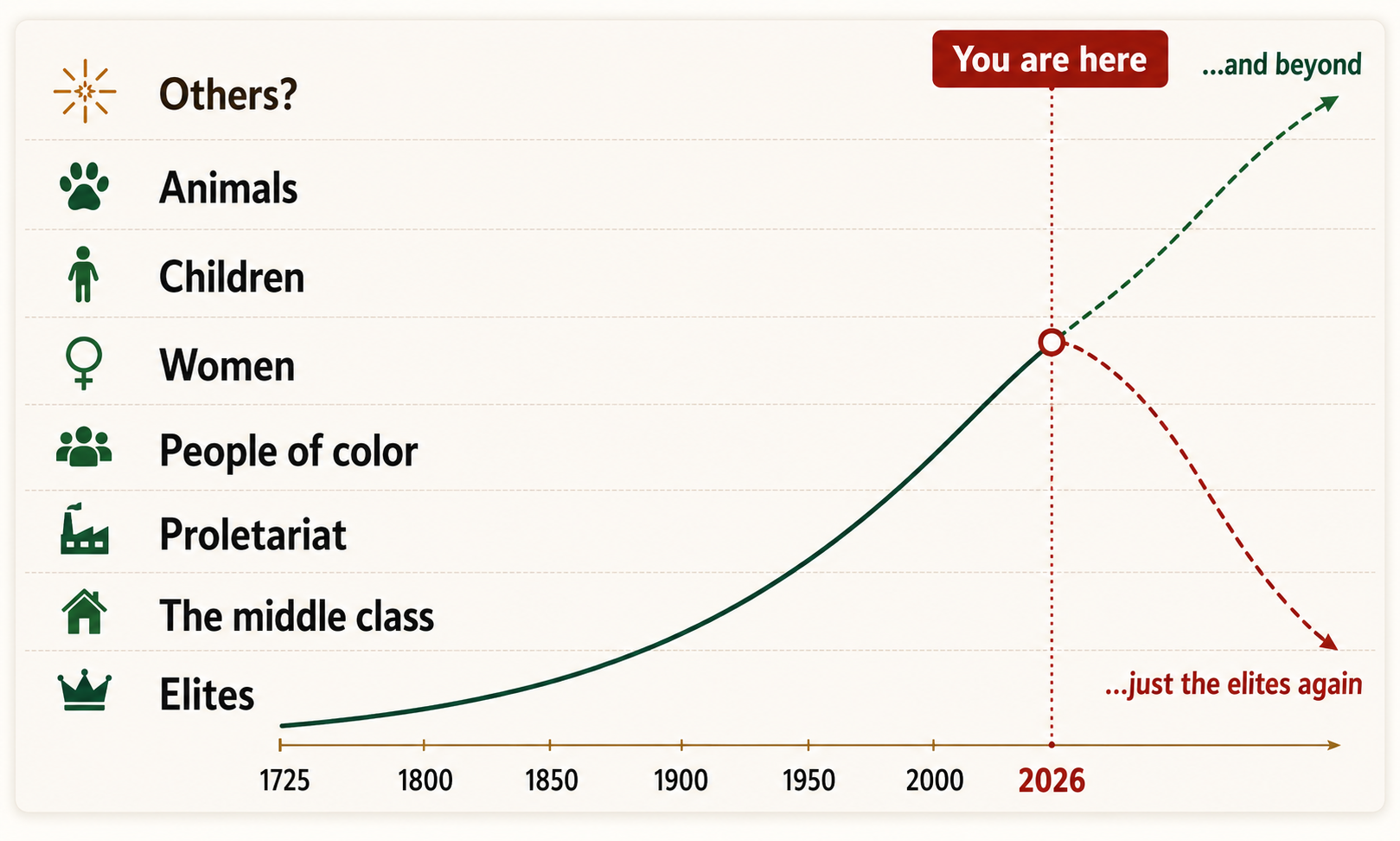
“Others” = 10^100 shrimp, AIs, emulated minds, etc
Why not?
AI!
Robots and AIs might displace the average human from the labor market. Drone armies will make human soldiers and policemen unnecessary. The value of the average human to elites will diminish significantly. As a result, treating the average human nicely and fairly becomes less important to the survival and flourishing of the state and the average person will be gradually or quickly disempowered[2]
Why yes?
There are many cases where someone is less empowered but society still treats them with respect. Some examples: indigenous groups that maintain special rights (Native American reservations, Hawaiian lands, Maori lands), affirmative action recipients, protected species and very old people.
The strongest example is countries who are “resource economies” but still have inclusive institutions. e.g Norway, NZ, Iceland, Canada, Australia and Botswana. Amazingly, there are basically no examples of countries that became less liberal after “striking gold” and finding a bunch of resources.
Obviously there are cynical “realpolitik” explanations for all of the above, but I’d like to think that inclusive institutions are just very robust. Once you “include a group”, it’s very hard to exclude them again, maybe for collective action or “slippery slope” reasons:
“First they came for the average person
And I did not speak out
Because I was not the average person
Then they came for meAnd there was no one left
To speak out for me”
Perhaps this will stay true forever? I hope so.
What can we do now?
While we (non-elites) are still empowered, we can pressure the institutions to change in a way that will make society more robust to disempowerment. Some quick ideas:[3]
Transparency
We could make our institutions and elites more transparent and legible to the average person. This might take the form of frequent public audits of AI companies and the regulators.
There should be strong incentives for sophisticated actors to investigate companies for violations / increasing x-risk and report those violations. We can use existing mechanisms for that, e.g short seller firms, class action litigations, market competitions (“my competitor is breaking the law!!”), or new mechanisms like generous whistleblower programs for AI insiders. Better epistemic tech would help the masses understand their institutions better and take better advantage of transparency.
Decentralization
We can make it harder for elites to coordinate. AI development should be distributed across multiple companies both vertically and horizontally. Ideally, those power centers are somewhat adversarial to each other. This way, key pieces of infrastructure aren’t controlled by a small group of people.
We should also encourage “AI insiders” to become “outsiders” via term limits (with long / infinite cooldown periods) for executives, top researchers, influential bureaucrats and power brokers. We could also have mandatory gardening leaves for AI executives to make “coordination by osmosis” less likely.
Ideally, AI capabilities are also distributed across multiple liberal democracies with international agreements. Something like: “we commit that we will stop trading with you and maybe even declare war on you if you wirehead your masses or become an autocracy“
Control
AI “constitutions” and AI values should be visible to and influenced by democratic institutions, ideally in ways that would “lock” those values in. Perhaps governments establish agencies that audit training procedures and evaluate models to make sure that they don’t concentrate power and are aligned with the needs of the average person. AI constitutional amendments could require a supermajority vote like US federal constitutional amendments. We can go even farther and demand that AI values can only be changed with some sort of international agreement between liberal democracies.
Differential technological development
We should slow down and limit technologies that disproportionately help the elites gain power: mass surveillance, AI propaganda, autonomous weapons and autonomous policing.
- ^
Another good one: there is a lot of redistribution within liberal democracies, but there is almost no global redistribution from rich countries to poor countries. Why is that? International redistribution doesn’t have strong institutional selection for it, but national redistribution does
- ^
Disempowerment isn’t even the worst case scenario. An AI takeover can lead to total human extinction or even something far worse
- ^
I found these articles inspiring: breaking the intelligence curse, mitigating ai enabled coups, mitigating gradual disempowerment
We have no counterexamples or causal experiments. We have at best guesses at why things happened when they did, or at all.
I think it’s fascinating that the forager → farmer → industrial → modern “progression” has included some return to forager values, and some brand-new directions that probably just wouldn’t work without the level of wealth and automation we’ve managed. I literally can not predict the future direction at any distance—it seems likely that it’s mostly-consistent over a single generation, but can change pretty radically over 3-4. In EITHER direction. Or in both directions—some attitudes and institutions become stronger, some become weaker, and some of each are considered “good” or “bad” by various constituencies.
> We have no counterexamples or causal experiments.
That is the nature of politics / economics / culture. There are no ways to conduct meaningful experiments on policies, but we still need to make policy decisions, so we need to have other ways to build causal models of the world. There’s a bunch of literature around how to do that. Daron Acemoglu won the 2024 nobel prize in economics for innovating some of these methods (specifically in the context of “institutional selection”)
> the forager → farmer → industrial → modern “progression” has included some return to forager values, and some brand-new directions that probably just wouldn’t work without the level of wealth and automation we’ve managed.
This is a really interesting point, can you expand on it more?
The two other examples here are the results of military defeats and caused the state to become more powerful. The Perestroika wasn’t caused by such a defeat of the USSR itself, led to a de-industrialisation of the former USSR and failed to transform Russian Federation into a liberal democracy.
Additionally, the theory of institutional selection would have to explain the rise of China which hasn’t become democratic and the economic problems of the USA (caused by moving factory work to Asia?)
Finally, we would have to deal with the issue of decentralisation causing the AI capabilities race or outright a misaligned ASI.
Both the Meiji restoration and the Alexander II reforms greatly increased the liberties of the average person. The fact that they made the state more powerful means that “liberalization” is adaptive and only states that do it “win”.
I agree that the “rise of China” is an interesting counter-point. Xiaoping’s China adopted some liberal ideas (free markets, some local democracy, some free-speech, some rule of law) but didn’t adopt “the entire liberal package”.
I imagine that de-centralisation and capabilities slowdown can go together. The government can heavily regulate the labs and limit capability growth, and the labs can compete on other things e.g costs, speed, “values”. What do you think?
Anything that doesn’t succeed gets retroactively declared as “not liberal” no matter who actually supported it, so the defeat of Prohibition and eugenics are not remembered as setbacks for liberalism. Now that freedom of speech is under attack, it has ceased to be seen as liberal as well, with hate speech laws being justified in the name of liberalism.