Gluten-free water
Epistemic status: a curiosity I chased for an afternoon. Facts verified and footnoted; the why is speculation.
AI use: research (more examples and their context), review, grammar and light phrasing.
No added hormones
I somehow know that the use of added hormones in poultry (which includes chicken) is illegal in the US.[1]This means that all chicken meat in the US is produced without added hormones. To my big surprise, chicken packaging in the US explicitly says “no added hormones”:
Foster Farms Fresh Chicken Drumsticks at Walmart
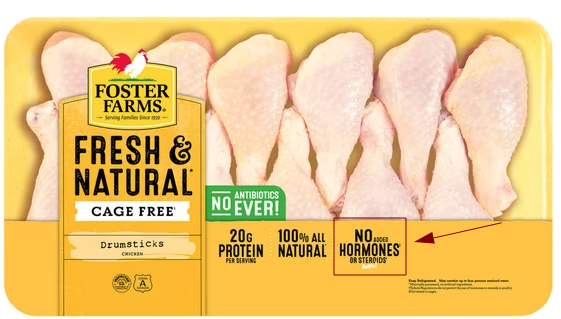
“No added hormones† or steroids ever”
Since this is the default state anyway, I found it odd. If all products are like this, why point it out as an advantage? I see the following explanations:
Disclosure unraveling. If there are two equivalent chicken products A and B, and A says “no added hormones” but B does not, it is very natural for a consumer to conclude that B has added hormones, otherwise B would have put the claim on its packaging too. So once A starts doing this, B has to do it as well, even though neither of them can use added hormones. Economists call this disclosure unraveling: when disclosure is cheap and verifiable, silence gets read as the worst case, so everyone discloses. The twist here is that all producers are identical, and the unraveling runs purely on consumers not knowing the law.
Beef production allows added hormones.[2]An ordinary consumer does not have to know all US laws related to meat production, so it makes sense to explicitly differentiate chicken from beef, even though it is just a consequence of a law.
Contrast “no added hormones” with “no antibiotics ever”: the latter is actually a very meaningful notice, and likely an explicit decision by the producer, but to me both notices have the same visual importance and weight on the packaging and read as being of the same nature.
USDA actually noticed this and requires[3]the manufacturer to say explicitly on the packaging that this is a federal prohibition. In the example above there is indeed a footnote: “Federal regulations do not permit the use of hormones or steroids in poultry”.
This inspired me to research more examples and context of such marketing claims.
Gluten-free water
The most amusing discovery was gluten-free water. In my mind this is equivalent to saying “our salt does not contain any gasoline”. Sadly, I couldn’t find any serious product with such a claim (there is Gluten Free Diet Water, a real US brand started by a Fort Myers hotel owner, but it is openly a gag). The FDA, however, gives this as an example of what’s ok to do:
Foods that are inherently gluten-free, for example bottled spring water, fruits and vegetables, and eggs can also be labeled “gluten-free” provided any gluten that came in contact with the food is less than 20 ppm.
There is a Mountain Valley spring water listing on Amazon which says “Diet Type: Gluten Free” in the description, but this seems to be an artifact of Amazon’s product taxonomy. Target has an entire section of gluten-free water on their website.
Here I was going to show you Google Search trends, but I discovered that a query without quotation marks does not measure what you expect it to. E.g. gluten free water would apparently also count “is water gluten free”. With quotation marks the search volume is close to 0, so apparently this is not a common thing:[4]Google Trends.
Unleaded gasoline
The next example is unleaded gasoline in the US. Since 1996 leaded gasoline has been banned for on-road vehicles,[5]so nowadays you will not encounter it unless you explicitly seek it out. It is 2026, and a bunch of gas pumps still explicitly label all gas as unleaded. At first I assumed this was laziness to change, but I am sure there have been new gas pumps produced in the last 30 years. So I suspect this is the same unraveling: “if we don’t write unleaded, people will assume it is leaded”. However, not all gas stations have this. Also, while researching this post I discovered that until 1996 there was a federal legal requirement to have this labeling,[6]and New York has its own rule that was never removed,[7]i.e. in NY every gas station is still legally required to say “unleaded”.
More examples
No added hormones on US pork: same as chicken.
“Non-GMO” pure salt: salt has no genes to modify. However, this one stands out to me. When I saw it, my first impression was “is there something about salt production that I don’t know which would explain this claim and make it reasonable?”. Apparently some salts can have crop-derived additives, which might be GMO.[8]
“Cage-free” US chicken meat: chickens raised for meat ordinarily aren’t raised in cages (unlike in egg production).[9]This is actually claimed in the example above too.
“Cholesterol-free” pure vegetable oil: all ordinary oils are cholesterol-free. However, this distinguishes this product class from butter (similar to chicken vs beef above). The FDA requires them to say “a cholesterol-free food” rather than “cholesterol-free”, to signal that the entire food class (not only this product) is cholesterol-free.[10]The FDA actually considered this for gluten-free water too, but decided against it, since there can be flavored variants or cross-contact, and declaring an entire product class gluten-free can be misleading.[11]
“Mercury-free” ordinary alkaline AA/AAA batteries in the US: already the legal standard.[12]
The EU actually banned a similar claim on cosmetics. Its guidance on “free from” claims forbids them for any ingredient that is already prohibited in cosmetics, and its own example is “free from corticosteroids”: not allowed, because corticosteroids are banned anyway.[13]
And the EU has a general rule for the whole genre: presenting rights that consumers already have by law as a distinctive feature of your offer is on the blacklist of practices that are unfair in all circumstances (Unfair Commercial Practices Directive, Annex I, point 10).[14]”FREE two-year guarantee!” from an EU retailer is the textbook case, since the two-year legal guarantee is statutory.
Schlitz
During the research, I stumbled on an interesting historic example of this: Schlitz advertising steam-sterilized beer bottles. From Albert Lasker’s personal reminiscences:
Hopkins told me this story. The Uhleins, who were the owners of the Schlitz brewery, wanted him to write their advertising, and they took him through their plant. They personally conducted him through the place. They showed him every operation in the plant, and he wasn’t impressed by anything until they brought him to a room full of steam where the bottles were being mechanically washed in steam.
They hurried through the room and said nothing. He asked them, “What is this process?”
They said, “This is the room where we sterilize the bottles in live steam to prevent germs.”
“Oh,” he said, “that’s most interesting.”
“There’s nothing to this. Every brewery does this. We’re not the only one. No brewery could exist without doing this to their bottles.”
He said nothing to them, but when he submitted the campaign, it was only around that. In no place did he say that every brewery did not do it. He merely stated specifically that Schlitz did it. That message, which was a salesmanship-in-print message, made such a terrific impression on the public that Schlitz beer grew by leaps and bounds, as if a magic wand had been put over the firm.
An ad from the campaign. The Morning Oregonian, Saturday, July 6, 1901, page 4.
It is unclear whether this was the explanation of the increase in sales,[15]but the nature of this claim is exactly the same as “no added hormones”.
At this point I must inform you that I washed my hands two times before writing this LessWrong post, and it does not give you cancer, hemorrhoids or high blood pressure. This is an extreme precaution. Your physician knows; ask her.
FDA, Steroid Hormone Implants Used for Growth in Food-Producing Animals: “No steroid hormone implants are approved for growth purposes in dairy cows, veal calves, pigs, or poultry.” Using an unapproved animal drug is illegal. ↩︎
Same FDA page: “the Food and Drug Administration (FDA) has approved a number of steroid hormone drugs for use in beef cattle and sheep.” ↩︎
USDA FSIS, Meat and Poultry Labeling Terms (also as a PDF on govinfo), entry “No Hormones (pork or poultry)”: “Hormones are not allowed in raising hogs or poultry. Therefore, the claim ‘no hormones added’ cannot be used on the labels of pork or poultry unless it is followed by a statement that says ‘Federal regulations prohibit the use of hormones.’” ↩︎
Google Trends help, Compare Trends search terms: without quotation marks, results include searches containing each word in any order; with quotation marks, the exact phrase, possibly with words before or after. ↩︎
EPA, EPA Takes Final Step in Phaseout of Leaded Gasoline (January 1996), and the final rule, 61 FR 3832, February 2, 1996: the Clean Air Act prohibits gasoline containing lead or lead additives for use as motor vehicle fuel after December 31, 1995. Leaded fuel is still sold for aircraft, racing cars, farm equipment and marine engines. ↩︎
40 CFR 80.22(e), as described in the Federal Register of June 25, 1993 (58 FR 34438, at 34440): “Since July 1, 1974, EPA has required all retailers of gasoline for use in motor vehicles to affix a permanent, legible label to each gasoline pump stand to identify whether the gasoline is leaded or unleaded. The label must state ‘Unleaded gasoline’ if the pump stand contains dispensers for unleaded gasoline. If the pump stand contains dispensers for leaded gasoline, the label must state ‘Contains lead anti-knock compounds’ and must be located so as to be readily visible to employees and customers.” EPA removed the paragraph in the same rule that banned leaded gasoline, 61 FR 3832, February 2, 1996: “This rule also deletes section 80.22(e), which requires that gasoline pumps be labelled to identify whether they contain leaded or unleaded gasoline.” ↩︎
New York, 1 NYCRR 224.10, “Retail sales of unleaded or leaded gasoline” (section 224.12 until it was renumbered in April 2025), paragraph (b), verbatim: every retailer and wholesale purchaser-consumer “shall affix to each gasoline pump stand … a permanent legible label”, and “For gasoline pump stands containing pumps for the introduction of unleaded gasoline into motor vehicles, the label shall state: Unleaded gasoline. For gasoline pump stands containing pumps for the introduction of leaded gasoline into motor vehicles, the label shall state: Contains lead anti-knock compounds.” The label must be “readily visible to a retailer’s or a wholesale purchaser-consumer’s employees and persons operating motor vehicles.” It is the 1974 federal wording, kept. ↩︎
E.g. Morton Iodized Salt lists dextrose (corn sugar, used to stabilise the potassium iodide) among its ingredients. ↩︎
National Chicken Council, Cage-free chicken: “No chicken you buy is raised in a cage. The majority of chickens raised for meat in the U.S. live in large, open structures called houses where they are free to walk around.” A 2017 NCC consumer study found that 70% of US consumers believed most birds bred for meat were raised in cages (report), which is presumably why the label sells. ↩︎
21 CFR 101.13(e)(2), verbatim: “Any claim for the absence of a nutrient in a food, or that a food is low in a nutrient when the food has not been specially processed, altered, formulated, or reformulated to qualify for that claim shall indicate that the food inherently meets the criteria and shall clearly refer to all foods of that type and not merely to the particular brand to which the labeling attaches (e.g., ‘corn oil, a sodium-free food’).” ↩︎
FDA, “Food Labeling; Gluten-Free Labeling of Foods”, final rule, 78 FR 47154, August 5, 2013. The 2007 proposed rule would have deemed misbranded any inherently gluten-free food labeled “gluten-free” unless the claim referred to all foods of that type (e.g. “milk, a gluten-free food” or “all milk is gluten-free”); the final rule dropped that requirement, noting that it can be misleading to suggest a whole food category is always gluten-free. ↩︎
Mercury-Containing and Rechargeable Battery Management Act, Pub. L. 104-142 (1996), sec. 203: no alkaline-manganese battery “with a mercury content that was intentionally introduced” may be sold, except button cells with up to 25 mg. ↩︎
European Commission, Technical document on cosmetic claims (2017; direct PDF), Annex III on “free from” claims, applicable from 1 July 2019, verbatim: “‘Free from’ claims or claims with similar meaning should not be made concerning (an) ingredient(s) which is prohibited for use in cosmetics by Regulation (EC) No 1223/2009″, with the example “The claim ‘free from Corticosteroids’ is not allowed, as Corticosteroids are banned by EU cosmetics legislation.” ↩︎
Directive 2005/29/EC (Unfair Commercial Practices Directive), Annex I, “Commercial practices which are in all circumstances considered unfair”, point 10, verbatim: “Presenting rights given to consumers in law as a distinctive feature of the trader’s offer.” ↩︎
Hopkins’ own account is the only source for the sales jump: “Schlitz jumped from fifth place to neck-and-neck with first place in a very few months.” Claude C. Hopkins, My Life in Advertising (1927), pp. 79-81. He also writes that he handled Schlitz for the J. L. Stack agency in Racine, i.e. before 1907, so the 1901 ad fits. ↩︎
This is great. It makes me think of a similar phenomenon where occasionally peanut butter labels will say “may contain peanuts.”
Whenever someone brings that one up, I keep thinking there’s a plausible real advantage here in terms of both columnar perception and rule legibility. Consistency allows the predicate the consumer is evaluating to become very narrow: “does the container have this text somewhere, yes or no?”. If you have to evaluate “does the container have this text or is the product of a general nature such that you’d naturally expect it”, the latter disjunct adds a ton of mental state needed for a consumer evaluating many different objects in a row, and becomes a potential ambiguity point that can tie up decision-making processes. That is, the benefit may be small for consumers doing conventional grocery shopping where they already have an idea of what they want, but “be able to send a form letter rejection to the manufacturer rather than researching which groups of people are most likely to know that this traditional cookie type with a foreign name normally contains peanuts” and “apparently our cousin is highly allergic, so let’s remove everything that contains peanuts from the (highly heterogeneous) pantry; the main pass will involve visually scanning labels for the words rather than consciously evaluating each item” would both benefit. I don’t know what the quantification of this would look like, though.
This makes sense, but it seems to be about the more common phenomenon where peanut butter will say ‘contains peanuts’ - also a little bit silly, but less strange than when it says ‘may contain peanuts’.
The pilot of Mad Men has a scene about this (the most relevant part starts at 3:25). They’re debating how to make people forget about the recent discovery that cigarettes cause cancer. Don Draper proposes the slogan: “It’s toasted.”
Most mineral water brands in my country have a non-GMO label.
Once I was wondering which popular labels one could also truthfully apply to a bag of refined sugar.
For example: low-fat, vegan...
That was basically a silly way to illustrate that things those labels apply to may not be necessarily healthy.
No added sugar.
Yep, that one always makes me think: added to what? Something that already contained lots of sugar?
You might be surprised that a vegan label on a bag of refined sugar would not be fully meaningless: https://en.wikipedia.org/wiki/Bone_char#Sugar_refining :
Yes this all of this. This is one of the things that drives me unreasonably up the wall. As a kid my mom always went out of her way to buy the one bread that was labeled as “trans-fat-free” because it was, you know, bread.
The popcorn I recently bought from Costco is lable as “whole grain” because well, because it wouldn’t pop very well if you smashed it first. (Although is it still a whole grain once it’s popped?).
adding 19 ppm gluten to my water and calling it gluten-free