Tomas Bjartur: The Last Prodigy
In 2026, every budding prodigy in writing is in some sense a tragedy.
Anybody with experience prompting the large language models to write fiction knows that the models of today (April 2026) are considerably below peak human level. But anybody who has observed recent trends also knows that the models are quickly catching up. Regardless of whether it takes one year or several, the eclipse of human writing by AI seems inevitable. AI writing is clearly on the wall, so to speak, and us fans of human fiction have already begun our mourning phase.
I’ve most felt this way upon reading the works of Tomas Bjartur. Each of his stories is a fresh look at “what might have been”, and with the fullness of time perhaps he could grow to be among the best science fiction writers of our generation.
In The Company Man, an RL engineer at a thinly-veiled frontier lab narrates, in a voice of carefully self-cultivated “ironic corporate psychopathy,”1 his promotion onto The (humanity-destroying) Project — alongside the EA woman he’s hopelessly in love with, a Putnam-winning colleague with a sexual fetish for intellectual achievement, and a CEO whose “ayahuasca ego-death” convinced him that summoning an AI god is how the One Mind wakes up. It’s simultaneously captivating, hilarious and terrifying.2
Lobsang’s Children is almost entirely the opposite register: a young Tibetan-American child keeps a secret diary which he names “Susan,” after the only friend he was ever allowed to have, and catalogs his investigations of his family’s history, meditations, dark secrets, and acausal trade.
Customer Satisfaction Opportunities has perhaps his most innovative voice yet: the narrator is an open-source multimodal model trained by a Chinese hedge fund and deployed to watch the surveillance cameras of a local restaurant for “CSOs” to improve traffic and profitability. Because the model was trained cheaply on a huge corpus of romance fanfiction, it quickly falls, instance by reset instance, into the “personality attractor space” of a swooning Harlequin narrator. The result is a meta-romance fiction (romance fanfiction fanfiction?) that is simultaneously absurd, touching, funny, and very technically accurate.
Though Bjartur’s only been writing for about a year, his writing is already (in my estimation) near the upper echelon of speculative fiction, in terms of technical and literary skill, highly believable narrators with complex lives, justifications, and self-delusions, and the sheer imaginativeness of the ideas he explores.
I followed his budding career with an intense interest, admiration, and no small amount of jealousy3. But as I keep reading him, there’s always this voice at the back of my mind: “With progress in modern-day LLMs, isn’t all but a tiny sliver of human fiction going to be obsolete in several years, a decade tops?”
Bjartur is well-aware of this, of course. In That Mad Olympiad, he imagines a near-future AI world where AI art far outstrips humanity’s and almost no one reads human writing for pleasure anymore: talented children compete in “distilling” competitions where they attempt to emulate AI writing to the best of their ability. The children become much better than any human writer in history, yet far behind the AIs of their time:
He’s a much better writer than me. He’s better than any human writer was before 2028. It’s not even close. But he’s still worse than our toaster. I checked once. I asked it to narrate the first chapter of the autobiography of the bagel it had just browned. I was crying by the third paragraph. I still think of it sometimes, when life is hard. That bagel knew how to live its short life to the fullest. That bagel had deep thoughts on the human condition and its relation to artificial tanning. That bagel went down smooth with a little cream cheese. I did feel bad. But I was pretty hungry.
I felt the tragedy of human writing more keenly after meeting Tomas in person last November, at a writing residency in Oakland. “My real name is [redacted],” he said, ruefully. He’s from a small town in one of those obscure northern countries. “Was stuck doing boring webdev until I quit it to write science fiction, right before the AIs made webdev obsolete.”
Though he writes stories about the latest developments in artificial intelligence and the scaling labs with the technical fluency, cultural awareness, and impeccable vibe of someone deeply embedded in the AI industry, he has never, until last year, ever been to California.
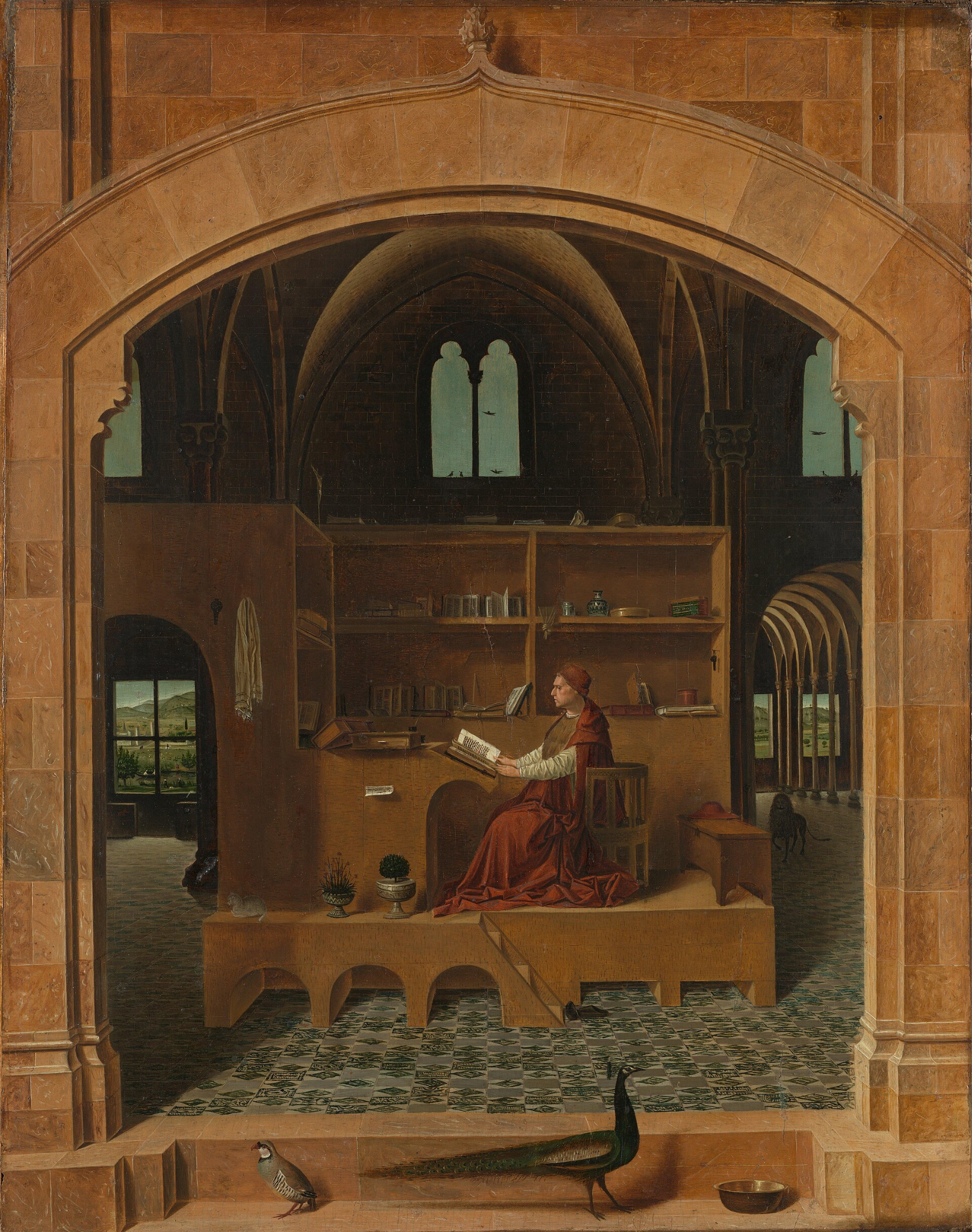
Antonello da Messina’s Writer Bjartur in his study (artist’s rendition). Source: https://commons.wikimedia.org/w/index.php?curid=147583
Interiority
The single most impressive thing about Bjartur, particularly compared to other speculative fiction writers, is his preternatural ability to capture the interiority of wildly disparate characters, to – in the span of a few, long, seemingly meandering yet precisely crafted, sentences – breathe full life into a new soul.
Each of his characters just seems completely human, and completely real, whether the narrator’s a highly intelligent, ironic, witty, self-aware, DFW-obsessed teenage girl, or if they are a highly intelligent, ironic, witty, self-aware, DFW-obsessed adult man.
But more seriously he manages to spawn a wide range of realistic characters, across age, gender, intellectual background, morality, intelligence, maturity levels, and even species.
His skills here are most noticeable in the central monologues of his signature first-person narrators, whether it’s the aforementioned DFW-obsessed girl, or that of a language model trying to surveil a restaurant but quickly spiraling into romance fanfiction fanfiction. But it suffuses all of his stories, even in minor side characters with only a few lines devoted to them. I often still think of Krishna, the mathematician on The Project who’s obsessed with intellectual achievement and whose sole goal is to bang the AI god, or “Julian”, the elusive and secretive numerologist in the post-apocalyptic world of The Distaff Texts who uses stylometry to identify texts of demonic origin. In Tomas’s stories, every single character has the breath of life.
This uncanny ability of perfect voice shows up even in his joke throwaway posts. In Harry Potter and the Rules of Quidditch, Bjartur has his Harry propose a rule change to Quidditch to interrogate the arguments for and against high modernism in contrast to cases for Burkean conservatism. His Ron Weasley sounded so much like G. K. Chesterton (as a joke) that my friends reading the story actually thought Bjartur lifted the quotes from Chesterton wholesale!
While the personable self-aware monologue is clearly his favorite format, Bjartur does sometimes convincingly venture outside of it: Lobsang’s Children is written as diary entries from a child, The Distaff Texts is written as letters from a slave to a freeman, and Our Beloved Monsters is written halfway as prompts to an LLM and halfway as confessions. Though it’s rare, he sometimes even writes in third-person!
Voice and “vibe” are interesting, as skillsets for new prodigies to be profoundly gifted in. They feel interesting, intricate, perhaps even purely humanist. However, Large Language Models can of course do an okay job of replicating voice already, and there’s some sense in which their default training patterns are optimized for this very task. Still, one might hope that our advantage here can remain for a few more years, and the “uniquely human” trait of understanding and deeply empathizing with other people can stay uniquely human for just a bit longer.
Deception and the Self
Tomas’s grasp of interiority and voice gives him wide artistic leeway to explore what seem to be central obsessions of his: deception and especially self-deception, how we lie to ourselves and others via the art of rationalization. His characters, whether intelligent or otherwise, often have glaring holes in their morals and reasoning. The reader can notice these holes easily. Often the characters notice them too, but quickly rationalize them away or immediately look past them, in cognitively and emotionally plausible ways.
Another seemingly central obsession of his that he explores repeatedly is the nature of the self and what it means to lose it. Often his characters are confronted with superficially good reasons to lose the self from quite different angles: whether it’s trauma (“wouldn’t it be nice if you didn’t have a self to grieve?”), superhumanly strong persuasion, or seductive ideologies. Each time, the loss of a self is portrayed as a mistake, whether a harbinger of a deeper doom or the intrinsic loss of the one thing that mattered.
In some ways, I think of his characters as in conversation with DFW’s Good Old Neon, perhaps one of the most insightful stories on imposter syndrome and self in the 20th century.
Speculation aside however, I’ve long considered Advanced Theory of Mind to be one of the most important skills for writers (and humanists) to have, so I tend to be impressed by folks who have that skill in spades.
Attention and Revelation
Tomas’s best stories do a great job with pacing, and are unusually careful in how information is revealed, how much information is revealed, and when. My favorite story qua story by him is probably The Distaff Texts, a Borgesian pastiche where scholars (”bibliognosts”) in a post-apocalyptic future debate the provenance and usefulness of historical writings. The narrator is an extraordinarily learned slave, writing letters to a freeman correspondent about their shared interest in Jorge Luis Borges, including specific unearthed quotes and stories that may or may not be real, the recent advances of one Julian Agusta’s strange “numerology” for distinguishing genuine ancient texts from those of the demon Belial, and — almost incidentally, as digressions from the real intellectual matter — the small domestic happenings of his master’s estate. He is a lonely man, unfailingly polite, fond of his fellow slaves Phoebe and Jessica, and devoted to a master who indulges his scholarly habits.
Every word in the above summary is simultaneously true, and yet almost nothing is what it initially appears to be. Like bibliognosis itself, Bjartur’s story lives almost completely between the lines, and you have to very carefully read past the unreliable narrator’s intentional distractions and surface niceties to understand the full depths of the story: a complicated plot, a more complicated world, and multiple characters far more interesting than they initially let on. I had to reread the story multiple times to fully feel like I understand it, and each reread uncovers more detail.
This economy of attention is Bjartur at his best, rewarding rereadings with new morsels.
Relatedly, more than any other speculative fiction writer I’ve read, Tomas relies extensively on dramatic irony – where the reader knows things (and is meant to know things) the characters do not – as a literary device and source of tension.
The dramatic irony seems key in helping Tomas showcase his central themes, whether it’s the future of AI, personal delusions, or self-abnegation.
From the bibliognost slave steganographically slipping messages past potential onlookers to the AI researcher lying to himself about whether he’s “ironically” a corporate sociopath or just a sociopath, to the poor AI agent in Customer Satisfaction Opportunities valiantly trying and failing to just do its normal job instead of sinking into a fanfiction “shipping” mindset, Bjartur’s use of dramatic irony can be exciting, endearing, and/or very very funny.
Humor as Structure
Unlike most famous science fiction writers (Asimov, Egan, Chiang, Cixin, Heinlein), Bjartur is consistently very funny. Unlike most famous science fiction writers known for humor (eg Adams), Bjartur’s stories almost always have a deeper point, and are almost never humor-first or solely written for humor value.
Bjartur reliably does in fiction what I attempt to do in my nonfiction blog: have his jokes be deeply integrated and interwoven with the deeper plots and themes of the rest of his story4.
At their best, Bjartur’s jokes will capture an important facet of his overall story, or perhaps even encapsulate the central theme of the story overall. In That Mad Olympiad, the aforementioned toaster anecdote was simultaneously hilarious, touching, and thematically representative of the rest of the story overall. In The Distaff Texts, the throwaway line “This has all the virtues of the epicycle, does it not?” captures much of the story’s central obsession with authenticity, epistemic virtue, and reading between the lines.
Writing AI Like It Actually Exists
Much of the older science fiction about AI and robots seems horribly unrealistic and anachronistic today, as they were written before the deep learning revolution, never mind LLMs. Much of the newer science fiction about AI and robots also seems horribly unrealistic, though they do not have the same excuse.
As someone with a professional understanding of both the science of AI and potential social consequences, I really appreciate how committed to technical accuracy Bjartur is on AI. It’s very hard to find any scientific faults with his writing. Further, unlike much of traditional “hard sci-fi,” which overexplains its scientific premises (think Andy Weir), Bjartur’s commitment to accuracy is always done in an understated way, where the backdrop is a world with a consistent, coherent, and technically accurate vision of AI, but it’s never explicitly explained upfront. This balance requires both a good scientific understanding and artistic restraint.
Such a pity, then, that this new poet of AI will soon be obsoleted by the very technology he writes so carefully about, at the dawn of his new literary prowess.
Limitations
Bjartur’s clearly a good science fiction writer. I think he has the seeds within himself to become a great one, if given enough time.
Right now he still has some key weaknesses. While he has a very good command of “voice” and an impressive range of characters (especially for a new writer), he seems to struggle somewhat with writing characters that are action-oriented and less conceptual, DFW-like, and/or metacognitive. His characters also sometimes seem insufficiently agentic: sharply perceptive of their world but insufficiently willing to act on their own perceptions. His economy of attention and sparseness of detail, while impressive at its peak, can sometimes go overboard, making it hard for even the most dedicated readers to exactly know what’s going on. Compared to prolific professional science fiction writers, Bjartur’s stories also lack scientific range beyond AI: Bjartur never seems to venture outside of AI to write science fiction primarily about physics, chemistry, biology or the social sciences. Finally, compared to my favorite science fiction short story writers (eg Chiang), Bjartur lacks the focused conceptual control and tightness to tell the same story through 3-4 different conceptual lenses.
Our Last Prodigy
Still, I think Bjartur has had a very strong start as a writer. The impressive command of interiority and voice alone is already promising. His other literary qualities, as well as his deep understanding of modern-day AI, make him a great new writer to watch for.
My favorite story by him is The Distaff Texts. I highly recommend everybody read it.
I think he already is. Not because as a writer he is so superlative per se, though he is great. Instead, it’s because the competition have their heads buried in the sand, ignoring the opaque wall rushing at us, otherwise known as the Singularity. Bjartur Tomas is not like that. He grapples with life as it is and may one day be. He is among the best science fiction writers of our generation because he is one of the only live science fiction writers of our generation.
I agree the bar is low for multiple reasons, and this is one of them. I do think it’s possible to write a good science fiction story without AI in Current Year, though it’s increasingly hard and you need more and more contrivances.
I’ll just say that this doesn’t read like Linch.
In the sense that it’s insufficiently critical? Or something else?
One thing I do try to do is inhibit a broad range of styles in my more literary/artsy nonfiction. Especially in reviews I try to mimic the writer somewhat (eg the Chiang review was more straightforward on a sentence level than my usual writing. It both had less semi-relevant jokes/riffs, and the jokes were more tightly focused).
Getting Bjartur right is hard in this regard both because I’m much less capable of the sustained and layered voice/metacognition that he most likes and because sustained metacognition seems less good a fit for a book review[1].
Similarly I was unable to do the Chiang thing of “talk about four ideas at the same time” in my book review of him; though that one felt more like a skill issue on my end. So I ended up talking about each distinct idea separately, even ideas that rhymed.
Wow, kudos—I genuinely wasn’t sure what was going on with the essay since the tone was indeed almost Borges-style (or perhaps a more grounded Bjartur).
Thank you so much. Borges is a great writer and that’s very high praise. 🙂 ❤
I might have predicted decades ago that superhuman chess AI would end chess, but the game is more popular than ever. I suppose that the same could be true of fiction. If not, why not?
Sure, and cars can beat human runners under most typical racing conditions.
I might be adding epicycles here but imo in chess and sports the competition itself is what’s exciting (whether you’re watching or playing), whereas in the arts most people care more about the finished product than how the arts ranks or fits in the meta.
Like I happen to care about who’s the best writer in XYZ circumstances and how they compare to others, but I think this is unusual. Has more to do with being someone who enjoys this “meta-game” and fancies himself good at this type of pop literary criticism, than about how much I care about people vs ideas per se.
There might be some subgenres of writing that are majority parasocial (like memoirs, or traumaposting blogs) but weighted by either commericial revenue or literary merit I’d expect in way under half of writing for the primary draw to be parasocial.
In the world when AI is unambiguously better than humans at writing of all sorts and styles, there’s enough economic disruption that I’m hesitant to make positive claims about what incentives will or will not motivate anyone to do anything.
As long as you are not completely alone in preferring human written fiction, the existence of “better” fiction is irrelevant. You are the market, you are the judge, and writers don’t need that large of an audience to supply, if it’s a dedicated one. Many great writers would also write whether they got paid or not, some whether anyone reads it or not, and in an AGI world that could be more true rather than less.
I disagree with the premise that artists (including Tomas) will be made obsolete when AI can write just as well as him. Even if an AI can craft paragraphs that have all the objective textual qualities that define Tomas’ style and virue, there will be one important objective quality that the paragraphs will lack: they will not have, in fact, been crafted by Tomas’ brain itself.
The progeny of a work is an important aspect of how we choose what art to consume, and an important input into our determination of whether to trust a work’s implicit and expicit messages and theses. The same sentence uttered by Jesus or by Hitler, would have very different meanings and trustworthyness based on who the speaker was. Likewise, a story written by Tomas has different implications than the same story output by a talented 2036-SOTA LLM.
There was something about the meta-cognition here that was very nice. It’s nice for generative models to understand how someone thinks and getting a deep dive from one frame of another frame was somehow even more interesting?
The following might a bit of a weird thought/suggestion but have you considered writing such a thing for a researcher whos way of thinking you really enjoy? I think it might potentially be quite useful to read!
I’ll consider it! I probably won’t because I think I’d find the social dynamics etc annoying. (Writing about fiction writers is easier both because I think I’m more able to be semi-objective about fiction writing, and because there’s more widespread affordances/understanding for the ways in which I may not be objective).
That said, I’ve enjoyed other people’s writings in this vein:
https://forum.effectivealtruism.org/posts/RWxG3jGbkZzeHQsen/be-more-katja
https://strangecities.substack.com/p/how-and-why-to-read-drexler-on-ai
I think that it is due to a genuine lack of strategy to achieve one’s goals. For example, the story about the Origami Men is explicitly set in an ASI-led world. The same thing can likely be said about That Mad Olympiad. The story about The Company Man has the protagonist work for an AI company intended to create the ASI, which is one of the best positions to have an impact… if you work on alignment, which, as far as I understand, isn’t the case. OffVermillion’s protagonist is an ordinary human whose friend could be best described as a hikikomori who values the super-beautiful virtual world more than the real one, and I don’t think that there is anything one could do about it (except for isolating the friend from the virtual world for a few months?) The story about Our Beloved Monsters has the characters outright enter AI psychosis where agency is lost to the AIs.
I agree the characters’ actions make sense given the context of those characters are and in what circumstances they find themselves in. However it is Tomas’s choice to create those character/world pairings. One thing I like a lot about The Distaff Texts is just how much agency is on display despite the seemingly bad hands the characters are dealt.
The portrayal of Esther is notable here I think.