The Neuralink Monkey Demo
The Neuralink YouTube channel (which is apparently a thing that exists) released a demo of their technology using Pager, a nine year old Macaque monkey.

Video Overview
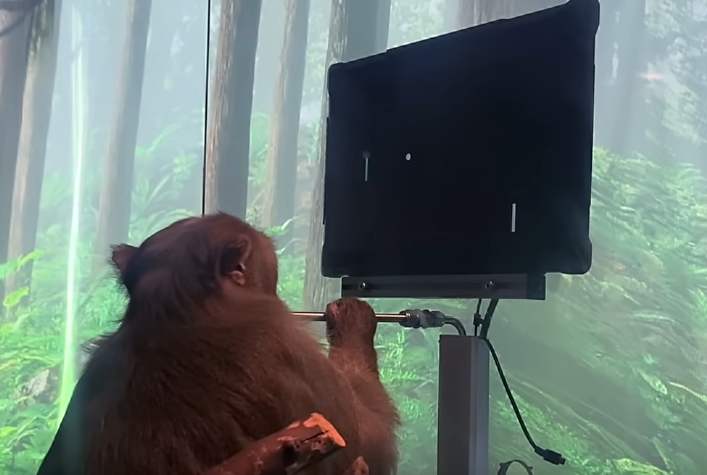
In the video, Pager plays two games using a joystick. For the first, he moves a cursor to an orange square in a grey grid, then moves it to the next square to pop up. For the second, he plays his favorite game, Pong.
While he plays, the Neuralink team have been analyzing the neural activity in his brain using a Neuralink implanted in his brain. They are able to receive data in realtime, and figure out which patterns of activity correspond to each hand movement.
The voiceover states that “After only a few minutes of calibration, we can use the output from the decoder to move the cursor instead of the joystick”. The team then unplugs the joystick and has Pager play. Pager is then able to just think about moving his arm, and is able to play Pong using his mind.
Implications
First of all, Neuralink was launched 1 year ago, and we already have monkeys playing games with their mind. I predict with 70% confidence that, within a year, Neuralink will be placed in a human and will have basic functionality. If I’m wrong, I think it’ll mainly be because of Neuralink not being legally allowed to conduct a human trial, or due to long term safety concerns as opposed to short term ones.
My impression from people who have been working on BCI for a long time is that this isn’t that impressive. Not that the hardware isn’t impressive, but that they’ve done similar-ish things with worse hardware for a long time.
Just a quick Google, I’m not exactly endorsing this article, but it seems to support my impression.
https://www.inverse.com/innovation/neuralink-video-shows-musk-gaming-monkeys
The hardware is impressive — it’s best-in-class, but the presentation was mostly theatrics. We’ve had brain-computer interfaces for cursor control for 30 years (pong can be reduced to 1D cursor control — it’s even simpler than the first task).
It’s just a lot cooler to the public when its Musk getting a monkey to play a video game.
If this has been a thing for 30 years, why is the hardware best-in-class? Also, is there a presentation that is more impressive/innovative but perhaps less theatrical?
The hardware should be best-in-class due to the massive amount of channels (over 1,000), and the fact that each channel is surgically implanted into the head. For comparison, 16 channels is on the high end for consumer-grade BCI kits, and each channel is a sensor that rests on top of the skin.
As far as why they aren’t making use of its capabilities to do something more impressive, I don’t know.
For what I would consider a more technically impressive presentation, see this video of a man controlling two prosthetics in 3d space to slice bread.
I assume because Musk put a lot of money into it and got the right people together.
I think that monkey video is the most advanced thing Neuralink has put out.
Including people doing things like the monkey does in the video, right? ‘Mind pong’.
I’m fairly confident I saw pong being played with a BCI many years ago. I’m sure you could find some videos without too much trouble, but Rabrg just posted a video of what I think is even more impressive than pong.
Neuralink is cool and very hyped, but I also think this is more subtle and perhaps even cooler: Facebook bought a company which creates a wrist based human interface device. They claim that they can sense hand & finger position from the signals detected from a specialized wrist strap.
Given how much expertise humans have in fine motor control of their hands, and the astonishing generalizeable capability our hands have displayed (in sports, writing, crafts, fighting), I am optimistic about a wrist based input device becoming common place, simply because there is no onerous requirement of surgery.
I suspect that the first use case will be like the monkey example, except where humans type on a phantom keyboard, and from there people will start learning entirely new ways to communicate using only hands—possibly as their primary interface to any computer.
Woah, just on a watch-like device! How far along is this technology?
Xela!2026 here from the future, who just realized that Xela!2021 made a prediction in this post, and specifically one that seems too optimistic:
It looks like[1] it took two years (to the month, as it happens) from posting for Neuralink to get FDA approval for human trials, started trials in September, and then by late January implanted in a human. By late February Musk said the first participant was controlling a mouse by thought. I also have seen much more recent tweets from a successful patient (they’re quite heartwarming because his little daughter are in them).
My current thoughts:
Obviously I shouldn’t have put 70% on them even getting approval in a year! What was I thinking‽ I really don’t think I would’ve done that today, this isn’t just hindsight bias (besides hindsight about how long and hard getting approval is generally)
Neat, I was right about why I was wrong. I find it highly likely that if approval was magically granted the instant I posted, the February milestone would’ve happened by May 2022.
As commentors pointed out, Neuralink isn’t as groundbreaking fundamental-tech-wise as I thought (as opposed to Musk ‘just’ pushing a product to market and optimizing the practicality, which to be clear would be nothing to snuff at). I don’t have any Neuralink-specific thoughts about this, but I feel like I’ve semirecently learned enough neuroscience that the fundamental technology is just no longer so surprising—Xela_2021 was shocked by the comment that we’ve had BCI mouse control for 3 (now 3.5) decades, but I think I (Xela!2026) would’ve put my median at 2015 with significant probability on it having happened sometime in 1980-2000, and even more on the fundamental tech capability being there even if nobody actually did it. Not sure to describe the generator, it just rhymes with other stuff I’ve seen neuroscience do that had already been achieved before 2015.
From Wikipedia:
and