Lies by Omission
(This post is undergoing a deep revision, so the current state is incoherent)
TL;DR: “Technically, I wasn’t lying” is never relevant.
Five scenarios
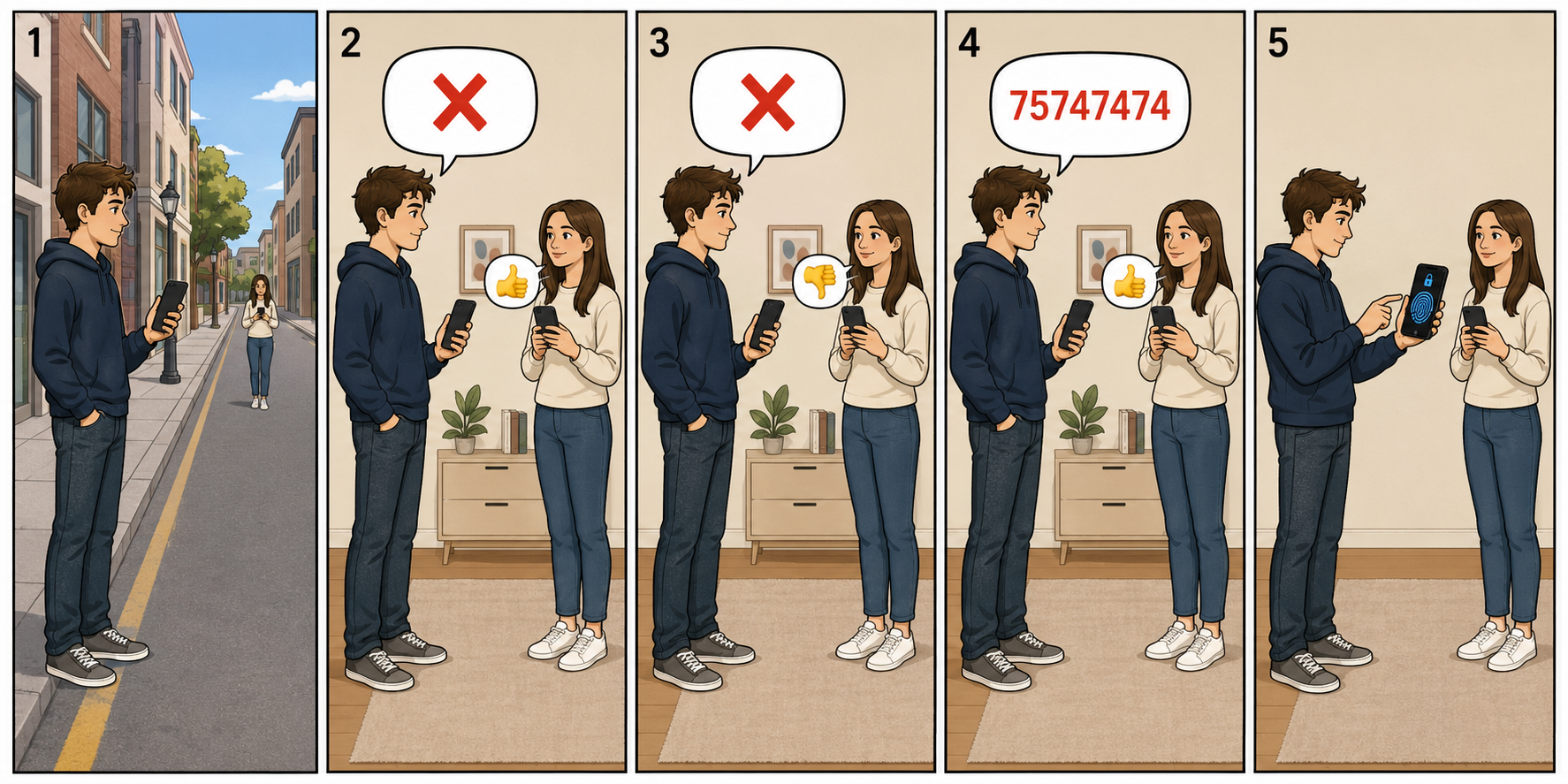
1. Bob wants to avoid getting robbed. He doesn’t share his credentials with people he doesn’t trust, like his acquaintance Alice.
2. Bob is married to Alice. He tells her he’d prefer not to share his credentials with her, to avoid risks. She agrees.
3. Bob is married to Alice. He tells her he’d prefer not to share his credentials with her, to avoid risks. She disagrees. They reach a compromise.
4. Bob tells Alice his credentials.
5A. Bob is married to Alice. He knows she’ll insist on knowing his credentials, so he lies and tells her the bank authenticates him via fingerprint on his iPhone.
5B. Bob is married to Alice. He knows she’ll insist on knowing his credentials. But through an odd set of circumstances, Alice happens to see Bob unlocking his iPhone one day and wrongly assumes this is how his bank works. Bob is aware of her mistaken assumption and is thus able to exploit this fortunate accident to satisfy his preference of keeping his credentials private — despite knowing this conflicts with Alice’s preferences.
I claim that scenarios 5A and 5B have a property in common, and I want to characterize it without losing the ability to distinguish between all other scenarios 1-5.
Failed attempt: Not telling is lying
In the first version of this post, I claimed that not telling was lying. As pointed by several commenters, this is highly problematic. There is a clear difference between saying a statement that doesn’t correctly describe the world, and not saying any statement.
The Behavioral Intentional Stance (BIS)
My proposed attempt is the intentional stance, or rather an adjacent concept I’ll call the “behavioral intentional stance”. One’s beliefs about the world adopt the (epistemic) intentional stance towards X when they model X as having preferences and acting based on those preferences.[1] It’s obvious that a liar still adopts the intentional stance epistemically when dealing with the target of their lie: they are aware that the target disprefers being deceived, and so they conceal their deception. But something adjacent to the intentional stance can be adopted or not adopted in one’s behavior.
Every decision is an optimization problem: there is a set of preferences, and acting means finding world states that optimize for those preferences. To behaviorally adopt the intentional stance towards X means including X’s preference in the set being optimized over. Preference sets are often incompatible, so adopting BIS towards X often means recognizing that the naive picture of how a collaboration might look is actually unworkable. Sometimes a slightly modified, compatible collaboration plans is easily found; sometimes it isn’t.[2]
Main claim: There is no middle ground between adopting and not adopting BIS. One can of course adopt it partially, i.e. adopt it towards collaborating in goal A, but not adopt it with regards to goal B. But in this case there is a meta-decision at the top about which goals call for the BIS, and that decision is made unilaterally.
What I’m not saying
I’m not saying that lying, or failing to adopt BIS, is morally wrong.[3]
I’m not saying that, in the example above, the man bears any responsibility towards the woman. In particular, I’m not saying he has any responsibility to correct her naive assumptions (for instance, in a context where his revelation comes as a complete surprise rather than a known social behavior that some people do).
I’m only saying that there is no middle point between adopting BIS and not adopting it.[4]
Possible objections
1. Does adopting BIS towards X mean that I should be optimizing for their preferences at all times?
No. Adopting BIS towards X only matters when you want something that involves X. If you don’t want anything from X, whether or not you adopt BIS makes no practical difference.
2. Doesn’t everyone hide information from other all the time?
The frequency of a social behavior in a society is a property of the society, not of the behavior itself. I agree that our society normalizes both lying and the obfuscation of the nature of lying.
3. Isn’t this draconian? What would you do if anyone hid even one item of information from you?
I don’t think anyone has a duty to adopt BIS toward me. Most low-stakes collaborations don’t require it. When I’m interested in any kind of deeper collaboration with someone, I try a conversation as early as possible to check that we share the same understanding of what adopting BIS means.
I wouldn’t treat most instances of someone failing to adopt BIS toward me as particularly informative about how much I should collaborate with them. But I would treat their inability to acknowledge that they weren’t adopting BIS, or their inability to see any difference between BIS and non-BIS, as a major red flag and a sign that complex collaboration with that person is probably impossible or risky.
4. What if someone hides A from X but feels uncomfortable hiding Y? Doesn’t this show some consideration toward them, even within the act of concealment?
Psychological distinctions are often arbitrary and don’t automatically track ontological ones. Evidence that this case is different is needed.
5. Imagine a wife who does everything to make her husband happy and who one day has an affair. She has good reason to believe he would be devastated if he found out, so she says nothing and never cheats again. Is she adopting BIS?
In most cases, not adopting BIS looks like treating X like an object, and this is indeed not the case here. But she is clearly not treating this like two agents optimizing together to move past a mistake. So it’s still clearly not-BIS; it just looks like treating X as a child in this case.
6. She was fine with it!
Sure. But whoever searches with a star-shaped cookie cutter finds only star-shaped cookies.[5]
- ^
I adopt it when I treat rain as an action of a god I might influence by understanding their preferences. I don’t adopt it when I treat rain as a physical process with nothing “behind” it.
- ^
More on this in this insightful post by Henrik Karlsson.
- ^
I’m also not saying it’s morally right.
- ^
So any potential moral disagreements reduces to the question of whether X owes Y the adoption of BIS towards them.
- ^
There are two dimensions: clear lie to technically not lying, and using the other to optimize for one’s preferences vs keeping the other’s preferences in mind.
-the decision to withhold the truth should never be based on personal needs, such as a need for power, a need to be liked or a need to protect one’s map from challenge.
-the decision to withhold the truth must always be based entirely upon the needs of the person or people from whom the truth is being withheld.
-the assessment of another’s needs is an act of responsibility which is so complex that it can only be executed wisely when one operates with genuine love for the other.
-the primary factor in the assessment of another’s needs is the assessment of that person’s capacity to utilize the truth for his or her own spiritual growth.
-in assessing the capacity of another to utilize the truth for personal spiritual growth, it should be borne in mind that our tendency is generally to underestimate rather than overestimate this capacity.
Scott Peck, The Road Less Traveled
A potential third dimension is the willingness to enter ambiguous conversations.
If you told the average person “I lied to Bob about my bank credentials”, they would picture you giving Bob a set of false credentials, and if you attempted to clarify that you in fact gave Bob no credentials at all they would say something like “Huh? So you didn’t lie?”
Using the word “lie” as the phrase “not telling is lying” does will predictably cause people to become mistaken about the state of the world. There is a word for such acts.
Can this particular objection not be gotten-around by using the person’s prior internal state-of-knowledge?
If Alice’s pior internal state is “Known-ignorance of Bob’s bank details” and “Strong-belief that Charles isn’t sleeping with anybody else”, then Bob’s remaining silent causes Alice to maintain a perfectly valid internal state, whereas Charles’ remaining silent causes Alice to maintain an internal state that Charles knows to not match reality (along a dimension about which Alice might reasonably be expected to care).
I’m not claiming Charles is necessarily morally obliged to tell Alice he’s sleeping with other people—just that I think this particular objection might not hold if we’re allowed to factor-in Alice’s prior internal state-of-knowledge.
You’d have to care about Bob’s internal state too. It doesn’t meet this expansive definition of lying if Bob doesn’t tell Alice because he foolishly imagines she doesn’t care, or forgetfully doesn’t think about it at all.
But more deeply, I don’t think the idea survives contact with Bayesian reasoning. Suppose that almost everyone who uses the word BIPOC supports the Democrat party. The same logic that gets us to “Bob is ~lying~ by not telling Alice he sleeps around” also says that Bob the Republican is ~lying~ by saying BIPOC, because his audience will generate a false internal state that Bob is a Democrat (which they might reasonably be expected to care about). A properly calibrated audience would generate an internal state something like “There is a 97% chance Bob is a Democrat and a 3% chance Bob is a Republican with an unusual vocabulary”, which is perfectly valid.
I don’t think we can put the philanderer and the unusual Republican into different categories here. If we want to say that the philanderer is ~lying~ then the concept expands to cover any statement that causes a Bayesian update away from perfect accuracy and confidence about the state of the world (at least on any subject the audience cares about, whatever “cares” means). Without calling that concept useless I will say it seems unwieldy in its extraordinary breadth.
Very good objection, thanks. What do you think of the point, possibly not clearly made in the post, of distinguishing whether Bob wants Alice to think he is a Democrat (maybe she organizes a cool party for Democrats) or doesn’t care what others think? Would you find it absurd to say that in the first scenario Bob indeed belongs in the same category as the “silent philanderer”?
I agree that there are paradigmatic cases of not telling and of lying, and that they are distinct. Naming the post as I did was a mistake, and I’ll change the title.
I’m less sure, though, how often real cases fall as cleanly on one side or the other as the paradigmatic ones do.
The point I was trying to make — and should have made more clearly — still stands: both are manifestations of the same underlying phenomenon, in contexts where both possibilities arise naturally (unlike the bank credentials case, where only lying is a natural possibility).
“If someone is interested in information and you care about keeping them in the dark, then not telling is ~lying~” includes keeping bank credentials secret. It sounds like to avoid that problem, you’re proposing “If someone is interested in information and you might naturally tell them and you care about keeping them in the dark, then not telling is ~lying~”.
This natural possibility thing seems very underspecified.
Thanks for this objection. This is exactly the kind of scenario I wanted to distinguish, and I agree that my point is very underspecified.
I’m not sure whether I’m trying to define “natural possibility” or something else entirely. My attempt was to draw a distinction based on how Bob’s optimizing his wishes routes through the possibility of telling someone else.
I see 5 scenarios:
1. Bob wants to avoid getting robbed. He doesn’t share his credentials with people he doesn’t trust, like his acquaintance Alice.
2. Bob is married to Alice. He tells her he’d prefer not to share his credentials with her, to avoid risks. She agrees.
3. Bob is married to Alice. He tells her he’d prefer not to share his credentials with her, to avoid risks. She disagrees. They reach a compromise.
4. Bob is married to Alice. He knows she’ll insist on knowing his credentials, so he lies and tells her the bank authenticates him via fingerprint on his iPhone.
5. Bob is married to Alice. He knows she’ll insist on knowing his credentials. But through an odd set of circumstances, Alice happens to see Bob unlocking his iPhone one day and wrongly assumes this is how his bank works. Bob is aware of her mistaken assumption and is thus able to exploit this fortunate accident to satisfy his preference of keeping his credentials private — despite knowing this conflicts with Alice’s preferences.
In scenario 1, Bob does not adopt BIS toward Alice.
In scenarios 2 and 3, he does.
In scenarios 4 and 5, he is in a relationship with Alice in which they have implicitly agreed to adopt BIS toward each other. (This agreement is usually implicit and poorly articulated — but I can’t think of any real relationship in which it wouldn’t come as a surprise to say: “just so you know, whenever your preferences have been conflicting with mine, I have been doing my utmost to thwart them.”)
I agree with your first objection: the word “lying” has a clear meaning and it applies to 4, and not 5.
But what Bob, considered as an agent optimizing for his preferences, is doing in both scenarios, is the same. The only difference is that he got lucky in scenario 5 and didn’t need to lie. If Alice got angry at Bob, and Bob defended himself on the grounds that he hadn’t lied, he would be obscuring his responsibility for what happened, which is not just one particular action but the fundamental fact that his preferences route through Alice differently than what she thinks.
There is a term for egregious version of this, “lie by omission”, when you omit critical information with intent to form false impression in recipient.
Interesting examples from here:
From here:
Kinda awkward, but it’s nice example of a person adding details to their answer that excludes some pathways for the question to be fulfilled and hope that questioner does not notice a hole.
Two great examples and a concept that should have and will be mentioned. Thanks!
If I take this position fully, then it’s not actually possible for humans to avoid lying. Our communication channels are too low bandwidth to transmit everything we know that might be relevant to someone else, even if we really wanted to. Most of the time we don’t think about this, because we all have an intuitive sense of when we’ve shared enough to be not-lying-by-societal-standards and only call it out when either it’s blatant or we disagree on the margin about where in the vague boundary region we should draw a bright line. Regardless, for practical purposes we do need to draw a line, and I don’t think the one gestured at here is workable.
The most we can say using an argument from bandwidth is “If the ideal moral setpoint (between “true-but-trivial; not morally necessary to share” and “true-and-significant; morally necessary to share”) is low enough a person acting morally would have bandwidth to spare, and if the setpoint is high enough a person acting morally would saturate their available bandwidth”. It can’t actually say anything about where the optimal setpoint actually ought to be.
I think you and I might be in agreement that the optimal setpoint does indeed leave plenty of bandwidth headroom for ordinary communication, but I’m not sure that @Fernand0 is actually arguing for a setpoint so high it would saturate all available bandwidth: the “I had an affair” and “I’m sleeping with other people” examples do seem intentionally-chosen to meet the ‘true-and-significant’ test.
Indeed I’m not, but my post isn’t clear on this point. Thanks for pointing it out! (I will rewrite it)
This makes me think of the Cooperative Principles, per Grice’s maxims, which is a concept in linguistics, pragmatics specifically. Coming from linguistics, I separate concepts of semantics (what a sentence means), pragmatics (what a sentence means in context that you can infer from a transcript), and paralinguistics (what one conveys at large in an instance where language is used, but also possibly related to gesturing, body positions, facial expressions...)
For me, lying is a concept that applies to semantics only.
Failing the cooperative principles means failing to be cooperative in communication, which is a superset of lying.
A very relevant point to be included in my rewrite, thanks!
Is not sharing a memetic hazard lying? Not sharing something you genuinely but wrongly believe to be one? Strongly suspect to be one? Note that your example #5 is related to this.
Thanks for pointing out what my post doesn’t explain properly. I’ll edit my post in I way that hopefully answers your questions.