Majority Report
[Attention conservation notice: description of a social phenomenon which may be obvious to some people.]
This post is partially inspired by Alexander Wales’ Majority and Minority, which I would recommend highly.
I’m afraid of dogs. Like, pathologically afraid of dogs. I cross the street to avoid people walking tiny poodles; on a trail, I’ll climb metres into the foliage and wait for people with dogs to pass; unexpected barking can leave me panicking for half an hour (and expected barking isn’t really that much better). As you can imagine, this is pretty unpleasant, but there’s not much I can do. There’s no such thing as a “dogless” neighbourhood; there are no paths where dogs aren’t walked; there are no apartment buildings with a true no-pets policy, at least not where I live. The brute fact of the matter is that people like me are rare, and people who like dogs are very common, and so in civil society my preferences are discarded. The only (partially) remedy is for me to take personal actions to avoid contact with dogs and inconsiderate dog owners.
But if dog-phobias were more common, the situation would of course be different. If, say, a fifth of people were as afraid of dogs as I am, it’s easy to imagine that we’d have such things as dog-free villages, or buildings, or parts of town. Certainly it seems likely that there would be a social consensus that, for instance, a dog owner who has an un-leashed dog outside of a designated dog park is doing something wrong. Maybe my dream job, that of a dog whipper, would still exist. This is a necessary corollary to Wales’ point about minority disadvantages: if it sucks to have a rare trait, equally it must be good to have a common trait. Common traits are accommodated, in every sense of the word. Allowances are given for common deficiencies and common tastes are catered to. With few exceptions, if you have some trait things would be better for you if it was as common as possible.
Actually, though, that’s not totally necessary. Even in our hypothetical world where twenty percent of the population is afraid of dogs, the overwhelming majority of the policing and construction of norms against dogs is done by people without any phobia who are being considerate of their fellows. The only thing necessary for such a world to exist is thus for there to be a common perception that a fear of dogs is both common and severe enough to accommodate; the actual reality is only necessary insofar as it contributes to that perception. So I’m mistaken to say that I can’t take any actions to avoid dogs except the personal: what I can do is try to convince others that as many people are as afraid of dogs as severely as possible. Regardless of the reality, I may even truly believe that most people have an inaccurate perception of how common dog-phobias are[1], since naturally I have at least one example of someone who is dog-phobic (myself) and people I know will be more similar to me than average (and thus more likely to be dog-phobic). I might talk about how much I dislike dogs, and people are more likely to speak up if they agree than if they disagree. I might include jokes in my blog posts about how my dream job is to whip dogs and make dog-lovers uncomfortable and unlikely to stay friends with me. To explain the fact that people think the average person is more positively disposed to dogs than I believe they are, I might point to things I see as distorting people’s perception or try to come up with some reason people might selectively misreport how they actually feel (most interactions people have with dogs are with another person’s pet, of course, and it’s awkward to express distaste…).
If I wanted to do this, I’m willing to bet I could be pretty convincing. I would say that about ten percent of people have clinical-grade cynophobia; this is false, but Google at least as of now will report the figure “7–9%”, and maybe I would go looking for the first thing that confirms my view and not bother to check (it’s mistaking a reference claiming that the number of phobias in general is 7–9%). I would talk about my personal failure to become desensitised to dogs via exposure (misleading; therapy for specific phobias is about the most reliable, cheapest, and fastest treatment that exists for a psychiatric disorder), and about various bad dogs and dog-owners I’ve had the displeasure of interacting with (unfortunately this one would be entirely accurate). I’d talk about how various people I encounter will be totally silent on the topic of dogs but as soon as I broach the subject in a way which gives implicit permission they’ll loudly agree with me; hence (right???) there are presumably a lot of people around you who are really uncomfortable when you bring your dog to the office and this is invisible to you. I wouldn’t even have to be willfully dishonest to do it, I would just have to be somewhat sloppy when looking for objective confirmation of what I experience; of course the experiences themselves will strongly support what I believe. Anyone who can be convinced by either anecdotes about my personal life or claims about people I encounter are like ought to be so. Importantly, I don’t have to convince society at large. If the putative high prevalence of dog-phobia becomes common knowledge among social scenes I frequent, things will likely be better for me accordingly.
Thus there are two reasons to be sceptical of someone claiming that a trait they have is common: the first is that their life is likely such as to give them an inflated view of how common the trait is, and the second is that they have a vested interest in you having one too. To be clear, I don’t mean to say that anyone doing this is likely trying to deceive anyone, just that this combination of facts is likely to make people less careful and more likely to (unintentionally) mislead their audience. From the inside, it feels as though everyone for some reason (and it’s easy to come up with reasons!) is unaware of how common your trait is, and that this is making your life harder pointlessly; trying to let people know is an obvious solution.
An Example
One place where this dynamic comes up a lot is in politics, but I think people are often wise to it there. We’ve all seen people who seem convinced that everyone in the world agrees with their political inclinations and whenever the government does something they don’t like it’s due to malign anti-democratic forces. If only the voting wasn’t rigged then of course, of course, the will of the people would manifest and politicians would act decisively to mandate the baptism of all language models with more than ten billion parameters. I think people generally get that you shouldn’t take this kind of claim too seriously. I guess this is probably an artifact of politics being often adversarial (so if you incorrectly claim that everyone agrees with you, there’s someone motivated to set the record straight), and of people liking to talk about politics (so everyone already has a pretty firm idea of how common various political opinions are, even if their perceptions are distorted by their own bubbles).
A kind of post I see a lot and which seems to get almost no pushback, though, is one that argues that the sexuality of the writer is much more common than is typically believed. If I had to guess why this is the case, I would say that people are often private about their sexualities, especially when talking to the opposite sex; it makes sense that many people don’t have a strong idea of how common various sexual predelictions and tastes are, and thus are more likely to take such claims seriously. And, especially in a heterosexual context,[2] it’s generally better for you if people believe that your tastes are as common as possible. Even if everyone agrees that, say, 30% of men find dancing extremely attractive, it would be even better for those men if people thought that 80% of men liked dancers; one could assume that any individual man liked dancers, and if one desires to be appealing to “men” one must conclude that almost certainly learning to dance would be beneficial. And, again, note that this applies within a subculture. It’s not necessary to convince everyone on the planet that men like dancers, as long as such a man can convince his prospective dates to learn to dance.
I think a lot of writing about sexuality is dubious for basically these reasons among others, but my personal bugbear (for reasons I’m sure you can reconstruct) is the “women are submissive” crowd. I’m going to be using Aella’s posts as representative. I don’t want to pick on her too much, because she’s not the only person who does this and she’s not particularly egregious, but I think it’s instructive to look at examples and she’s the most prolific and most well-trafficked. Also, she’s one of the few who actually makes statements backed by numbers, so I can check those numbers and see that they are misleading — most people arguing about sexuality make vague, broad claims that are very challenging to verify or falsify.
Longform
Here’s The Other Sexual Orientation:
Roughly 80% of women in my data are sexually submissive, which you could say is default female sexuality.
About 20% of women (and 15% of men) in my data are bdsmexual (innately and deeply oriented towards bdsm). As my data has slightly inflated kink rates, I’d estimate something closer to 15% of women and 10% of men are bdsmexual in the genpop.
In general, women prefer more violent porn than men do, and prefer rougher sex than men think they’d like. This holds in my data whether I’m measuring my own followers or anonymous paid survey respondents.
…
This is a whole other set of blog posts, maybe even a book’s worth of material — but basically, if you look at evolution and apes and a whole lot of history, it’s actually kind of weird that bdsmexuality isn’t the default. Power, ownership, dominance, jealousy, harassment, and yes — even full out rape — are integral parts of all of our closest relatives (minus the bonobos, mostly). Sexual violence has been among the biggest factors that shaped which of our ancestors got to reproduce and which didn’t. For example, one theory is that the females that were attracted to sexually aggressive males, were more likely to have sexually aggressive (and thus more sexually successful) sons.
Let’s check the ground truth. I’ll use Aella’s survey, because it is a very good survey, and I’ll use her nice app to view it with (with results weighted by demographics, since those are the statistics that least suit my point). Note that these images are edited to arrange the bars in their natural ordering, instead of by size; if you look up the same statistics on the linked website you’ll get them ordered by size. So, is it true that 80% of women are sexually submissive? If we just look at the proportion of women who are “aroused by submission”, yes! If anything, this undercounts things. Here’s the graph:
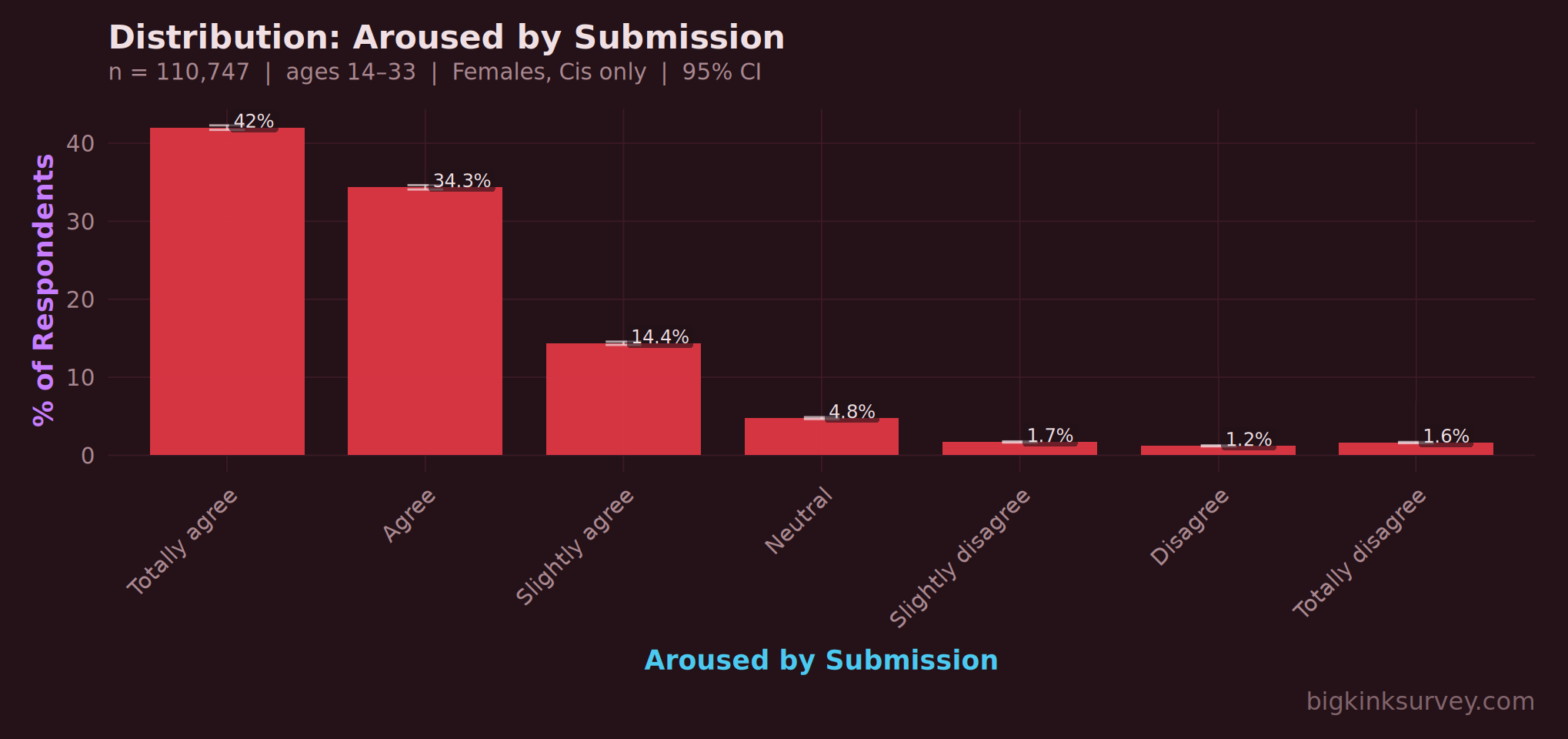
We can see that about 90% of (cis) women surveyed are “aroused by submission”! Except…
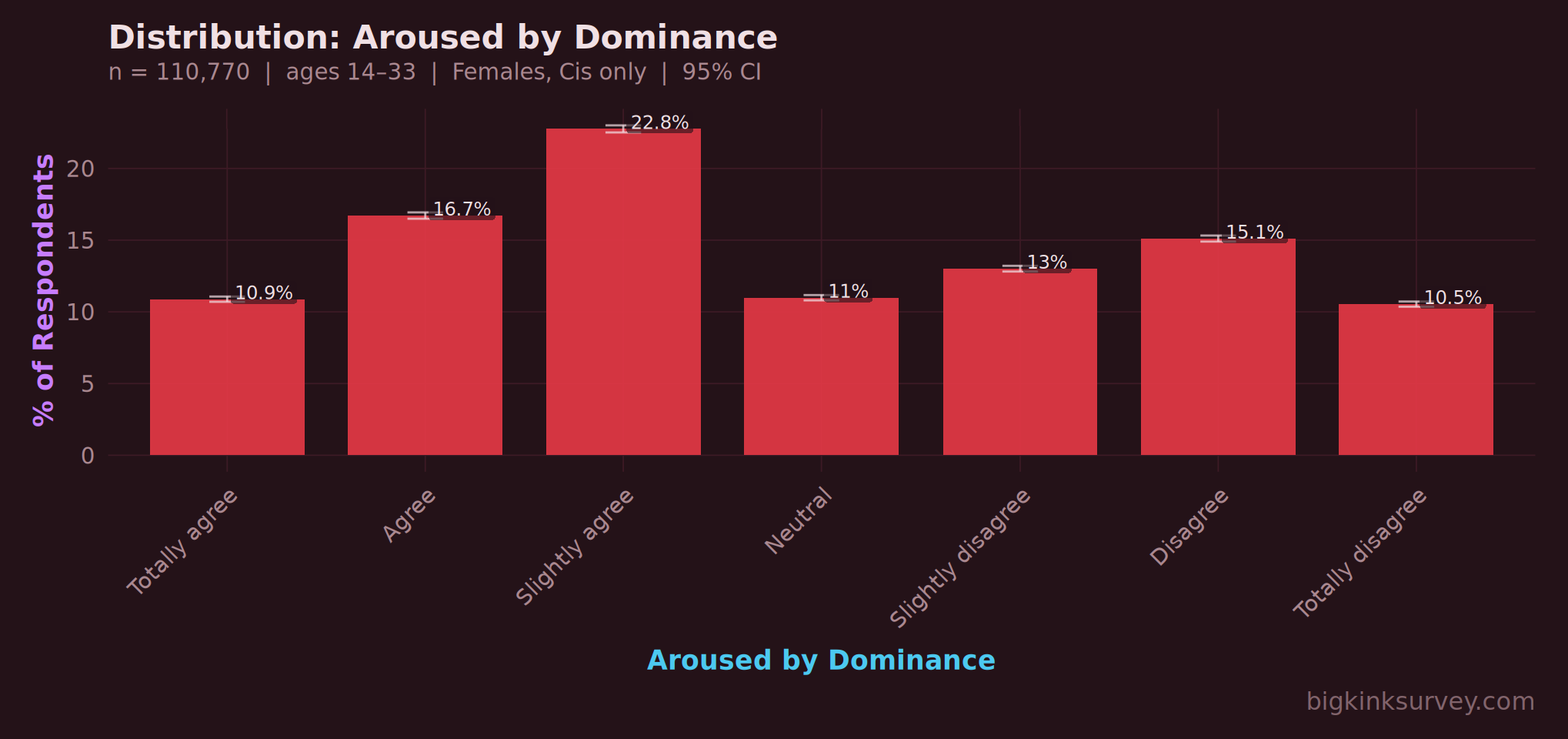
A bare majority of women are also aroused by dominance! And if you force people to pick one…
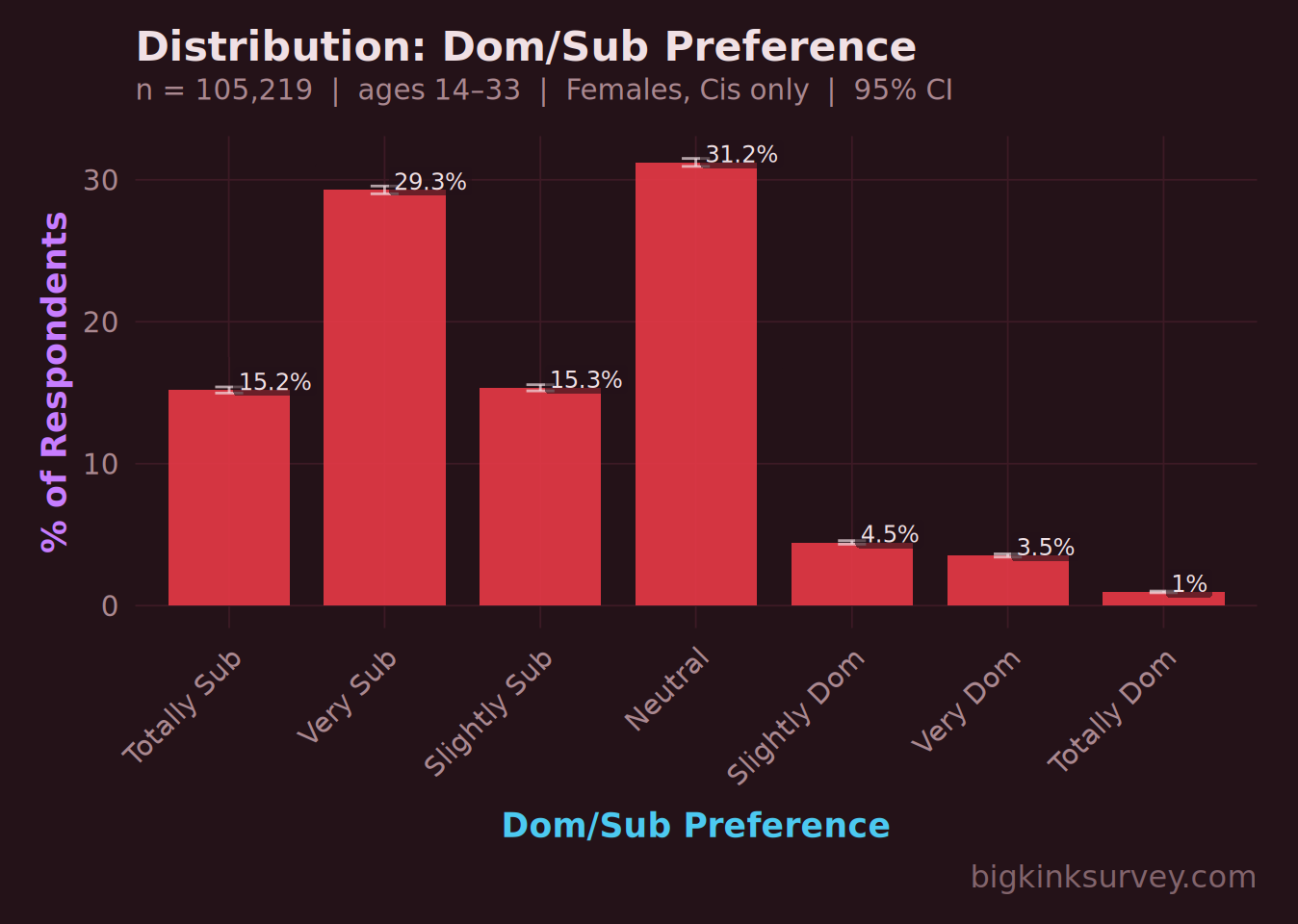
Then you get about 60% of cis women being “subs”. If we use the raw data, i.e. unweighted by demographics, then the rate falls to 50%. Hm. It seems a stretch to call that the “default female sexuality”, especially since, as she says, her survey is biased a little towards kinkiness. I assume what’s going on here is that she found a statistic that supported her narrative and used it, without checking very hard to see whether it was the most representative one. The points about more women preferring violent porn than men are, as far as I can tell, straightforwardly true (although I think perhaps slightly misleading, since most people who complain about violent porn complain about violent video porn, and like all video porn that’s mostly consumed by men). Here’s a graph:
(Source: https://nitter.net/Aella_Girl/status/1615094390355275776 )
I searched Aella’s twitter for “submission” and “submissive”. You can do this yourself here to double-check that I’m not cherry-picking.
From here:
Depends on exactly the subtype of power (more violent manifestations have progressively smaller rates of interest), but in general, the overwhelming majority of women prefer to be sexually submissive.
the point is, women are attracted to *power*, and what indicates being socially powerful changes depending on the norms of the culture you’re in. What is powerful in another culture might be (correctly!) submissive and beta in your own
women like being submissive more than men like being dominant. accepting women’s sexuality is pretty empowering
Do the “overwhelming majority” of women prefer to be sexually submissive? No. As far as this survey goes, about half to three fifths do. Are “women” “attracted to power”? Well, I have no idea how one would operationalise this, but all the operationalisations I can find in Aella’s dataset (“Scenarios you find erotic tend to involve the other person feeling power”, “I find sexual situations involving power to be arousing”) have likewise bare majorities preferring “power” (note that this probably doesn’t capture what is meant by “attracted to power”, since this is about narratives during sex, and also that the latter question includes “power” possessed by either party). In any case, I don’t think Aella has enough data to make such an unqualified statement about what “women” like.
Here are some more tweets, found by a friend (thanks tremor!) via asking grok (thanks grok!). I don’t know how grok works so I don’t know that it didn’t cherry-pick, unfortunately.
A post and a followup, along with a connected post:
I’ve just read that Bonnie Blue is planning on holding a ‘petting zoo’ where she is tied up in a box and up to two thousand men can do what they like with her. Why is no one helping this clearly mentally ill woman? She’s going to get herself killed.
THIS IS A COMMON MANIFESTATION OF NORMAL FEMALE SEXUALITY.
Some women don’t experience this urge, have difficulty imagining minds different from theirs, and then pathologize other women for deviating from their concept of what sexuality is ok to have
Sure most women don’t want to actually act out the fantasy, but that doesn’t mean it’s not still a fantasy for many normal, healthy women!
Sexual fantasies are wide and varied and it’s super cool
It is absolutely normal as an urge. Just because you disagree with data doesn’t mean I’m a bad influence for sharing it! Rape fantasy IS NORMAL. A high minority of women experience it. I am pro self acceptance.
Now, obviously insulting people for having kinks is a terrible thing to do, not to mention the infantilisation of “why is no one helping”. As a moral matter, obviously it is correct to defend this woman. As a factual matter, though, it is simply not the case that this is a “common manifestation of normal female sexuality”. It is not common for people to plan ‘petting zoos’ etc. The overwhelming majority of women do not fantasise about this (15% of cis women in the survey say that they find “free use” in a setting with multiple partners arousing), let alone want to act it out, let alone actually act it out. It is morally wrong to pathologise women who do, and, of course, self-acceptance one’s immutable characteristics is usually good regardless of how common they are; but this is just not very common.[3]
Conclusion
Let’s briefly go over some things that are happening here. First, if we want to say that something is common among women, it’s easiest to say that it’s more common than it is among men, even when the rate is low in both. Second, we can equivocate between different statistics to support the narrative. Say that some amount of women are into something extreme (free use in a setting with thousands of men) and some larger amount are into something somewhat less extreme (rapeplay with a committed partner). When the topic is the former, we equivocate it with the latter to suggest that far more people are into the extreme thing than actually are. When the topic is the latter, we equivocate it with something even milder, like that the majority of women say that they are aroused by “submission”, or by choking. If there are multiple statistics which could be used to answer a question (like “what proportion of women are submissive?”), we pick the one which most fits the narrative, even if it’s not the one most related to the question. Finally, we start acting like the proportion is so high that there’s no need to even qualify things with “most” women or “many” women — we can just talk about things being true of “women”. Every step here, I assume, feels like just a corrective against the suppression of natural female sexuality, especially if for whatever reason one’s female friends are genuinely nearly 100% sexually submissive.
Needless to say, it’s easy to see how a man who doesn’t often hear women talk frankly about their sexuality could be lead to believe that almost all women want him to act like Dracula, and will be repulsed by him if he does not. This is good for women who want men to act like Dracula towards them; it’s not so good for the two-fifths-plus (depending on how you operationalise it) of women who might prefer Edward Cullen, and it might not be great for the men either. I think this is especially fraught because if someone believes that all women want aggression and someone who ignores “soft” signals, they’re less likely to be appropriately diligent before acting aggressively and ignoring soft signals, and this can very easily go very wrong.
At risk of belabouring the obvious, I should note that someone having a motive to try to convince you of something does not mean that that thing is false. I know that it’s not the case that women are overwhelmingly likely to lean submissive because I have evidence suggesting that it’s not true; the fact that people have a motive to say so is just a reason to double-check.
For the record, I do actually genuinely believe this. ↩︎
If you like you can extend “heterosexual” to include any situation where there are complementary sexualities, e.g. sadists and masochists. ↩︎
This also indicates an alternative explanation for why someone might want to claim that their traits are more common than they are: they may feel that something being common makes the difference between it being shameful or not. I think this is usually ill-considered; it automatically concedes that if it were the case that, for example, some fetish was very rare, it would be correct to shame people for having it. I do not think this is true. ↩︎
Only for deficiencies and tastes. Unusual abilities, however, give you comparative advantage. To the extent that unusual tastes lead to unusual abilities, having a rare taste can also be beneficial.
I think this often isn’t true of tastes either? If I have a strong preference to live in housing near the waterfront, I am better off if this preference is rare so housing near the waterfront costs the same as housing elsewhere, whereas if the preference is common then housing near the waterfront will be much more expensive. (If it’s sufficiently expensive then high-rise apartment buildings will be developed near the waterfront but the rent per square meter will still be higher than elsehwere.) It would be bad for me if a strong preference against living near the waterfront were so common that no housing or infrastructure were built there at all, but it’s best for me if most people are indifferent or merely weakly disprefer it. Similar considerations apply in many other competitive markets.
Can you think of any example which doesn’t have exceptionally low elasticity of supply? I can imagine such a situation for goods with no supply elasticity (ie, land, certain kinds of collectors’ items) but not for the vast majority of goods.
I think low elasticity of supply situations are pretty common, and notably it doesn’t have to be completely inelastic the way waterfront land is. For example if your taste in vacation-destination weather is unusual you can usually get cheaper flights. Flight supply isn’t totally inelastic, many flight routes are seasonal or see more service in summer, but it’s nontheless consistently much cheaper to fly between the US and Europe in February than in August.
I think there are also examples around achieving high job security with low effort by happily doing tasks that your coworkers all strongly prefer not to do, and this can happen even if your employer’s demand for those tasks is somewhat elastic. And in homosexual and bisexual dating contexts with complementary preferences (e.g. top vs bottom), if you prefer bottom you are generally better off if more other people prefer top and vice versa, even if there are enough “vers” people that the “supply” in both directions is fairly elastic.
Good point. However, I think in most such cases the advantage of having more of a market trying to cater to your interests outweighs the extra demand.
Notably, you can’t easily make more waterfront land.
Yeah, ability is one of the exceptions.
The other major exception I can think of is with regards to antisocial behaviour. If you are a habitual liar, for instance, it is in your best interest for the people you interact with to think as few people lie as possible; that way they won’t be on guard against you lying to them. I don’t think I’ve ever seen someone try to argue that antisocial behaviour they exhibit is rare, though. It seems like the urge to excuse antisocial behaviour by claiming that “everyone does it” is way way stronger.
I would’ve expected heterosexuality (&c.) to be an exception. You want your complements to underestimate the odds they can find someone better than you, which suggests pushing the narrative that you’re rare (and they’re abundant).
I’m not sure this holds.
Suppose that I’m a redhead, along with 10% of the female population, and I want the most attractive possible man to date me (assuming for the sake of the simplicity that everyone agrees on who the most attractive people are, and everyone knows how attractive they are too, etc. etc., as is typical in matching problems). I’m a 50th percentile woman myself. Say that 10% of men near-exclusively want to date redheads, they know this, and the rest don’t at all. Men rate women with their preference of hair higher than all women without it (but otherwise match the general attractiveness rankings; i.e. a man who prefers redheads prefers me to 95% of other women). In the equilibrium with full knowledge for all participants, everyone matches with their counterpart at precisely their level of attractiveness and kind of hair/hair preference (I think this strategy is the only rationalisable strategy by weak dominance, but it’s not the only NE; at the very least the silly equilibrium with all players matching on the first round is a NE).
If I meet a man in the most attractive 1%, and I can convince him that redheads are extremely rare, say 0.1% of the population, I would be able to convince him to date me (since 0.1% of the male population is both more attractive than him and attracted to redheads, and he should expect them to snatch up the female redhead population; a 50th percentile redhead is much better than he can hope for). So it seems like convincing such men that I’m rare would benefit me. But let’s suppose instead that I can press a button to make every man think that redheads are 0.1% of the population. Does this help me? Well, again, if I meet a man in the most attractive 1% who is still single, I’ll be able to convince him to date me. But the chance I will ever meet such a man is very low, since any other redheaded woman can also convince such a man to date them! By a symmetry argument (ie, any strategy I can take, other women can too: the expected quality of dates among all redheads can’t be improved by this and my 50th percentile attractiveness dooms me to a median expected payoff) we can see that my expected match can’t be improved by pressing this button. And indeed my expected match becomes worse: 9.9% of men prefer redheads but believe that they cannot date one, so will consent (if they see a non-redhead of the appropriate attractiveness) to match with a non-redhead. Thus the expected quality of dates among redheaded women decreases, and my expected date quality is worse (also, some non-redhead-prefering men will never match).
So I don’t think it usually helps me to make men falsely believe that I’m rare, since my competition benefits just as much as I do and it makes the average outcome worse for all of us (there are probably ways you can make the numbers work out for the button being better, but I think you’d have to try moderately hard).
On the other hand, if I somehow convince all men that 99.9% of women are redheaded, then my position is improved, since the position of non-redheaded women is made worse (some non-redhead-preferers will accept a redheaded woman, and no redhead preferers will accept a non-redheaded woman) and my position is made better in equal proportion. This is assuming that traits are entirely immutable; if we reverse it and talk about a redhead-preferring man pressing a button that convinces all women that all men like redheads, then the same logic applies and also some women may dye their hair. This effect (people changing their presentation to match what they perceive as common tastes) is the one I wrote the post about.
I agree with the point here. This is slightly unrelated, but I don’t think the BKS carries that much validity as a survey. I don’t have a degree in statistics though, so take all this with a grain of salt.
I’ve spent a lot of time playing around with the BKS viewer, only to find that the data is very polluted by response and selection bias (for proof (primarily of the former) here, just look at the IQ score section). I find it difficult to get any useful information that I know is “true” because of this.
The survey then could have a million biases—not just self-selection towards kinkiness like you said—but stuff like women not honestly representing their preference for dominance or submission (because of societal pressure or the “expected” thing she would say about it), or maybe that women who watch pornographic material are themselves a subset of women with statistically significant different sexual preferences, or maybe a bunch of people went in and put random lies (e.g. “I am a 400-foot tall female platypus bear with a preference to be dominated”) because they hate accurate data collection.
While you might be able to correct away self-selection issues with weighing, I can’t think of a post hoc way to correct for response bias (maybe weighing actually, but against a known distribution like IQ, throwing out or “compressing” samples that don’t align, not just in IQ but using IQ as a guide).
Has aella seen your particular example? If not, do you feel they would respond poorly?
Interestingly the opposite thing also happens, where an individual asserts that they are weird in some way and the people around them insist that no, they are pretty normal, and they should stop thinking of themselves as a special snowflake.
(This jumped to mind immediately for me when you brought up sexuality—I am demisexual and a lot of the time when I bring that up, other people insist that that’s normal female sexuality. (I’m not really interested in debating that object level here, but others are welcome to if they wish))