II. Anthropic reasoning with duplication is not consistent with probability properties
tl;dr
There is an impossibility result in anthropic probability: no reasonable probability theory can stay consistent across a duplication event.
In particular, it must violate either Bayesian updates-from priors in non-anthropic situations, or the martingale condition – today’s probabilities are expectations of tomorrow’s probabilities.
In this post, I’ll extend beyond basic anthropic problems and see what happens when duplicates or copies are allowed. I’ll start with an impossibility result that may help clear up some of the confusion in anthropic probability: namely that no reasonable probability theory can stay consistent across duplication events.
It’s the duplication event that is the issue. The presence of duplicates or copies is not a problem. Giving birth or creating new agents is not a problem. But duplicating an already existing agent breaks anthropic probability.
That being said, just because no anthropic probability theory is perfect, doesn’t mean that some aren’t better than others. SIA is a top candidate for an anthropic probability theory (and indeed it is consistent before and after duplication events).
In the final post in the series, we’ll see some of the issues with SIA and infinity, and I’ll introduce D-SIA, distributional SIA, which fixes many of the issues.
Inconsistency of probability across duplication
To illustrate, I’ll be using yet another variant of the Sleeping Beauty problem.
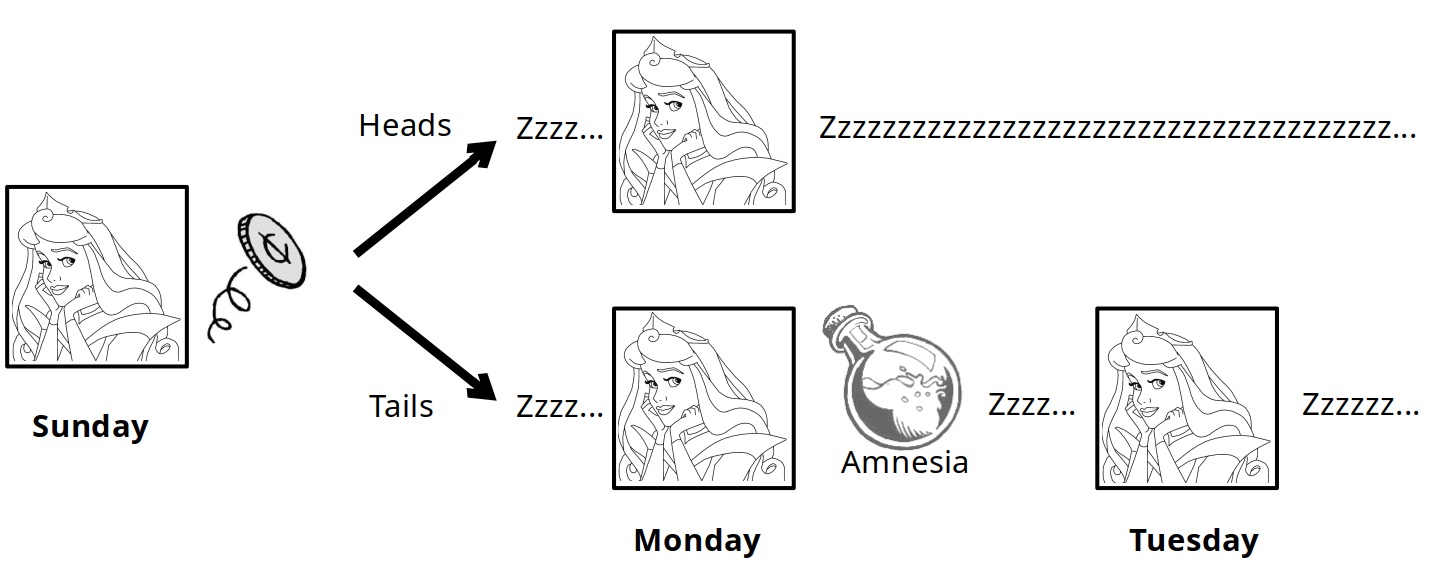
In the traditional problem, a coin is secretly tossed, and Sleeping Beauty is put to sleep on Sunday. She reawakens on Monday. If the coin was heads, that’s the end of the experiment. If the coin is tails, she is fed a sleeping draught with an amnesia potion that erases her memory of Monday, and is then reawakened on Tuesday, initially unable to distinguish the Monday awakening from the Tuesday awakening.
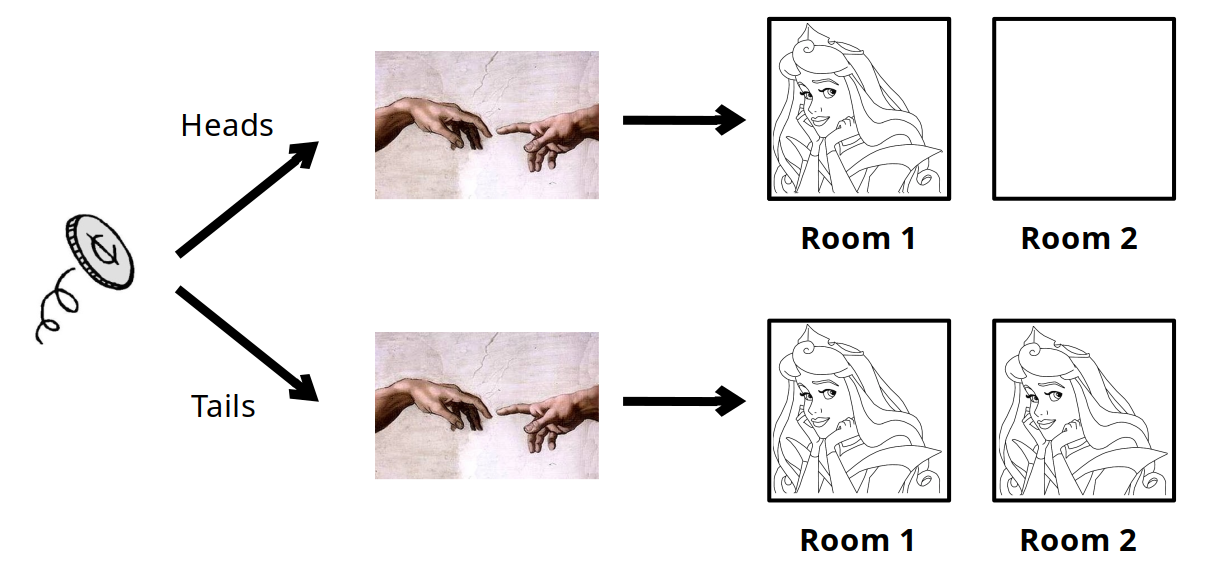
The incubator variant has no initial Sleeping Beauty and instead has two identical rooms, 1 and 2. A coin is tossed, and on heads, one Sleeping Beauty is created in room 1, and on tails, two identical Sleeping Beauties are created, one in each room.
The original Sleeping Beauty problem has memory loss, which you can argue is a loss of rationality or confusion about their past experiences. The incubator variant has no initial Sleeping Beauty. So I’ll be using a new variant, Duplicate Sleeping Beauty.
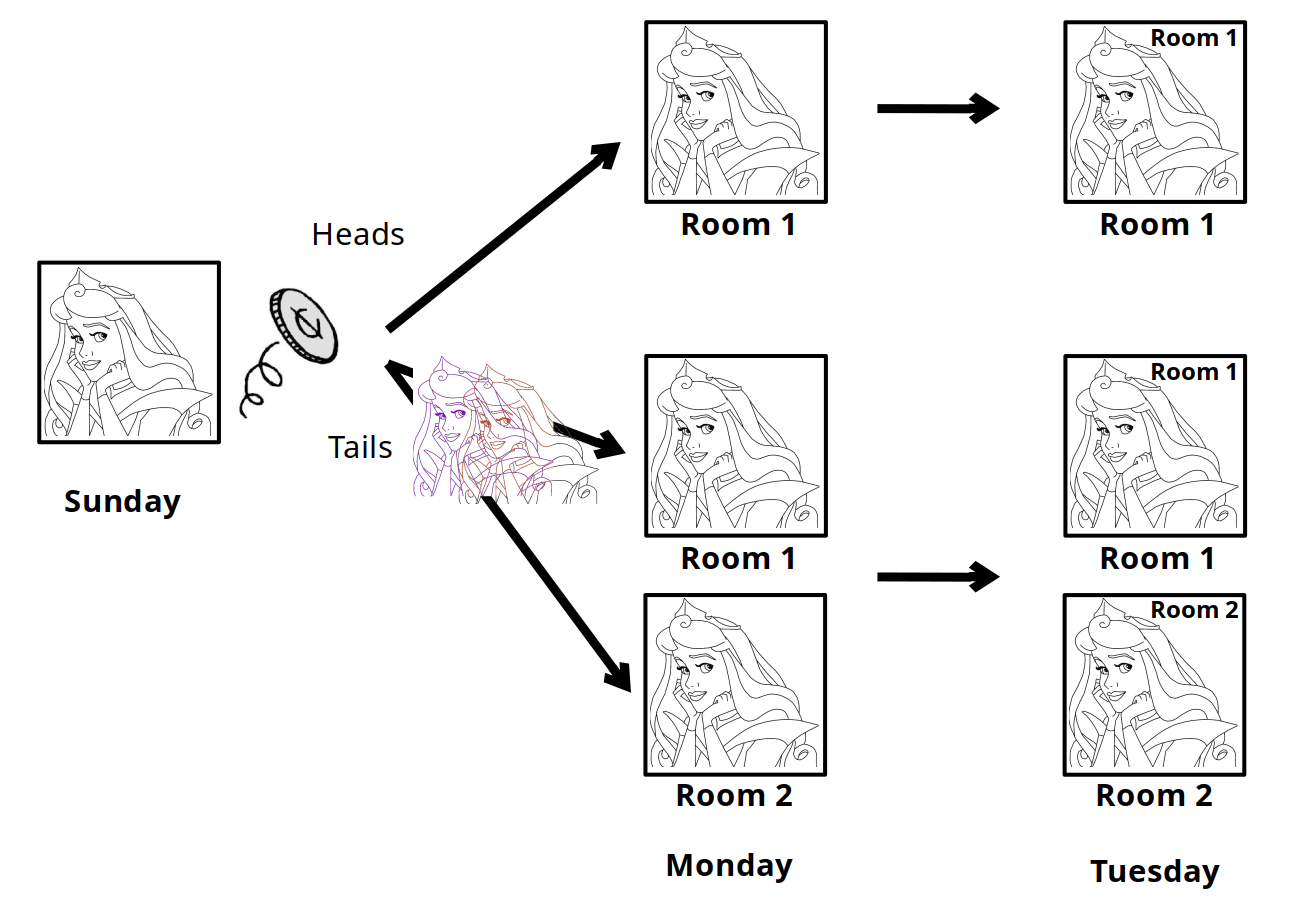
Duplicate Sleeping Beauty: there is an initial Sleeping Beauty and two identical rooms. Sleeping Beauty is put to sleep on Sunday and a coin is tossed. If it’s heads, she is put in room 1 and awakened on Monday. If it’s tails, she is duplicated, and one duplicate is placed in each room, and they are both awakened. On Tuesday, she will be informed of which room she is in.
Then I’d claim:
There is no reasonable probability function that applies across the duplication in the Duplicate Sleeping Beauty.
First, let’s define “reasonable”.
Martingale and simple Bayes
One of the key properties of a “reasonable” probability function is that it has the martingale condition (also known here as conservation of expected evidence). Specifically:
Suppose I asked for the probability of future observation
The martingale property of probability says that these two questions are the same. It’s a fundamental property of probability, and it’s hard to see what it would mean for the two to be divergent. Note that the martingale is defined over observations and expected observations.
The other reasonable property is simple Bayes: if an agent has no uncertainty about who they are in the world, then the agent’s probability can be derived by Bayesian updating of their observations on the prior.
Constructing the impossibility
In Duplicate Sleeping Beauty, there are three moments to consider: Sunday, before Sleeping Beauty is put to sleep. Monday, after she is awoken. And Tuesday, after she is informed of which room she is in.
Then there are no identical duplicates on Sunday or Tuesday, so simple Bayes can be used to give probabilities. Then we’ll show there is no probability assignment on Monday that is martingale-consistent with Sunday and Tuesday.
Specifically, let
Now on Sunday, there is a single agent, no observations so far, so Bayesian updating gives
On Tuesday, the agent has awoken and been told which room she is in. So each agent has seen (awake, room 1) or (awake, room 2). There is one agent in
So we can apply simple Bayes again. Being in room 2 compels
Now let’s consider Monday. Going to sleep on Sunday, Sleeping Beauty knew she would awaken, so martingale guarantees that the probability can’t change on Monday:
Then the martingale condition gives:
Thus
I’ll now add another technical probability requirement: that, since (awake, room 2) is actually possible, then
Creation and birth versus duplication and merging
The problem only arises because of the duplication event. If a different Sleeping Beauty is created ex nihilo in room 2, that’s not a problem. If Sleeping Beauty gives birth overnight to a new agent in room 2, that’s also not a problem. The problem is that the subjective timeline of a single well-defined agent has split, and that messes everything up.
It’s less physically plausible, but if the two copies were to merge, that would mess things up in the other direction. Agents being created is not a problem; agents dying is not a problem. It’s the forking and merging of timelines that is the problem.
Anthropic disputations
Pause for a moment to sympathise with the various people who have analysed and disputed anthropic probability. No matter how obvious it seems to you that one or another option is right, it’s clear that something very weird is going on. You might think of many “halfers” as people who took the initial 50-50 probability of the coin toss and tried to push it forward with the martingale condition. And you might think of many “thirders” as people who took the final probabilities when Sleeping Beauty knows which room she is in, and tried to push that backward with the martingale condition.
Spare also a thought for those who tried to insist that, actually, somehow, both the Sunday and the Tuesday simple Bayes were right and that something weird but fundamentally acceptable was happening on Monday. Basically, something is breaking down in the standard laws of probability, and people are trying to patch it.
SIA specific issues
When discussing that argument, someone made the point that, on Sunday, Sleeping Beauty knew exactly who she was, while on Monday, she had lost that knowledge; hence that just being awake Monday gave her some new evidence. Since it’s new knowledge, she should update on it: even if “being awake” is entirely predictable as an observation, she still enters a new epistemic state, and her probability should be allowed to reflect that.
I understand the argument but disagree. Contrast with a simpler situation: I’m in room 1 or room 2, no duplication or anthropic effect. I’ve seen “Room 1” painted on the door, so I know I’m (almost certainly) in room 1. However, tomorrow, I will discover that actually the painter mispainted, and painted room 1 on both rooms; thus, tomorrow, I will lose exact knowledge of which room I’m in.
What the martingale and conservation of expected evidence are saying is that, if I know today that tomorrow I will lose exact room knowledge… then I have actually lost that exact room knowledge already. The martingale breakdown is not that Sleeping Beauty, on Monday, won’t know who she is. It’s that, despite knowing this fact, today she does know who she is.
We can be more precise. Sunday Sleeping Beauty knows that the Monday Sleeping Beauties will lose knowledge of who exactly they are. And the Monday Sleeping Beauties know that too. So none of the agents are in any doubt as to the epistemic states of the other agents. The breakdown is that even though all agents agree on all facts about the universe and about each other’s knowledge and have the same priors, their probabilities differ.
The power to change the past
We can illustrate the probability breakdown further. Let’s assume that the martingale condition holds from Monday onwards, since there are no further duplications. Then, under mild conditions, Sleeping Beauty will follow SIA from Monday onwards[1].
Chosen world-size Sleeping Beauty[2]: we can modify the Sunday-Monday transition: on Sunday, Sleeping Beauty gets to choose how many total duplicates of her would exist in the tails world, from one to a billion (each in a separate numbered room). If she chooses one, then this is no longer an anthropic problem, and the probability of heads remains
Thus with her current actions, she can predictably and directionally change her future credence of a past event. That is not how standard probability works.
Decision theory
As an aside, note that decision-theory-with-precommitments has no problem managing duplication events. That’s why I consider decision theory as the more fundamental object; probability theory is a subset of decision theory where the utility function is the Brier score or any other strictly proper scoring rule.
The utility function will also encode how to aggregate Brier scores across multiple duplicates; summing will lead to SIA-like behaviour, while averaging leads to SSA-like behaviour. In that view, a Sleeping Beauty who sums Brier scores and chooses to create a billion copies is not changing her current or future credence of tails; instead, she’s maximising her utility in the tails world.
Defending SIA
Though SIA has problems around duplication events, it has no such problems after the event. It can deal with duplicates, copies, Sailor’s children, anthropic events involving risks of death or extinction, and similar.
So it is still, in my view, the best candidate for (non-infinite) anthropic probability. In as much as anthropic probability can be made to make sense, SIA seems to be the best candidate around.
How so? Well, I consider the martingale breaking down between Monday and Tuesday (where there are no duplication events) to be much worse than breaking down between Sunday and Monday (where there is a duplication event).
The most convincing argument to me is that in non-anthropic situations, SIA seems inarguably correct.
On top of that, there are modifications of duplication problems[3]which SIA handles perfectly fine.
In the next post, the last in the series, we’ll show the problems SIA has with infinity and how a variant, D-SIA (distributional SIA), can fix these.
Suppose that on the heads branch, instead of being put in room 1 with certainty, she is put in room 1 with probability
See also “Defeating Dr. Evil with Self-Locating Belief”. ↩︎
Let
At the point where there is a duplication event in one world that is possible in
For those duplication events, the extra duplicates are created, but don’t actually achieve consciousness and are deleted immediately.
Then any reasonable theories of anthropic probability will agree with each other in, and the probabilities that they will give are the same as SIA in
What’s changed here? Think of Sleeping Beauty again. Because of the inert duplicate in the heads world, when she wakes up on Monday, she will downgrade the probability of the heads world. Why? Because she could have been the inert duplicate. So “waking up” now carries information: she is not an inert duplicate. The Sunday Sleeping Beauty expects that she will experience waking up on Monday or will experience nothing, so waking up does carry information. The “experience nothing” carries away exactly enough probability mass that everything is consistent from then on. And the Chosen world-size Sleeping Beauty? Here it’s not Sleeping Beauty changing the probability of past events. Instead it’s her playing a duplicate version of Quantum suicide: she’s sacrificing her duplicated existence in the heads world so that her surviving copy will find heads very unlikely.
So, though SIA can’t claim to be martingale across duplication events, it can claim to be martingale on similar setups that are at least arguably isomorphic.
Warning: people who are SIA fans may find this argument more convincing than it seems. An SSA fan could point out that SIA is unchanged by inert duplicates, while SSA is. Therefore, it’s not surprising that if we insert inert duplicates in the right places, we can get SSA to vary until it matches up with SIA. It’s interesting that all anthropic probability theories seem to match up at this point, but, they could say, SIA and SSA are the only serious contenders, so if they match up, everything does. ↩︎
Note that the math isn’t showing up for me, might be a formatting issue.
There’s a fatal flaw in the logic here.
But then you talk about the prior probability of heads. This is not meaningful, since she does not observe the coin flip.
Here’s a consistent probability assignment that meets the martingale criteria.
On Sunday, she estimates probability ~1 of waking up tomorrow in a room. She doesn’t have a probability on a particular room or of a coin result as of Monday because she doesn’t observe that on Monday. She further estimates a probability of 2⁄3 for Tuesday room 1 and 1⁄3 for Tuesday room 2.
On Monday, she confirms that she woke up. She continues to have the same 2⁄3 and 1⁄3 probability assignment across the two rooms possibilities for Tuesday, since nothing has changed.
Alternatively, she can consistently maintain that each room is 1⁄2 likely.
I’ve got a different scenario with no duplicates. A fair coin is flipped today, if it’s heads, Roulette Rory gets killed with 75% probability before learning what the coin says. If it’s tails Rory survives. We ask Rory what her probability is. She says today her probability is 50⁄50, but if she learns about results she is 80% confident in tails.
Why is it ok for Rory to expect her future self to be 80% confident in something that she’s currently 50% confident in, but it’s not ok for Beauty to do the same? In both cases, the number of observers is varied in a way that’s correlated with the observation. That’s all that’s happening here.
Sorry, the latex display should be fixed now.
Pertinent comment, so I’ve added an
In this case, not making an observation (due to death) is another possible history. The possible future histories are “see heads”, “see tails”, and “{}” (see the other post on how deaths don’t affect Bayesian probability).
That’s also the reason why ID(Sleeping Beauty) doesn’t have the paradox; the duplicates existing but not observing their history means that heads Sleeping Beauty gains information on Monday (I’m not dead, hence I wasn’t the duplicate that died).
I don’t think the epsilon chance of observing now really helps. It makes the current probabilities meaningful but you still have no particular reason to insist that the current probabilities (“what happens if I were to observe this today”) matches the future probabilities (“what happens if I observe it in the future”), given that the observations are correlated.
Re death, it just doesn’t seem different to me. If I can magically increase my probability in outcome A by committing to suicide in not-A worlds, I can also increase my probability in A by duplicating myself in A worlds. You’ve set up a formalism that allows the former and not the latter, then you’re pointing to a contradiction. But they’re both about as mysterious and settled the same way. The first isn’t controversial and the second shouldn’t be either.
(The exact probabilities still depend on SSA vs SIA vs others. But the fact that they won’t match the objective probabilities seems fine.)
Isn’t your application of Bayes’s rule wrong?
P(T | awake, room 1) = P(room 1 | T, awake) P (T | awake) / P(room 1 | awake)
The second and third factors on the RHS are exactly the values under contention.