What if people value their work mattering?
I, for one, do not look forward to sharing the apparent fate of mathematicians.
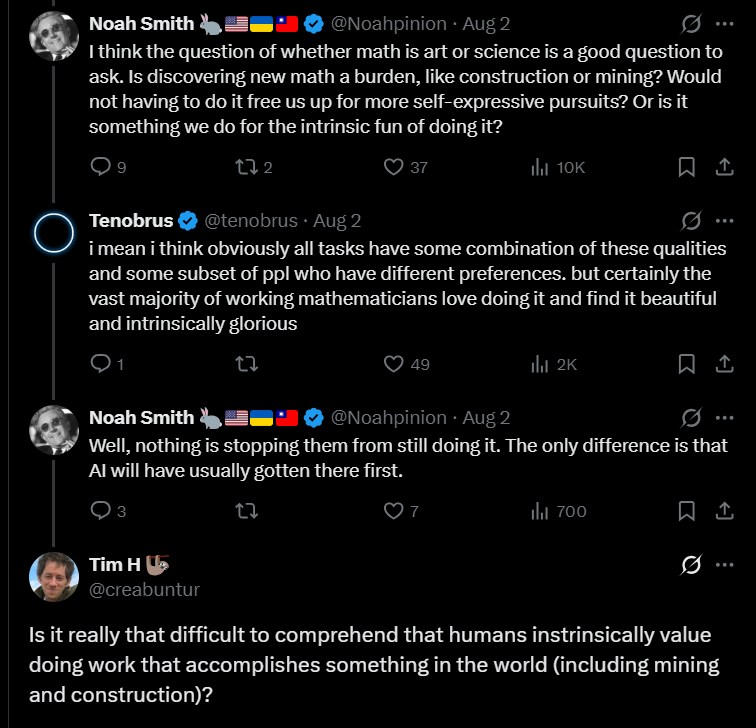
Contrary to my flippant response this morning on X, though, it is actually non-trivial for an economist (like me, also) to conceptualize people intrinsically valuing whether their work has impact.
Enjoyment of an activity is easy to put into utility.[1] But there is no standard way to formalize the notion that enjoyment of doing math research is dimmed by knowing “that AI will have usually gotten there first.”
So I wrote down a toy model in which people intrinsically value their work mattering. Could it be that transformative AI even makes people worse off on net (despite everything going well safety-wise, etc.)? Spoiler: Yes, if the amount one’s work matters is a complement of consumption in utility, then even unimaginable riches may be unable to compensate for the loss of impactful work.
The main idea is to assume the marginal product of one’s labor directly enters utility. That’s how I propose to formalize the notion that people value how much their work matters (as opposed to just enjoying the activity “for its own sake”). It’s an imperfect proxy, to be sure,[2] but it provides a way to operationalize the relationship of “mattering” to the standard quantities in a macroeconomic model.
Being the first to resolve a major math question corresponds to productive labor, contributing to the production of new math in a way that privately rediscovering something AI has already revealed does not.
Suppose capital
where
Dividing both sides of the aggregate production function by
That is, for a given total capital level, an increase of
For simplicity, utility is a function of only
What happens beyond that initial dip depends on the specific utility function. Let’s assume constant elasticity of substitution
If
If
Interestingly, though, when the relative weight of consumption in utility,
That’s for a case in which consumption and “mattering” are complements (
(I have also worked out some results for endogenous capital, with capital accumulation over time, but I will save those for another post, if there’s interest. More could also be said about grounding the parameters in empirical work, implications for policy debates, and so on, but the intention of this initial post is just to establish a theoretical possibility.)
Happily, AI is complementing my labor, at this point. Claude Fable 5 helped with working out algebra and creating the chart, as well as thinking through the interpretation.
- ^
For example, Anton Korinek and Megan Juelfs think through various non-pecuniary aspects of long-term loss of employment in their 2022 “Preparing for the (non-existent?) future of work.”
- ^
A full philosophical treatment of “mattering” is far beyond the scope here, but suffice it to say that I acknowledge forms of mattering outside of market work and even “production” more generally.
- ^
A often denotes human-involved TFP, but here that is set to one here, WLOG.
- ^
That is, take the derivative with respect to L.
- ^
That is,
- ^
Specifically,
- ^
Assume workers receive not only wage earnings but an equal share of all production. Labor is assumed perfectly inelastic (perhaps due to a future four-hour workweek law).
- ^
This is due to the “envelope theorem.” It only depends on utility being smooth and strictly increasing in
- ^
The closed form utility as a function of
Try flipping the status quo. If AIs were already solving all the problems in your particular field, would you advocate for banning them from the field so that people would need you to solve those problems for them (presumably more expensively, presumably making some problems’ solutions too expensive to be solved at all) and so that you would feel like your work mattered? How does the idea of such advocacy strike you?
In that scenario, there wouldn’t be “folks who have spent decades at work on certain problems, in part based on a reasonable belief that they have a comparative advantage in their area” (as I put it in a different reply). But, right, such advocacy would strike me as difficult to justify.
If it were just one field’s problems being solved, I wouldn’t even consider such advocacy. My concern is about there being no interesting problems left for humans to solve whatsoever.
The scenario I worry about: my grandchildren are born into a world in which there are no interesting problems to solve at all, one in which there is effectively a genie who can both answer any question and make anything physically possible to make. If they are still born with a need to do meaningful work, that scenario seems cruel, and advocacy to change that status quo strikes me as reasonable—all the more so, advocacy to prevent that scenario if bringing it about has costs and/or risks. (Some may propose to instead modify my grandchildren somehow to remove their desire to contribute meaningfully with their work. My instinct is to oppose that but I haven’t given it much thought.)
What is it that AI takes from mathematicians, when it does all the math? The paid position of mathematician disappears.
What is stopping them from doing it is the absence of opportunity to dedicate one’s life to its study.
We could continue paying mathematicians if we want. But what we (likely eventually) can’t do is restore their ability to make new discoveries with their minds, to receive credit for that and know their efforts contributed to knowledge. There appear to be folks who have spent decades at work on certain problems, in part based on a reasonable belief that they have a comparative advantage in their area. And within a short time, the situation is radically changed and they are transformed from an aspiring Mozart to an aspiring Salieri, only able to appreciate and perhaps help explain to others the accomplishments of AI.
But at this too they would be outmatched shortly. What remains?
Integrity, trustworthiness, knowledge of their intent, commitment to some ideals.
AIs having capabilities and using them to achieve goals you know and agree with are not the same thing. Yes, this AI can persuade me that I understand this math fact, but did it do it in a valid way?
Alignment is key to this.
at the moment, at doesn’t do even that. mathematicians are still the meaning makers with respect to mathematics. the LLM can craft a path from A to B, but cannot say “this is not babble. this is meaningful, both now, and in the future of this language game we call mathematics which has such mysterious use in describing the world in which we live.”
So you are moved up a level of abstraction. How much time does that give you? :(((
math autoresearch does appear to be of its own special kind. still requiring “research taste” (the forecasting of profitable areas of proof space exploration) without “experiments” beyond actual proof construction and lean formalization. AI experiment design needs to be much more sophisticated to extract actual knowledge. makes one sympathetic to the world model advocates.