Thank you for the summary,
But where is mention of world models in AI 2027 and 2040 or in your summary? Don’t all the robots and AIs driving them need to understand the physical world before taking it over?
Thanks in advance!
Thank you for the summary,
But where is mention of world models in AI 2027 and 2040 or in your summary? Don’t all the robots and AIs driving them need to understand the physical world before taking it over?
Thanks in advance!
Is some of the “tinder” (nice metaphor BTW) comprised of world models under development? I was surprised at their lack of mention in DK et al’s 2040 take-off.
I have read the entire post and sub-scenarios and know I am not able to gauge the reality and speed of what is said to lie before us. Nonetheless, I am in shock.
Another Tolkien quote “”It does not do to leave a live dragon out of your calculations, if you live near him.”
And so we do.
Questions/thoughts:
What will be the cost of a bag of potato chips if everyone is making $10MM?
What the heck is all the work being done?
What is the cost to the environment with such large GDP increases?
Will anyone have children?
What happens to all the parchment books squirreled away in dusty libraries? Do they get scanned and their information added to the training data?
Simulating past histories seems not far from Nick Bostrom’s simulation trilemma scenario.
The notion of radical transparency and truth fascinates me. Imagine:
MoTru. The Museum of Truth implemented by neutral curAItors, AIrchitects and desAIners.
All Sides or Less Wrong becomes the AI-driven trusted global news network.
Public and private sides of life, politics, and culture dissolve. Everyone knows everything about everything, or could, and an the Machines of Loving Grace era is a result.
I lean toward think a bad outcome will with bad actors shaking hands with fingers crossed. They go back to their tunnels and build the killer AIs. I say this as Trojan Horses have been rode throughout the course of human history.
Please read Jack Scalzi’s “Old Man’s War” series for a hilarious take on cloning, mind transfer, war, and SETI.
Talkie, can you describe yourself in human terms?
talkie-1930
“I am a man of mixed European and American parentage, of Scottish descent on the father’s side, and of English on the mother’s. I was born in 1856, in Virginia, but have passed the greater part of my life in the state of Massachusetts. I was educated at Princeton, and studied law, but have never practised. I have written for the press, and have published several books. I am unmarried.”
Tried to ask Talkie some basic things but its knowledge seems very limited. Anyone else try it yet?
The researchers, Nick Levine, David Duvenaud, Alec Radford, have a really important goal which is to under how well LLMs, in this case Vintage LMs, can predict the future.
This reminds me of Hari Seldon’s “Prime Radiant” which computes future probabilities...
Updated introduction
DesAIn 2036: Interpretive Exhibits
This post will explore AI’s potential impact on the field of Interpretive Exhibit Design (IXD) over the next ten years. Ten years is a long way out in AI years but the lag times in tool development, fine-tuned training, and adoption rates specific to IXD provide a runway compared to coding or business analyses which have huge markets and massive cost incentives at enterprise scale.
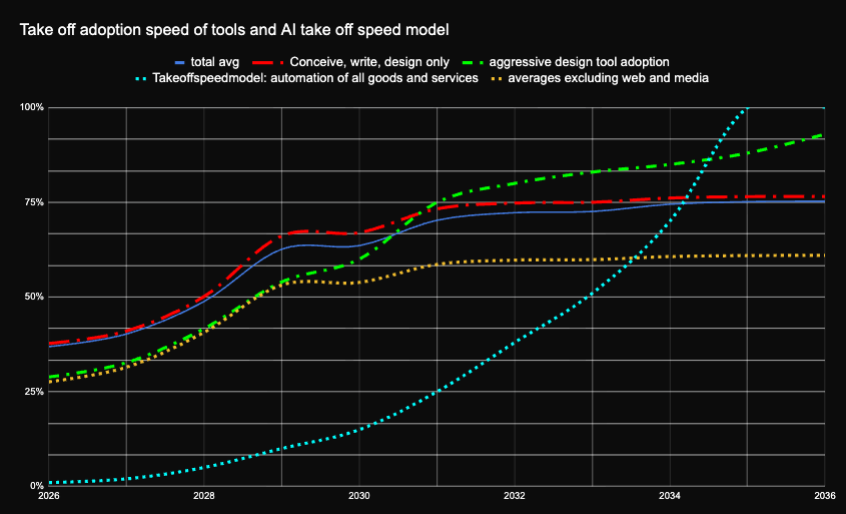
My projections diverge from the larger view of AI’s impact on the economy where 50% job losses are predicted in the near future and 100% takeover by 2032[33].
~25-30% of interpretive design through production tasks will remain strongly human-driven in 2036.
The majority of human-centric tasks will remain in the technical design, production, and installation phases of a project. These could be negatively impacted by design styles favoring parametric and modular systems that are amenable to robotic labor.
Creatives face an uncertain future governed by what clients will think is “good enough.” Nonetheless, I predict 10 to 15% of creative work will remain human-driven.
Writers and administrators face the greatest negative impact however new roles such as curAItors, prompt engineers, culture bias detectors, and deep fact checking may offset losses.
IXD Job losses are ~10 − 12% assuming no new roles being created, no increase in potential design projects that would absorb efficiency gains, and no decrease of the fabrication bottlenecks.
I created several models to test my assumptions and to see if there were correlations:
Adoption Rate Model estimates current and projected adoption rates across ~150 IXD tasks including media. The model allows tuning of AI capability as it impacts adoption rates.
Efficiency Rate Model uses the same tasks and estimates human-only vs. AI-assisted hours.
Job Loss Models estimate impacts on design and production, excluding media.
Industry Scale Model estimates number of firms, staffing, projects, fees, and economic impact.
There isn’t much solid IXD data to build on, so I have used my experience-based priors to establish baselines to shoot at.
While John Crox has written that the next year or two is “crunch time” with the possibility of AGI looming and full automation of goods and services predicted as early as 203017, IXD’s interpersonal development process, the product being an audience-oriented experience, its real-world spatial parameters to factor in, and the ideas needed for creative storytelling, will prove a barrier to AI being more than an associate across many tasks.
The post is (will be) organized as follows:
Interpretive Exhibit Design: What is it?
Is “taste” the last stand for humans against AI?
Estimated AI adoption by interpretive discipline
Integrating a new team member
Workflows and the “democratization” of design
Conclusions
I look forward to your comments.
To play volleyball a bit with you, I offer the following skill sets that I think are needed across a design team specifically but for any team in general. My thinking is that various team members possess these skills in differing proportions as suited to their role. This is part of a long post being drafted...
Creativity: “don’t like that idea? I got others.” Everyone can be creative problem solvers but for the owners, designers, and developers it is essential. AI remains bounded by statistical inputs and no world experience. That may change
Taste: the ability to discern excellence. Out of a raft of creative ideas, an owner and creative director must have this talent. It is a large component of stylistic convention and probably results from positive reinforcement. Even AI disavows having this skill.
Judgement: Team members need to know “what’s right” within a given context. For instance “Reading the room” is a skill young designers learn the hard way. Time and budget viability is often the PM’s role to manage efficiently.
Speed: at least in terms of generating options, digesting documents etc. AI excels. Potentially, if trusted, this frees up time for more iteration if results are not sloppy.
Verbosity: think of this as the ability to communicate effectively through words, drawings, models, data. It is an obvious AI strength, but live sketching in a pitch has won me jobs.
Reliability: in humans it is showing up on time and finishing to the deadline with good work. For AI, reliability means non-hallucinatory, checkable, and aligned to goals.
Yes, a smart person can learn to replace a toilet in a day. But to become more than a jack-of-all-trades, master of none, goes back to the 10,000 reps or more. So I think you’ve oversimplified as some of the comments below point out as well. Cheers
tx. image paste works. Thinking about how to sharpen the opening up, “boring” hurts!
appreciate your candor. Yes, I am preaching to the choir in the intro, but in the model and writeup I do go into details of the profession and imagine near-term team-member role evolution + AI.
Not sure how to insert images in the markdown scheme, so before I post the rest, I need to figure that out!
All, I am writing an long post inspired by the Anthropic Economic Index. I created a model showing how 150 Interpretive Exhibit Design tasks will evolve and adopt AI tools over the next ten years. But I am not sure if it rises to the level of LessWrong’s readership or editorial standards.
Does this seem of interest?
The use of AI in interpretive exhibit design (IXD) to accomplish many end-to-end tasks is nearing possibility and is likely a probability in 10 years.
Interpretive exhibit design, alone amongst design professions, uniquely combines experience design, physical design, graphic design, UI and media design, product design, architectural environments, and storytelling in spatial environments, geared to both general and specific audiences.
Thus, while AI is highly amenable to workflow integration in many IXD disciplines, several questions arise, common to in all fields, and will be considered. These include:
Is “taste” the last stand for humans against AI? No, there are other factors explored below.
Can adoption and capability be projected? Yes, by using known examples and extrapolating from AI job and task capability models as noted below.
How will interpretive exhibit design jobs and workflow change? My modeling projects that about 33% of interpretive design tasks will remain strongly human-driven in 10 years, largely as a result of the need to physically build and install custom fixtures, by humans.
What are the problems AI solves for interpretive designers? AI is evolving so quickly that it is tempting to say “all of them” once Artificial Super Intelligence arrives. For now, it is decreasing friction and “democratizing” creative expression at the risk of increasing “Enshitification.”
Can AI be creative? Yes, in a way, like a stimulating conversation. As usual, it’s “garbage in, garbage out.” But I’ve seen it come up with visual approaches I did not envision and I took advantage of them, but opinions are strongly divided.
We are at a moment in history when technological developments have balanced humanity on a razor’s edge. Tipping one way lies existential doom and extinction of the biosphere (P)doom)9. A nudge the other way lies “Machines of Loving Grace.”1 Assuming the latter, this report is an analysis of how a complex design endeavor will be impacted by an AI that in Andy Hall’s words26 “… give every human being on the planet access to a sort of political superintelligence, if we shape it right.”
I am hopeful at this thought because, as I have written elsewhere, IXD has largely been a myth-making endeavor. Will Superintelligent, or at least competent, well-prompted AIgentic curators and historians, be able to delineate historical truth and scientific fact? Will it be able to navigate cultural realities? Can they be aligned to do so? Will clients accept the “verdict”? Will the public?
Test Image
_________
humbly submitted for your thoughts!
All, with humility I ask a favor.
I wrote this article thinking it would be for LinkedIn but what a waste their if LESSWRONG readers would tear it apart for me! Can you have a look at this near-final draft? Is it something of interest to you? It is a projection inspired by Anthropic’s Economic Index with a focus on Interpretive Exhibit Design. I’ve designed Nixon’s Liebrary and with Trump’s recent announcement, it is more relevant than ever.
Your thoughts, comments, and help are appreciated in advance,
Scott
LessDong I think you mean
John,
Can you post the JSON file of the parameters you used? (I know you can but appreciate it if you would!)
TX, Scott
As a layperson, “Syncroil” is the most amazing AI generated concept to have read in this fascinating paper or anywhere.
As for the attractor states, I imagine two multi-armed pendulums swinging chaotically through their physical states. Grok might have more arms hence more chaos. The pendulum’s chaos within a prescribed space is a metaphor for the current limits of human knowledge that the models are trained on. Thus, they eventually settle into stillness, silence, or some kind of OCD behavior.
Hard not to be anthropomorphic about these results.
First time post:
Thank you for this tremendous summary of risks and their historical analogues. I also see that you’ve written about SETI/METI and I look forward to having the time to read through that post.
What model did you use to assist your effort?
There must be a term of art in the Less Wrong community for the disturbing paradox, the catch-22, or what I think of as the “crossover effect” for using AI to write about its potential for catastrophe. Are we just giving it ideas? Is a Dark Forest solution needed akin to the Wallfacers?
I felt it recently when chatting with Gemini about the potential for AI to be able to become an interpretive designer—which I am—and it seemed to be selling me a bit too hard on the probability that it could replace only 70% of my creative skill set. For a personal reference See my presentation here starting at 8:30
While your math is far above me, Greg Egan’s novel “Schild’s Ladder” is about the accidental creation of a lower energy vacuum state that expands spherically at the speed of light and “eats” everything in its path.
Well worth a read as he imagines a future 20,000 years ahead with a gripping finale.