Late in 2019, I, like many of my rationalist friends purchased the parts for and assembled a genuine, bona fide LUMENATOR™️ - a device for greatly increasing the brightness of your home—according to the original specification. To me, lumenators are the quintessential application of the More Dakka mindset: when you face a problem that responds positively to a little bit of X and responds even more positively to larger amounts of X, you don’t just stop applying X once you feel you’ve done a reasonable amount of it, you add more and more and more until your problem goes away or X stops working. I built a lumenator not for seasonal affective disorder, but because it helps me wake up feeling refreshed in the morning and I feel happy when my house is very bright inside. In 2019 I lived in a small group house in Waterloo, ON and we’d often give people directions to our house like “turn the corner and then look for the one with ridiculously bright light streaming from the windows”. They’d show up without trouble and remark: “Wow, I didn’t actually expect I’d be able to find your place based on those directions”.
I’ve brought my lumenator with me through 5 changes of address and still used it up until a few months ago. More recently I’ve felt that despite trying really hard, as a community we didn’t More Dakka hard enough. When you really push the envelope on luminance there are a few limiting factors you run into: cost, power, and heat dissipation. Luckily for us, there’s an industry that has massively ballooned in the days since Eliezer’s original post and has created an industrial-scale demand signal for light sources that are super bright, about as compact as possible without being a fire hazard or requiring active cooling, and emit light that is spectrally similar to sunlight. Want to take a guess?
marijuana
The idea: mount one of these lights directly above my bed, put something in between to diffuse the light coming from the many tiny LEDs, and put it on a timer so it gradually brightens around the time I want to wake up. Here’s my build:
$210: passively cooled 200 Watt lamp: SPIDER FARMER SF2000Pro, Full Spectrum Plant Grow Light, Dimmable
$70: Spider Farmer GGS Controller Kits (for timer based schedule)
I’m sure you could DIY a replacement for this, but I don’t have time for that :)
$13: Photography Diffuser Fabric 78.7 x 59 Inches
Empirically, the fabric is almost imperceptibly warmed when mounted ~1.5 ft. from the light for several hours of continuous use, so I think there’s minimal risk of starting a fire.
I also tried Diffusion Gels Filter Sheet Kit 15.7x19.6inches but these were too small. I found gel filter sheets to be significantly better at diffusing without attenuating though, so I’d shop for a larger version of this next time around.
~$35: ceiling hooks to mount the light, and to mount the diffusion fabric, a grommeting kit, some fishing line, and a few command hooks.
I’d recommend you anchor your hooks in something stronger than drywall so you don’t need to find out what it’s like to be woken up by an 8 pound piece of metal falling on your face (I too am blissfully unaware of this).
Total: ~$330
At 200W the lamp offers a PPF of 540 µmol/s, but we’re not plants and our eyes perceive some wavelengths as more or less bright. Accounting for luminous efficiency and the lamp’s spectrum the manufacturer estimates we get about 53 lumens per µmol/s, or a total luminous power of about 30,000 lumens. With similar calculations Claude estimates the illuminance as about 4,000 lux @ 6 ft. or 33,000 lux @ 2 ft. Not bad at all!
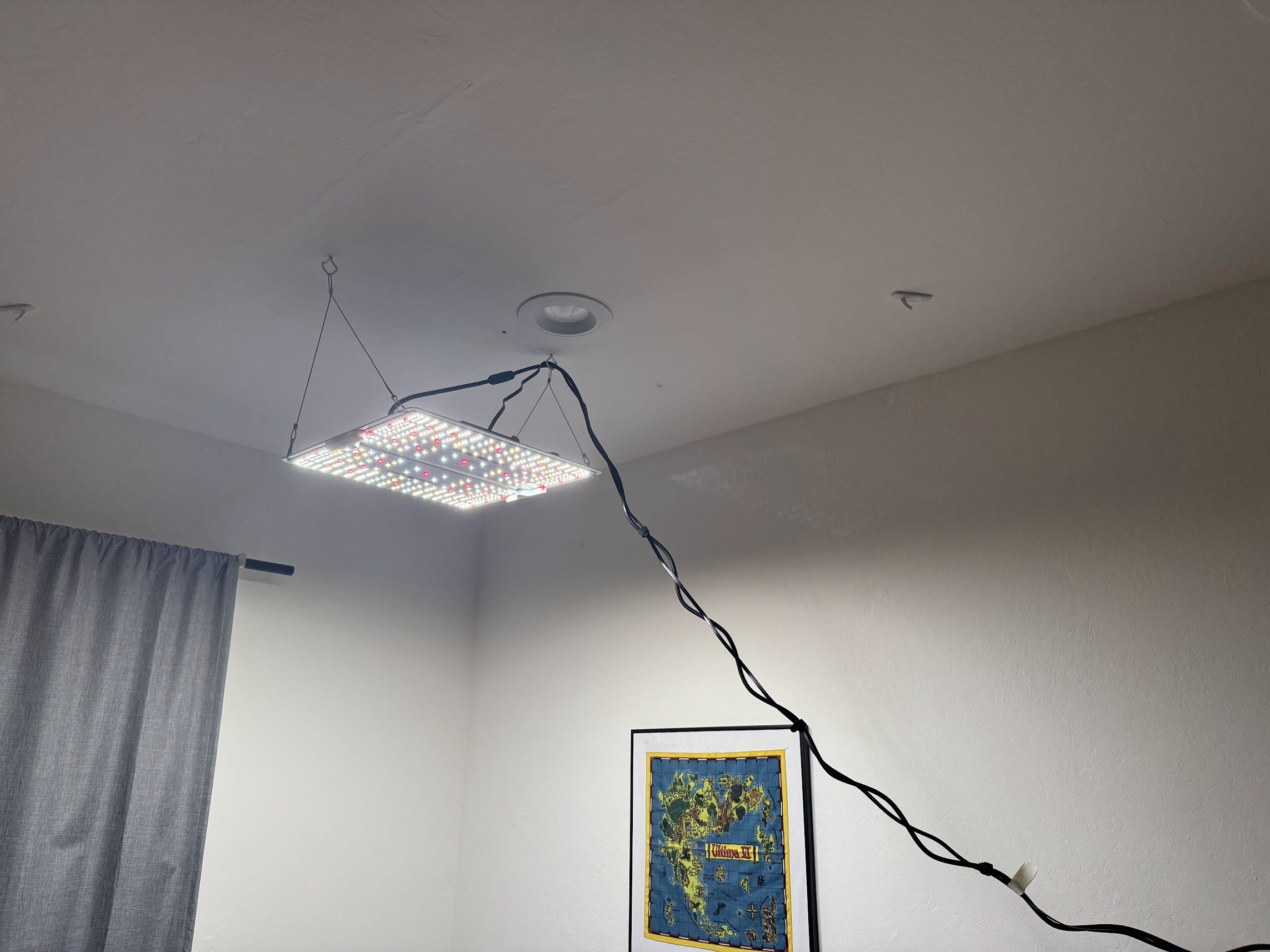
Here’s what it looks like without the diffusion filter:
And with:
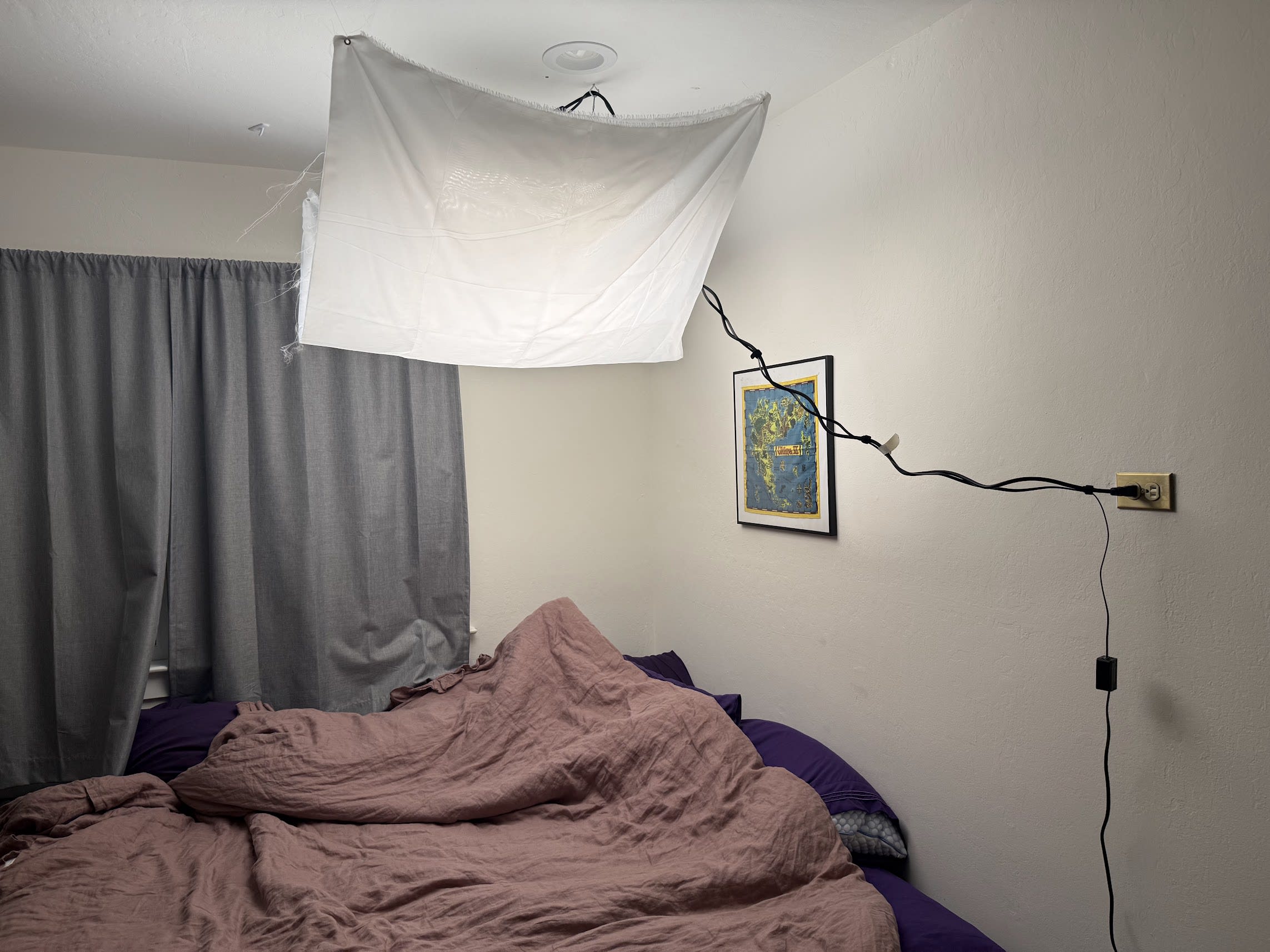
Anecdotally it feels really bright, the pictures don’t do it justice. I’ve configured it to turn on in the morning at minimum brightness and then increase to maximum over ten minutes. At maximum it doesn’t feel quite like sunlight but doesn’t feel like normal indoor lighting either; it feels more like basking in indirect sunlight in a cozy glade on a crisp summer day. My bedroom has pot lights installed that guests regularly complain about for being too bright, and if the lumenator is on you can barely tell the difference when I turn them on.
There’s only one problem: the device can be set to brightness levels between 11% and 100% but not below 11%, and it turns out that 11% is still really bright! Bright enough to wake me up instantly when it clicks on. I’ll be looking around for a similar light with a more dynamic range on the lower end.
Overall, it’s been a very fun experiment and I’ll likely continue using it despite the 11% problem because it feels really nice. If you’re interested in trying it out for yourself I’d be happy to post more detailed instructions. Let me know.
I’ve got a few thoughts from both work in the film industry and on projects involving grow lights. TL;DR I would still recommend film-specific lights over grow lights.
Spectrum
While grow lights are “full spectrum”, they are optimized for plant growth, boosting certain color ranges while neglecting others. While farmers may work with grow lights for extended periods of time, their comfort is not the priority. Film lights are closer, as they are designed to look and feel like natural lighting (more so than even the convenient/cheap lighting that individuals and companies can purchase for daily use. This is demonstrated especially by the notoriously bad quality of commercial fluorescent lights). More importantly though, film lights are optimized for aesthetic control. Plants are there to grow. Farmers are there to do their job. Actors are there to look pretty.
If charts help, this is how a grow light compares to film lights of various types. The Skypanels are industry standard for extremely bright ambient light (and are then shaped and colored with light control)--the science LEDs are designed specifically for control, and allow you to make detailed adjustments to the spectra.
Diffusion
If you are in a group house with multiple lumenators, it’s probably worth purchasing a full diffusion roll. These can be cut to size. https://www.bhphotovideo.com/c/product/1774322-REG/lee_filters_216rc1_24_x_25_filter.html There are different qualities and gradations of diffusion (some with fancy names like “opal frost”). If you are living with something every day, I would recommend doing tests to see which of these sparks joy. But B&H and Adorama are good starting places for this.
Surface Area
The larger the surface area the light is going through, the softer it will be, and I would argue, the more pleasant to live with. To me, the obvious “more dakka” solution is to try to create a full wall of light instead of having a small point source. What I’ve done on music videos before. One technique for this is a “book light” where a light is directed toward a bounce board (reflective white surface) and then bounced through curtain of diffusion.
One setup I use frequently that gets maybe 80% there is to set up tube lights (like these, though they may not be powerful enough for this purpose) on a stand behind a sheer white or off-white curtain. A curtain with a light behind it gives a nice natural look, and is already diffused, and the tube form factor will naturally spread out the light more than a panel form factor.
Heat and Power
There’s no way getting around this one with film lights. Film sets are hot. LEDs have made this much better than the old days of tungsten lighting, but MUAs will nearly always go in between takes and wipe sweat off of actors’ faces. Film sets do not optimize for physical comfort (especially when you consider ACs and fans go off during takes). I think there’s a definite gap in the market for extremely high powered lights for indoor use that use the same kind of cooling technology as grow lights.
My Personal Solution
Take this all with a grain of salt. I don’t use lumenators; I live in the Southwest where we get 80% sunny days, and I have large windows that I frequently have to black out because I get eye strain due to glare!
useful update, thanks for writing it up :]
sounds like it’s maybe not that great for bedroom use but possibly much better than the traditional setup for common areas.
I would guess the dimming floor is because below that it would start visibly flickering. The solution is to have independent switches for different LEDs so you can turn most of them off as you dim, but I guess the marijuana industry doesn’t care :)
you’re probably using a camera app that uses automatic exposure adjustment, which is the reasonable default for non-ILLUMIRATI. If you want to produce images that fairly represent what your Lumenator looks like to the human eye, try to find a “Pro mode” (on a smartphone, you might need to switch to a different camera app first) where you can manually configure a high exposure setting.
Very good! I have myself replaced my original (2012) setup https://www.lesswrong.com/posts/Ag7oQifJQM5AnMCrR/my-simple-hack-for-increased-alertness-and-improved
...with a new one that consists of enough chained E27 splitters to accommodate a total of 28 LED corn bulbs with E27 sockets. I’m using HZSANUE 2P32W-E27DW, which are cheap and each turn 32W into 3600lm of 6000K Daylight White. Total: 100800lm but I prefer to say >100 KILOLUMENS. 💡💡💡💡💡I’ve used this setup a lot for weeks and am happy to report that although I’ve been drawing 896W from ultimately just an old and cheap-looking standard ceiling E27 socket, the wiring has held up fine, because 220V lets me draw that amount of power without hitting the limit of 4 amperes of current, which would exceed the E27 socket spec and trigger the circuit breaker.
It’s awesome, I have still not hit diminishing returns.