What is a species?
TDLR: Biology has no consistently applied definition of “species.” The field operates on vibes, reverse-engineered justifications, and conservation politics. I propose a litmus test: any species definition that, if applied consistently, would split Homo sapiens into multiple species is wrong. This kills the Biological Species Concept, the phylogenetic species concept, and most morphological/ecological criteria. I think the definition should be “two populations are different species when gene flow between them is biologically impossible,” which lumps a lot of species currently recognized by the IUCN back together.
Part I: Definitions
Definitions need to carve reality along its joints
For those with a passing familiarity with semantics, it’s popular to say that you can define a word however you want, that reality is a continuum and all lines subdividing it are arbitrary. One culture’s sea-blue is another culture’s wine-dark.
This has the virtue of being true, in a strictly philosophical sense. In all other ways, however, it’s false. It’s true that you can create a word that means whatever you want. You can make a new noun called a “mumpston” and define it as “all radially symmetrical red things manufactured in Laos, and also frogs.” There’s no law of linguistics stopping you. You have looked at reality, drawn an arbitrary border around a group of things, and assigned that group a label. That is, technically, how words work. I dub thee mumpston.
The problem, of course, is that the word “mumpston” is deeply unintuitive. It does not facilitate better communication, or a deeper understanding of the world. It does not “carve reality along its joints.” It’s a bad definition.
It is your responsibility to make your definition align with some actual property of reality, to survey the smooth granite of reality and find a crack to drive your wedge. Just because there is no law of linguistics saying that you can’t coin the word “mumpston” (Gricean implicature notwithstanding), that doesn’t mean doing so isn’t wrong for other reasons. Clausewitz didn’t write a law of warfare saying that you cannot respond to a cavalry charge by pouring river water in your socks. Nonetheless, if you do, you’ll probably die.
When we make a definition, we have already recognized the joint
When coining a new word, you have already recognized a pattern, since you need to notice a pattern before you can give it a name.
In practice, our pre-noticed pattern serves as a list of observed phenomena that appear to be following a common rule. Our work to create a written definition consists of finding the rule that generates all the items (and only the items!) on that list.
Take early attempts to define the word “mammal.” We start with a list in our heads: mammals are horses, dogs, humans, mice. We give a first attempt to create a rule that would generate this list: “mammals are warm-blooded animals.” But then we remember birds, which are warm blooded but not on our pre-existing “mammals” list. When this happens, we have a choice. We can either change our written definition, or change our list. That is, we can make a new “mammal” rule that excludes birds, or we can add birds to our list of mammals.
The art of definitions consists in knowing when each option is appropriate. Sometimes you need to change your definition: you cannot be too legalistic, unwilling to admit your definition doesn’t align with the joint in reality that inspired you to coin a new word in the first place. Imagine if the Platonists, when confronted with Diogenes’ plucked chicken, had simply insisted their definition was correct and added “dead featherless chickens” to their list of humans. It would be foolish to define “mammal”, find out we had accidentally included birds, then insist that birds were mammals. Sometimes your written definition doesn’t align with the reality as well as you thought, and it’s time to move your wedge over a little bit until it’s actually aligned with the crack in the granite.
On the other hand, you also cannot treat every unintuitive item on the list as proof that your written definition needs updating. When we find out that dolphins are warmblooded, have tiny hairs, and are related to wolves, the right move is to admit that dolphins are mammals, not to redefine “mammal” to exclude dolphins.
Your guiding principle must always be reality. What empirical pattern am I actually trying to describe, and how does this item fit into that pattern? If you lose sight of this question, you will only hurt yourself. Cracks in the granite don’t move because you tell them to. All that moves based on your definition is where you’re trying to drive the wedge.
Eventually, definitions need to be consistently applied.
Every definition will have edge cases, and you can spend forever refining your intensional definition to handle each new one. But when your counterexamples have stopped teaching you anything new about the pattern, further refinement is just moving the line back and forth across a tiny continuum of gray. At that point, you must simply draw a line by fiat and apply it consistently.
This is not optional. If you keep your definition vague enough to shift around the gray zones case by case, you are pretending to have a written definition while actually operating with an inexpressible a private list in your head, one that nobody else can access or verify. This is a serious problem for science, whose entire enterprise depends on researchers meaning the same thing when they use the same word. If you say “mammal” and I hear “mammal” but we have different lists of “mammals” in our heads, all communication going forward is built on a misunderstanding.
Written definitions exist precisely to prevent this. They make your list public, checkable, and consistent. Without consistent definitions, words become polysemous, unstable, and misleading. This is acceptable in poetry. Not in science.
PART II: Splitters and Lumpers
Splitters and Lumpers
In biology, linguistics, history, religious studies, and many other fields, there is a centuries-long debate between two factions with opposing semantic predilections. One group, the splitters, assign more patterns names, drawing very fine distinctions between otherwise similar items. The second group, the lumpers, assign less patterns names, choosing instead to create a few informative classes rather than endlessly subdividing the world. Splitters carve more, lumpers carve less.
Here is George G. Simpson, from The Principles of Classification and a Classification of Mammals (1945):
Splitters make very small units — their critics say that if they can tell two animals apart, they place them in different genera… and if they cannot tell them apart, they place them in different species. Lumpers make large units — their critics say that if a carnivore is neither a dog nor a bear, they call it a cat.
In biology, splitters sometimes insist that two birds are different species even if they are functionally indistinguishable. The “Scottish crossbill” is a different species from the “Common crossbill,” according to the splitters, because a computer analyzing their alarm calls will notice that “Scottish crossbills” call at an infinitesimally higher pitch. Linguists have their own splitters: Nigeria is home to somewhere between 200 and 800 languages, depending on who you ask. Likewise the art historians — is “modern art” one thing, or must we distinguish Impressionism from Expressionism from Abstract Expressionism from Neo-Expressionism?
In areas such as art history, there is arguably no “objective” joint in reality to name. There is no law of causality to justify splitting Neo-Expressionism from Abstract Expressionism. This is good for the art historians, since it means they can argue about where to place the line until everyone gets tenure, with no threat of actually discovering an answer. In fields that are trying to describe actual phenomena in causal reality, however (like biology!), there should theoretically be a fairly narrow range of acceptable answers.
Taxonomy Conferences
Everyone agrees that “species” are a product of evolution. Two populations of the same animal become reproductively isolated, evolution begins working on each independently, and eventually you have two different species. The details vary (as we will see), but almost everyone agrees on that basic story.
“Taxonomy” is the practice of reconstructing this process. Taxonomists figure out who is related to who and how closely. For reasons beyond the scope of this essay, it turns out this process is monstrously difficult. Tracing millions of years of evolution, even with modern genetic tools, is very hard.
And so, every year, taxonomists huddle in their ivory towers and rearrange our model of the tree of life based on whatever the previous year’s research has turned up. This beetle is actually more closely related to that beetle, this blue aster we thought belonged with the other blue asters was actually red a million years ago, so it probably belongs with the red asters, etc. Sometimes, new data indicates that a population we thought was a single species is actually two, or six, or twelve. Or 279. Much less often, we decide that several apparently different species are actually the same, and we lump them back into a single species.
If this were happening responsibly, it would look something like this: all of biology would share one written definition of “species,” carefully drawn to track something real about evolution. Where the edge cases grew too gray, a line that represented our best, reasonable guess would be drawn by fiat. The splitters and lumpers would argue passionately over where to draw that line at a conference in Switzerland or something, then, after days of debate, decide once and for all, and that would be that. The losing faction (usually the lumpers) would pay Danegeld and their heads would be mounted on spikes, and the winners would dance Charivari through the streets of Davos. Then, every year, when the taxonomists convened, they would split or lump species based on this consistent definition and whatever data had become newly available by basic research. It would be an orderly, semantically responsible project, life painstakingly categorized.
Unfortunately, this is not how it happens.
In practice, there is no single written definition of “species,” and no single body with the authority to enforce one. Many different groups of taxonomists convene independently, some with a written definition, others operating purely on vibe-based instinct, and they produce different lists that contradict each other. Worse, the same group will justify different decisions based on entirely different criteria. Sometimes they invoke genetic distinctness, other times behavior or morphology. Most alarming of all (from a scientific perspective), some taxonomists use political considerations to define a species, calling a population a new species just to bring attention to it or give it legal protection, even when everyone in the room privately believes it’s not scientifically accurate. There is no consistent rule being applied. Everyone has a list of animals in their head that they already believe are species, and then they reverse engineer their written definition case by case to avoid changing that list.
There are some charitable interpretations of this state of affairs. One is that every group of taxonomists is accurately calibrated to a joint in reality, they just disagree about which joints are important. Everyone is genuinely driving their wedges into a crack in the granite. Everyone has picked a different crack, but the rock will be split either way. The second possible interpretation is that everyone has identified the same crack, but they just genuinely, consistently disagree about where precisely that crack is. They are all just drawing slightly different lines to match it.
But neither of these interpretations is quite what is happening. What is happening is closer to semantic relativism: the prevailing view, sometimes called “the pluralistic view of species,” holds that there is no “fact of the matter” about what a species is, that reality can be carved however we like, and that it is perfectly fine, even inevitable, for one group to lump what another group splits. You can use one definition one day, and a different definition the next. Philosophically, there’s nothing stopping you! The granite is all cracks and we can drive the wedge wherever we like.
This would be a reasonable position in art history. In biology, which is ostensibly trying to describe something real about the world, it is an abdication of the idea that “species” is an objective fact about the universe, that there exists some consistent pattern in reality that makes chimpanzees and gorillas different but labradors and huskies the same.
Thank God! This master’s student is going to settle the species debate!
Biology is insanely complicated. Almost anything interesting is a gray continuum if you look at it hard enough, and actual clean joints in reality are nigh impossible to identify without zooming in so far that you’ve accidentally gotten a PhD in chemistry. Anyone who insists otherwise doesn’t know what they’re talking about.
That being said, I find the current state of the species debate so frustrating because it would genuinely be so easy to do better. Most people engaged in the debate don’t know how definitions work — most of them don’t even know that definitions work in a particular way. A systematic approach to the species question could discard many tangents in the debate almost right away, and let everyone zoom in carefully on the genuine gray areas. Then we could all go to Davos and start demanding Danegeld armed with actual arguments about genuinely debatable issues.
So, using our understanding of what definitions are for and how they’re made, let’s define the terms of the debate, then start sending invitations.
PART III: A Definition of Species
Solid Ground: All humans are the same species
Arguably the most important single item on everyone’s “species” list is Homo sapiens, or modern humans. It is considered completely beyond debate that every human alive today is a member of the same species.
We need to be careful here, because I will later argue that political considerations have no place in species definitions. I stand by that. The reason all humans are one species is biological, not political. But the fact that it is so politically toxic to claim otherwise is useful for a different reason: it makes it very hard for people to hand-wave their way out of an inconsistency. In my experience, when you point out that a proposed definition would split, say, Pugs and Great Danes into different species, people will cheerfully bite that bullet and say “maybe dog breeds SHOULD be different species!” rather than admit their definition is broken. But, for very good reason, almost nobody will say “I think West Africans and Norwegians are different species” with a straight face. The human example makes it impossible to dodge.
This is an extremely useful litmus test in the species debate. As a lower bound, any definition you propose needs to preserve humans as one species. If anyone tells you otherwise, you should be extremely suspicious. They are either telling you 1) that scientific definitions don’t need to be consistently applied, or 2) that modern humans should be considered multiple species. Engage this person in debate with extreme caution.
Definition Attempts
Now let’s try to create a written definition for species in a semantically responsible way: draft a written definition of “species,” then compare it against a list of things we already think follow the pattern. For this process, let’s use the IUCN species catalogue as our pre-existing “species” list. If our definition disagrees with the IUCN list, we will then carefully consider which is more aligned with the joint in reality we are trying to name. We will then decide if we should change our definition or change our list.
Definition Attempt 1: “Two populations are different species if they cannot produce fertile offspring.”
Let’s start here, as this is the first definition most people are given in school.
Besides being concise, intuitive, and usually correct, this definition also has the virtue of seeming to align well with a crack in reality. If species are produced by evolution, a good definition of “species” should map onto something evolution actually acts on. This one does. If two populations cannot produce fertile offspring, there is no gene flow between them, which means evolution is acting on each population independently. The reproductive barrier is real, heritable, and matters to the process we’re trying to describe.
This definition also refrains from splitting Homo sapiens into multiple species. There is no human population on earth that couldn’t have children with any other human population. So it passes the first test.
Challenge 1: Eastern Wolves and Gray Wolves can produce fertile offspring, but are considered different species by the IUCN.
According to the IUCN, the Eastern Wolf is a “species” of canid that exists in the Great Lakes region of the United States and Canada. It was considered a subspecies of the Gray Wolf until it was split in 2000 on the basis of a single mitochondrial DNA study. It can produce fertile offspring with both gray wolves and coyotes. In fact, a 2011 study found eastern wolves are ~40-58% genetically identical to modern coyotes. In other words, “eastern wolves” are probably just a coyote-wolf hybrid. Putting aside the obvious question this raises about whether coyotes and gray wolves should be considered separate species, if “incapable of producing fertile offspring” were applied consistently as the threshold for species status, the eastern wolf should be considered either a subspecies of gray wolf or a subspecies of coyote.
Yet the classification persists. And it’s very obvious why. Canada’s Species at Risk Act assigns legal protections based on species status. Reclassifying the eastern wolf as a hybrid population would strip it of those protections and likely end the conservation programs built around it. It would probably become legal to hunt wolves again in Ontario, trapping bans would be lifted, decades of conservation funding would evaporate, and the hybrid population may become genuinely imperilled. Researchers whose careers are built on the eastern wolf classification, advocacy organizations, and government agencies have a strong interest in the species designation being maintained regardless of what the genomics say.
This constituency and other similar groups (e.g. those who want to split the Northern and Southern White Rhino into different species to raise money and awareness), often argue that since species boundaries are inherently somewhat arbitrary, political and conservation considerations are as legitimate as biological ones when drawing taxonomic lines.
This argument misunderstands what scientific definitions are for. If “species” is to mean anything biological at all — if it is to remain tethered to evolution and genetics — then arguments about where to draw its boundaries must themselves remain tethered to evolution and genetics. The alternative is a written definition of “species” that reads : “two animals are different species if they can’t produce fertile offspring, unless declassifying them would have policy outcomes undesirable to conservationists, in which case the definition need not be consistently applied.”
It is beyond the scope of this essay to argue that science should be primarily occupied with truth, or that consistently applying definitions accurately calibrated to reality is a matter of truth rather than preference. It is equally beyond scope to ask whether misrepresenting the species status of an animal might be diverting substantial conservation resources away from efforts that matter more for biodiversity. Both questions would pull this essay into epistemology and applied ethics.
All I will say is this: I am extremely sympathetic to the motivations of those who want to maintain the Eastern Wolf’s species status because they don’t want wolves to be trapped and hunted in Ontario. However, that is besides the point. Whether the animal being conserved constitutes a biological species is a question about genetics and evolution, and it should be answered on those terms. A “species” is not a political construct, it is a biological construction with political implications. The conservation and welfare of wolves in the the Great Lakes is worth pursuing, and should be pursued. But that is a separate question.
Conclusion: We should change our extensional definition, not our intensional definition: the “Eastern Wolf” should be taken off our list of species. Our intensional definition remains.
Challenge 2: The Eastern Meadowlark and Western Meadowlark can produce fertile offspring, though they are considered different species by the IUCN.
The two Meadowlark species in the United States are functionally indistinguishable. Like the Scottish Crossbill and the Common Crossbill in Europe, they have slightly different songs. But otherwise, good luck trying to tell them apart.
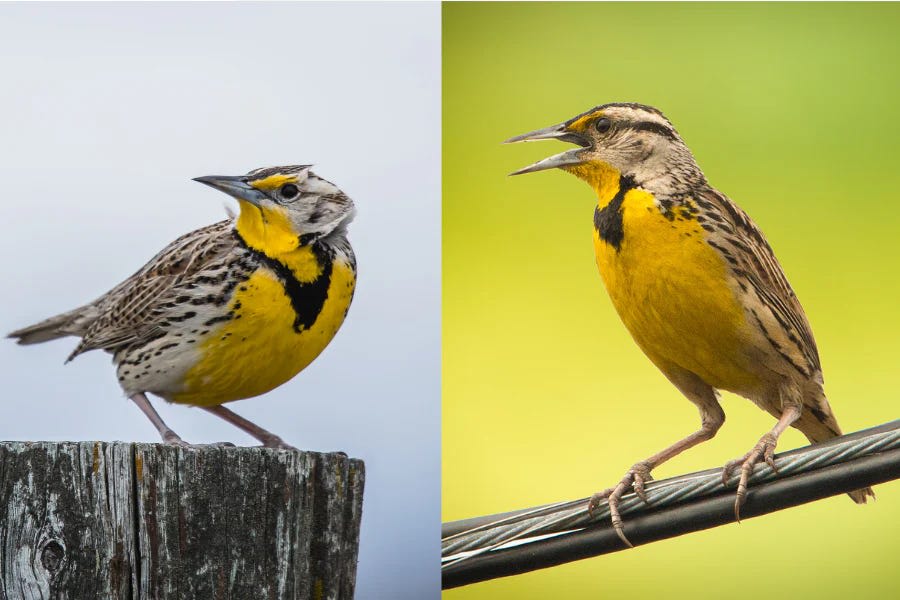
Can you tell which is which? Me neither. The meadowlarks have one continuous range across North America. Everywhere from the Atlantic to the Pacific Coast, you can find meadowlarks. Somewhere in the middle of the great plains, humans have drawn a line. On the east side of that line, are Eastern Meadowlarks. To the west are Western Meadowlarks.
However, around the line, individuals from each “species” regularly interbreed. And those offspring are NOT infertile. They are perfectly capable of producing more “intermediate” Eastern x Western Meadowlarks. Which, by the way, look a lot like their virtually indistinguishable parents.
Why on earth are they considered separate species, you may ask?
There are multiple possible justifications, but the most consistently used in this case is the “The Biological Species Concept” popularized by Ernst Mayr. It reads:
“Species are groups of actually or potentially interbreeding natural populations that are reproductively isolated.”
This is slightly broader than the definition we are currently testing, which, as a reminder, reads:
“Two populations are are different species if they cannot produce fertile offspring.”
The Biological Species Concept considers animals different species if they COULD interbreed, but are currently PREVENTED from doing so by geography or other barriers. The logic with Meadowlarks is that since a meadowlark in California will not, under normal circumstances, breed with a meadowlark in Delaware, the two populations are reproductively isolated. Under the Biological Species Concept, this qualifies them as separate species.
So, comparing our written definition to the IUCN list which contains both Eastern and Western Meadowlark, we once again have a choice. Do we change our definition to match the Biological Species Concept, or do change our list of species? Does the Biological Species Concept hold up?
Unfortunately, no it doesn’t. First and foremost, the Biological Species Concept immediately fails to the Homo sapiens test. If we consider that two populations which are reproductively isolated from each other are different species, even if they could theoretically interbreed, then we are forced to conclude all kinds of strange thing about humans. The most obvious example is that, under the Biological Species Concept, the Indigenous Peoples of the Americas were a different species of human than Europeans before the Colombian Exchange. Even stranger, the same logic probably applies to wealthy Frenchman and rural farmworkers in Sichuan. It is at least as unlikely that a Parisian aristocrat will have a child with a rural Sichuan agricultural worker as it is that a Western Meadowlark will end up in Delaware and have chicks with a local Eastern Meadowlark, which does sometimes happen. Are Parisian aristocrats a different species from Sichuanese farmhands? The Biological Species concept applied consistently would claim they are.
Personally, I am happy leaving it there. The Biological Species Concept cannot be consistently applied to humans, and since we all agree humans are one species, the definition must not be cutting across the joint of reality we call “species” very well. Our intensional definition violates an axiom, it cannot be correct. Enough said.
There are other reasons to be suspicious of this definition, however.
Suppose a single population of yellow fish live in a large pond. A dam is built down the middle, splitting the population in two. Under our definition, speciation occurs the moment the dam is completed, even though nothing biological about the fish changed. Their appearance didn’t change, their behavior didn’t change, their genes didn’t change. Two fish that were the same species in the morning become different species in the afternoon. It happened the moment the foreman finished laying the final brick.
Now suppose that dam is, for some reason, extremely political. Four years after it’s construction, the opposing political party is elected into power, and they tear it down. Four years after that, the original party wins again, and they reconstruct the dam. Power changes hands every 4-8 years, and each time the dam is either torn down or rebuilt. Do the two populations of fish go from being 2 species to 1 species to 2 every time?
This would be a pretty silly result. Proponents of the Biological Species Concept usually respond to this situation by adding conditions to their definition. The two species need to be separated long enough to evolve independently, to have accumulated morphological or genetic differences, etc. But now, obviously, they are changing their definition to something completely different from “potentially interbreeding populations that happen to be currently reproductively isolated.” If they want to use a different definition, we can test that one. But the Biological Species Concept clearly cannot be consistently applied without being forced to update our list of “species” into something that looks pretty crazy.
Conclusion: We should change our list, not our written definition: the Western Meadowlark and the Eastern Meadowlark should be the same species.
Challenge 3: The Northern Red Oak and the Black Oak can produce fertile offspring, though they are considered different species by the IUCN.
Broadleaf forests in the eastern United States are full of hybrid oaks. The Northern Red Oak and the Black Oak are particularly famous for this. This is why it’s often tricky to tell them apart on a botany walk. A lot of them are hybrids! And they’re not all the same degree of hybrid either, since all the 50⁄50 hybrids are fertile, and perfectly capable of reproducing to create 25⁄75 hybrids, or 12.5/88.5 hybrids, and every ratio in between. In fact, there’s probably no such thing as a genetically “pure” Northern Red Oak or Black Oak anywhere in the world.
So… why are they considered different species?
If cornered, botanists don’t usually have a good response. They often try a range of arguments, none of which make very much sense or could possible be applied consistently. For completeness sake, I will address them ad seriatim.
The first possible species justification is 1) morphological difference: since you tell them apart, hybrids notwithstanding, northern red oaks and black oaks should be considered separate species. “The Black Oak has more deeply lobed leaves with a more lustrous adaxial surface.” The acorn caps are different. Et cetera.
Once again, applying our Homo sapiens test to the intensional definition “physically distinguishable, hybrids notwithstanding” reveals there is no way to apply this definition of “species” consistently. Otherwise, any physically distinguishable population of humans (i.e. people from Africa vs. people from East Asia) would be considered a separate species. Once again, since we take it as axiomatic that all humans are the same species, we are unwilling to change our list to match this definition. Ergo, our definition must not align very well with the joint in reality that we want to call “species.”
This inconsistency is not only true for humans. If morphological difference were sufficient to classify something as a separate species, there would essentially be no such thing as subspecies, clinal differences, or breeds of any kind. If Pugs and Great Danes are both Canis familiaris, then the Northern Red Oak and the Black Oak are the same species.
The second justification for treating them as distinct species is 2) ecological difference: since they occupy slightly different niches, (the Black Oak is better at growing in sandier soil than the Northern Red Oak, etc.) they should be considered different species. The argument is that even in a mixed forest full of hybrids, natural selection is pulling each population in a slightly different direction, which counteracts hybridization and keeps the two populations recognizably distinct. On this view, what makes them different species isn’t reproductive isolation but the fact that evolution is continuously acting on them as separate units.
Once again, the easiest counterexample is humans. The indigenous peoples of the Andes and the Tibetan Plateau have evolved genetic adaptations to high-altitude hypoxia. Andeans carry more oxygen per red blood cell and have enlarged lung volumes; Tibetans have a blunted pulmonary vascular response to low oxygen and enhanced tissue blood flow. This physiological differences are heritable, genetically distinct, the result of thousands of years of natural selection, and they involve different ecological niches in exactly the sense that oak splitters use the term. We do not assign these populations of humans separate species status, but if the “different ecological niche” criterion were applied consistently, we would have to.
The third justification is 3) genetic difference: If you run genetics on a Northern Red Oak and a Black Oak, you can tell which is which, or least to what degree it is a hybrid.
The most sophisticated version of this argument is phylogenetic. It states that “species” can be defined as “tips” in phylogenetic trees. This argument goes that if drew a family tree of North American red oaks, the Northern Red Oak and the Black Oak would each occupy their own distinct tip of the tree. Ergo, they are species.
This is called the “phylogenetic justification” for a species. Since the “phylogenetic revolution” in taxonomy, it is probably the most common justification for splitting species.
The problem is that phylogenetic trees can be drawn at essentially any level of granularity. The tips of the tree aren’t discovered — they’re chosen. You decide in advance what counts as a unit worth including, and then the tree faithfully represents those units as tips. Pointing to a population and saying “it’s a species because it appears as a tip on the phylogeny” is circular: it’s a tip because you made it one.
For example, here is a phylogeny of the great apes, including humans.
Very simple. And look at that! The tips all correspond to the 5 generally accepted species of great ape. How convenient! Only one problem. Here’s a phylogeny of all modern humans.
If we applied the genetic distinctness argument consistently, even in its sophisticated phylogenetic form, we would have to split modern humans into dozens of species.
This is not to say that species are not genetically distinct from each other. They clearly are. Genetic distinctness is a necessary but insufficient condition to grant specieshood. And phylogenies are too flexible a tool to act as a definition for anything.
Conclusion: We should change our list, not our definition. The Northern Red Oak and the Black Oak should be the same species.
Challenge 4: Lions and Tigers can produce fertile offspring, yet the IUCN considers them different species.
Lions and tigers used to co-occur in India and the Middle East before both were hunted to oblivion by autocrats with too many chariots, like Nebuchadnezzar and Alexander the Great. There is no evidence they ever hybridized in the wild. However, they have been convinced to hybridize in captivity, producing “ligers.” Crucially, hybrids that are often but not always infertile. Female ligers can sometimes reproduce, though with very low success rates.
This creates a problem for our definition. It turns out the word “fertile” is not quite as binary as we were assuming. Lions and tigers can sometimes-but-not-usually produce fertile offspring. Does that make them the same species?
It is important to approach this question with caution. It would cause every wildlife biologist on earth untold amounts of physic damage if lions and tigers turned out to be subspecies of the same large cat. As a wildlife biologist, one must recognize that this is likely to cause a strong bias against that conclusion, no matter where the joint in reality actually falls. It’s important to be clearheaded, and approach the question with an open mind.
Fortunately, I think the problem here lies with our definition, not our list. What we were actually trying to capture with our written definition was whether evolution can act on two populations as a single biological unit, whether gene flow between them is possible in any meaningful sense. Geographic separation, like that between human populations before the Columbian Exchange, or Eastern and Western Meadowlarks across North America, doesn’t change the underlying biological reality: those populations could still interbreed, and genes could still flow between them. The barrier is temporary and external, not biological.
The lion and tiger case illustrates the flip side. They can occasionally produce fertile offspring, but so few of them are fertile (and those that are are so unfit, suffering from gigantism and organ failure), that no meaningful gene flow actually occurs between the two populations. From an individual lion’s or tiger’s evolutionary standpoint, a liger is functionally the same as no offspring at all — all the genes in that offspring stop with the liger and maybe, super rarely, one generation of its descendants. In the long term, no tiger genes enter the lion population, and no lion genes enter the tiger population. The two lineages are evolving independently, which is what actually matters.
This means we get to keep lions and tigers as separate species.
However, now we need to come up with a new written definition that preserves all our previous decisions, but keeps lions and tigers as different species. Maybe something like:
“Two populations are different species if gene flow between them is so unlikely as to be practically biologically impossible.”
The definition of “so unlikely as to be practically biologically impossible” here would need a technical definition. Just how unlikely is “impossible?” This is the kind of genuine gray area that I think requires drawing a line by fiat. THIS is one of the narrow debates where the line becomes a little arbitrary. It’s the kind of question that a group of taxonomists would need to debate in Davos. My proposal would be something along the lines of “a hybridization event catalyzes gene flow between the populations <1 time per 100,000 successful reproduction events in areas (real or theoretical) where they co-occur.”
As a first gut check, we should make sure this new definition preserves Homo sapiens as a single species. It only takes a moment’s reflection to see that it does: all human populations are biologically capable of mutual gene flow, so all humans would be the same species. Check!
Conclusion: We should change our written definition, not our list: the Lion and the Tiger remain different species. Our new written definition is “Two populations are different species if gene flow between them is so unlikely as to be biologically impossible.”
Challenge 5: Carrion Crows and Hooded Crows have gene flow between them, yet the IUCN considers them different species.
Carrion Crows and Hooded Crows are two European species of crow that look very different, but are actually genetically almost identical. The only difference is that a small region of the genome controlling pigmentation has been effectively “de-activated” in hooded crows, resulting in their distinctive white-gray body feathers.
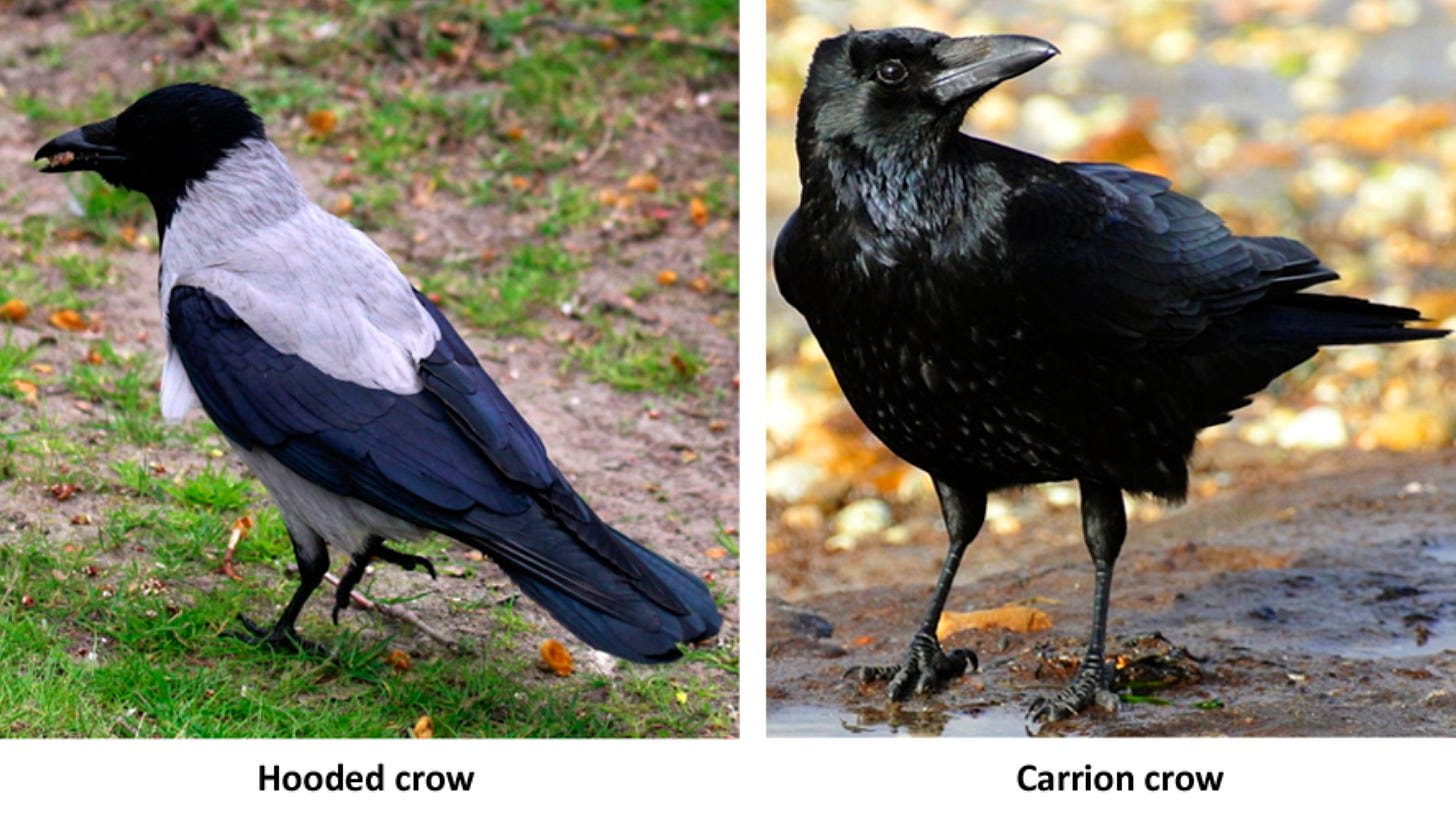
There is nothing, biologically, stopping these species from breeding. In fact they sometimes do in Central Europe, where a small part of their ranges overlap. Those hybrids are then fertile, much more so than the “liger.” Many of them manage to reproduce. Then, the 25⁄75 hybrids are even more fit than the 50⁄50 hybrids, and so manage to reproduce even more of the time. In this way, genes pass back and forth between the Carrion and Hooded Crows.
In fact, hybrids are only less “fit” (i.e., they pass on less alleles per capita) because both species of crow have “assortive mating” patterns, meaning they strongly prefer individuals that don’t have “aberrant phenotypes.” In plain english, that means Carrion Crows and Hooded Crows find each other funny-looking, and don’t want to mate. However, this preference isn’t 100% deterministic, so Carrion x Hooded Crow hybrids do sometimes happen. But these 50⁄50 hybrids look intermediate, which means they’re funny-looking to everyone, so they have a relatively hard time finding a mate.
So, Carrion Crows and Hooded Crows look different, not only to humans but to each other. They are capable of producing hybrids, and those hybrids are biologically health and fertile. But for behavioral / ecological reasons, they are still much less fit than their genetically undiluted conspecifics. Despite this, gene flow does occur between the two populations where they co-occur in central Europe, albeit not much.
Should they be considered separate species?
Our current definition we call them the same species, since gene flow between the two populations is not “practically biologically impossible.” In fact, we know there is gene flow between the populations — we can see it in their DNA.
However, to me it finally feels like we’ve landed in a genuinely debatable gray zone. I genuinely understand how reasonable people applying a consistent definition could disagree with this. There are very strong reasons to argue that these populations are on opposite sides of a genetic and evolutionary joint in reality.
Personally, however, I still think the crows should be called the same species, mostly because it is my belief that speciation should be biologically irreversible, and it is still theoretically possible that the two crow species could return to one species.
Suppose that, if it weren’t for the assortative mating preferences of Hooded and Carrion Crows, their hybrids would actually be more fit than either parent. This is called hybrid vigor, and it happens all the time in nature. We have no way of knowing if this is true of these crows, because the signal is being masked by their mating preferences. But if it were true, and if both populations lost that preference through some mutation or behavioral shift, the two populations could subsume each other, becoming a single, phenotypically and genetically indeterminate population again.
For most of the things we call “species” this would be impossible. For Lions and Tigers, for example, “tigons” (from male tigers and female lions) are almost always sterile, and “ligers” (from male lions and female tigers) are so unfit that the two species would almost certainty go extinct far before the hybrids actually accounted for the entire population. For humans and chimpanzees, our closest relative, no evolutionary process could make us reconverge back to our most recent common ancestor any more than water could run uphill. It’s just literally impossible.
Such a thing is still possible for the Hooded Crow and Carrion Crow. It would only take a single behavioral mutation in two populations and possibly a case of hybrid vigor, though even that probably wouldn’t be necessary. This makes me think that, though the two populations are certainly in the process of speciating, the speciation hasn’t happened quite yet. Since the two populations are mostly reproductively isolated (there is gene flow between them, but it is minimal), eventually genetic drift will carry the populations far enough away from each other than their offspring will start looking like ligers — sickly, often sterile, and almost entirely unviable in the wild. That moment is the point I would say they have become different species. Right now, humans have recognized that two populations are almost certainly about to speciate, and called the speciation a little too early. Right now, they’re just two subspecies walking in opposite directions. But they haven’t actually arrived.
Conclusion: We should change our list, not our definition: Carrion Crows and Hooded Crows should be the same species, although they are likely to speciate soon in geological time. Our final definition remains “Two populations are different species if gene flow between them is so unlikely as to be biologically impossible.”
PART IV: Implications, or the Lumpers were right!
The IUCN List of Species is absolutely full of entries that, under any consistent definition of “species,” should not actually qualify.
This is a live problem. More species are added every year using justifications discarded above for the simple fact that, if applied consistently, they would indicate that modern humans were many different species.
For example: here is a graph of species lumps and splits in North American bird species since 1880.
You will notice that until the 1980s, there were more lumps than splits, until genetic tools started becoming more widespread, and genetic differences in species were detectable everywhere. This inspired splits such as that between the Eastern and Western Meadowlark, the Black-capped and Carolina Chickadee, the Indigo and Lazuli Bunting, and many other pairs which regularly produce fertile offspring and have strong gene flow between them.
I’m sure I could find similar graphs for essentially all taxa in all parts of the world. The splitters are ascendent.
This has been called “taxonomic inflation” by critics, most notably Nick Isaac and colleagues in a widely cited 2004 paper. The incentive structure is not hard to understand. Finding a new species comes with prestige, attention, and often funding for basic research and conservation. Researchers have a strong bias toward arguing that their study population represents something new. And since there is no standard, consistently applied definition of species, it is easy to shift the goalposts for each candidate population, applying whichever definition produces the desired outcome and discarding it when it does not. The result is a literature full of splits that could never survive consistent application of any single criterion.
I think this has five main implications.
Evolution doesn’t care about your aesthetics.
There is a higher level of organization in the tree of life called a “class.” For a long time, everyone considered reptiles and birds separate classes. Then we ran a bunch of genetics, and it turned out that, technically, birds are a subclade of the reptile clade, so strictly speaking all birds are reptiles, in the same way that all cetaceans are mammals.
Biologists accepted this as true, then simply refused to change the taxonomy. It was just too disturbing to consider birds reptiles. To this day, everyone knows that we should be calling birds reptiles, but we just refuse to do it. Because look at them! They’re NOT reptiles! It does too much violence to the human sense of aesthetics to admit that’s what the phylogenetic tree looks like.
We often do the same thing with species. The Hooded Crow and Carrion Crow just look different. Surely they must be different in a way that is evolutionarily salient enough to justify calling them different species. Biologists need to be trained to avoid falling into this cognitive trap. It may be the case that, after careful consideration, you decide that Hooded Crows and Carrion Crows are evolutionarily distinct enough to be considered different species. But you should come to that conclusion after a sober analysis of the facts, un-influenced by human aesthetic preferences.
A consistent species definition will probably support lumping more often than splitting, and this will more reliably protect genuine biodiversity.
Splitters often justify inflation on conservation grounds, arguing that more species means more protection. But if our list of species is inflated with pseudospecies, it dilutes attention and funding from genuinely distinct lineages that actually need protection. Every dollar that goes to protecting the “Eastern Wolf” cannot go to protecting the Indri, or the Golden-cheeked Warbler or any number of other genuinely threatened, actually irreplaceable species. Taxonomic inflation is bad for conservation.
We should all go to Davos and fight about this.
I joked about a taxonomic conference in Switzerland twice in this post. I think we actually need to do this. Biology needs a single authoritative body (probably the IUCN) with a single consistently applied definition. The current “pluralism” in the species concept is chaos and pseudoscience masquerading as intellectual humility. Taxonomic inflation hurts conservation efforts, analyses in macroecology, and basic research in wildlife biology. I swear on my life, even if me and all the other lumpers are the ones who have to pay Danegeld in the end, I’ll still dance Charivari if that means we can have a scientific definition consistently applied.
The species debate is a case study in what happens when a scientific field forgets how definitions work.
The species debate is a case study in what happens when a scientific field forgets how definitions work. The problem isn’t that evolution is complicated, or that the joints in reality are hard to find, though both are true. The problem is that taxonomists stopped asking whether their definitions were consistent and started asking whether they were convenient. The result is a field where the same taxonomic body invokes reproductive isolation on Monday, genetic distinctness on Tuesday, and conservation necessity on Wednesday, and sees no contradiction in any of it.
This is why scientists need training in more than their hyper-specific subfield. There is too much object-level training in science (how does the bootstrapping technique work in phylogenetics?) and not enough meta-level training (what is a definition, and how do we know when one is working?). Epistemology and semantics shouldn’t be liberal arts electives taken to round out a science degree. They are tools for tackling the central questions of science. The species debate is a cautionary tale for what happens when a field doesn’t have them.
The lumpers are right in biology.
It is my belief that, in biology at least, the lumpers are right. Not because lumping is more elegant or more conservative, but because when you apply a single well-calibrated definition consistently, you end up with fewer species. If we actually applied a definition rigorous enough to preserve modern humans as one species, I believe a substantial portion of the IUCN list would collapse back together, leaving only populations that are genuinely, irreversibly, and evolutionarily separate.
It’s true that there are some edge cases I haven’t addressed. In asexually reproducing populations, or microbes capable of horizontal gene transfer, the species concept starts becoming genuinely incoherent. But these exceptions don’t apply to most of what the IUCN catalogues. For the vast majority of the list, the question is simply whether we’re drawing the lines consistently. And I don’t think we are.
About the author: My name is David Goodman, I’m a master’s student in biology at Oxford. This is the second post on what will be a monthly Substack about whatever I’m into.
I would strongly recommend reading Species Concepts in Biology for a history and explanation of the current system(s). In summary, there are multiple joints at which you can carve reality, and which joints you choose to carve depends on why you are carving reality in the first place.
As someone who studies viruses of bacteria, how are you supposed to apply the Biological Species Concept to asexual organisms anyways? Are there no bacterial “species”? But we need a way to categorize and talk about them, even if they’re not a species under the BSC. Even if this will group bacteria together whose genome lengths can vary by an entire order of magnitude.
Fundamentally, the Species Concept is the same problem. We need a way to categorize and talk about animals, so we find ways to categorize them based on how useful the categories are. Birds are feathered reptiles. Reptiles are non-feathered reptiles. We form these categories not because they carve reality at the phylogenetic joints but because these categories are useful. Fish are fish. Trees are trees.
(Viral species are even worse. Linear phylogenetic inheritance is thrown out the window. Everything is modular and recombines with each other.)
I don’t really follow the IUCN or like the focus on “biodiversity” for its own sake (just expose them to mutagens if you want more genetic diversity) (I also have philosophical issues with “conservation”—what, exactly, are you conserving and why is that time more worth conserving than any other time?) I’m probably informed by my study: in my opinion everything is a bag of genes, and genes constantly flow between them; species aren’t real and are just useful lines to draw in a continuum of gene flow, which constantly changes over time.
But can you verify it? Do you have experimental evidence that a human from location A can form fertile offspring with a human from remote location B? That’s why geographical isolation is used to define species; because they (mostly) don’t overlap, we don’t have evidence if they can or cannot interbreed. Only when we have evidence of hybridization can we start discussing whether to collapse them into the same species (ring species notwithstanding).
Also, I don’t know nearly enough about plant hybridization, but I’m pretty sure that plants can hybridize extremely easily and if we applied only an “interbreeding” species concept the categories would collapse into uselessness.
Do you think that we should categorize e.g. the Sentinelese people as a separate species due to lack of evidence of hybridization? That seems like a strange thing to do given that (I assume) we’re all pretty confident they can still interbreed.
The Sentinelese has been reproductively isolated for probably less than twenty generations, which can be sufficient for speciation (given strong selection pressures), but relatively unlikely. So I don’t think it’s necessary to assume that speciation has occurred.
(aside, estimates of Sentinelese isolation are full of wild speculation and misinformation. We have no genetic samples from North Sentinel Island, which means we have no evidence. All estimates are speculation, with an upper bound at a few thousand years due to shared ethnographic artifacts. Missing artifacts (metalworking, etc.) may or may not help establish a lower bound, but is confounded by natural resources available on the island. Also, going back more than tens of generations would imply a high amount of inbreeding given the limited carrying capacity of the island, which could theoretically be sustained with strong selection.)
--
Imagine a forest with one species of frog. Then a road is built through the forest, separating the forest in two. The day after the road is built, I discover that there are now two reproductively isolated groups of frogs! Are these now different species?
(under most species frameworks) No! That’s preposterous. The two populations have been isolated for less than a day. Sure, they may at some point in the future diverge (and now natural selection is acting on the two groups differently), but at this point the two species are genetically identical.
--
But now imagine you stumble across on species of frog in one forest, and a similar-looking frog in a different forest. The two population are reproductively isolated. Are they the same or different species?
Well, you might ask how long they’ve been reproductively isolated for, since if the forests were connected yesterday then we converge on the same scenario as above. A week, a month, a year, a decade, a century, a millennium, a million years. At some time of separation we cannot reject [no speciation] out of hand, or, rather, number of generations, since that’s what matters in (genetic) speciation. And in nature, we can generally assume that the groups have been isolated from each other for thousands of generations (unless the barriers are human-made, or with recorded history, and because our genetic divergence estimation tools don’t work well for times less than that).
Can they produce fertile offspring? Well, no, not in nature, since that’s what reproductive isolation means. Maybe you can put two of them in a box and test it out manually, but you don’t have the funding to do that. And genetics don’t help too much in determining hybridization potential.
(an aside, what counts as producing fertile offspring? If they can produce fertile offspring via IVF, but never crossbreed if you cage them together because they don’t have the same mating calls or compatible mating apparatus or look funny to each other or sleep at different times of the day, does that count as producing fertile offspring? this is why “natural populations that are reproductively isolated” is added to the definition)
So you have two groups of frogs, isolated from each other for thousands of generations. Evolution is acting upon them as two different groups. But they look suspiciously similar. Do you call them different species?
I could go either way, and lean towards labelling them as different species until we have evidence to the contrary. Otherwise one of the forests might be bulldozed before we can gather the evidence.
Re: Challenge 5: So interbreeding is biologically trivial but limited by patterns of assortative mating. Have you seen interracial marriage statistics? This seems like another perfect place to invoke humans, and I’m very surprised you conceded it as a gray area. The only way I could even imagine someone arguing these birds are distinct species but humans aren’t would be something like “well these birds interbreed at a rate of X% while humans interbreed at a rate of 2X%, and the speciation line happens to be conveniently in between those two”, which is an argument that blows up as soon as we look at some country or historical period with much lower rates of human interbreeding.
The very idea that “they can interbreed fine but mostly don’t due to assortative mating” could ever count as a speciation line implies that if a human society becomes sufficiently anti-interbreeding, that will constitute an immediate speciation event, and if they later begin interbreeding freely, the two new species can collapse back into one in a single generation. That’s obviously silly, any definition that behaves that way is cataloguing culture, not biological reality.
If the humans become sufficiently anti-interbreeding for
six hundred thousand generations (which is how long ago the crows have been split, and twice the number of generations that humans have separated from chimps) then yes I think you may consider it as a speciation line.EDIT: I used the wrong numbers, that’s probably the upper bound. The lower bound is 400 generations. Am looking for more precise divergence timelines than “Pleistocene glaciation”
EDIT2: So the mutations in coloration seem to have arisen around 400-500kya. So that’s about 14-16 thousand generations.
(the crows have been merged into the same species as of 2025; they were the same species but were split in 2002 due to pre-genetic evidence. probably merged again due to genetic evidence)
Because evolution happens in discrete steps, speciation happens at particular moments in history. If you wanted the “correct” method for categorization you would pick the cause(s) of the speciation events. But this often times not possible because we only know traces of the history of evolution.
Crossbreeding is a poor choice for categorization because it only captures one chapter of the story. Its a solution used by genes to carve out their niche against other genes, but its not the only solution.
I feel this article was insufficiently integrative across the fields of evolution, ecology, and conservation science. In the first, it largely ignores the research frontier of speciation with gene flow and the speciation continuum. You also note that the phylogenetic (cladistic) species concept is necessary but not sufficent, and yet also make no mention of phylogenetic discordance and/or hemiplasy in macroevolutionary time. Obviously you can’t mention everything, but these are massive holes in your conclusion, ones that contemporary speciation research naturally brings up.
In the second, you say that your speciation concept would improve ecology. Why? Ecologists who can see trait variation that they are interested in are not going to ignore it on the basis of speciation, which trait variation tracks poorly. The fact that still much evidence for hybridisation between pairs of taxa is based on natural history observations makes this situation worse, since it is genuinely hard to circumscribe very plastic species vs a hybrid zone. I suspect for this reason the potential for hybridisation is vastly underestimated. Measures of biodiversity are trying to move away from species richness due to this, something that would not be solved by a more consistent definition that still has the same fundamental issues.
In the third, conservationists are already integrating along these lines. IUCN includes subspecies and populations of distinct conservation relevance. It is not clear to me how the population viability concept connects to the species concept debate, except insofar as it gives us a common language to compare populations that already has consensus. Conservationists and taxonomists definitely understand the definitions—it’s just a bit intractable and tangential to the conservation value.
Having said that, I appreciate you are writing this under your own name and I am writing this under a pseudonym. Compliments to writing good quality conservation content, even if I disagree with it.
Hi David!
Definitions should ideally be based on how they are intended to be used. That’s partly why bacteria are defined based on base-pair differences, birds are defined mostly by appearance, and humans are not split into subspecies.
I agree with your overall article. The definition of ‘species’ is broken and ridiculous. But I think trying to find the final form of the Definition of Species is a lost cause and missing the forest for the trees. Instead, I think it’s better to move towards allocating conservation effort based on the phylogenetic tree and evolutionary distinctiveness. (Really this is a proxy for preserving traits of living things: everything that might potentially be important or interesting about life!) There has been remarkably little progress on doing this. At least the global biodiversity framework has recognized evolutionary distinctiveness as a “complimentary indicator”, and EDGE is working on it. Instead of fixing the way we define species and subspecies, skip the lumpers and splitters problem entirely and allocate resources based on the evolutionary distinctiveness itself. (An easy single number, capturing the proportion of the tree if life it represents!) If the species are totally unique, isolated, and represent a huge branch of the tree of life, then they should be prioritized and get more resources than another random species. And certainly compared to the the split-to-all-hell island anoles. Creating a new species would just… split the resources in half… as they should be? It just seems pretty self evident to me that this is the way to coordinate and prioritize species conservation.
It does get complicated when you compare between beetles and mammals of equal distinctiveness, but at least the phylogenetic difference is objective and then you can pile on the human favoritism explicitly on top. There may be also be some species that evolve faster than others, but favoring those doesn’t seem terrible or like it will be a huge problem afaik.
To read some more of my musing on this—check out my article for EcoResilience Initiative here.
Speaking as a scientist, best practice is to provide the working definition for critical terms. It would be unwise to assume that any biological definition is universal, static, comprehensive, and known to the audience. Putting the onus on the writer to disambiguate their terms also alleviates the requirement to achieve a uniform definition. Scientific categories are basically statistical in nature. All models are wrong, some are useful.
My understanding is that in legal world, there is a different mechanism for dealing with ambiguity: we empower a judge to interpret the law. Laws, in turn, are written with the understanding that they will be interpreted by judges, enforced by police, and modified by politicians elected by voters.
Your argument implies we should use political discomfort to decide which biostatistical model the term “species” refers to, then require that judges use that model when interpreting the law. I would never accept this as a scientist, I would not want judges to adopt this heuristic, and the argument basically reads to me like a bit of motivated linguistic political theater.