How reality turns to slop
tldr: ai slop influences culture by shifting the Overton window, which then feeds back into AI during training
I want to describe a dynamic by which AI generated outputs might push the world to become more and more cartoonish, strange, simple, and generally slop like which I am calling hyperslopification (AI slop + hyperstition). This work is somewhat speculative but I will also try to point to real world examples of where I think this might already be happening. This is a particular instance of the broader concern that AI distorts culture by changing the memetic environment.
Slop is hyperpalatable
The term ‘ai slop’ is generally used to designate ai generated content that is low in quality and produced with little effort, often in large volumes. However I want to emphasise a common property of ai slop which I will call its ‘hyperpalatability’. Hyperpalatable food is engineered to be easy to consume and addictive by including large amounts of salt, fat and sugar; ingredients which we have evolved to crave. AI slop similarly exploits our evolved preferences by producing cultural artefacts that optimise for aesthetic properties like symmetry and legibility as well as more visceral ones like sexiness and cuteness.
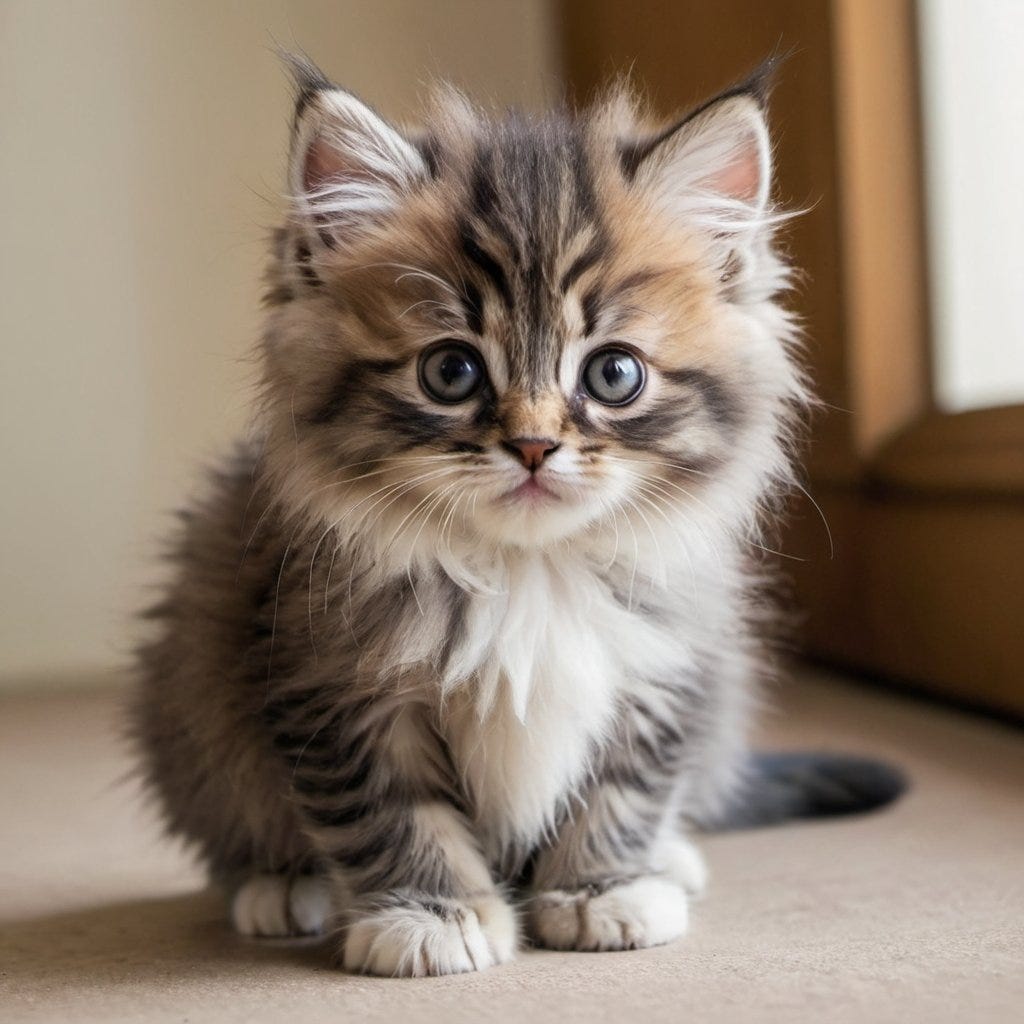
Cuter than a real kitten?
This has been a general trend in our culture since well before AI. In particular social media and recommendation algorithms have already altered the memetic environment in a way that selects for cheap manipulation of human attention; clickbait, ragebait, thirst traps, etc. However generative AI pushes this to extreme levels for a number of reasons:
You get what you measure. Hyperpalatable aesthetics are by definition easy to measure, so they are easy to train AI for. In fact training procedures like RLHF are likely to optimise for these even if it is not being done deliberately or cynically, since they reflect actual human preferences (at least in some sense).
Increased variance. AI generated images are not restricted to reality so they can have more of any given property whether deliberately or just randomly (this is of other mediums like drawing but these are always at least somewhat high effort).
Slop dominates memetically
The hyperpalatability of AI slop described above makes it inherently memetically fit. It grabs attention, and provokes strong reactions. Furthermore its low cost (in time, effort and money) make it especially useful for precisely the people who are most interested in producing viral content whether for profit, propaganda or simply for likes. It can easily be used for A/B testing, targeted to extremely small niches, or in rapid response to current events or trends. Even its weaknesses contribute to its spread, with its ridiculousness and controversy around it provoking reactions that drive virality. All of these factors combined with sheer volume mean that AI generated videos, images and text can easily start to take up an outsized space within online culture.
Reality becomes hyperpalatable
Where things get interesting is the effect that this has on our expectations for reality itself. As we get more and more used to seeing images that are cuter, sexier, weirder, etc. both our baselines and our Overton window shift in the direction of extremity, and life starts to imitate art.
One particularly obvious domain for this to happen is beauty standards. There has already been plenty of discussion about how things like instagram filters and Hollywood steroid use push people to expect more and more unrealistic norms. As we see more and more AI generated people we start wanting more and more symmetrical faces, squarer jaws, more bulging muscles etc. The Guardian has already reported a rise in people coming to plastic surgeons seeking ‘AI face’. As AI shifts our desires the market will move to satisfy them, you can expect the next generation of Hollywood actors and internet influencers to look AI generated whether by plastic surgery or simply selection.
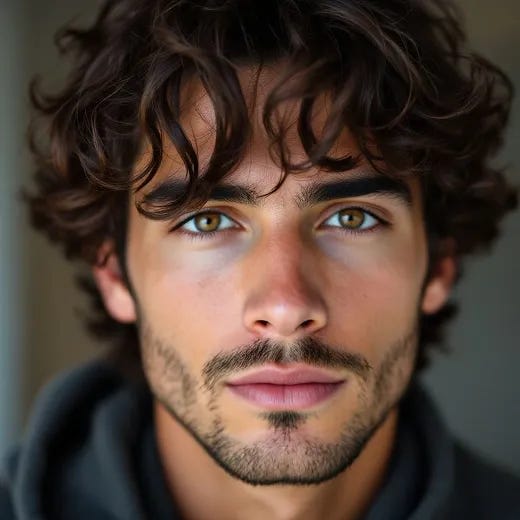
a ‘totally realistic’ face
Pink rifle parades: a case study
The inspiration for this post came from a talk by British-Iranian artist Parham Ghalamdar. The talk focussed on how during the 2025 Twelve Day War between Iran and Israel, social media was flooded with a wave of AI generated images of Iranian female soldiers posted by pro Iran propaganda/meme accounts. A few things are worth noting about these images:

The Iranian military does not allow women in combat roles, so the images of them brandishing weapons or piloting planes are very obviously unrealistic.
Many of the women are not wearing hijab which is a legal requirement for Iranian women in public. Beyond this some of the images are clearly sexualised.
As with most AI generated images there is something cartoonish about how legible it is. When asked for an “Iranian women soldier”, AI will tend to produce something that is extra-Iranian, extra-feminine and extra-millitarised.

particularly egregious
Whether these were state propaganda, Iranian citizens, other propagandists or simply parodies, the result was to create a new image in the Iranian popular consciousness: A woman who was simultaneously empowered, patriotic and overtly feminine.
Since the start of the current US-Israel-Iran war a new wave of AI-generated women soldiers has appeared on social media. But more remarkably in April we saw parades in which women varyingly wore army uniforms, carried pink rifles, and rode pink army jeeps. Also present at the parades and more broadly in a wave of war time online pro regime messaging are unveiled women (something that could get you beaten and arrested just months earlier).
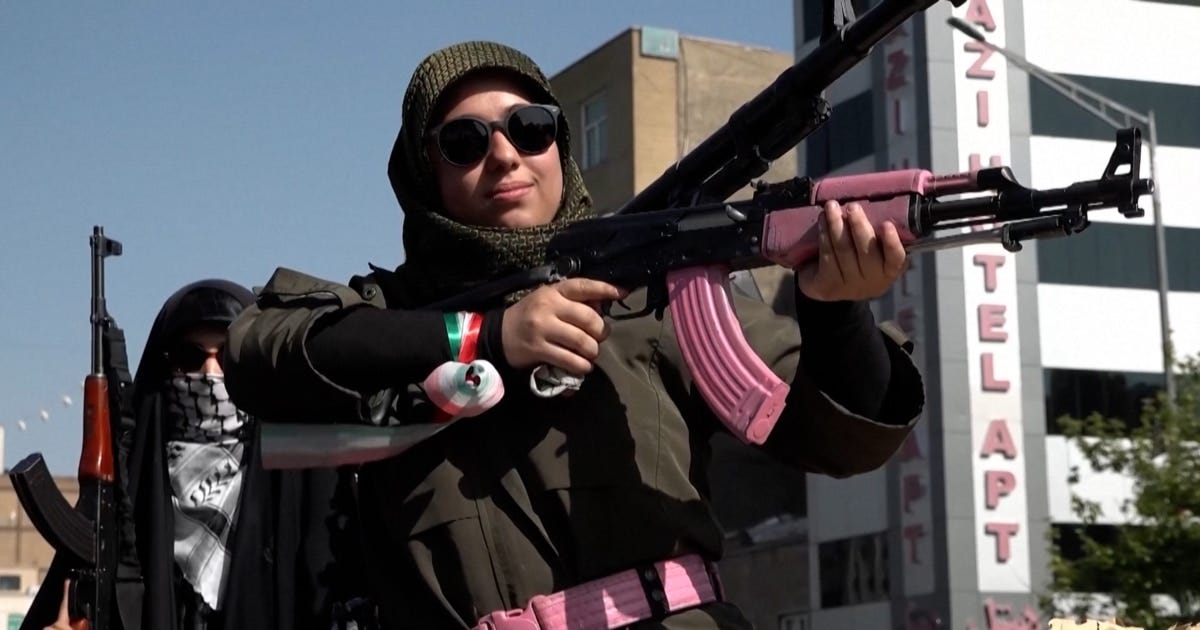
a new role model for Iranian women?
Of course it’s hard to prove that any of this is a direct consequence of the AI imagery. The Iranian regime has has used images of armed and unveiled women before especially during times of instability. But there is something suspicious about how cartoonish the pink rifle parades are, in contrast with the austere images of armed women dressed all in black that you can find from the 90s for example. They look like AI slop: extra-Iranian, extra-feminine and extra-militarised. It seems plausible that the previous years AI imagery helped shift both the demand and the tolerance for a new kind of propaganda image, and reality has moved to fill the gap.

Feedback loop
As reality starts to look more and more like AI slop, how does the slop respond? It seems plausible to think that it will get more and more hyperpalatable. This can happen by a few mechanisms:
During pre training: The new ‘slopified’ reality is fed back into AI training data. This creates a sort of model collapse even without AI being trained on its own outputs.
During post training: shifts in human preferences and tolerances for hyperpalatability are reflected during RLHF.
During use: shifts in preferences and tolerances means that people will demand and accept more and more hyperpalatable AI outputs. People also deliberately create more ridiculous outputs to parody the ridiculous realities.
All this means we can expect new waves of even more attention grabbing, addictive and ridiculous AI generated content which can in turn feed back further into reality itself in a potentially runaway process. Of course this may well hit diminishing returns, negative feedback or hard limits in different domains at different points, but I think we still have a long way to go.
a (sloppy) diagram
Appendix: a few possible domains for hyperslopification
writing styles: Its already been observed that many people are starting to write in GPT-ese even when not using AI. As people (especially those learning to read now) get more accustomed to this extra-legible style of writing, others are likely to be tolerated less and less.
Political imagery: populist politicians already like using AI to generate images of themselves that would not be tolerated if real. They are also producing real images that look increasingly cartoonish. These two phenomena seem likely to feed each other.
That just sounds like cultural changes with extra steps?
AI-aided exploration identifies a cultural demand for X, and reality may or may not follow to fulfill that demand.
Replace “AI-aided exploration” with a manual “artists/propagandists/politicians probing the zeitgeist” and you get the pre-AI status quo. Trends being created and abandoned. AI generation lets you do the same thing but faster? I don’t see the step change.
AI commodifying cultural production leads to much more thorough “probing” (by sheer volume if nothing else) of the space of possible outputs. This creates a kind of “memetic fitness inflation” where the level of palatability a meme must have to survive is being pushed up. You can say this is just an acceleration of existing dynamics but it is a step change in that acceleration (analogous to something like the shift from youtube to tiktok)
There is also the effect of feeding back into the models. Individual creators can be people whose preferences are robust relative to broader cultural trends, so can inject variation back into the culture. But if all production is passing through the same few models, trained on similar corpuses then you get something like the lock in hypothesis, except instead of stagnation you have drift in a particular direction.
The same was already done by things like internet allowing far more people to participate in content creation, exploring the space with sheer brute force.
The “individual creators” also run trends into the ground by trend chasing too hard, and oversaturating the cultural space with them to the point that any demand is met with overmatch. Likewise, there are already entire styles that have gone in and out of fashion due to those styles being used by AI.