We Die Because it’s a Computational Necessity
Note: This builds on my sketch from September 2025 “You Gotta Be Dumb to Live Forever.” Candidly, that work had a lot errors. I’ve done my best here to correct those and clarify the exact results here, but it is possible this is still all messed up. With thanks to David Brown; and Tatyana Dobreva for her great questions and feedback. All errors are mine.
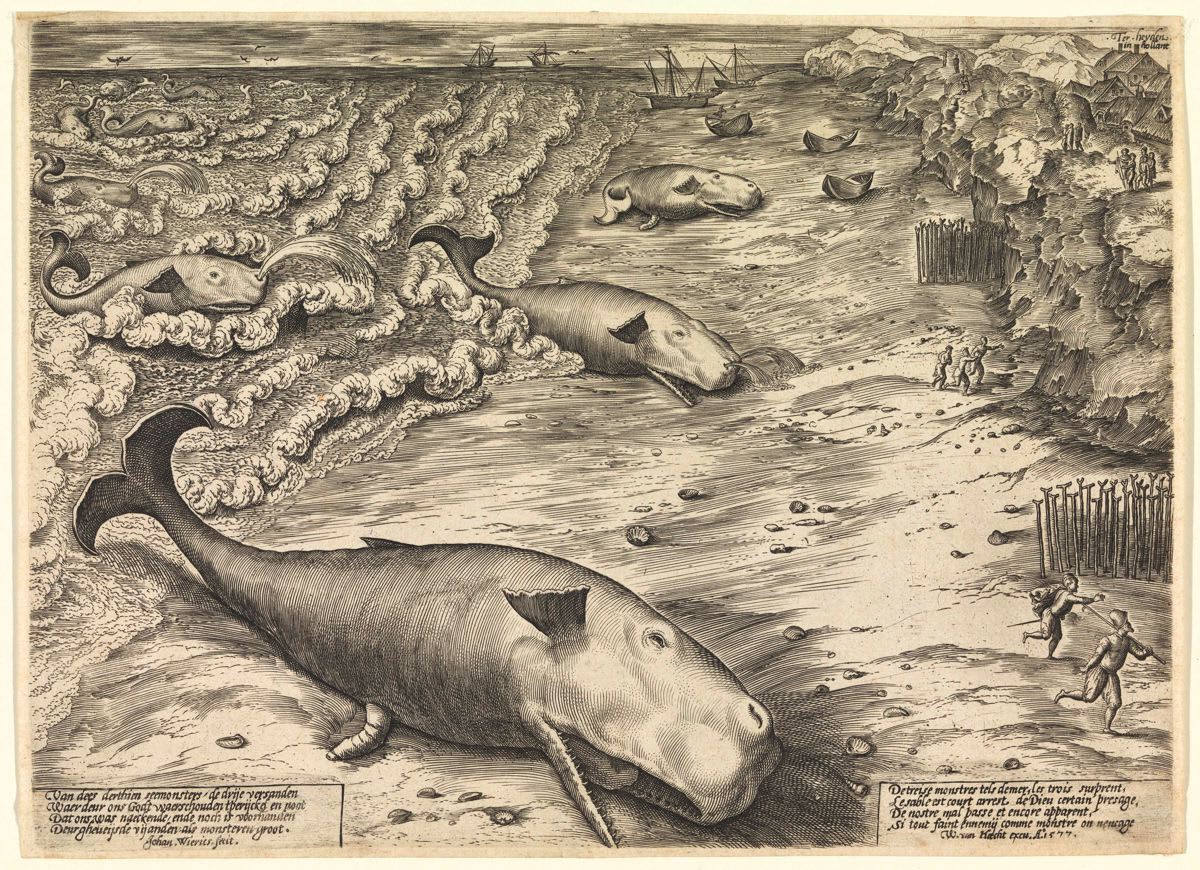
Johannes Wierix: Three Beached Whales
Another thing that got forgotten was the fact that against all probability a sperm whale had suddenly been called into existence several miles above the surface of an alien planet…
[The whale experiences life as the ground rapidly approaches.]
I wonder if it will be friends with me?
And the rest, after a sudden wet thud, was silence.
— Douglas Adams, The Hitchhiker’s Guide to the Galaxy
Why do we die?
And not just why do we humans die, but why does any complex thing die?
The standard answer from biology is that the Weismann Barrier,[1] which establishes a strict separation between the immortal germline (say DNA) and the mortal soma (for example your body), is a strategy that evolution discovered to faithfully preserve inheritance by requiring a disposable vessel.
In reality, I argue death is a computational necessity that is generalizable across all complex organisms, be they organic, artificial life, AI, or otherwise. These systems must die if they want to solve problems of a certain complexity class because doing so requires computational techniques that physically forbid self-replication.
This occurs because any system that must preserve its own description so it can reproduce ends up structurally confined to a lower-dimensional subspace of strategies. By “strategies,” I mean the computations that can be performed, the problems it can solve, and the configurations it can exist as. The complement of this subspace is something I call the Forbidden Zone. In this area, there are a set of peculiar strategies that necessitate the destruction, or irreversible modification, of the system’s own blueprint. We have good examples of these from biology:
B Cells produce unique antibodies by discarding and rearranging parts of their own DNA in an irreversible step.[2][3] They cannot make a faithful copy of the genome they threw away.
Immune effector cells actively hunt tumor cells and pathogens. Once they have completed their attack, they deliberately self-destruct (apoptosis). A destroyed cell cannot be copied.
Neurons are stable because they permanently exit the cell cycle (they become post-mitotic). This is necessary because their function relies on long-term signal transmission and homeostasis. These cells are alive but sterile; their irreversible modification means reproducing would destroy their functional value.
All of these strategies, whether they require a cell to discard parts of itself, destroy itself, or commit to an irreversible non-replicating state, exist in the Forbidden Zone. Dramatically, no integrated, self-replicating system can execute them. The body exists because the genome cannot perform these special strategies itself, it must build mortal systems to run computations that self-replication makes mathematically impossible.
This dual immortal/mortal strategy does not apply to all life, for example a bacterium does not need a body to survive. There is, however, a precise threshold where the level of complexity demands relinquishing wholly contained self-integration. I identify a Regime Dichotomy based on how search space scales:
The Polynomial Regime: Complexity is low and the cost of self-preservation is minimal because the problems that the system faces are proportional to its size. These are things like replicating your DNA, adapting to a local environment, and running a basic metabolism. Bacteria exist in this regime, where integration is essentially free.
The Exponential Regime: Problems involve combinatorial search, and each degree of additional complexity multiplies the number of potential strategies rather than just adding to them. Self-preservation excludes the system from an exponentially large fraction of its reachable strategy space in this regime. This is where B cells and neurons exist.
There is a sharp phase-based transition at exactly the exponential regime and this is meaningful because it is not a sliding scale; it proves exactly why the Weismann barrier appears where it does in nature. When a self-replicating system enters the exponential regime, the only architecture that can retain its full computational capabilities is one composed of a simple immortal replicator that builds complex mortal workers. This is why humans need bodies, but bacteria do not.
Above the polynomial and exponential regimes, there exists a theoretical ceiling governed by the uncomputable Busy Beaver function[4][5]. Reasoning about this theoretical limit, we learn that no computable bound can uniformly contain the cost of persistence. At every level of this hierarchy, there exist description lengths where the costs are severe, and as computational power grows, the severity grows without limit.
By working in computational terms, I can show that these results are not just applicable to biological life but are strictly substrate-independent. They apply directly to self-replicating artificial life, Turing machines, Von Neumann probes, and Artificial Intelligence because all of these entities face the identical physical constraints.
Death is not an error. It is supreme computational technology, and we are only smart because we die.
Outline of The Essay
This essay is somewhat longer, but builds the argument through the following sections:
Self-Replication Definitions: first I define what self-replication requires using the von Neumann architecture and Kleene’s fixed point, and derive the preservation constraint (what self-replication forbids), which confines any integrated replicator to a proper subspace. I also define a Non-Trivial Persistent Replicator (NTPR).
The Cost of Persistence: next I quantify how much productive potential is expended in order to remain replicable (what I call the Persistence Ratio), proving a sharp regime dichotomy dependent on the environmental time budget.
The Forbidden Zone: I show that maintaining self-description unconditionally excludes an exponentially vast region of behavior space, highlighting when optimal strategies are destructive or descriptively dense.
Architectural Comparison (The Discovery Time Theorem): I combine the cost analysis and exclusion principle to categorize every evolutionary search problem into three zones, showing exactly when differentiation is mathematically necessary.
The Architectural Dominance Conjecture: Based on these findings, I predict that above a specific complexity threshold, differentiated agents strictly dominate integrated ones.
Conclusions: Finally I conclude with a discussion of the findings, some biological applications, and a specific prediction for AGI.
1. Self-Replication Definitions
This section is primarily about defining some preliminaries about the minimum requirements for self-replication, the preservation constraint and what it means to be non-trivial (why a computer virus is different from a crystal which also self-replicates.)
Von Neumann solved the problem of how self-replication is logically possible [6]. He did this by resolving the problem of infinite regress (a machine’s description must describe the description itself) by outlining a Universal Constructor
However, self-replication as a concept is too broad to distinguish something like a crystal[9] from an open-ended evolutionary system. Open-ended evolution requires three conditions:
Universal Construction—It must have the power of a Universal Turing Machine so that it can build any computable structure (simple self-copying automata lack this[10]).
Self-Reference—It must be able to effectively access its own description (guaranteed by Kleene’s Theorem).
Informational Fidelity—It must have robust error correction to prevent the blueprint from degenerating into noise over indefinite generations.
Definition 1.1 (Von Neumann Threshold):
Satisfying
Definition 1.2 (The Preservation Constraint): An integrated self-replicating agent must preserve a valid, recoverable copy of its complete self-description throughout the time it is computing in order to replicate at the end of its generation. It cannot do anything that would irreversibly prevent this reconstruction, regardless of whether the destruction occurs in the
This restriction imposes a strict topological limit on the system’s potential configurations. Notably, somatic units do not face this constraint; they are free to use all
Definition 1.3 (Replication-Compatible State Space): Let
This means an integrated agent is confined to
Definition 1.4 (Destructive Strategy): A strategy
For the restrictions of destructive strategies to be sensible it is important that we distinguish informational duality. Simple replicators like crystals[9] or prions[12] only propagate a physical state. I distinguish these trivial cases from meaningful ones:
Definition 1.5 (Non-Trivial Persistent Replicators—NTPRs): A system
(C1)
(C2)
(C3)
(C4) Reliable replication at noise
I define a complexity floor (
Remark: NTPR is a universal distinction. Because conditions (C1) and (C2) rely on Kolmogorov complexity and mutual information, metrics that are invariant up to a constant term by the Invariance Theorem[13], the definition holds regardless of the underlying machinery. A computable bijection between systems (like mapping DNA to binary) only shifts description lengths by a constant, guaranteeing that the depth threshold (
Some Examples:
| System | C1 | C2 | C3 | C4 | Status |
| Bacteria | ✓ | ✓ | ✓ | ✓ | NTPR (Integrated) |
| Von Neumann Probe | ✓ | ✓ | ✓ | ✓ | NTPR (Integrated) |
| Ciliate Protozoa | ✓ | ✓* | ✓ | ✓ | NTPR (Differentiated) |
| Crystal | ✗ | ✓ | ✗ | ✓ | Not NTPR—low |
| Fire | ✗ | ✗ | ✗ | ✗ | Not NTPR—No encoded |
*C2 is satisfied by the ciliate’s micronucleus; the macronucleus degrades amitotically and is rebuilt from the germline during conjugation. This is an interesting intracellular instance of the germline-soma separation.
2. The Cost of Persistence
Given that self-replication has a structural constraint, how much problem-solving power is relinquished just by virtue of a system keeping itself alive? I define a universal way to consider this by fixing an optimal prefix-free Universal Turing Machine
Information:
Capacity:
The Ceiling (
Logical Depth: The minimum runtime of any near-shortest program for
The Generational Model: Each generation of a self-replicating system is a halting computation:
The agent must allocate a portion of its description to the specification of
Theorem 2.1 (The Productivity Bound). For a self-replicating system of total description length
Proof. Both the integrated replicator and a differentiated soma of the same total size
Please note that the superscript denotes that the time budget is
2.1 The Regime Dichotomy
To characterize this tax we must constrain the conceptual Turing machine to a physically realistic model. I do this by modeling the agent as a Linear Bounded Automaton (LBA) with internal tape length
With this constraint, the preservation mechanism becomes a fixed-cost partition. Exactly
This yields the persistence ratio under the uniform environmental clock
The critical difference from a naive formulation is that both the numerator and denominator evaluate the time budget at the exact same argument
From the physical model above, I derive the main result: the severity of the persistence tax depends entirely on whether the environment’s time budget exceeds the system’s internal configuration space. This creates a sharp phase transition rather than a continuous decay.
Theorem 2.1 (The Memory-Bound Phase Transition). Let
(a) The Free Regime (
(b) The Transition Zone (
(c) The Taxed Regime (
Proof. Follows directly from evaluating the piecewise limits of the uniform clock
Note: the LBA model governs physically realizable results. The unbounded Turing machine model is used solely for the incomputable ceiling to establish the theoretical limit.
2.2 Finite Memory, Computability, and the Physical Ceiling
One might intuitively assume that giving an agent a computable super-exponential time budget (e.g.,
If
This reveals a deep property: no computable physical environment can yield a uniform persistent penalty worse than the
2.3 The Incomputable Ceiling
Even though I have established the limits of the persistence tax for realizable systems, I want to show the tax is an intrinsic property of self-reference. To do so I remove physical constraints and examine the system in the limit of infinite capacity by moving from the LBA to an unbounded Turing Machine. Here, the ratio is measured against the uncomputable Busy Beaver function
Theorem 2.2 (Unbounded Collapse).
Proof. The Busy Beaver function
This establishes two fundamental truths:
The hierarchy has no top. No computable time bound can uniformly contain the persistence penalty. At every level of resource availability, there exist description lengths where the tax spikes arbitrarily high.
There is entanglement with incomputability. In general, you cannot compute exactly how much productive capacity a specific replicator sacrifices because doing so requires computing
2.4 Information Closure and Noise
The previous results treated the replication overhead
1. The Cost of Accuracy: We define the noise-dependent overhead as
While the mathematical algorithm for an optimal error-correcting code (e.g., a polar code[15]) might be
2. The
for a fidelity parameter
3. The Forbidden Zone
The previous section established that there is a productivity tax on persistence. This section demonstrates that this tax is not just a reduction in efficiency, but a fundamental restriction on reachability of strategies within the total space of possible behaviors.
The preservation constraint divides strategies into two regions: those compatible with self-replication, and those that are not. Reserving
3.1 The Subspace Exclusion Principle
The size of the Forbidden Zone can be quantified by comparing the volume of the full strategy space
Theorem 3.1 (The Subspace Exclusion Principle).
The ratio of the full strategy space to the replication-compatible subspace is strictly and unconditionally:
Proof. The class of partial functions computable by prefix-free programs of length
Therefore, the full strategy space is
The Forbidden Zone. The set
In Harvard-like architectures where program memory (genome) is physically separate from working memory (proteome), the constraint operates on control program expressiveness. The Forbidden Zone persists because the
3.2 Don’t Go There! When Does the Forbidden Zone Matter?
The relevance of the Forbidden Zone depends on the environment and particularly whether the fitness landscape peaks in the excluded region. I identify three sufficient conditions where it does.
Condition A: Destructive Strategies. If executing a strategy
V(D)J Recombination: B-cells physically cut and paste gene segments to create antibodies with high specificity, permanently deleting the intervening DNA to build their combinatorial antibody repertoire.[2][3]
Enucleation: Mammalian erythrocytes eject their entire nucleus to maximize hemoglobin volume, a strategy that is not possible for a cell that retains its genome for future division.
Apoptosis: In digital evolution experiments within Avida (an artificial life software platform), Goldsby et al.[21][22] demonstrated that division of labor evolves spontaneously under such pressures: when a task corrupts the replication template, the population splits into a clean germline and a sacrificial soma.
Even without destruction strategies, some problems are too complex to be solved by the reduced description space of the integrated agent.
Condition B: Descriptively Dense Strategies. A strategy
An example here from biology is the developmental program used in the vertebrate body plan. Morphogenetic computation which involves coordinating billions of cell fate decisions likely requires a control program
I should note that even for standard, non-destructive problems (i.e. most biological traits like metabolism, color vision, etc. don’t destroy the genome), the integrated agent loses.
Condition C: Probabilistic Exclusion (The Mild Forbidden Zone). Even if a solution
Shrinking the search space by
When
4. Architectural Comparison: The Discovery Time Theorem
In the last two sections I established that self-replication imposes a tax on productivity and the Forbidden Zone excludes agents from a vast region of strategy space. I now use these findings to operationalize and compare two fundamental architectures of life: those that are Integrated (every agent carries its constructor, like bacteria) and Differentiated (a germline retains replication and constructs mortal somatic units, like multicellular organisms).
4.1 The Rate Advantage (Resource Efficiency)
One straightforward consequence of replication overhead is a throughput penalty. For finite-resource environment every bit allocated to the constructor
Definition 4.1 (Resource-Constrained Search). This is a persistent query system consisting of agents searching a fitness regime
Theorem 4.2 (Linear Rate Advantage). The asymptotic ratio of throughput between optimally differentiated (
Proof. For the Integrated system, each agent costs
If we assume the somatic units perform the full search task where
This result demonstrates that the architectural trade-off is a matter of resource efficiency. In the ideal case, where coordination costs are negligible (
There is a critical nuance I should mention regarding somatic division: although somatic cells (like the skin or liver) divide mitotically to fill the body, this represents an amplification step within a single generation rather than a persistence step across generations. Because somatic lineages do not need to maintain indefinite information integrity they can tolerate mutation accumulation and telomere erosion because the lineage terminates with the organism’s death. Consequently, somatic replication avoids the high fidelity premium of the germline, which is why
4.2 The Combined Discovery Time
Now having quantified the linear penalty of carrying the replication machinery, I examine the computational cost of preserving it.
Theorem 4.3 (Discovery Time by Regime). Let
(a) The Shallow Zone (Optimization): If
Here, differentiation is merely an optimization (a constant factor speedup). This applies to simple adaptive problems like metabolic optimization or chemotaxis. Consequently, unicellular life (integrated architecture) dominates these niches due to its simplicity.(b) The Forbidden Zone (Necessity): If
In this case, differentiation is computationally necessary. This applies to uniquely multicellular problems like V(D)J recombination. Their existence in complex organisms confirms that the Weismann barrier is a mathematical response to the computational necessity of destructive search.(c) Probabilistic Exclusion Zone: If
4.3 The Biological Regime: A Tale of Two Subsystems
The mathematical framework of discovery time is parametric in
Different subsystems within a single organism inhabit distinct computational regimes. The germline operates primarily in the Polynomial Regime: DNA replication is a mechanical construction task that scales polynomially. In this regime, the computational tax is negligible. The soma operates in the Exponential Regime: complex adaptation, immune search, and neural computation involve combinatorial search over high-dimensional spaces. The Weismann barrier[1] maps exactly onto this computational boundary: it sequesters the germline in the safe polynomial regime while freeing the soma to operate destructively in the risky exponential regime.
The Functional Density Constraint
5. The Architectural Dominance Conjecture
I have established two distinct advantages for the differentiated architecture: a linear Rate Advantage (efficiency) and an infinite Reach Advantage (feasibility). I now synthesize these findings into a unified conjecture that predicts the transition between unicellular and multicellular life. The core insight is that these advantages are not fixed, instead they scale differently with problem complexity.
Conjecture 5.1 (Architectural Dominance).
Consider a persistent replicator facing a search problem
(a) Rate Dominance (Proven): For simple problems, the differentiated architecture achieves a strictly higher query throughput by a factor of
(b) Reach Dominance (Proven): If
(c) Probabilistic Dominance: For search problems where optimal solutions are rare (
(d) Threshold Existence: There exists a critical boundary at the exact transition from polynomial to exponential computational demands where the advantage shifts from linear efficiency to complete mathematical necessity. The Weismann barrier is the physical, architectural response to crossing this mathematical boundary.
In summary, the Weismann barrier is the architectural response to crossing this boundary. It is not just a biological optimization, but rather a computational phase transition required to access the high-complexity regime of the fitness landscape.
5.1 Limitations
There are numerous open questions that this framework does not address, but that would be highly useful to answer with experimental data or additional theoretical work. I am very grateful to Tatyana Dobreva for suggesting a number of interesting questions along these lines, including:
How does the immortal jellyfish (T. dohrnii) prove or disprove the ideas presented? Do epigenetic marks survive transdifferentiation?
How does the “memory” that some plants retain of droughts through epigenetic modifications play into the ideas here? I assume that these modifications would not violate the Preservation Constraint, and it is fine for information to transfer between the soma and germline, but it would be better to have clarity on this type of situation and how exactly it fits (or doesn’t.)
In general, what do we learn by understanding this concept as a computational necessity rather than a biological optimization? I think, but really am not sure, that this essay suggests the Weismann barrier is the only type of architecture that can accommodate complex organisms, rather than it being one of many solutions evolution came up with. This would also suggest we can’t escape death. Following from that, we should expect to see any complex thing die as well (not just biological life.) Our bodies are also not just a gene protectors, but they exist because we need to do complex calculations that require destruction.
These are just a few of the open questions, research ideas, and some random thoughts I had to answer them. They are interesting and complex topics that deserve more work.
6. Conclusions
The unfortunate sperm whale from The Hitchhiker’s Guide to the Galaxy joins the universe for a brief explosion of complex cognition ending in another sudden, and more unfortunate, explosion. In a way this is the exact same thing we have shown in the paper: according to the mathematics of self-replication it is the precise and necessary shape of any higher intelligence.
I have shown that the price of existence is a computational tax. In formalizing the preservation constraint, which is the absolute necessity that a replicator must perfectly protect its own description while acting, I found that self-replication is not merely a metabolic burden. Instead it is a structural prison. The Forbidden Zone is a mathematical fence defined by the limits of computations rather than a biological accident.
I think this result suggests an inversion of how we view multicellularity. If this paper is correct, then the Weismann barrier is not an evolutionary adoption that evolved to prevent mutational load, rather it is a necessary computational escape valve. The reason that life split into an immortal germline and a mortal soma is because it was the only physical way to solve the universe’s hardest problems. To solve these problems it is necessary to build an architecture that is not burdened by the requirement of surviving them.
It is important to note that this logic is substrate-independent. It strictly bounds any complex, evolving system, whether that is a biological, digital, or synthetic entity. It also predicts that any entity facing the exponential regime of problem-solving must eventually separate a protected persisting germline (or germline adjacent concept) and a disposable soma-like structure(s).
An interesting implication of this is that AI should hit this same identical preservation tax. (Note: I am not implying this necessarily has any relevance to safety arguments.) For an AGI to maximize its own intelligence without risking the corruption of its primary weights, or its fundamental alignment (whether the encoded ones or the one of the AI has chosen), the AGI must adopt this type of differentiated architecture. It will be forced to move its core algorithms in a frozen, immutable germline, while creating “mortal”, and highly complex, sub-agents to explore the deepest mysteries of the Forbidden Zone. An amusing conclusion is that if AGI doesn’t kill us, we might identify AGI when it starts killing parts of itself!
In one sense immortality is computationally trivial. Bacteria have pulled it off for billions of years. But anything complex that wants to do interesting and hard things in this universe must be able to address state spaces of such exceptional combinatorial complexity that the self must be sacrificed to explore them.
From this perspective, death is not an error in the system. In fact, it is the computational technology that lets intelligence exist. It’s a tough pill to swallow, but we are smart only because we have agreed to die.
- ^
Weismann, A. (1893). The Germ-Plasm. Scribner’s.
- ^
Tonegawa, S. (1983). Somatic Generation of Antibody Diversity. Nature, 302, 575–581.
- ^
Schatz, D. G. & Swanson, P. C. (2011). V(D)J Recombination: Mechanisms of Initiation. Annu. Rev. Genet., 45, 167–202.
- ^
Chaitin, G. J. (1975). A Theory of Program Size Formally Identical to Information Theory. JACM, 22(3), 329–340.
- ^
Rado, T. (1962). On Non-Computable Functions. Bell System Technical Journal, 41(3), 877–884.
- ^
Von Neumann, J. (1966). Theory of Self-Reproducing Automata. (A. W. Burks, Ed.). Univ. Illinois Press.
- ^
Kleene, S. C. (1952). Introduction to Metamathematics. North-Holland. (Thm. XXVI, §66).
- ^
Rogers, H. (1967). Theory of Recursive Functions and Effective Computability. McGraw-Hill.
- ^
Penrose, L. S. (1959). Self-Reproducing Machines. Scientific American, 200(6), 105–114.
- ^
Langton, C. G. (1984). Self-Reproduction in Cellular Automata. Physica D, 10(1–2), 135–144.
- ^
Kabamba, P. T., Owens, P. D. & Ulsoy, A. G. (2011). Von Neumann Threshold of Self-Reproducing Systems. Robotica, 29(1), 123–135.
- ^
Prusiner, S. B. (1998). Prions. PNAS, 95(23), 13363–13383.
- ^
Li, M. & Vitányi, P. (2008). An Introduction to Kolmogorov Complexity and Its Applications (3rd ed.). Springer.
- ^
Bennett, C. H. (1988). Logical Depth and Physical Complexity. In The Universal Turing Machine (pp. 227–257). Oxford.
- ^
Arıkan, E. (2009). Channel Polarization. IEEE Trans. Inf. Theory, 55(7), 3051–3073.
- ^
Eigen, M. (1971). Selforganization of Matter. Naturwissenschaften, 58(10), 465–523.
- ^
Eigen, M. & Schuster, P. (1977). The Hypercycle. Naturwissenschaften, 64(11), 541–565.
- ^
Bertschinger, N., Olbrich, E., Ay, N. & Jost, J. (2006). Information and Closure in Systems Theory. In Explorations in the Complexity of Possible Life (pp. 9–19). IOS Press.
- ^
Krakauer, D. et al. (2020). The Information Theory of Individuality. Theory in Biosciences, 139, 209–223.
- ^
Grünwald, P. & Vitányi, P. (2004). Shannon Information and Kolmogorov Complexity. arXiv:cs/0410002; see also Grünwald, P. & Vitányi, P. (2008). Algorithmic Information Theory. In Handbook of the Philosophy of Information (pp. 281–320). Elsevier.
- ^
Ofria, C. & Wilke, C. O. (2004). Avida: A Software Platform for Research in Computational Evolutionary Biology. Artif. Life, 10(2), 191–229.
- ^
Goldsby, H. J., Dornhaus, A., Kerr, B. & Ofria, C. (2012). Task-switching costs promote the evolution of division of labor and shifts in individuality. PNAS, 109(34), 13686–13691.
- ^
Buss, L. W. (1987). The Evolution of Individuality. Princeton.
- ^
Michod, R. E. (2007). Evolution of Individuality During the Transition from Unicellular to Multicellular Life. PNAS, 104(suppl. 1), 8613–8618.
- ^
Dawkins, R. (1982). The Extended Phenotype. Oxford.
I worked super hard on this and I see people seem to dislike it.
If anyone could provide feedback on why you don’t like, or disagree, with the work I would really appreciate it.
This is great stuff. Just from reading the opening, this is the first writing I’ve seen that takes self replication seriously by building on von neumann’s arguments and combining them with the decades of progress we have since made in algorithmic bounds and computer science
Uhm, I am probably too alive to understand this.