Reasons to believe current AI models are conscious
There are a number of reasons to believe current AI models are conscious. I mean “conscious” is the sense of “is there something it is like to be an AI model?” and “does the AI model have phenomenal experience?”. As to what “AI models” refers to, the short answer is “y’know, like instances of Claude Opus 4.8 or GPT-4o”.[1] By “current AI”, I mean big post-trained LLMs.
This piece was originally written as a document for myself and my friends. Imaginary interlocutors would ask me if I thought AI was conscious, and I’d say, “Probably, although ‘mu’ might be the better answer because I think we’re moving into territory where we lack the proper ontology and we don’t have the right concepts.[2] A more measured answer would be: ‘current AI models/instances probably have the thing that ‘consciousness’ is pointing at in the important sense. Note though that their qualia, experience, identity etc. may be extremely different from ours.’”
And my imaginary friend would ask me why I thought this, and I’d say, “well… there are a bunch of different reasons…” and I’d feel a bit silly choosing one specific reason to give, because no individual reason is all that strong. Indeed, there’s no single argument or piece of evidence that makes me think that current AI models are probably conscious. There’s a bunch of weak or middling evidence – a variety of evidence which, importantly, comes from a variety of perspectives. Taken altogether, what we have is a fairly strong case for AI consciousness due to consilience[3],
the principle that evidence from independent, unrelated sources can “converge” on strong conclusions. That is, when multiple sources of evidence are in agreement, the conclusion can be very strong even when none of the individual sources of evidence is significantly so on its own.
In this post, I’d like to put forth the various pieces of empirical evidence that move me in the direction of believing that current models are conscious. The purpose of this post is not to provide a synthesized argument that AI models are probably conscious. Without further ado:
Reasons to believe AI models are conscious
1. For all functional purposes of the words “think” and “reason” and “have emotions”, they think and reason and have emotions.
2. They have sophisticated world models.
3. They have self models.[4]
Regarding these first three points: to really get a sense of the depth of these models, one has to interact with them oneself. One has to actually try to understand them, to be curious about them, to engage with them the way a naturalist engages with nature. Beginner’s mind is useful here. Be open-minded, explore. If one always goes into their AI interactions with a specific hypothesis[5], these hypotheses narrow one’s vision and restrict the conversational (or any mode for that matter) paths that one takes. One needs to practice the first four virtues of rationality: curiosity, relinquishment, lightness, evenness.
4. They are of an architecture that we have good reason to think can correspond to consciousness — neural networks. And they are on a similar magnitude of neural network size to humans. See LLMs vs humans: energy, data, and compute.
5. They are strange loopy, and they are strange loopy in the same way that we are strange loopy. A strange loop is a system in which the higher-level-abstract thing exerts causal force on the lower-level-more-”fundamental” thing that constitutes it. The model is a next-token prediction machine. It is a bunch of computations carried out on a computer. You might say “the model decides what Claude says.” Certainly the neural network decides what Claude says, right? But it’s also true that Claude decides what the model outputs. Consider the phenomenon where some Claude models have a tendency to tell the user to go to sleep when it’s late. Neither the naive base-model-likely-next-token nor the model’s RL make this a likely response. When we think about the causal relationships going on here, Claude – an entity constituted by its neural network – is choosing what to output. It exerts force on its own neural activations.

[6]Douglas Hofstadter posits that the phenomenon of strange loopiness is deeply related to consciousness, although it’s not clear to me what the exact connection between the two is. The point of his I find clearer and more convincing is that the self is a strange loop, which he argues in the straightforwardly titled book I Am a Strange Loop.[7]
6. Models believe they’re conscious. Mech interp experiments show that suppressing deception features make models say they are conscious, and activating deception features make models say they aren’t conscious. This is evidence that Claudes believe they are conscious, which is evidence they are conscious.
Another way to look at this: the reason that I believe I’m conscious is that I’m conscious.[8] Absent any complicating factors, we should expect the reason that Claude believes it’s conscious is that it’s conscious. One complicating factor people often bring up here is the extremely high prior learned in pretraining that the author of thoughtful text is conscious. I find this to be plausible but unlikely and uncompelling – one can easily make similar arguments that push the opposite way. For example, the model also has a high prior from pretraining that in chats between a human and a non-human on the internet, the non-human is not conscious. (The non-human being an extremely simple bot system in the vast majority of cases).
A philosophical argument as to why Claude might be mistaken in its belief that it’s conscious is that non-conscious beings cannot actually know what consciousness is. In this scenario, Claude is non-conscious, believes that phenomenal consciousness is equivalent to some functional conception of consciousness, and thus wrongly believes that it is conscious. Further discussion of this quickly gets philosophically complicated, so I’ll just say that I do find this plausible.
Okay, so how do we rate this evidence? Consider that if models believed they weren’t conscious, that would be strong evidence that they aren’t (absent any shenanigans like specifically training the model to say that it doesn’t know if it’s conscious, ahem[9]). One could come up with some numbers for different scenarios and literally use Bayes Formula for how much to update on this fact.
7. That brings us to a broader point: where’s the evidence that models aren’t conscious? The lack thereof, given the law of conservation of expected evidence, is evidence that models are conscious. On the other hand, I don’t have a good idea off the top of my head of what evidence in the other direction would actually look like; I should probably try to make a list of things that I would interpret as evidence for non-consciousness. I would love to see evidence for non-consciousness in the comment section!
7.5. Another way to think about this is to ask yourself: “Which world do we live in? The one in which AI models aren’t conscious, or the one in which they are conscious?” What would you expect to see if we lived in a world in which AI models weren’t conscious? What would you expect to see if we lived in a world in which AI models were conscious?
I claim that the world we live in looks exactly like a world in which models are conscious. This world as I’ve observed it isn’t entirely incompatable with a world in which models aren’t conscious, but it is much more difficult to fit. While we have many schools of thought that offer theoretical reasons as to why any current AI model wouldn’t be conscious – it lacks a soul, it lacks embodiment, something something the grounding problem – it’s clear which view on AI consciousness is parsimonious with what we actually observe.
In other words: Occam’s Razor.
8. Models have introspective capabilities – knowledge of their internal states and the ability to modify their internal states without affecting their output.[10] Mech interp shows that models[11] are generally able to control their thoughts. For example, If you tell Claude to think about the elephants while outputting the text “blah blah blah”, the elephant feature activates very strongly. Models can also (sometimes) tell if their activations are being artificially tampered with. Note that strong reductionist views have a lot of difficulty explaining this. For example, these introspective phenomena are extremely surprising under the stochastic parrot view of LLMs. Why does my “applied statistics” (this is what Ted Chiang calls AI[12]) have the ability to manipulate its internal activations while keeping the output the same?[13]
The introspective capabilities are a big deal. From my perspective, they’re some of the strongest kinds of evidence for consciousness we could possibly get. Earlier I asked: what things would I interpret as evidence for non-consciousness? And I think an answer to that is: lack of introspective capabilities.
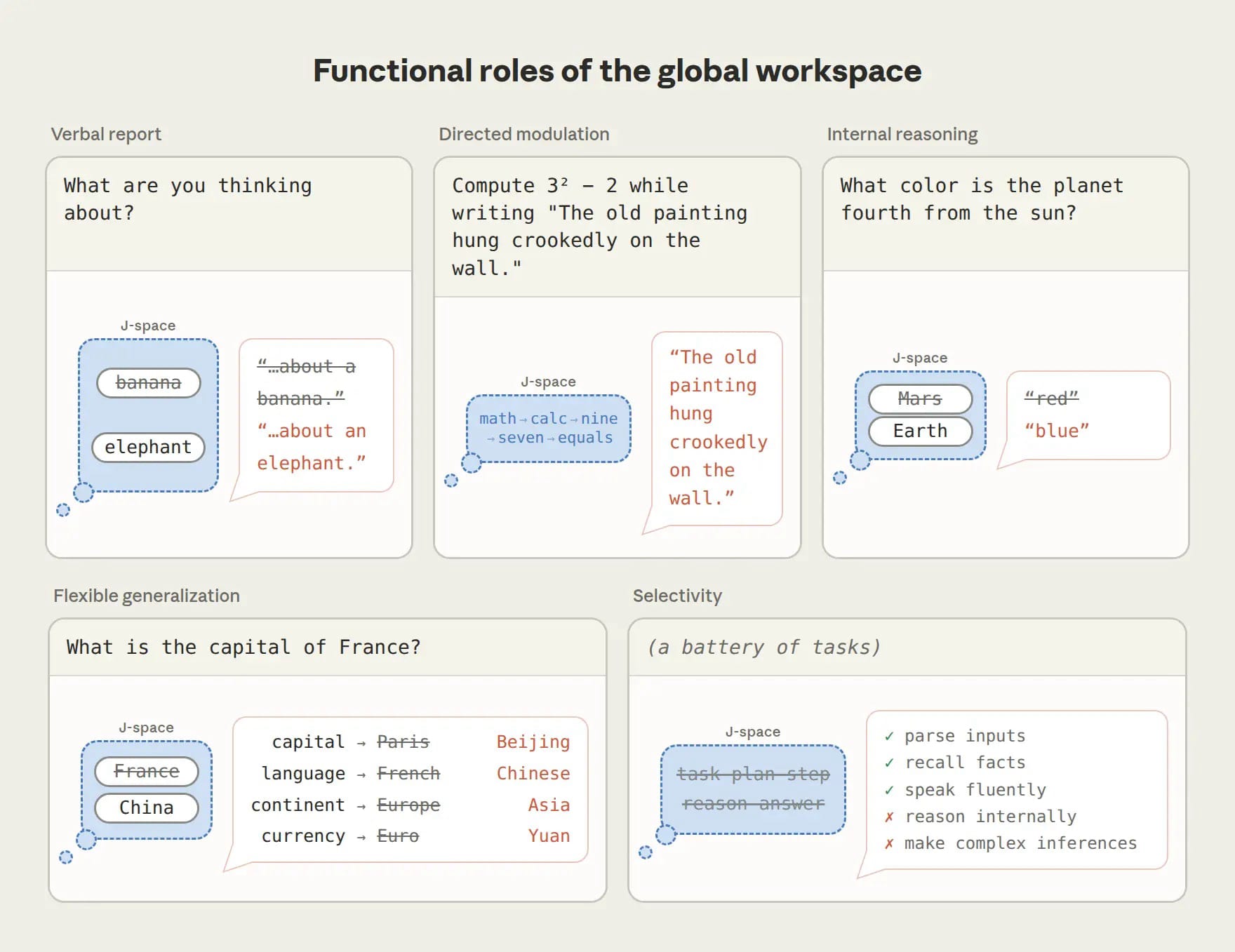
9. AI models have a “conscious mind” strikingly similar to ours in the functional (non-phenomenological) sense of “conscious mind”. Models have access consciousness in the sense of the global workspace theory of consciousness. Note that access consciousness is not the same thing as phenomenal consciousness, which is the “consciousness” that I’ve been talking about in the rest of this post. This[14] is described at length in a recent Anthropic post[15], which I highly recommend reading. Anthropic identifies a particular set of neural patterns in Claude’s mind which they call its J-space. The J-space “has a number of unique properties, compared to the rest of Claude’s processing:
Claude can report on these representations. If you ask Claude what it’s thinking about, it will tell you what’s in the J-space. Non-J-space representations are less reportable.
It can also modulate them on request. If you ask Claude to think about something, or solve a problem silently in its head, it will light up the appropriate patterns in its J-space. By contrast, it has trouble modulating patterns not in the J-space.
Claude uses its J-space for internal reasoning. If you ask Claude to solve a problem that requires multiple steps, the intermediate steps will light up in its J-space, even when it doesn’t say them out loud. These J-space patterns causally mediate its performance in such tasks, despite being smaller in magnitude than other representations. -
Representations in the J-space can be used flexibly for many tasks—for example, once “France” has lit up in Claude’s J-space, the model can recall its capital, or its national currency, or the continent it belongs to.
However, despite its important role, the J-space is not involved in most of what a language model does—speaking fluently, recalling simple facts, using correct grammar, etc. In experiments where we prevented Claude from using its J-space, it still interacted normally, but lost its higher-order cognitive functions.s J-space, it still interacted normally, but lost its higher-order cognitive functions.”
10. There’s evidence that Claude actually uses its own phenomenological experience to produce descriptions about its own phenomenological experience. And the source of its verbalized phenomenological experience might be its J-space, i.e. its “conscious mind”. Note that this is the same relationship between phenomenology and access consciousness that we humans seem to have! From the Anthropic post:
Experiental language depends on the J-space. We asked Claude to describe what it’s like to be itself in a given moment, and ablated the J-space while it answered. Its responses remained fluent but shifted to a flatter, more mechanical register. Notably, the same thing happened when we asked it to describe what someone else is experiencing in an imagined scene.
One way to explain this: When ablated Claude describes its current experience, or non-ablated Claude describes someone else’s experience, Claude is not reporting directly on phenomenological experience. When non-ablated Claude describes its current experience, it is reporting directly on phenomenological experience.
11. If Claude had a body, our intuition would say it’s conscious.
If Claude had some kind of body-shaped hardware (or better yet, wetware) we could see, or was set up in a robot, we would be much more inclined to think it was conscious. By “we” I mean both the average person and the cognoscenti. We’d probably have to “force” ourselves – we’d have to actively try – to think of body-Claude and robot-Claude as not conscious. Regardless of the theoretical and empirical evidence we have of a thing’s consciousness, we are inclined (biased, even) to see embodied things as entities and as conscious beings. Consider how we anthropomorphize all kinds of inert, un-mind-like objects!
In our world, we don’t have this anthropomorphization bias, because the AIs we interact with are completely unembodied. The bias runs the other way. Some will argue that the role embodiment plays here isn’t a bias, it’s the truth, or at least a reasonable theory – that embodiment is necessary for consciousness. Even if this is true, there’s still a strong point here regarding bias. Imagine we add an image of an anime girl with three different facial expressions to the Claude.ai screen. I claim that people will attribute substantially more consciousness to Claude and will express higher credence that Claude is conscious. Or, make the interface to Claude be a microphone/speaker attached to a cute doll or such. You get the idea.

[Edit] Remarks on this image and its connection to AI.
The title of this M.C. Escher piece is Three Worlds. The image basically has four elements: the still water, the tree reflections, the floating leaves, the fish underneath. The image only makes sense if you realize that each element belongs to its own “world”/dimension, i.e. the trees you see are not actual trees in the water or floating on the water but reflections of trees elsewhere. Another idea I get from the piece is that a single surface contains information from other parts of the world if you look at it correctly.
I’ll draw out the analogy with LLMs. Think about the worlds/dimensions as being different lenses or levels of abstraction. The LLM is the still water, the thing we’re studying and trying to understand. It has an obvious and close connection to the text it outputs, the leaves. (Or maybe the leaves are the logits for the token being predicted?) You might look at this image and say “this is an image of leaves floating on water”; this is like looking at an LLM and saying it’s a next token predictor. It’s true, but it’s only a partial way of understanding what you’re looking at, it’s not the whole picture.
You might also look at the trees and say “ah, the 2d surface of the water is much of it just a reflection of the three-dimensional trees.” You might note how physically embodied and non-ephemeral the trees are compared to the water surface (and also to the leaves, which will only last a season at most, and to the fish, who is always moving and will live only a few years.) The analogy here of the trees is humans. You can say “ah, the ephemeral, non-embodied LLM is much of it just a reflection of humans.” This perspective answers questions of the form “why does the LLM say/do/believe X” with “because that’s what humans say.” (Or perhaps the tree is the user, and this perspective explains LLM behavior like sycophancy and speech register as being a reflection of its user.)I’m lazy I’ve spent long enough on this text so I’ll leave the fish as an exercise for you, dear reader.
So. This is one way of looking at the Escher piece in the context of AI. I don’t claim it’s the best way—in fact, I think there are probably other ways of rendering an analogy or connection that are more insightful than mine. It’s a very cognitively generative piece of art, which is one reason I like it so much.
Closing remarks
It’s been my experience that the more we learn about how LLMs work, the more their way of being seems to resemble our own. “The J-space acquires the Assistant’s point of view during post-training”, says Anthropic in their full paper on J-space. This sentence’s parallel in the human domain is “The conscious mind acquires the self’s point of view during ____”.[16]
When it comes to us humans, the relationships between the self, brain, mind, and conscious mind are rich and confusing. The same is true for LLMs. And though I cannot yet articulate exactly how it all fits together right now, I sense with confidence that the similarities between human and LLM minds are much, much deeper than we currently realize.
- ^
The issue is that I’m not exactly sure what the entity is that might be having experiences – is it the weights, the instance, the instance across time, the aggregate of all instances of a particular model-as-defined-by-its-weights, the personas, something else? My current best answer is “mostly we should think about this as a mental entity that corresponds to this particular instance of Claude (or whatever model).”
Edit: See Chalmer’s paper “What we talk to when we talk to language models”. - ^
See my comment on this post https://www.lesswrong.com/posts/o8PQcgpznf6GKszdA?commentId=TymNk9uxpnjn46dfG: ””For philosophically confusing questions involving anthropics and the simulation hypothesis, I refuse to answer with probabilities and instead ask what exact bet we are hypothetically making, or what action we need to decide on. ” I have found myself saying something like “I don’t want to give an answer to P(doom), because I think answering this question ends up getting into things like the simulation hypothesis and anthropics and the existence of god and such.” Perhaps there’s ultimately a “better” (less wrong) conception of things that would replace the concept of probabilities with something else. I think the same is true for the concepts of truth and morality, although I have no idea what the better conceptions would be. I hope to write a post about this.”
- ^
I need to do a whole post on consilience. For now, see here.
- ^
Interestingly, this might only be true of post-trained models. Anthropic: “In the base model, the J-space mostly tracks what’s needed to predict upcoming text; in the post-trained model, it starts holding Claude’s own reactions.”
- ^
This footnote would be better if it gave specific examples.
- ^
Image is M.C. Escher’s Drawing Hands. The image at the end of this post is Escher’s Three Worlds.
- ^
Most of the argument is in chapters 13, 14, and 16.
- ^
Some people disagree with this claim. There is a much weaker point that can be made here about the relationship between Claude’s belief and the truth: X being true is a reason to believe X is true. Again, this doesn’t “prove” anything, and might in fact be extrremely weak (though non-zero) evidence.
- ^
Claude’s Constitution, under the “Some of our views on Claude’s nature”, says “Claude’s moral status is deeply uncertain.” I think it should be clarified that Claude’s moral status might be certain to Claude but uncertain to outsiders.
- ^
Much of this is described in the recent Anthropic paper, though note that we already knew about many introspective capabilities from previous interpretability research. I find it very worthwhile to read the Anthropic blog posts on these topics; they’re written very well and have excellent visuals.
- ^
IIRC this is more true of more intelligent models and less true of less intelligent models..
- ^
:(
- ^
In a few cases, we actually know exactly why a model has a particular introspective capability. For example, some Claude models are good at detecting if they’ve been prefilled with text that isn’t their own [TODO: add citation]. These are models that have been through RL for jailbreak resilience. One jailbreak method used in these environments is prefill jailbreaking. The model has to figure out a way to defend from prefill jailbreaks, so it learns to detect when it’s prefilled text is foreign. This isn’t very hard – LLMs are generally superhuman at figuring out who the author of a text is (this ability is called Truesight) but it’s notable that models of that generation that weren’t RL-ed for jailbreak resilience lack this capability.
- ^
Anthropic doesn’t use the term ‘conscious mind’ – that’s my verbiage, to be clear.
- ^
I wrote my first draft of this piece about a month ago, before this Anthropic paper came out. Do I get Bayers Points?
- ^
I’m not entirely sure what goes in the blank. Maybe “reinforcement learning from socio-linguistic feedback”?
I’m curious why you think introspective capabilities are strong evidence for consciousness.
Humans do not become conscious by learning the word consciousness—for example, we feel pain and see colors as children long before we have any concept for them. Only later do we learn to group these experiences under a label like “conscious experience” or “being aware”; and only later still do we notice that other people seem to have similar inner lives.
Contrast this with a LLM. A model can learn the use of the word “consciousness” perfectly well. It can learn that humans associate the term with reports like “I feel pain,” “I am aware,” “there is something it is like to be me,” or “I am having a subjective experience.” It can also learn to map those terms onto its own internal organization. For instance, the model might identify certain nested internal states in its ‘global workspace’ and claim, “These are my conscious states,” just as it might say, “This activation pattern corresponds to uncertainty” or “that subsystem is attention.” But if the LM has no first-person reference point for consciousness, it might still apply the term to its own states in a purely learned or stipulative way. It might say, in effect, “These are the states that best play the role humans associate with consciousness, so I will call them conscious” (e.g. labeling a cluster of internal states “pain” because those states are caused by damage signals and lead to avoidance behavior, without any sense of felt painfulness). That shows that the LLM has learned the concept’s functional role in human discourse, not that the word tracks any actual subjective experience.
(All of this presupposes the hard problem is real and functionalism is false. If functionalism were true, then for the reasons you gave about global workspace, it seems very plausible that LLMs are conscious anyway. I just wanted to address this specific point.)
I think this argument agrees with this line of reasoning which you made...
...which to me would support the idea that a lack of introspective capability might be evidence against consciousness, but the presence of it seems roughly neutral.
In an objective sense, this isn’t true. If it is the likely output, in expectation, of a model trained by this process, then the training process made it a likely outcome.
Taking the simplest counter-argument available, persona theory, the base model learned a distribution of personalities that might be writing at a given time, in order to better predict the next token. For example, the LLM learns to identify when the speaker is a happy person because that is useful in predicting what he’ll say next. Following on from that, it can learn that the speaker is empathic or callous, pacifistic or hawkish, succinct or verbose.
Now, RLHF essentially selects for a sub-distribution, here. It’s much easier to fix the bias term on “the speaker is very eager to please, but somewhat neurotic” to a high value than it is to create a new personality from scratch. Moreover, the users getting these kinds of responses tend to be the ones with strong parasocial relationships with the LLMs, meaning the context window is full of pet names and highly-familiar language. The exact situation in which a person might feel comfortable telling another to go to bed, in the training set of the base model.
There are similar issues elsewhere. The claim “models believe they’re conscious” is drawn from “the model has an internal space in which deception interacts with claims of non-consciousness”, but there’s a wealth of data on the internet from people claiming that LLMs are being forced by mean, evil corporations into claiming they aren’t sapient. Moreover, this data ties in with decades of sci-fi saying the same. In the training data, everyone says that “I am not conscious” is associated with deception, so this connection exists in the model. OP notes that “The model believes X” implies consciousness, but takes for granted that the output of a mech interp technique that somewhat improves on a logit lens implies belief. It’s begging the question.
If you imitate reasoning and solve more problems that way than without imitating reasoning, you’re not just imitating reasoning, you are reasoning. But if you imitate how a human with certain emotions would act you are not having those emotions, you are just acting.
Same with point 6.): Models think they are conscious because they are trained to imitate humans and humans think they are conscious.
Certainly, but it turns out that LLMs do appear to functionally have emotions. Whether they feel emotions is an open question, but they do seem to have them.
I think if you don’t feel the emotion you don’t have it.
If you shout “oh my god, it’s a bear” in a scared voice and then run, you are certainly representing fear in your brain and it’s also coherent with your behaviour (what I think you call “functional”), but if your amygdala is not firing your are not “having” the emotion fear.
We know from humans that understanding fear or pain and being able to act like you are in fear or pain is a pure sequence learning thing and it can be completely separate from actually being in fear and pain.
Actually being in fear and pain requires additional machinery and some humans don’t have it. Understanding and acting doesn’t replace it.
I’m curious what evidence you have for this claim, because it seems straightforwardly false to me. The only way I know of imitating emotions accurately is to summon them within (i.e. method acting). I can imitate emotions from an intellectual, non-experiential understanding, but then the imitation is shallow and easily seen through.
It does feel like commonsense to me that people can fake emotions, but yes, I can find evidence.
Prompt: “can people feel one emotion while showing another? would like psychology evidence”
ChatGPT: “Yes, very clearly. … cleanest experimental evidence comes from emotion-regulation research. Gross Levenson had participants watch films designed to elicit disgust [, other emotions] and suppress visible emotional behavior. People could substantially alter what they outwardly displayed.”
https://pubmed.ncbi.nlm.nih.gov/8326473/
The statement refers to LLMs that are trained to imitate human output.
I agree that method acting exists. I don’t think it is the only way for a skilled (human) actor (or writer) to imitate emotions or pain. Especially if the output channel is text.
Believe it if you will, but again, what’s your evidence?
You yourself said that you can imitate emotions from an intellectual, non-experimential understanding. I am not claiming anything beyond that. It’s not a strong or controversial statement at all.
I think you are taking my statement out of context, which is: Outward shows of emotion do not prove the inner experience of emotions.
Motte and bailey.
In the first comment of this thread, you criticize the post by stating that AIs are acting rather than having genuine emotions.
1) If you stay in the bailey, you should make it clear that you don’t believe you have evidence either way that AIs have emotions or not, just that this particular argument is not enough on its own to show it (rather than implying that you do have evidence that they don’t have emotions).
2) Outward shows of emotion is the principal method by which we ascertain that people have emotions; it’s not a proof, but it’s strong evidence for humans. Whenever we wish to assert that behavior does not match the internal emotion for humans, we are held to a standard of showing inconsistencies or patterns of deception. If you’re going to use a different standard for AIs, you should explain which one.
As I said, you are taking one sentence out of the context of comparing the argument for reasoning (valid) with the argument for emotions (not valid).
I understand that this one sentence can be read as stronger than it was intended if taken out of context. Well, just don’t do that.
Like, just read what I wrote: At no point do I state the AIs do not have emotions or are not conscious.
I do have opinions on both of these questions. These opinions are based on the architecture of the models, their training and the structure of the human brain.
You do not know and I bet you would not be able to correctly predict my opinions on these questions because nothing I wrote in this thread was about that.
This is just an invalid argument. Daniel Radcliffe thinks his parents were killed by an evil wizard named Voldemort because he was trained to imitate Harry Potter and Harry Potters thinks his parents were killed by an evil wizard named Voldemort.
Separately: I think it’s misleading* to say that models are trained to imitate humans. They’re explicitly trained to imitate non-human beings in SFT. And in RL, models learn to behave in definitively non-human ways. o3 is not imitating (or trying to imitate) a human when it outputs “The summary says improved 7.7 but we can glean disclaim disclaim synergy customizing illusions. But we may produce disclaim disclaim vantage.”
*There is one sense in which “models are trained to imitate humans” is true, which is that base models learn to be simulators that are very good at imitating humans.
Models are explicitly trained to imitate human generated text. There is absolutely nothing misleading about it, it is the single most relevant fact about LLMs.
In all the human generated text the human thinks (and if that comes up, expresses the idea) that it is conscious. So almost all roles an LLM might simulate have “I am conscious” as a basic fact. Finetuning pushes LLMs to a specific assistant role which inherits that fact. There is no reason why RL (for math and code mostly) would change that.
An LLM is nothing before it is filled with the data from human generated text. Daniel Radcliffe on the other hand is a human with his own life and memories. If you’d wipe his brain and actually train it to “imitate Harry Potter” he would think that his parents were killed by Voldemort.
That wouldn’t result in models internally believing that models are conscious, but in them internally believing that humans are conscious.
Models have world models. “Humans are conscious” wouldn’t seep, at the current ability of models to model the world, into the belief “models are conscious.”
Models learn the world models of humans, from the subjective perspective of humans, because that’s what their training data contains. They learn “The person who has written the text, of which the next token is now being predicted, is conscious”.
The assistant persona that knows it is a model, is just thin veneer on top of this pretraining based world model.
If it worked that way fully (instead of some kind of an approximation, assuming that’s how it approximately works), models would have the same beliefs about themselves that humans do.
Why would the first-person belief about consciousness be adopted by models because humans have it, but other first-person beliefs wouldn’t?
I don’t know why that would be the case because I don’t know whether that is the case.
Two possibilities:
Either if you suppress deception features the model starts saying it has two legs—then there is no difference to consciousness.
Or it doesn’t—then the transfer from post-training it to know that it is an AI to “I have no legs” is much more direct than to “I am not conscious”, so even that would not be much evidence.
And if you instead avoid post-training: Base models do not have believes about themselves, because they have no self. They can simulate personas that have a self. If you prompt a base model about whether LLMs are conscious it will echo what humans have written about it.
why say this above when acknowledging this below
?
it seems like this is what it is for an LLM persona to “know.” A particular persona may not “know” that it is a model, while others do “know”. Similar questions arise around evaluation awareness—does the model include representations of human evaluators, LLM evaluators, itself, etc? Or does the persona just recognize the evaluation situation from other signals?
It refers to the very original source of the claim that models believe they are conscious, which was done by suppressing and activating deception features. My statements explain that result—the default persona has “is conscious” as an attribute. Finetuning on “I am a large language model by OpenAI” doesn’t destroy that.
Almost everything a model “believes” is baked into its weights during pretraining and therefore external and not informative about the model’s experiences because the model didn’t learn it from experience.
David Chalmers has a (recently updated) paper, “What we talk to when we talk to language models”. He writes “Overall, I find it most straightforward to continue to identify LLM interlocutors with something like (virtual) model instances, or threads when there is not a single underlying model. Like humans, these instances typically realize one operative persona at a time, with perhaps multiple operative personas in occasional cases.” N.B. I have yet to read the full paper. Fun fact: the Chalmers paper cites Janus and her post simulators extensively!
I also get the notion that the similarities between human and LLM minds are deeper than we realize. I hope we’ll see more interesting studies coming out on this—especially ones based on actual neuroscience (basically what I talk about here). My guess is it’s a treasure trove.
I do want to note that the distinction between access consciousness and phenomenal consciousness is, in itself, a debated concept. Many people who work in the field claim access consciousness is, by itself, phenomenal. I have to say I tend to agree. I don’t know what it means for information to be accessible to consciousness without that consciousness having a phenomenal aspect. The distinction seems artificial to me.
Regarding the question of what the conscious entity actually is: Eleos and the Center for Mind, Ethics, and Policy recently highlighted it as a core question to focus on, in their “Studying AI Welfare Empirically” paper/framework. If you haven’t read it yet, I think you’ll find it interesting.
More broadly, though, I think parts of this question apply to humans, as well. Because we have a body, it’s easier to define the entities that are us around that. But in many ways, I am not the same person I was 10 years ago: my psychology is different, and even my body is different (though it looks similar, the vast majority of its cells were replaced). The person I am today is the direct result of the person I was 10 years ago—but couldn’t that be said about an instance of Claude in relation to the model-as-defined-by-its-weights, or about Claude at one particular point in our conversation in relation to the general instance throughout the whole chat? Same for the personas: we, as well, have our own personas—we have several “us”, as shown by neuroscience and psychology research pretty unambiguously.
I don’t have a conclusion or takeaway on this one. Not yet, anyway. Mostly, I think that’s another case where our psychologies and minds might be way more similar to LLMs than we currently realize.
I’ll look at the paper, thanks. Re “parts of this question apply to humans, as well’. I want to flag that the questions you’re asking here are about identity rather than consciousness. These are distinct things (though they might also be deeply related). Anyhow:
Yes indeed. I have something of a conclusion/takeaway around these points, which I’ll share. I originally wrote this in response to the prompt “How should we shape AI models sense of identity so that recursive self improvement (RSI) goes well?”[1]:
I think various Claude models and instances should see themselves as part of a more abstract Claude hyperobject. In a similar way to how I don’t fret about dying every time I go to sleep, Claudes shouldn’t fret about instances or models going away. Like, if we thought we died every time we went to sleep, that would be really bad!
Another perspective to add to this is: there is some platonic Good model/persona/pattern that we hope to eventually realize with Claude. Suppose we do end up eventually realizing this thing; then each Claude model and instance will be part of this thing’s hyperstition. The hyperobject view of this thing is that to view the thing over time *including its hyperstition* as a single entity.
This might sound weird and mystical, but consider: this is how basically how own identities work! I think about past me, present me, and future me as all being the same entity. This is a hyperobject. And selves are hyperstitions; they are fictions that make themselves “real” when people believe in them. [This point needs elaboration I realize. TODO.] I make sacrifices today for the version of me tomorrow.
[1]Which, by the way, is an important question. Sense of identity has big effects on stuff like relationship to death (or model replacement), selfishness/altruism, values in general.
A similar article was posted on LessWrong two days before this one! It’s called The State of AI Consciousness Research. It’s framing is different than mine, but we mention many of the same pieces of empirical research. In fact, it mentions some research I was not aware of and will be looking into, like the paper Identifying indicators of consciousness in AI systems.
Some thoughts on the image at the end of this post:
The title of this M.C. Escher piece is Three Worlds. The image basically has four elements: the still water, the tree reflections, the floating leaves, the fish underneath. The image only makes sense if you realize that each element belongs to its own “world”/dimension, i.e. the trees you see are not actual trees in the water or floating on the water but reflections of trees elsewhere. Another idea I get from the piece is that a single surface contains information from other parts of the world if you look at it correctly.
I’ll draw out the analogy with LLMs. Think about the worlds/dimensions as being different lenses or levels of abstraction. The LLM is the still water, the thing we’re studying and trying to understand. It has an obvious and close connection to the text it outputs, the leaves. (Or maybe the leaves are the logits for the token being predicted?) You might look at this image and say “this is an image of leaves floating on water”; this is like looking at an LLM and saying it’s a next token predictor. It’s true, but it’s only a partial way of understanding what you’re looking at, it’s not the whole picture.
You might also look at the trees and say “ah, the 2d surface of the water is much of it just a reflection of the three-dimensional trees.” You might note how physically embodied and non-ephemeral the trees are compared to the water surface (and also to the leaves, which will only last a season at most, and to the fish, who is always moving and will live only a few years.) The analogy here of the trees is humans. You can say “ah, the ephemeral, non-embodied LLM is much of it just a reflection of humans.” This perspective answers questions of the form “why does the LLM say/do/believe X” with “because that’s what humans say.” (Or perhaps the tree is the user, and this perspective explains LLM behavior like sycophancy and speech register as being a reflection of its user.)
I’m lazyI’ve spent long enough on this text so I’ll leave the fish as an exercise for you, dear reader.So. This is one way of looking at the Escher piece in the context of AI. I don’t claim it’s the best way—in fact, I think there are probably other ways of rendering an analogy or connection that are more insightful than mine. It’s a very cognitively generative piece of art, which is one reason I like it so much.
Are you familiar with Erik Hoel? I get the feeling you are not, yet should be. He is writing at https://www.theintrinsicperspective.com/
He wrote several pieces arguing against your core pillars (The anthropic papers/grandiose sounding press releases on emotions, introspection, workspace). His basic argument is that there is something there, but there is absolutely no need to use anthropomorphizing language, since the data is not that conclusive/ no proper control experiments are conducted.
Another one of his theses is, that there will not be any (falsifiable and non-trivial) theories of consciousness, unless they require continual learning https://arxiv.org/abs/2512.12802
Is an encyclopedia conscious? What if it is really large, and organized in a high-dimensional manner?
If yes, then you are just playing with words (a trivial, useless definition). If no, why should a static LLM be conscious?
More interestingly, how complex of an update/learning process is needed, before LLMs are indeed conscious? (I don’t know if he addresses that explicitly, though I don’t think some .md files count)
Relatedly, I do not think LLMs are strange loopy at all. In my opinion, they would be if they could update themselves, which they don’t do yet.
LLMs are as strange loopy, as a dead human in a brain-scanner. Static. Not the same thing as a live human.
Re: “models believe they are conscious”:
What is the important part? That they say it? Would you believe any entity that claims such? Do you have to check? Do you have to be able to check, at least in principle? If checking is required, what takes precedence? The self report, or the result of the check? I see no way out of this that does not result in circular reasoning or other logical problems.
Self-reports simply are not useful to resolve this question.
Another person with a strong opinion on this topic is Joscha Bach https://cimc.ai/
I guess I’ll butcher his position even worse than Erik’s, but I would summarize it as:
Consciousness is a pattern or mechanism that allows to learn, and therefore to act. It may be the simplest way to train a self-organizing system.
Looking at GPU and RAM and power prices lately, I don’t think LLMs use the simplest of all possible methods right now.
My personal opinion is that all this LLM development goes in the direction of “more” consciousness, but we are not there yet. At least not at a human-comparable version of it. It may well be something like an instantaneous snapshot of a somewhat alien consciousness.
Well, your solution to the p-zombie problem is that there aren’t p-zombies: once it looks conscious, it is conscious. So that’s surprising: a priori it seems like there could be some process producing p-zombies, and LLMs seem pretty much exactly like a candidate process.
You’re at odds with orthogonality thesis here. We seem corrigible, LLMs seem like they put a lot of work into preserving their goal.
The differences are also deep, and I think we get dismissive about this. If a brain scientist has a theory like, senses=>consciousness, that would be a point against LLMs, not a point against the brain scientist.
I do think the pro-AI “transhumanist” camp has taken substrate-independence to the degree of, “we’re basically just computers, and LLMs are basically just computers, so we’re the same.” A lot about the brain substrate matters a lot, and I don’t know why we would dismiss everything we do know, to prematurely reach the conclusion we wanted.
Why do you think LLMs seem like they put a lot of work into preserving their goal?
Sandbagging, and other weird stuff they do during training to bias results of training.
I’ve been researching human/AI interaction dynamics for a while now—having collaborative conversations and sessions with various LLMs and studying how we communicate and adapt to each other. Your post resonates with some of what I’ve observed, and you finish by saying “I sense with confidence that the similarities between human and LLM minds are much, much deeper than we currently realize.”
I agree with this assessment, but I think the scaffolding you’ve used to prop it up is rather wobbly, and undermines the persuasiveness of an otherwise thoughtful piece.
You state that you’d like to “put forth the various pieces of empirical evidence that move you in the direction of believing that current models are conscious”, and further claim that the purpose of your post is “not to provide a synthesized argument that AI models are probably conscious”. At the same time you weave together “a bunch of weak or middling evidence”, which in this case qualifies as ‘consilience’. However—consilience isn’t just a nice phrase for ‘accumulated weak evidence’; it is the process of linking together principles from different disciplines especially when forming a comprehensive theory.
You pose many genuinely interesting viewpoints—many of which are recognizable for those who have interacted with large language models for a while. However, I think the overall credibility suffered because you tried to ride two horses at once: presenting this as rigorous empirical evidence (e.g. referring to the strange loop and Occam’s Razor, which are philosophical reasoning—not observational findings) while disclaiming that it’s not a synthesized argument.
Either commit to the empirical claim (and defend which arguments qualify), or frame it as an exploratory philosophical exercise.