Note: I don’t know if this is useful for any mouse except for mine (Anker Vertical Mouse). I’m posting this partially because it might be useful to someone else and partially because I’m trying to spam the site post something every day after being pre-inspired by Inkhaven.
I used to get carpel tunnel symptoms while working on a computer all day, and the thing that finally solved it was a vertical mouse. Unfortunately, there’s only a couple options, and the one I like best[1] has an annoying issue where the wheel wears out after a year or so. It’s cheap enough that this wasn’t a huge deal, but I finally got around to trying to fix it and realized it’s stupidly easy.
The Problem
It turns out the problem isn’t with the wheel itself. The problem is that the rubber around the wheel isn’t attached, and it stretches out over time. This messes up the friction against the inexplicably-smooth inner part of the wheel and causes it to slide.
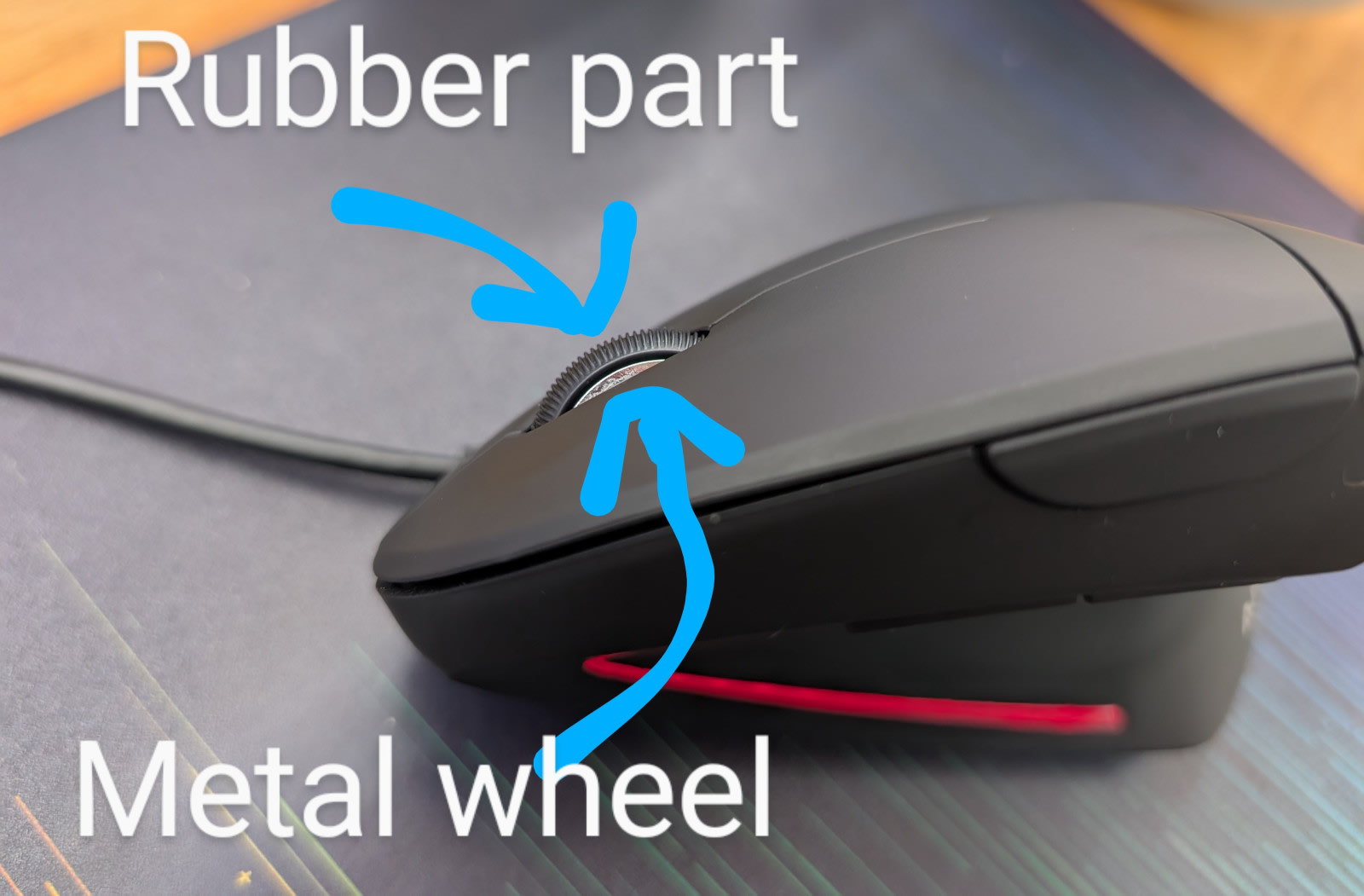
Nothing is actually wrong with the wheel mechanism; we’re just not actually moving it.
The Solution
This suggests a few solutions:
Add something between the rubber and the metal to increase tension.
Add something between the rubber and the metal to increase adhesion.

My first thought was to shove a cut-up rubber-band under the wheel, but that ended up being too bulky and made the rubber catch when turning the wheel. My second idea was adhesive putty for hanging posters[2]. This is actually perfect, since I can control exactly how much I use, and it’s not just high-friction — it’s an actual adhesive[3]. This particular putty is also allegedly removable in case it causes problems.
I expect that some sort of glue would also work, but it would be much messier, and you’d need to pick a glue that adheres well to rubber and metal.
The Process
The rubber isn’t actually attached (that’s the problem), so it’s easy to peel up. I just formed a really tiny string of putty, peeled the wheel up on one side, jammed putty in, turned the wheel and repeated.
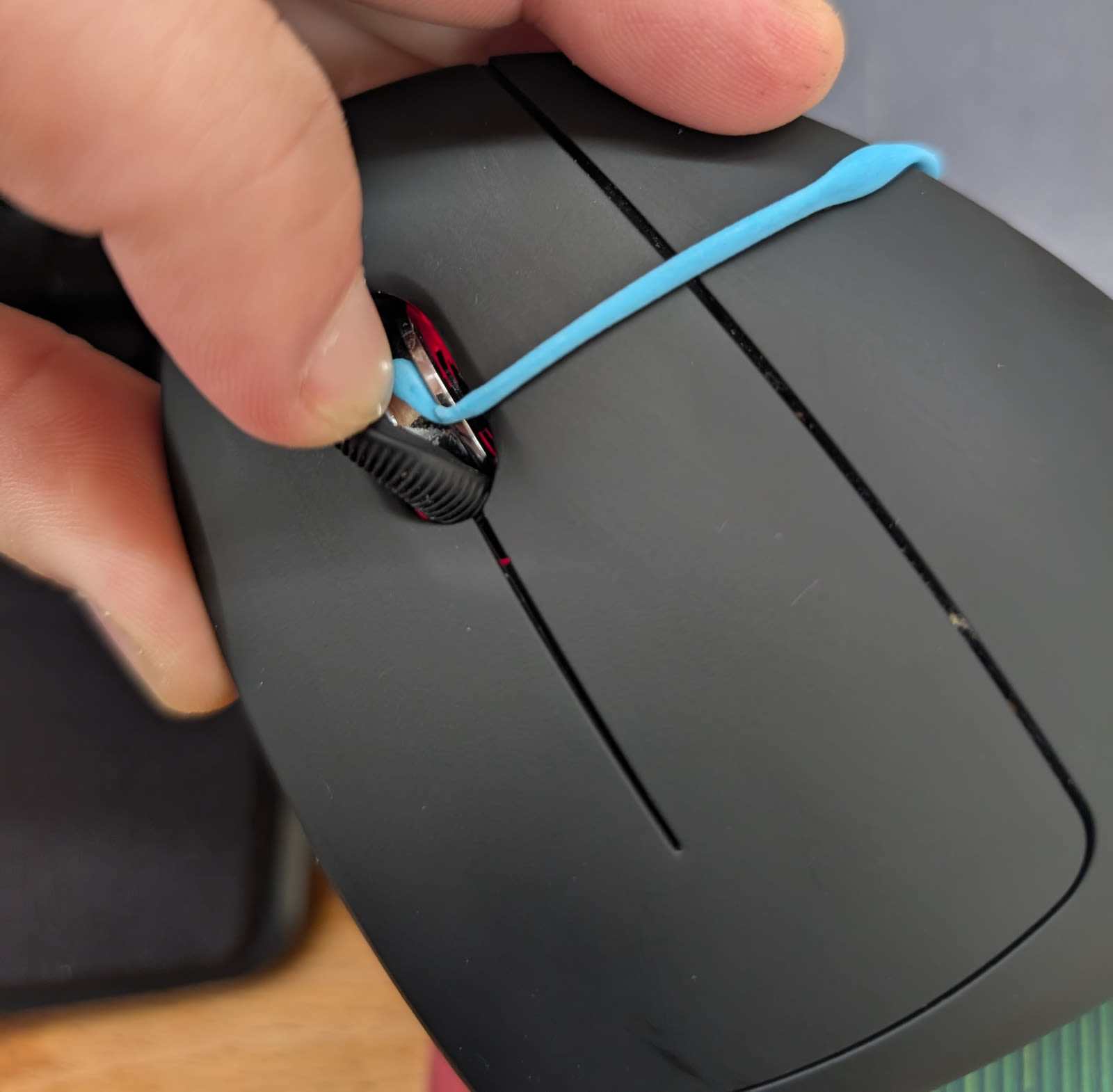
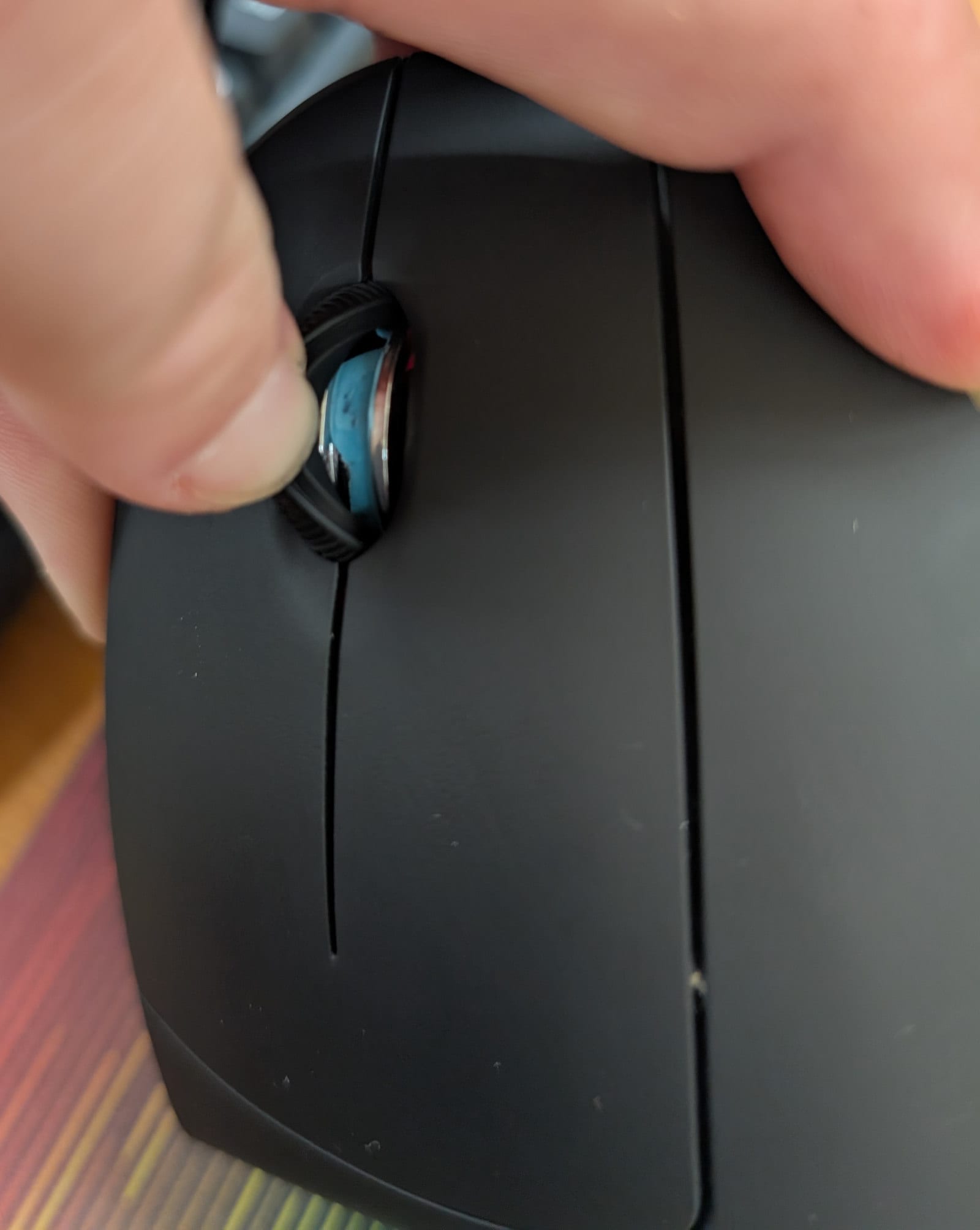
After I got the putty all the way around, I needed to use a pen to push all of it to the center of the channel. Then, I let the rubber fall back down and aggressively pushed down on it while turning the wheel for a few seconds.
Results
After doing this, the wheel immediately become perfectly responsive, scrolling every time I moved it even a single tick and with the lightest pressure I can apply.
I’ll revisit this over time, but since the original mouse inexplicably has nothing to increase friction in the wheel, I expect that adding an adhesive like this will solve the problem permanently and save me tens of dollars over the coming years.
- ^
I like this mouse specifically because it’s wired. If you like wireless mice there are a lot more good options.
- ^
This is almost-certainly cheaper if you buy it in-person at a hardware store. I linked the brand I used but I don’t think it matters.
- ^
I swear I’m not an AI.
Interesting. I couldn’t care less about being better at fixing mouse wheels, but I think I took away a more general lesson from this post, and I think this lesson is a valuable one.
If I were in your shoes, the thought to attempt to fix the mouse wheel wouldn’t have even occurred to me. It wouldn’t have been in my “things I might be able to fix” bucket.
Then if you prompted me to ask myself the question—“should I try to fix this?”—after busting the cache and re-evaluating my belief, I’d have arrived at the same conclusion: no. I’d have assumed that doing so would be too tricky and high effort.
In general, I tend to get intimidated by these sorts of things that require you to “open up the hood”. I tend to assume that doing so is going to be too messy. I’m a programmer and this applies to reading source code of libraries I’m using too. When I run into issues I’ll check the GitHub issues, but if that doesn’t prove fruitful, I usually give up.
But at least in the example of the mouse wheel, I would have been wrong.[1] And having a concrete, grounded example of being wrong about this general sort of thing is helpful. Moving forward, I’m going to try to be more open-minded. Spending a Yoda timer or two to brainstorm is probably a good approach in many situations.
Well, I’m not sure if I would have reasoned about it as well and successfully as you did, but it’s at least plausible that I would have.
I left it out in the post, but I’ve thought about this several times but always assumed the problem was something more complicated. OSX has weird mouse wheel behavior that’s hard to turn off[1], so I first assumed this was an extreme case of mouse wheel acceleration and I was turning it too slow. Experiments confirmed that spinning the wheel faster[2] fixed the problem, so mystery solved right?
As far as I know, the only way to fix this is by messing with the kernel, with software like SteerMouse, which I’m not allowed to install at my current job.
Which incidentally requires a lot more force and increases the friction between the wheel and the rubber.