Baking has traditionally made extensive use of egg whites, especially the way they can be beaten into a foam and then set with heat. While I eat eggs, I have a lot of people in my life who avoid them for ethical reasons, and this often limits what I can bake for them. I was very excited to learn, though, that you can now buy extremely realistic vegan egg whites!
EVERY engineered yeast to convert sugar into ovalbumin, the main protein in egg whites and the one responsible for most of its culinary function. This kind of fermentation was pioneered for insulin and microbial rennet in the 1980s, but many companies are now applying it to producing all kinds of vitamins, proteins, dyes, and enzymes.
EVERY has been working with commercial customers for several years, but you can now buy it as a shelf stable powder. At $24 for the equivalent of 45 egg whites ($0.53 each) it’s more expensive than buying conventional ($0.21 each) or organic ($0.33) egg whites, but not massively so.
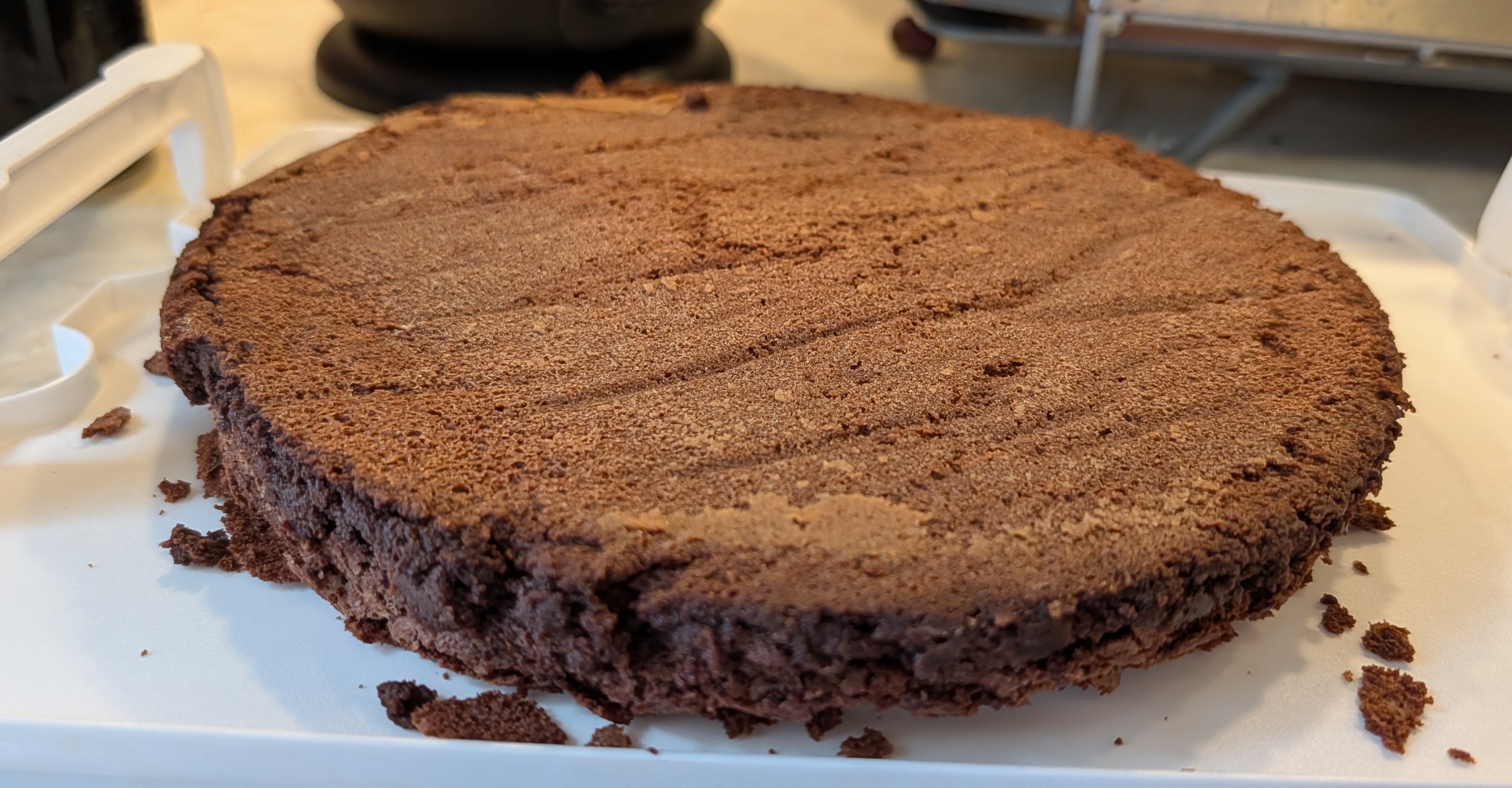
I learned about them from a coworker who made an angel food cake, and I’ve since made flourless chocolate cake and swiss buttercream frosting. It whipped and set just like egg whites; it’s really impressive!
While this is great from a vegan perspective, it won’t help most people who are avoiding eggs for allergy reasons: it’s still ovalbumin. Labeling will generally say something like “contains: egg allergen”, and the packaging I bought has the quite wordy “although not from eggs, the proteins may cause allergic reactions in certain individuals, especially those sensitive to egg, due to its similarity to real egg.”
I’m now trying to figure out all the things that this now means I can cook for my oldest (no eggs for moral reasons). And also what sort of places that the ability to make “less watery egg whites”, by mixing the powder with less water than normal, could let me do things I couldn’t otherwise.
Their Amazon page says “Non-GMO” which I found odd: surely a yeast with a chicken gene is about as GMO as it gets! Is there some obscure loophole where this doesn’t count, or are they (or am I) wrong?
A genetically modified yeast makes the ovalbumin, which is then purified such that it no longer contains any of the yeast. That means the ovalbumin you’re buying is technically not GMO. There’s a note about this on the back, and I agree it’s loopholeish.
Macarons are the obvious target, since people already age whites partly to shift water balance, and powder gives you that dial directly. But macarons are sensitive to everything, so also the highest-risk experiment.
The biggest gain for meringue specifically is probably flavor loading: more protein network per unit of cocoa or fruit powder means the foam can carry more before it collapses. They might also bake faster and more reliably; lower hydration should help with tackiness, hollow shells, and humidity sensitivity.
Other recipes where egg whites are currently the limiting water source include flourless chocolate cakes, nut tortes, high-fat foams, and mousses. Concentrated whites could let you add aeration without thinning the base.
If you really want to go crazy, here are two previously impossible things you can try:
A near-dry protein foam folded into melted chocolate before it sets could give you something like aerated chocolate with a different cell structure than what you get from pressurized gas injection.
Twice-cooked meringue pops: Put something on a stick (could be something like a preformed cake pop) and coat it with a layer of ovalbumin meringue (maybe 1 part ovalbumin, 3 parts sugar, 2 parts water by weight, plus a little of whatever flavor-bearing addition you like). Mount the stick vertically on an oven-safe container to bake it until the meringue sets. Once it sets and cools, deep fry it. This might allow a thick but light, airy, and crunchy shell. You could do a small baked Alaska pop this way, refreeze it, and then deep fry it.
This is the best news I’ve heard in a long while! Thanks for sharing!
I’m also curious about applications where we don’t want less watery egg whites; we just want a more flavorful liquid than water.
This morning I made these flourless fudge cookies (for Passover) using spiced wine reduction + EVERY egg white powder for the egg whites. While the flavor was only-okay (wine reduction concentrated too much tannin flavor), structurally it worked quite well.
By any chance, do you know if we can use this powder to create some kind of omelets? I’m thinking something like: add water to the powder, stir it to make a paste, put it in a frying pan.
Similarly, any comment on adding the powder to some cooked pastas or rice?
It should work fine for omelets, with the usual downsides of egg-white omelets and with less eggy flavor.
While you could add the powder to cooked pasta or rice it’s expensive as protein powders go and if you’re not trying to use it for its physical properties I doubt it’s worth it?
Addendum: actually, taste aside, texture can be important. Can you comment on the kind of texture one could get to add some water to this powder? I find it hard to estimate the texture one could get by creating such pastes.
Buy some and try? $24 shipped: https://www.amazon.com/Healthier-Comforts-Animal-Free-Powder-Protein/dp/B0G15WPP16
Amazon does not ship it in France. I stumbled upon this candidate though: https://www.koro.fr/substitut-d-oeuf-vegan-1-kg
That’s pretty different: it’s a conventional egg substitute, and not a precision fermented product.
Good points. Thank you.
Indeed it really depends on if this powder has egg like flavor or not. If not, no point in adding it to pasts. But if yes: it might be an interesting way to veganise some dishes.
It doesn’t have an eggy flavor, no. That’s a plus for some things, a minus for others.
I would assume an, as strong as you like, egg white flavour?
I don’t taste any egg white flavor with these.