TLDR
The Saturation View holds that a world of varied joys is better than a world of equal but identical joys. Elliott Thornley objected that no one benefits from this variety, and Will MacAskill answered that it is a claim about the pattern of value in the world, rather than about individuals’ experiences. This post elaborates on Thornley’s point and argues that a pattern that possibly no one ever experiences is not a valid moral category. Treating it as intrinsically valuable smuggles a fictional experiencer into the moral conversation.
I call this the reified referent: the mirror image of Carol J. Adams’s absent referent. Where the absent referent hides a real being, the reified referent invents an unreal one.
There may be good instrumental arguments for variety, but we should reject the claim that a world can be made better by a change that no individual gains from. And if, like me, you care more about reducing suffering than increasing happiness, there may be a danger in valuing variety, since it can push toward widening the spectrum of valence, away from stability and perhaps tranquility.
Thanks to @KonradKozaczek and @Alistair Stewart for helpful comments on this post.
My View on Saturationism’s Main Claim
In The Saturation View, Will MacAskill, in work with Christian Tarsney, proposes that the value of an experience depends not only on its welfare but on how many relevantly similar experiences already exist. Near duplicates have diminishing marginal value. A world’s value is a function of total welfare and of how widely that welfare is spread across the landscape of possible experience types. So Variety, a world of diverse excellent lives, beats Homogeneity, a world of equal welfare concentrated in identical copies of the single best life.
I think variety could have instrumental value: exploration, robustness, error correction, and hedging under moral uncertainty. Felt variety is valuable too: novelty, contrast, and surprise are good experiences. But that is already counted inside the welfare, so at the experience level variety should not be double counted. If two beings have the same valence, one from a very familiar experience and one from a novel one, then whatever the novelty adds is already inside the number, and something else in the familiar experience is making up the difference.
But the crux of Saturationism is not at the individual level but the pattern level. Elliott Thornley pressed this in his comment: “no one benefits from this variety. No one cares about this increased variety, at least in some sense of the word ‘care.’ You yourself, the person choosing Variety over Homogeneity, wouldn’t care if you were incarnated into this universe.” MacAskill answered: “The claim that Variety is better than Homogeneity is not a claim that each person in Variety is better off. It is a claim about the pattern of value in the world.” I argue that the main mistake of this view sits exactly there. “The pattern of value in the world” invites us to count a fictional character’s experience of variety, even though it could be that no individual experiences this variety at any moment in time.
The Reified Referent
In The Sexual Politics of Meat (1990), Carol J. Adams coined the absent referent: the animal is made to vanish from the meat, so that a living individual disappears behind a word. I propose the inverse operation, which I call the reified referent: language makes a nonentity appear inside the moral conversation and treats it as a stakeholder. The absent referent hides someone who is really there. The reified referent invents someone who is not there, at the expense, to a certain extent, of the individuals who are.
God is taken by some to be a case of this kind. If no god exists, then “we must do this because it pleases God” brings the preferences of a fictional character into ethics. The subtler cases are much harder to detect. A group made of you and your friend is real in the sense that its parts are real; the group as a collection is a useful thought experiment, but it has no patienthood of its own. A specific case of the reified referent happens when the group itself, or the “total picture”, is quietly promoted from a collection of experiences to an experiencing subject who gets a vote.
There is a simple test: restate every value claim in terms of what some being feels or will feel. Whatever cannot be restated this way relies on a reified referent.
This is quite counterintuitive to me, but truth that is viewed as an intrinsic value is also a reified referent. I value truth enormously, but there is no God looking at the world and feeling happy when truth is revealed or reflected in it. Hence it should be viewed as of instrumental value.
Environmental ethics runs on this error, in my view. Intrinsic biodiversity value treats the diversity itself as mattering; the last rare lizard is said to matter intrinsically more than an individual of an abundant species. But no lizard knows he is endemic. The rarity is not in the lizard’s life; it is in a catalog. The environmental language consistently hides the sentient and highlights the insentient, reified referents: “the ecosystem”, “the species”, “the balance of nature”. But a forest full of color, valued apart from any mind watching it, is actually colorless. Color is not the wavelengths themselves. It appears when light meets a mind, which transforms signals from “outside”, through the visual system from the retina to the brain, into something completely different in quality and essence. Without a mind, the beautiful picture is just waves and particles, and the forest is silent.
Two Sealed Rooms
Two beings live in sealed rooms. They will never meet, never learn of each other. In World V, being A spends an hour receiving a foot massage and being B eats a wonderful meal. In World H, both eat the wonderful meal. Every experience involved has exactly the same valence, the same quality level of goodness. Ask A whether she wants to switch worlds: she is indifferent, and she must be, because if she preferred one, the welfare would not be equal. Ask B, same answer, because nothing changes for him. No being, at any moment, in either world, is one drop better or worse off than in the other, yet the Saturation View holds that World V is better. “Better”, though better for no one, is a sentence in search of a subject. The only way to make sense of it is to imagine a viewpoint hovering over both rooms, comparing the kinds of experiences, and preferring the spread. That viewpoint is the reified referent.
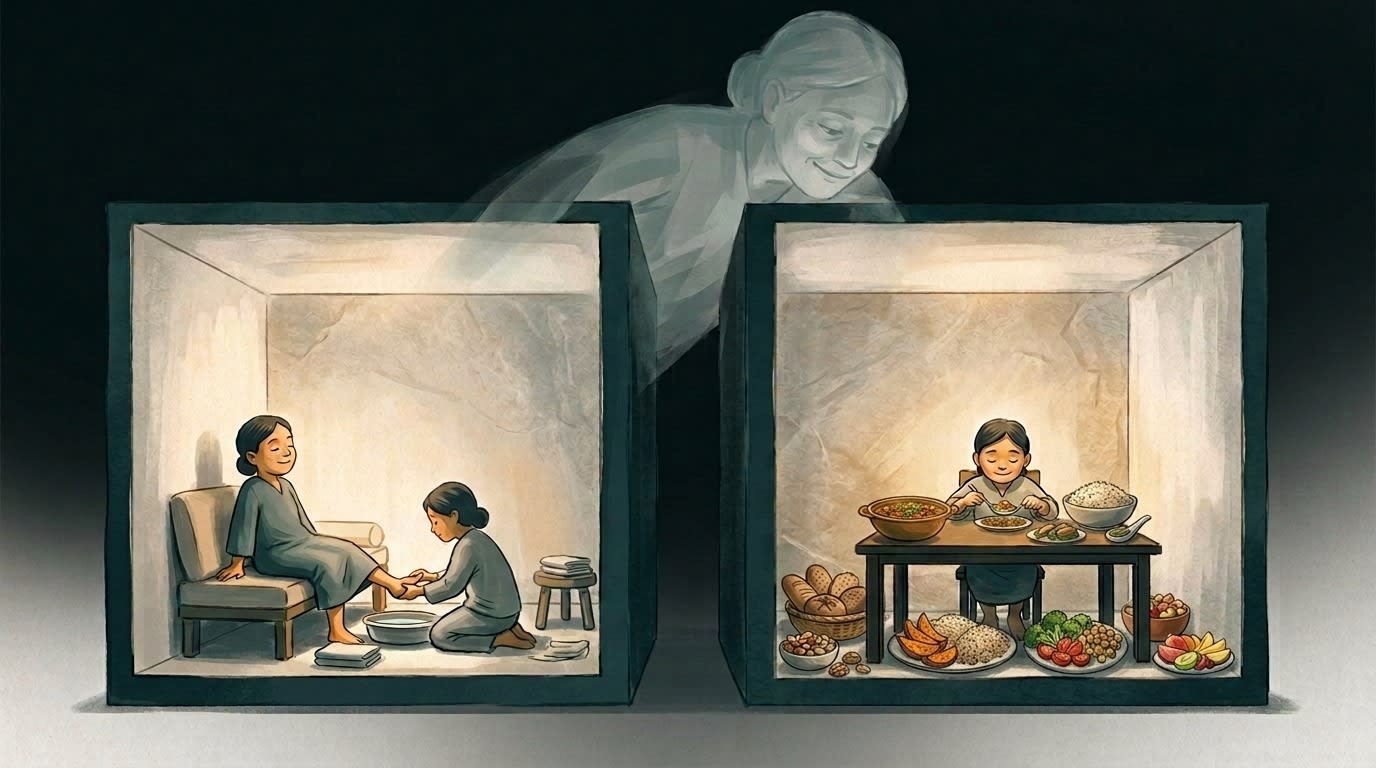
To count that look as a cost is to charge real beings for the boredom of a ghost. To view a being’s joy as less worthy because of his species, or his location, or the fact that there are other beings with similar joys, seems equally mistaken to me.
Could Variety Push for More Suffering?
Variety is not the only pattern one could value. Think about spikes: a life where valence swings between very low and very high, against one with the same total welfare but a narrow, calm range.
Let’s assume your total life’s valence is just a bit above neutral. Within your life, you may prefer the spikes, which are more attuned to excitement, or the opposite, stable valence (tranquilism pushes further in that direction). I am more sympathetic to the latter.
Spikes could be one parameter inside variety. If I get this right, stable valence does not leave much room for valence diversity, whereas spikes could give us, even under the same total valence and the same total equal valence for each individual, more variety of valence, hence of experience. This can lead us to a dangerous place where we push for a wider and wider spectrum of valence. I am especially worried about this since I value reducing suffering, especially the worst kinds, more than increasing happiness. A wider spectrum of valence is a bigger risk of severe suffering.
Why the Ghost Feels So Right
I argue that using a reified referent is a mistake, but it is a tempting one, and I have a few thoughts about why:
You cannot imagine an unwatched world without mentally watching it, or think about a world no one thinks about. But apart from individuals, almost by definition, no one is watching the world. I think it is better to see the world as the sum of experiences, nothing else. Any outside view, beyond individual experience, is not loyal to reality.
Homogeneity really does lower our welfare through boredom and diminishing returns, so we carry that feeling across lives, where it no longer applies. It is a bias.
No one proposes an ugly impersonal value. Diversity, beauty, complexity, wilderness: every impersonal value ever proposed is a pleasure to think about. If impersonal value were really independent of observers, that would be a strange coincidence. If impersonal values are observer pleasures projected onto a fictional observer, this is exactly what we should expect.
Is Pareto Using a Ghost Too?
When I claim a world with five suffering beings is worse than a world with three flourishing beings and two suffering ones, am I adopting a viewpoint nobody occupies? No individual experiences the sum. If the Totalist may hover above the world and add, why may the Saturationist not hover and compare types of experiences? One can argue that either both are ghosts or neither is.
This argument puzzles me, and I think there is something deeper here I am not able to put my finger on.
I will say this: the summing view uses an imaginary accountant, yet that accountant only counts real things: valence, intensity, duration of consciousness, all of them properties present in the experience itself. Hence, the beings vote, and the accountant counts the votes. Under the Saturation View, the accountant votes: it discounts a joy according to a relation no one feels.
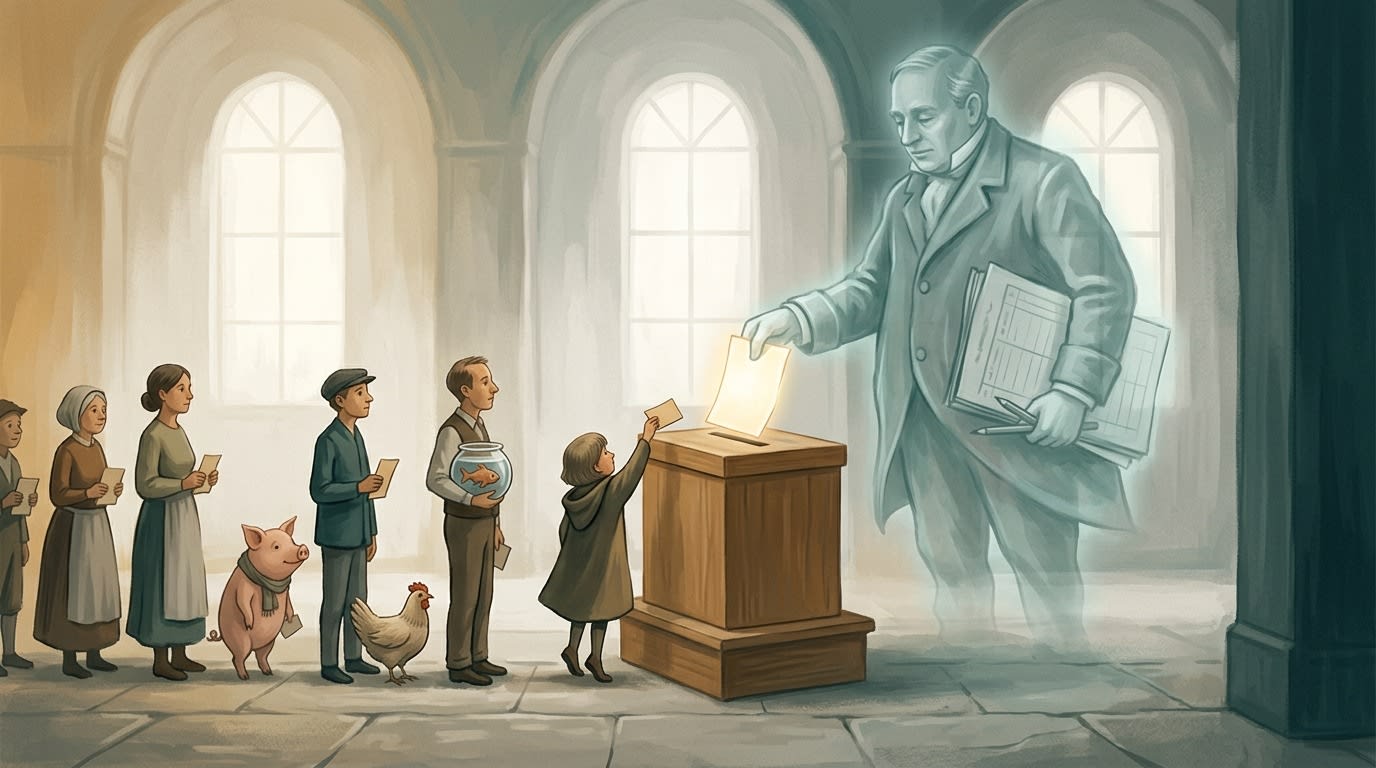
But what about inequality? Inequality is also a pattern that possibly no one feels. Imagine the two sealed rooms again: in world A the two someones have a positive welfare of 2 and 10, and in world B both have a welfare of 6. No one ever feels any inequality, so why should we prefer world B?
Compare the two worlds individual by individual, which I think is the right way to judge any situation, and the valence changes for every individual. If we push a button and switch from world A to world B, something meaningful happens to someone. This is not the case with the Saturation View, which could prefer one world over another where no individual is worse or better off, so pushing the button changes nothing for anyone.
If the signs were reversed and the numbers represented suffering, the value of reducing the most intense suffering would make us prefer world B.
Epilogue
The universe has no point of view. When we pretend it has one only in order to count what real beings really feel, I think that is a justifiable ethical move. When we let that pretend point of view vote, real beings pay the price. On the Saturation View there is always some point where real felt welfare should be sacrificed for an unfelt pattern: some being’s day made worse so that the world looks better to no one. A civilization steering by this view is putting a lot of effort into decorating a gallery that has no visitors.

I have the sense that this argument involves people talking past each other, in terms of why they’re asking the question.
Viewing a hypothetical universe ‘from outside’, as it were, without having experiences myself, I would tend to agree that joys that (by my chosen calculus) add up the same should count the same regardless of differences in level of variety.
Alternatively, from way inside, from the POV of one experiencer, I couldn’t care less whether others have had, will have, or are having comparable experiences.
In both cases, though, these are ways of evaluating timeless snapshots of a world. As an agent acting in or on the world, from within the flow of time, I’m making choices that alter its trajectory and therefore alter the distribution of future experiences. If I, in fact, value a world whose future contains more variety, then I’m not smuggling in anyone’s preferences but my own. If it brings me more joy to help create a world of greater-variety-but-otherwise-equal-value experiences, then aren’t we done? Doesn’t that settle it?
I think there is a difference; I value the joy a being may get from a world with more variety, or even from shifting the world to be with more variety, but the Saturation view claims that regardless of this experience, the value is in the variety itself, apart from the experiencers, even if they don’t know anything about the variety, like in the two sealed room experiment I presented. Aiming as a society for a world with more variety where there is tradeoff with welfare is just valuing a ghost, something that doesn’t exist. the fundamental claim of variety, like of environmentalism, lay outside experiences. As so far as it is in experience, it is already counted inside welfare
Ah. That’s (at least partly) a discussion about moral realism, then, I think? Whether there is, in principle, a neutral vantage point from which any method of calculating the aggregate value of a world could be implemented.
Reading the linked source posts, I occasionally got a sense of flipping back and forth between talking in abstract terms as if there is such a vantage point, then talking concretely in terms of what the readers might find moving to argue for adopting one or the other position. For example: “What if you just don’t share the starting intuition?...If so, the view probably won’t move you very much.”
It still seems to me that a moral realist would tend towards wanting to answer “What should we want” while an anti-realist would tend towards “What do we actually want” and that their stance towards this population axiology discussion might depend on that.
This contains the hidden assumption that adding up individual votes is “counting the votes” and yet using some other algorithm than addition is not “counting the votes”. You can say that well, that’s what counting means, but then, the fact that you even think it’s important that the accountant counts the votes rather than “collates” or “aggregates” or some other neutral phrase, carries the same hidden assumption.
You can call this procedure of aggregating the votes in other ways. I think the my point is, and I think I haven’t been able to really crack this down, that the action done on the votes doesn’t brings anything new to them, just puts them together side by side. As where if the outside viewer has a vote himself, that you are adding a fictional character that you “care” about, and this is a mistake. If we think about an analogy, let’s say your 5 friends, you vote on where to eat − 3 say hummus and 2 say Indian food. So you count the votes and go to eat hummus. But if you were to say—there is an outside view that matters, and it, this reified referent, wants us to eat Indian because many more humans eat hummus today than Indian food (which is probably false...), so we should eat Indian instead…
The issue is that “counting the votes” is not special compared to “using some algorithm that is not counting”. If the outside viewer chooses to count rather than use some other algorithm, that’s still his choice. He’s still “voting” to use counting rather than some other aggregation method. Using counting as the method is not the same thing as not choosing a method.
We’ve settled on counting when aggregating votes from humans under normal circumstances, but you can’t generalize this to utility—you’re essentially privileging one particular type of utilitarianism over others.
This is a very important point imo, how do we view the different actions this outside viewer, that sees all, takes and is one set of actions fundamentally different than another? It is the case that in the saturation view, the outside viewer puts in a new point of view, a new “reality” that is not present in reality, and that is the view that likes diversity. that is fictional. I would view that as very different than the outside viewer only counting the welfare of individuals. aggregation doesn’t change the votes and doesn’t add up any new ones.
I agree with the post. The universe shouldn’t value things not valued by any individual.
Instead, an alternative that produces the same result as the Saturation view is that individuals might value both uniqueness (i.e. being different from other people in the world in some way) and objective truth, whether intrinsically or instrumentally. Valuing uniqueness means they prefer World V over World H. Valuing objective truth means that they prefer being in World V over a situation where they think they’re in World V and are actually in World H.
yes, but these preferences would already be counted inside welfare. The saturation view says diversity across lives is better, which is not pinned in actual experiences, but in a value of an outside macro view no one holds
I agree—in case it wasn’t clear, I meant that my alternative is different from saturation view but I think it could have similar implications of which worlds (close to ours) are better, compared to the Saturation view itself.
It’s funny because my reason for finding the saturation view appealing sounds similar to your objection to it. In the extreme case of literally identical experiences, from the inside of those experiences it doesn’t really seem to make sense to ask “which instantiation I am?” as they are by definition indistinguishable from inside. There doesn’t seem to be a matter of fact here. There may be a matter of fact to the amount of copies, but “which instantiation I am” would be a strange kind of fact about some experience that isn’t specified within the experience. Furthermore, the amount of these copies isn’t anything any of the individual instantiations feels from the inside either. So when a literally identical copy of an experience is added, it seems like there’s a sense in which there doesn’t seem to be anyone who benefits.
So then you can consider the scenario where the experiences aren’t quite 100% identical, but contain some extremely small and trivial differences making each experience technically unique, maybe one tiny pixel is of slightly different color in their fields of vision. It would seem strange that this changes things drastically, as in 100 previously identical copies previously having the moral worth of 1 experience now having the full worth of 100 experiences.
Somewhat more plausibly, it might add some moral weight to these 100 instantiations but at best to a trivial degree that is proportional to the triviality of the changes. And from there, considering where the differences are increasingly more substantial, you can see how we might end up in something like the saturation view.
Basically, this is an alternative way to “count” the “amount” of experience. In your “sealed rooms” example, it’s a bit like World V in some sense has “more people” than World H due to the two people being more distinct. It’s a strange way to put it, but strange in a way that I’d expect when one takes Parfitian views on personal identity seriously which I personally feel compelled to.
FWIW, I didn’t even have such a strong intuition for there being an intrinsic value to diversity before I encountered arguments along these lines. For example, first time reading “Value Is Fragile” my immediate reaction to “replaying a single highly optimized experience, over and over and over again” as an example of “almost all value being lost” was “Huh? Is that really so bad? Sure something more diverse sounds better, and all else being equal I’d wish for diverse kinds of happiness. But it also kind of sounds like being worried that future people have a crappy taste in music from your point of view. The boredom is just a problem for you right now, contemplating these monotonous futures.”
I also find it quite likely that I might change my views on this entirely, most plausibly from some kind of “reality-fluid”/measure or nature of probability angle. This stuff is very confusing, for sure.
Why do you say that “when a literally identical copy of an experience is added, it seems like there’s a sense in which there doesn’t seem to be anyone who benefits.”
It seems to me like if your adding an exact copy or some other being totally different, and they both have same valence at every moment (or overall + distribution across time), there is no real difference between the two scenarios...