Job-Less Utopia: Macroeconomics in the Age of AGI
After 25+ years, I thought I try something new. I find the public and professional discussion about the future of Jobs in light of AGI jarring, with both sides largely missing the point (don’t worry novel jobs will appear vs mass unemployed dystopia). My new book
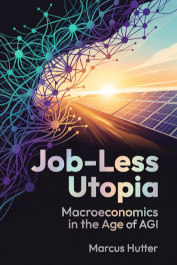
shows why a Job-Less future is desirable, affordable, and likely.
The book develops the case along thirteen theses:
Total automation is inevitable: AGI and advanced robots will eventually perform virtually all cognitive and physical tasks better and cheaper than humans (Chapter 2).
Material abundance is maintained: Replacing human workers with AI does not shrink the economy; the exact same (or a greater) volume of goods and services will still be produced (Chapter 3).
Near-zero marginal costs: All supply chain costs ultimately trace back to human labor, raw materials, and energy. Automating labor and harnessing abundant energy will drive the production cost of most non-scarce goods and services remarkably close to zero (Chapter 3).
The land bottleneck is solvable: Even at zero labor cost, land and scarce resources remain priced. Proven tools (land value taxation, sovereign resource funds, Harberger taxes) can capture these rents and channel them into GI (Chapter 3).
The ‘New Jobs’ fallacy: The historical pattern of technology creating new human jobs will eventually end. The transition will be too fast for human retraining, and new roles will also be performed better by machines (Chapter 4).
Meaning exists beyond employment: The psychological need for traditional employment is a product of modern cultural conditioning. Humans are naturally primed to find purpose in family, community, hobbies, learning, and structured competition (Chapter 7).
Mass unemployment is a feature, not a bug: Un(der)employment is perfectly consistent with universal prosperity. The primary goal of an economy is to provide a decent standard of living, not to maximize human toil (Chapter 2).
Forced employment is dystopian: Attempting to artificially maintain full employment in a highly automated society will trap humans in low-paying hyper-competition and socially wasteful (BS) jobs (marketing arms races, predatory finance, …) (Chapter 4).
UBI is economically affordable: Multiple complementary instruments can finance GI, either directly via automation, luxury, Pigouvian, land, inheritance, consumption, and service taxes, or indirectly via wealth funds, even cost-neutrally (Chapter 5).
Alternative safety nets are inferior: Conditional welfare, job guarantees, and means-tested transfers re-introduce surveillance, conditionality, or BS-jobs that UBI avoids. Universal Basic Services can augment but not replace cash transfers. Blocking automation via regulation only halts progress (Chapter 6).
Democracy is self-correcting: Failing to redistribute the wealth generated by AI risks severe inequality (Figures 5.3 and 7.5) and social unrest. In a functioning democracy, the displaced majority will vote for parties that enact redistribution; at the limit, the threat of civil unrest compels even reluctant capital owners to share the gains of automation (Chapter 7).
International challenges are solvable: Global asymmetries and tax base erosion can be managed through tariffs, destination-based consumption taxes, digital services taxes, a global minimum tax, and international coordination (Chapter 8).
Coordination failures become easier to address: By removing the desperation for employment, AGI paired with UBI deflates the pressure behind BS-jobs, marketing arms races, and exploitative gig work, creating political space for complementary institutional reforms (Chapter 10).
Hard-cover: http://amazon.com/dp/1066828415/
(see website discounts; contact me for a free review copy)Recorded talk: http://www.youtu.be/4efgvM3APqI
Or make robot armies to keep us in line. This is extreme of course, but there’s a spectrum of such things (AI-powered lobbying, robot police, maybe coopting part of the population, etc). If the masses of people become irrelevant both economically and militarily, they will also become irrelevant politically, or at least the force of history will pull very strongly in that direction.
I think this is the main point that most people thinking about this miss, maybe because it’s just so nasty to imagine. No solution comes to mind at all, except the hard solution of building a worldwide popular movement right now, while the masses of people still have some power.
Strictly speaking, Plan A claimed that “humanity delays the development of superintelligence until 2040, makes all AI research public, allows dozens of companies globally to catch up to the frontier, and intentionally enters a regime of mutually assured compute destruction.” Additionally, the only reason why the Citizen’s Dividend is smaller for non-Americans than for Americans is plausibility, as the authors describe in the Appendix.
Yeah, sorry, I edited my comment to remove that point before I saw your reply. Though I think “Plan A” is bad for other reasons.