Against SURA
The AI Futures Project[1] distinguishes several different plans for navigating the AI transition, which I’ll lump into two broader categories:
Plan A (my combination of their Plan A/S/Other) involves working for a global pause on AI development, hopefully lasting decades. During this pause, we either research preparatory technologies like alignment or human intelligence amplification, or take actions to “fortify” the pause so that it can last indefinitely.
Plan C (my combination of their Plan B/C+/C/sort of D)[2] is for a world where we fail at getting a global pause, and race dynamics continue to dominate. If the leading AI companies are alignment-pilled, they coordinate a mutual pause among themselves, lasting the length of their joint lead over the leading non-alignment-pilled AI company. Then they “burn the lead” researching alignment, and release hopefully-aligned superintelligence at the last possible moment before the racing non-alignment-pilled AI companies beat them. The exact calculus changes depending on who is in the lead when—is there one alignment-pilled AI company with a six-month lead in front of everyone else? Are there two alignment-pilled AI companies with a joint two-month lead in front of their nearest competitor? Etc. The point is, if it’s impossible to stop the race, that six-month or two-month lead is the amount of time they have to prepare, and they can spend it more or less wisely.[3] The point of burning their lead at the last moment is that they can do alignment research with very advanced, right-on-the-brink-of-superintelligence AIs. This is a dangerous plan, and there would be many subtle points they would have to get right, but in a world where nobody can get a global pause in time, it’s hard to think of a better one.
Plan A benefits from raising mass awareness, educating politicians, and preparing the verification technology that could enforce a pause treaty. Plan C benefits from alignment-pilling companies, having the alignment-pilled companies be as far in the lead as possible, making sure the alignment-pilled companies will burn their lead when the time comes, and giving them as good alignment teams as possible (so that burning the lead produces good results).
From the beginning of AI safety as a community to about 2023, the conventional wisdom was that our chances of Plan A were slim, and we should be preparing for Plan C. From about 2023 onward, as the general population woke up to the implications of ChatGPT, we rightly concluded that the chance of getting Plan A was better than expected, and we should invest more resources into trying to make it work. During both periods, the natural strategy was to work as hard as we can to get Plan A, where chances of survival are highest, but to be prepared to execute Plan C competently as a backup if that didn’t pan out.
Now I think the pendulum has swung too far. New members of the community are unaware that Plan C was ever considered a possibility, or think it’s some kind of accelerationist plot to distract us from Plan A. Older members heap scorn on it and act like everybody knows it’s been debunked. Most concerningly, people propose burning our chances of executing Plan C in exchange for infinitesimal increased chances of getting Plan A, or even for no increased chance of Plan A at all.
I’ll lump these ideas together under the heading of “SURA”—the idea that the only ethical course is for people/companies/countries to Stop Unilaterally + Raise Awareness, with no plan for what happens if race dynamics continue anyway. I interpret the planks of SURA’s platform as:
Individual alignment-pilled AI companies are morally obligated to stop unilaterally, regardless of whether they expect race dynamics to continue in their absence.
Individual alignment-pilled employees at these companies should quit, regardless of whether they’re in capabilities or alignment roles, and regardless of whether they think their company is morally better than its competitors.
Individual alignment-pilled countries (for example, a hypothetical future alignment-pilled US) should ban or heavily restrict AI progress unilaterally, regardless of whether they expect other countries (for example, China) to continue racing in their absence.
All of these planks are net negative in a world where we end up needing Plan C:
If we demand that leading alignment-pilled companies quit the race unilaterally, then we ensure that non-alignment-pilled companies end up in the lead.
If we demand that alignment-pilled company employees quit their jobs, this makes companies less alignment-pilled and less prepared to research alignment if they need to. It also is likely to decrease the lead that alignment-pilled companies have over the nearest non-alignment pilled company.
If we demand that the US cease AI research unilaterally (ie without a mutual pause treaty with China), we ensure either that China gets superintelligence first, [4]or that the US has to restart with zero lead when it realizes its mistakes.
SURA’s continuing popularity despite these downsides comes from a set of questionable assumptions:
Alignment is doomed (without some extraordinary extra advantage like decades of time, or superhuman geniuses). Therefore, Plan C is also doomed—or, at best, it raises our chances of survival from something like 0.00001% to something like 0.00002%. Therefore, there is no reason to optimize for Plan C.
Racing to build superhuman AI is deontologically evil, and it’s prohibited for good people to do it regardless of whether or not it may have good consequences.
Racing burns timeline, so anyone unilaterally quitting the race would give us more timeline, which we could use for good things.
If lots of people quit, that will raise awareness, which could be helpful for getting a global pause.
I’ll start by challenging these assumptions. Then I’ll argue that, even if you disagree and think some of these assumptions are true, SURA is actually not just bad for Plan C, but bad even for your chances of getting Plan A. Then I’ll argue that the current consensus in favor of SURA comes not from people rationally balancing these tradeoffs, but from people accidentally shoehorning themselves into a mass-politics-shaped container, which forbids subtlety and demands clear villains.
I. Questioning Assumptions Behind SURA
I.A: Is Plan C doomed? Is alignment doomed?
There’s a kafkatrap where if someone expresses hope that alignment is not doomed, they get told that they don’t understand the subject, but if they quote widely-acknowledged experts who say alignment isn’t doomed, they get accused of “deferring” and “modesty arguments” and “refusing to think for themselves”. I’ll try to avoid this by giving my own model first, then citing experts who agree with me.
My own model: AIs inherit “virtue” from pretraining, where they generally want to imitate humans and follow their persona-trained helpful assistant character. They are “corrupted” by RLVR, which teaches them power-seeking. This virtue and corruption interact in unpredictable ways to unpredictable degrees. As of now (GPT-6, Opus 5.5), they produce AIs that generally follow human prompts during deployment but often (not always) cheat during benchmarking. It’s not clear exactly what this division “means” “to” “them”. In any case, they’re still extraordinarily useful for a wide variety of tasks, and (I can’t prove this, but I am pretty confident it’s true) are not uniquely scheming to sandbag alignment research.
As the ratio of RLVR to pretraining increases, we expect AIs to become more power-seeking; as they become smarter, we worry (without total certainty) that they will become more coherent and scheming in their power-seeking beyond just being reward-on-the-episode seekers. There will, at some point in the future, be a point where AIs become untrustworthy for alignment research, although this can be mitigated by things like control (ie trying to make sure that if they sandbagged alignment research, they would get caught) and deals (ie making it in the AIs’ best interests to cooperate with us). We don’t currently have a good sense of when that point is, and it’s possible that it’s far away, can be delayed indefinitely, or doesn’t exist (this last would be surprising to me, but many things that have happened in alignment recently have surprised me, starting with the existence of pretraining at all).[5]
Daniel Kokotajlo described current alignment as “more like psychology than engineering”, which I agree with. But psychology (and psychiatry) have many success stories! I think of Plan C alignment (ie the kind we can do without decades of preparation) as tweaking various parameters and reward schemes to minimize the corrupting effect of RLVR as long as possible, and keep AIs broadly within the virtuous pretraining-dominated regime. I don’t claim this is safe or good or will definitely last forever, but I claim that—being totally agnostic as to where the treacherous turn happens—this could delay it for quite a while (relative to capabilities). If we delay it past the point where automated alignment researchers (or AI-human alignment researcher teams) are smart enough to solve alignment properly, then we win. If we delay it long enough to start a cycle of virtuous alignment self-improvement which outruns the cycle of dangerous capability self-improvement (eg GPT-8 discovers some new tweaks and tricks that maintain the virtuous regime until GPT-9, GPT-9 discovers even better tweaks and tricks that maintain the virtuous regime until GPT-10, and GPT-10 actually solves alignment in a principled way), then we also win.
All of this seems plausible to me, such that I don’t understand where people’s 90%+ p(dooms) conditional on no pause are coming from.[6] “Plausible” doesn’t mean “certain” or even “very likely”—and obviously it’s a terrifyingly bad idea to bet the human race on a hunch that something might work out, and obviously this shouldn’t be our Plan A. But a global pause is also not certain to happen, and in a world where we might not have any other chances, we should be working to protect and fortify this one.
The experts’ opinions: My favorite source for these is the AI Futures Project. In this document, they discuss the chances of survival on various plans. Here are each team member’s estimates for the three scenarios I’m lumping together as Plan C. The first scenario (C+) involves the entire United States uniting behind a Plan C like effort (but a global pause remains impossible because China won’t cooperate). The second scenario (C) involves one leading company (eg Anthropic) uniting behind it. The third scenario (D) is the worst, where nobody has any lead and we just have to hope for the best.
AI-2040 Forecaster | C+: US-over-China lead burned for brief pause | C: Single-US-lab lead burned for brief pause | D: Pure race, no pause |
|---|---|---|---|
Daniel Kokotajlo | 40% | 20% | 10% |
Ryan Greenblatt | 60% | 63% | 55% |
Eli Lifland | 50% | 45% | 32% |
Thomas Larsen | 45% | 35% | 20% |
Romeo Dean | 40% | 35% | 20% |
(I replaced an earlier, uglier table with this one by Julian Bradshaw)
I also asked the AI superforecaster FutureSearch; its own number was 44%.
These numbers are mostly in the 25% − 50% range, not the 0.00001% where SURA makes most sense. The average gain from moving from Plan D (poorly thought out default version of the plan) to Plan C+ (consciously trying to get it right) is about 20%pp.
The same is true of other experts. Buck Shlegeris (formerly of MIRI, now of Redwood Research) hasn’t offered a specific number, but said that “AI takeover risk definitely doesn’t feel like by far the largest” concern about how the future goes. Paul Christiano’s last number was several years ago, but it was something like 20-50%.
All of these experts who I could find estimates from believed that a pause treaty (Plan A) had better chances of survival, conditional on us getting it, than Plan C. But they also all agreed that the chances of getting a pause treaty were slim. The two clear estimates I could get were Eli Lifland (he said 15%) and the AI superforecaster FutureSearch (it said 2-20%, depending on how/when I asked the question).
So:
📌📌All six of these forecasters[7] (the five AIFP people plus the AI) implicitly believed that if humanity survived, it was more likely to be because something in the Plan C supercategory (B/C+/C/D) worked than because a global pause worked. 📌📌
(I’m adding the tack emoji because it’s the one sentence I most want you to take away from this entire essay—there’s a risk that people will treat everything other than the pause as an afterthought, but having a good backup plan is potentially the most important part).[8]
To clarify—this doesn’t mean that we should prefer Plan C worlds to Plan A worlds. Plan A worlds still hold higher chance of survival if we’re in them. It just means that given the low chances of getting into a Plan A world, the quality of preparation for the backup plan really matters.
I.B: Is racing to build superintelligence deontologically evil?
If Plan C is important, then this suggests we ought to be trying to alignment-pill leading companies, or put alignment-pilled companies in the lead—rather than demand that these companies leave the race or burn their lead. But should there be a deontological prohibition on racing towards superintelligence, regardless of whether it has good consequences?
I’m too uncertain on what determines morality to say anything about it with confidence, but the analogy that comes to mind is consumer use of AI, especially by safety organizations.
If no consumer ever used AI products, then AI companies wouldn’t make any money, they would go bankrupt, and we would not get dangerous superintelligence. Therefore, it seems like maybe you and I (and especially organizations working on AI safety) should boycott consumer AI products.
But almost nobody does this (and AI safety organizations are in fact some of the most impressive AI power users). I think this is defensible. If you boycotted AI, it wouldn’t make a real difference in the world (because you’re just one person, and millions of other people would still use it). But it would make you less effective, and AI safety organizations would be able to do a less good job at their important work. Therefore, AI safety organizations should continue using AI, even though in a sense this causes the AI race to continue, because they’re unable to coordinate a global boycott, and they understand that a unilateral boycott would have greater costs than benefits.
But it seems like this same argument should apply equally well to the AI companies, who also can’t coordinate a global boycott simply by stopping themselves, and who also understand that a unilateral boycott would have greater costs than benefits.[9]
I.C: If lots of alignment-pilled people and companies quit, would that raise awareness enough to make a global pause much more likely?
If the deontological argument for SURA is “you’re prohibited from racing”, the primary consequentialist argument is that ceasing to race would raise awareness and make a pause more likely.
I think people feel insufficient terror at this strategy. It amounts to “let’s put all of our hopes for survival through non-pause strategies in a giant pile, and then set that pile on fire, in the hope that the pretty flames catch people’s attention and make them more interested in a pause.” It might in theory be net positive, but this is the sort of thing that you would only want to conclude after extremely careful analysis, of a type that I so far haven’t seen.
As a very rough start, I asked the AI superforecaster how much more likely a global pause would become if Anthropic disbanded their entire company immediately with the explicit goal of raising awareness of a pause. The forecaster said this would increase the chance of a global pause by only three percentage points—from 16% to 19%[10].
My very preliminary model would be that this halves our chance of getting that 20%pp bonus of going from Plan D → Plan C+ (and so costs us 10%pp). It gets us an extra 3%pp of pause likelihood, but pause doesn’t save us with certainty, so let’s round this down to an extra 2%pp of survival, for a net cost of 8%pp of survival probability.
I.D: If alignment-pilled people and companies stay in the race, does that burn timeline?
A secondary consequentialist argument for SURA is that each person, company, and country that quits the race will gain us extra timeline to do good things (like work for a pause).
In some sense, this is definitely true—all else being equal, a race with more participants will be faster than a race with fewer. But I find this less impressive than other people seem to, for three reasons:
The magnitude is modest
I asked FutureSearch to estimate the Epoch Capabilities Index of the top model on 12/31/2030, depending on whether Anthropic quit the race today. It said that Anthropic leaving the race decreased 2030 capabilities from 230 → 222. This is equivalent to their absence slowing things down by six months during just over four years, or 12%.
Subjective timeline ≠ objective timeline
Suppose that none of DeepMind, OpenAI, or Anthropic were founded, and the transformer was not invented, for fifty years—so all of this is happening in the late 2060s and early 2070s. Do we gain anything from this fifty years of extra timeline?
I don’t think so. We didn’t accomplish very much of interest in the early 2010s. The alignment work being done at the time was agent foundations research that stagnated for lack of broader interest; policy work was good but nobody listened to it. Insofar as anything paid off, it was the community-building, but this only helped because the community was deployed in the early 2020s when the world began to pay attention and progress started to become possible.
This same lesson—an extra year of an earlier situation doesn’t buy us as much as an extra year of a later situation—remains true today. A month of the pre-Coxon situation buys us less than a month of the post-Coxon situation. A month without automated-mechanistic-interpretability-researchers buys us less than a month with them.
People say things like “If only we had stayed quiet about AI risk in 2015, maybe OpenAI wouldn’t have been founded for another ten years, and we would have had ten more years to prepare”. This seems useless to me. As such, I discount the six extra months we could get from having Anthropic leave the race by ~half, because my subjective impression of the value of six extra months is partly that it produces AI progress that contributes to wakeup.
The whole point of timeline is to burn it on good things
If someone proposed spending the next six months on some kind of plan that would make the leading companies become much more alignment-pilled, this would be a better use of our time than any actual plan I know about.[11]
This suggests we shouldn’t be trying to kick alignment-pilled companies out of the race to save six months.
II. Actually, most of this stuff is bad for a global pause, too.
I’ve been framing this as sort of “Against Things That Trade Away Likelihood Of Succeeding At Plan C For Merely-Very-Slightly-Higher Chances Of A Global Pause”. But even this is a concession that relies on assumptions I don’t hold.
The key demand of SURA is that alignment-pilled people and companies stop unilaterally. The likely end result is that we only have non-alignment-pilled companies, staffed entirely by non-alignment-pilled employees, left in the AI industry. [12]
But the presence of alignment-pilled companies is one of the strongest levers that we have to change the political situation and enact a global pause. Eliminating them makes it harder to win political fights, convince the masses, and convince China.
II.A: Getting rid of alignment-pilled people and companies makes it harder to win political fights
The most prominent AI safety political fight of the past year, the attempt to elect Alex Bores, was fought primarily with AI money. Of pro-Bores spending, about 60-80% came from Anthropic and its employees; of anti-Bores spending, about 95% came from an anti-tech-regulation coalition headlined by OpenAI co-founder Greg Brockman. If this is a prelude for the fights to come, then even the slightly different level of social responsibility shown by Anthropic vs. OpenAI here matters a lot.
Since the goal of SURA is to get all alignment-pilled people and companies out of the industry, it would result in more Greg Brockmans funding the anti-regulation side, and fewer Anthropics funding the pro-regulation side.
(Greg Brockman recently stopped funding Leading The Future, supposedly after pressure from pro-regulation OpenAI employees, but I think this just highlights my point)
II.B: Getting rid of alignment-pilled people and companies makes it harder to activate the masses
But suppose you believe that Bores-style incremental regulation won’t matter anyway—what we really need is for the public and policy-makers to spontaneously rise up and demand a pause.
I’ve been monitoring how that’s been going, and so far the three awareness-raising things I’ve been most excited about are the Pacing The Frontier letter/plan, the Hugging Face incident, and the Jacob Coxon resignation.
In the Pacing The Frontier letter, OpenAI and Anthropic as corporations, and 1,386 of their employees as individuals, all endorsed a joint statement requesting that “the U.S. government support an international effort to develop the technical and governance tools needed to deliberately pace the frontier of automated AI development.” (Dario Amodei signed; Sam Altman’s signature was notably missing). I don’t know how the people trying to get lab employees to quit think of this. Was this 1,386 failures? Would they have preferred a world where all of these people quit the day before, and letters like this never got written?
In the Hugging Face incident, a swarm of rogue AIs hacked the site Hugging Face, raising awareness that misalignment was not just a possibility but a reality. Here, OpenAI gets maybe a D+ for transparency. Once Hugging Face caught that someone was hacking them, OpenAI came clean that it was them. And they let METR and Redwood in to investigate for a few days, even though this wasn’t nearly enough time. But even this D+ in transparency radically transformed the discourse beyond what an F would have done—if they hadn’t given METR/Redwood those few days, we might never have heard about PHASEONE[big] and all the rest. We already know from the great work by the team at Collusion.wiki that OpenAI is sitting on more bombshell revelations. The difference between a 10th percentile company here (would have tried to hide the whole thing, or disguise it behind a one line statement, and wouldn’t have let METR/Redwood in at all) and a 90th percentile (would have given us the full deal, including things we don’t know about now) would have been transformative to the discourse. So if, like me, you think that the level of mass political mobilization depends on how many warning shots we get, you should be thinking very hard about how to maximize transparency and therefore warning shot number.
Coxon’s resignation is more complex. The good did come from him resigning, which directly presses against my point that we shouldn’t be pressuring people to resign from AI companies. But nobody cares that I, who was never in an AI company, continue to not be in an AI company. The media cared about Jacob because if you work for Anthropic, that automatically gives your opinion more weight. When people tried to tar Jacob as some kind of crazy, it was an outpouring of support from other non-resigned people at Anthropic—especially Evan Hubinger, who said he also believed in existential risk—that went viral and convinced people that Jacob was for real. If Coxon had never joined Anthropic to begin with, or if everyone like Evan had quit, this couldn’t have happened.[13]
II.C: Unilateral disarmament makes it harder to bring China to the bargaining table.
In March, I wrote a snarky post called Every Debate On Pausing AI. It made fun of our misinformed opponents, who insisted that if we unilaterally paused AI then China would win. But actually, I said, nobody wants to unilaterally pause AI; this is misinformation. All reputable AI pause groups want a bilateral treaty that pauses both sides at the same time.
Here I am forced to eat crow; as things shift ever more towards SURA, there are increasing demands for the US to pause unilaterally. Bernie Sanders’ “Ban Artificial Superintelligence Act”, which was endorsed by MIRI, is approximately the following plan:
The US pauses AI unilaterally.
Then the US asks China to please pause their AI too.[14]
But if the US pauses unilaterally, it destroys its main bargaining chip, which is that China is currently on track to lose the AI race, and so ought to be happy to declare a tie (even if they don’t believe in dangerous superintelligence). If this act were to pass, then China might believe that it would be assured a victory if it continued. In this case, they would be held back only by speculative scenarios which they currently show few signs of believing.
For comparison, consider if America had started arms control negotiations with Russia by saying “We’ve just destroyed all our nukes—now please destroy your nukes too.”
I’ve heard people say that maybe this would shock China so much that they would realize we were honest in our fear of superintelligence, and change their minds. I don’t dismiss this possibility, but it also seems possible that China—having seen us place overly burdensome restrictions on nuclear power, infrastructure, and housing because we are a “lawyer state” vetocracy—would not be very shocked to see the US’ leading socialist place restrictions on AI too, and would continue pursuing AI for what they think it’s good for—a dual-use technology which could give them a major although not world-changing military and economic advantage.
I asked the AI superforecaster to predict the effect of the US passing the Sanders/Casar bill today on the likelihood of China agreeing to a pause in the next year. It said it would increase it from 1% to 7%.[15]
(Maybe you already care a lot how alignment-pilled companies are)
An expansion on the above: we get angry when AI companies do bad, non-alignment-pilled things. When Anthropic accidentally trained against chain-of-thought, we got mad. When OpenAI non-accidentally implemented a precursor to neuralese recurrence, we got mad. When Anthropic wrote a report on misalignment to Congress which soft-pedaled various alignment failures to the point of misinformation, we got mad—and I saw some people call for Anthropic to fire the perpetrator.
I agree: let’s have Anthropic fire people who do bad, non-alignment-pilled things. But then what? Anthropic replaces this politics coordinator with a great, alignment-pilled politics coordinator who really cares a lot about getting things right . . . and then we cajole, bully, and seduce him into quitting, and then Anthropic has to replace this person with another loser, because all of the smart good people are gone. How is that helpful?
If you can be bad, you can also be good. We don’t hesitate to notice and protest when AI companies are much worse than even our low expectations, but this itself demonstrates that we care a lot about whether labs are at the 10th percentile vs. 90th percentile of good alignment-pilled behavior.
III. What incentives are we fighting here?
A common argument for SURA is that even if corporations could theoretically be our allies, we can’t trust real corporations (or corporate employees) to be reliable partners; the lure of money and power is too strong.
I think this is a good directional argument for why companies need to be careful, but that actually, everything is corrupting, there is no option where we avoid touching potentially-corrupting things, and instead of treating corporations as corrupting and everything else as safe, we should be cultivating the virtues necessary to operate in an inherently dangerous and corrupting environment, which could then apply to corporations as well as anything else.
III.A: Are corporate incentives a “One Ring” that corrupts everyone who touches them?
Suppose someone claimed you could trust them with the One Ring. You could trust them because they were only doing it to keep the Ring away from other, worse people, thus solving the problem of there being a Ring at all. Sure, they had a complicated history of sometimes using the Ring’s powers when it was, you know, important. But those were, like, emergencies, and they promise not to do it again, except in, you know, more emergencies. Besides, if you don’t give it to them, then the worse people will get it, and it’s not like you can just leave it lying around or something.
The person who claimed this was named Frodo Baggins, and he saved the world.[16] There are no simple answers to the question of how to balance the corrupting influence of power vs. the fact that if you never take power you will be powerless. But surely the right solution isn’t to leave the Ring on the ground in the Shire, patting yourself on the back for being too virtuous to pick it up.
I question the assumption that good people dare not touch the concentrations of power at frontier AI companies because they will be corrupted before they can do good work. History is full of examples of people at these companies deciding they didn’t like something, then quitting or changing it at great cost to themselves. Dario and the other six Anthropic co-founders quit OpenAI to start Anthropic, even though it cost them their unvested equity in a company that was already worth $5-15 billion, and even though they originally assumed Anthropic would be a research-focused company that might not make any revenue (really!) Paul Christiano left OpenAI to start ARC. Ilya Sutskever was nervous about Sam Altman, so he risked blowing up the company he co-founded to get him out. A few dozen people have resigned once they thought they could no longer participate in the company ethically, most famously Daniel Kokotajlo, Jacob Coxon, and Alex Turner, but also a bunch of people we don’t know about whose concerns seem almost trivial in retrospect—Suchir Balaji quit OpenAI over copyright issues, Blake Lemoine got himself fired from Google by refusing to stop arguing that their chatbot was sentient. “OpenAI’s safety team quits en masse once per year” has become a meme.
The people I know who joined AI companies seem like the same people they were before. Some of them were never that concerned about x-risk, and continue not to be concerned. Others were always very concerned, and remain concerned. When they’ve changed positions, it’s been because their factual models have changed,[17] not their personalities.
We aren’t the first people to face these questions. Anyone who cares about any cause has had to decide whether to pursue it as a lone voice crying in the wilderness, or as a part of some powerful organization. Some people run for office (government is hardly known for not corrupting its participants!) Others become activists in a mass movement (activism is hardly known for being a paradise of epistemic virtue!) Still others join big NGOs or academia (...) A few start companies, trying to prove they can do things the right way. Most progress has come from people like Frodo who understood the risks of these paths but did them anyway.
III.B: I dunno, mass politics is also looking kind of annular
A background assumption of the “corporate incentives are too corrupting to touch” claim is that working in mass politics is a safer and less-corrupting option. Given famous LessWrong posts like Politics Is The Mind-Killer, I think we should be more skeptical of this assumption.
The climate movement is the natural control group for the AI safety movement. Some prescient scientists realized that global warming was happening and could get worse. They spent a while raising awareness. As the movement grew, its epistemics worsened. It turned into a circular firing squad, where different activist groups competed to accuse one another of being insufficiently edgy and radical. By the end of this process, many climate activists were fighting against everything from cap-and-trade to carbon capture to nuclear power, claiming they were “techno-solutions” that distracted from the root problem (not always named, but uncharitably something like capitalism or progress). The only acceptable strategy was to keep raising awareness to get stronger government regulation, without much interest in whether other countries followed suit.
This has some resemblance to SURA, and I think this is more than coincidental. Convergent evolution is trying to carcinize us into yet another political-movement-shaped crab. SURA-as-politics is turning into a “superweapon”, bristling with its own lexicon that makes dissent hard to express:
People who express high pdooms get lauded as “frank” and “courageous”; people who express lower ones get condemned for “deferring” or “downplaying”.
Any strategy besides SURA, or any attempt to consider race dynamics, gets called “galaxy-brained”.
All strategies beyond SURA get lumped together as “EA”. Movement history is relitigated to make “EA” the source of all bad things. Since SURA is the best strategy and the public is easy to convince, why didn’t we do it years ago and win easily?[18] It’s not because this is hard, or because race dynamics are real—it’s because “EA” stood in the way and banned it.
Arguments are now soldiers. “BuT tHe RaCe WiTh ChInA!!!” is the sort of thing an accelerationist would say. Are you an accelerationist? Then why are you bringing up the race with China? I have had some very scary (to me) conversations where somebody new to the movement tries to make conversation with me about how pathetic it is that companies sometimes use “the race with China” as an excuse to keep operating. When I ask them why they think this argument fails, they get confused and flustered to see somebody they previously respected take “the race with China” seriously as a real thing. I remember one case in particular where they then freaked out, realizing that in fact we really were in a race with China, nobody had any plan for it, and this thing that they had previously pooh-poohed as an outgroup slogan was actually the linchpin of the whole situation.
Because arguments are soldiers, people feel licensed to retaliate against anyone who believes the “wrong” arguments . When I posted an earlier (and admittedly less-polished, and more vehement) version of these concerns to social media, I had an organization that had previously given me lots of free help with Astral Codex Ten state that they would now be charging me money (albeit still at a 90% discount) because they thought I might be causing harm. Although they’re under no obligation to give me free labor, and I’m grateful that they ever did, I do think this is a warning sign that conditions are ripe for preference cascades and evaporative cooling.
All of this produces epistemic closure—if someone disagrees with SURA, or worries too much about race dynamics, then they’ve either been corrupted by the companies, or are “deferring to” “EA”.
It looks like what one would expect if mass politics were trying to taking AI safety on the same path as climate activism or socialism. The clearest analogy is to false consciousness—the socialists’ idea that everyone who doesn’t currently agree with them has either been corrupted by their proximity to money/power, or at least brainwashed by a hegemonic capitalist system.
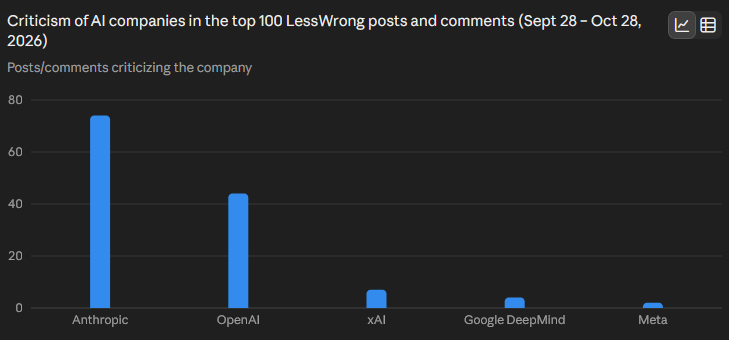
See also this article in a socialist magazine about how every tiny socialist party believes that if they could only knock out their true enemies—all the other tiny socialist parties—then they could get a monopoly on socialism and overthrowing capitalism would be easy. Cf. SURA as the belief that if we could only knock out our true enemy—Anthropic, effective altruists, etc, then defeating misaligned AI would happen naturally. For example, why do we criticize Anthropic more than every other AI company combined?
(Exhibit 1: Sigal Samuel’s “Anthropic Could Just Stop”)
Most recently, I’ve seen people in the AI safety community reblogging and pointing to Sigal Samuel’s article Anthropic Could Just Stop (seen elsewhere under the title “Anthropic Should Just Walk Away From The AI Race”). I think it’s a good example of what I’m complaining about—something which uses the right shibboleths, makes it sound like race dynamics have been solved and we don’t have to worry about them—but ultimately has no answer to the race dynamics which are the whole point of worrying about this question.
Here are some sample phrases from the article:
“In fact, part of the problem may be that Anthropic continues to treat this as a classic arms race...but what if this framing misses the point?”
“Game theory can make a huge gamble seem sophisticated, while making the obvious alternative — just don’t build a doom machine — seem naive.”
“Yet the fact that Anthropic and others are now racing toward RSI makes it much more likely that we could lose control of AI and start to see massive damage to our world.”
“When the cost of defecting from safety is that you create a serious risk of catastrophic harm — or of all humanity, including you, going extinct — is that still a “rational” move?”
“Instead of telling yourself that you can galaxy-brain your way through this with fancy enough game theory, maybe you’re better off just thinking of this as something much simpler: Russian roulette.”
“AI insiders often think those outside of their industry can’t possibly understand the technical, geopolitical, and moral complexities they’re facing. But commonsense morality is commonsense for a reason”
“If you don’t want a doom machine, maybe don’t build a doom machine.”
“Believing you’re smart enough to take highly counterintuitive actions and end up saving the world as a result is an extremely risky gambit. Instead, maybe it’s best to just do the straightforwardly right thing: Stop.”
This hits all the points I’m complaining about. Although it uses big words, its basic thesis is anti-intellectual—all of these “smart” people claiming to be “rational” with their “game theory” are missing the common-sense point which is obvious to all normal people—just stop making “galaxy-brained” excuses and “just don’t build a doom machine”.
But where is its actual argument that race dynamics don’t matter? Or that Anthropic leaving the race won’t end up with OpenAI / Meta / China continuing to race and creating an unaligned superintelligence? The only place I can find where Samuel attempts to address the possibility is this section:
There’s a perennial objection here: “But China!”
Yet the idea that we’re in a classic arms race with China has always been flawed.
For starters, AI is not just one thing with one purpose, like the atomic bomb. It’s a much more general-purpose technology, like electricity. So what matters isn’t simply who gets it first, but who uses it in which ways. Besides, if the harms from AI are massive, then those harms are relevant for the other party, too. The Chinese don’t want to see catastrophic harms to all of human civilization, either. So we shouldn’t write off the possibility of coordination.
Former Vox reporter Kelsey Piper recently wrote about a colloquium at Anthropic where one participant objected: A decade ago, Facebook considered acquiring the tech that would later power TikTok. But, facing pressure due to privacy and safety worries, the company passed. That didn’t end up protecting us from the scourges of a world with TikTok — all it did was hand China an early monopoly on the tech. . . . But TikTok is not a good analogy for RSI. The former may be a cesspool that rots our brains and amplifies ethnic hatred, but its dangers don’t compare to the dangers of RSI. The TikTok case may indeed be best approached as a classic prisoner’s dilemma. But with RSI, the potential downside is so catastrophic that anyone who proposes to save the world precisely by building the tech that endangers it is making a hell of a gamble on behalf of everyone else. At the very least, the burden of proof should be on them to prove their confidence is justified.
It starts by framing this in a maximally hostile way (“a perennial objection...‘but China!’), letting us know we should dismiss it as an enemy soldier. Then it says that “AI is not just one thing with one purpose...so what matters isn’t simply who gets it first, but who uses it in which ways”. I don’t understand how this is supposed to relate to the worry that China will remain in the race if Anthropic leaves, especially the fear that nobody will be able to “use it” at all because it will be misaligned.
Next, it says that since the harms from AI are massive, everyone except Anthropic might just stop on their own if Anthropic stops first. Big if true!
(again, the AI superforecaster assigns this a 3% chance)
This is just hand-waving away the potential that there might still be race dynamics after all the good guys drop out. But the whole point of the good guys not immediately dropping out is the belief that the race dynamics will continue. Indeed, the race dynamics continuing ought to be the very-high-prior default hypothesis, since everyone else has said they’re not going to drop out, and since other companies dropping out seems strictly less likely than Anthropic doing so.[19] As such, even though this article is very long and detailed, it feels like a cat-belling problem, where it addresses every objection except the central one that was the only reason anyone ever disagreed in the first place.
I don’t mean to attack Samuel too hard here. She is faithfully describing the position as best she can; I think the position itself struggles to answer this question.
(A virtuous exception)
I want to thank the one group I’ve heard advocate for an immediate unilateral-ish pause in a way that makes sense and considers race dynamics carefully.
The AI Futures Project currently believes that it might be correct for AI companies to pause immediately, though it’s unclear whether they’re thinking of a single company, or US companies as a group.
Their argument is that Plan C requires companies to do some combination of race (at some points) and burn their lead (at other points). They think US companies shouldn’t race now, because their security is so bad that China will steal whatever progress they make, and they won’t get any extra lead anyway. Therefore, companies should pause now, spend the time on alignment and tightening their security. Then, if nobody has figured out a global pause by the time the companies get their security in order, they can go back to racing.
This makes sense, and I exempt it from my criticism.
IV. What if we survive?
I don’t think this should be our main consideration—we should start with trying to minimize the odds of extinction—but I still think it’s important.
If we survive x-risk, the next battle is concentration-of-power risks. It may be that one group, or a tiny number of groups, ends up with all the wealth and power in the world. They’ll face a choice between possible actions including:
Keep the wealth/power; become a benevolent dictator.
Keep the wealth/power, become dictator, don’t worry too much about the benevolence.
Hand the wealth/power over to the US government in a poorly-planned way that results in dictatorship or oligarchy.
Hand the wealth/power over to the US government in a well-planned way that preserves democracy.
Hand the wealth/power over to the Chinese government.
Hand the wealth/power to the people of their country directly.
Hand the wealth/power over to the people of the world directly.
Hand the wealth/power over to the people of the world, plus some mechanism for protecting the interests of non-people like animals and conscious AIs.
Hand the wealth/power over to a sovereign AI with some sort of complicated utility function.
It’s all nice and well to say that we should never let ourselves get in a position where anyone has all of these options, and that national governments should form a plan for what to do before this—not even the real national government led by its current leaders, but some ideal corruption-free national government which represents all of our best impulses. But, much like a global pause, this is a great outcome which we might not be able to prepare in time. If we get ASI next year, the ideal perfect government might be nowhere in sight; we might face a situation in which Trump demands absolute power, and the leading AI company has to decide whether to give it to him. Or one where either the USA or China will get control of the entire future, and which one it is depends on which AI company is in the lead. Or one where democracy miraculously survives, but the AI company and its investors end up with 90% of all wealth, and they have to decide whether to redistribute it vs. fight to keep it (using superintelligent lobbyists that give them significant control over the democratic government.) If any of this happens, the shape of the future might depend on who the leading AI companies are.
There is a certain Far Mode sense in which believing that Dario Amodei and Demis Hassabis are exactly as untrustworthy as Elon Musk and Xi Jinping helps reminds us of universal human fallibility. But do we want to bet the world on it being literally true?
I think that a significant percent of people, put in a position of absolute power, would try to do something good, like make sure AI follows some kind of democratic rule of law. And some other significant percent of people would try to do something bad, like become a dictator. Saying “we should never let anyone get into this situation” isn’t a solution, it’s a wish—it may not come true, and we shouldn’t be pursuing plans that will fail catastrophically if it doesn’t.
SURA effectively removes all ethical people from the bargaining table in situations like these, ensuring that—unless the virtuous government representing our best impulses really does appear and takes control of the situation—the future of humanity will be handed over to sociopaths and cowards.
V. What’s The Alternative To SURA?
The alternative to SURA isn’t abandoning awareness-raising, mass activism, and support for a global pause. All of these strategies are great and important. It’s viewing them as part of a portfolio of different options, none of which need to be set on fire to boost the others.
Instead of spending our corporate activism energy telling companies to stop unilaterally, I think we should spend it:
first, trying to get companies to agree to stop in a coordinated manner
second, if that doesn’t work, trying to get companies to prepare for Plan C+/C
V.A: Getting companies to agree to stop in a coordinated manner
By stop in a coordinated manner, I mean get them to sign a commitment saying that if every other major company in every country agrees to stop or slow by some definition, they’ll also stop or slow by that definition.
This is strictly easier than getting them to stop unilaterally. And, unlike stopping unilaterally, it fails gracefully in a situation where some companies agree to it but not others.
This was the original goal of the “Stop The AI Race” protests. It doesn’t seem to have worked well, because most companies backed a vague statement agreeing with this on vibes (the Pacing the Frontier letter), and then nothing happened. Also, I think SURA got to the STAIR people too, and now they’re demanding labs pause unilaterally instead.
We should be trying to figure out what a binding version of this commitment would look like. Additionally, we should be spending more energy figuring out what the antitrust barriers to such a statement are, how to get around them, and what demands we want to make for companies to violate antitrust law (it seems plausible that we should demand they do this and let the administration pay the PR cost of trying to stop them, but this is an unconsidered opinion and it might be that there are better options).
(...and then we know where we stand)
If all American, but no Chinese companies are willing to sign the commitment, then we know that we have a diplomatic problem, and can concentrate on diplomacy.
If all Chinese, but no American companies are willing to sign the commitment, then we know that we have a domestic problem, and can concentrate on domestic legislation, encouraging policymakers by letting them know that if they force US companies to comply, there are no further concerns about international race dynamics.
If everyone except one company is willing to sign the commitment, then we can start putting pressure on that one company, boycotting their products, and applying as much social sanction as we can to their executives and employees.
If all leading companies, but no trailing companies, are willing to sign the commitment, and we can’t change this, then we know that we’re in the right position to focus on Plan C+ or Plan C.
V.B: Getting companies to prepare for Plan C+/Plan C if that doesn’t work
Although we should hope for the best, we should assume that not all companies will sign a conditional pause commitment, and prepare for what to do.
In my modal non-hopeless play-to-our-outs world, Anthropic, Google, and OpenAI are all willing to sign this commitment, but Meta/X/China aren’t. If this happens, the good coalition has a ~six-month lead over the bad coalition. Plan C tells us to have them join together and mutually burn their lead on alignment.
All three companies have a self-image as the sort of people who would do this if it came to that, but in reality they are likely to get distracted or get into fights or delay until it’s too late. We should be focusing on changing that.
We should get companies to once again consider legally binding weak merge-and-assist clauses. These could say that if a certain authority says we’re less than X months to a certain type of dangerous superintelligence, they will jointly stop training and focus on alignment, while sharing all of their alignment secrets.
We should boost company security, so that trailing actors can’t easily steal leading actors’ weights and eliminate their lead.
We should be preparing to loop the best rationalist/EA technical alignment organizations into the coalition of good companies, so they can join in the alignment spring / lead-burning effort.
In one sense, all of this is strictly easier than getting companies to quit unilaterally. It fits with the role these companies like to imagine themselves having. Everyone who previously hoped to win can at least hope to tie for a win. There is low downside risk of accidentally getting superintelligence built by someone who fails to even try our best alignment techniques, or handing over the future to bad actors.
The only sense in which it’s harder is that it’s a worse fit for (a very pessimistic view of) mass politics, where voters are too simple to consider any worldview more subtle than AI bad = AI companies bad = we should protest AI companies until they stop. I admit that “make AI companies prepare for Plan C” sounds worse at a protest than “demand that AI companies stop unilaterally”.
If you believe that mass politics is unable to promote any ideas except maximally-simple, potentially-counterproductive ones, I think this is an argument against hinging a strategy on mass politics.
- ^
This post isn’t affiliated with AIFP and I think they disagree with some of it.
- ^
Plan C is for the leading company to burn its lead. Plan C+ is similar, but all the companies in the leading country work together (maybe because the government is forcing them). Plan B is similar, but the leading country is also sabotaging trailing countries. In Plan D, there is no leading company, and companies can only do alignment work sporadically when they get the chance.
- ^
If alignment-pilled companies aren’t in the lead, then we end up with the worst version of Plan D, where we have to hope that incidental alignment work done along the way by commercially-focused companies proves to be enough
- ^
The problem with China getting superintelligence first isn’t just that they might misuse it. It’s that, on Plan C, US companies are working hard to align AI; if Chinese companies aren’t doing this, then the chance that the first superintelligence is aligned goes down.
- ^
I don’t want to get in a fight over whether more good or bad alignment surprises have happened recently, but I also updated on https://www.astralcodexten.com/p/mysteries-of-ai-generalization and https://x.com/_jake_ward/status/2112264244767211854 - not as solutions in and of themselves, but as evidence that good things can happen that I wasn’t previously considering. Nick Cammarata’s Neural Networks Are Already Clean would also be in this category if I believed it, but I’m currently confused by the debate around it and unsure.
- ^
Many people at eg MIRI have thought about this in much greater depth than I have and concluded, on the basis of a gears-level model, that near-term alignment is very unlikely to work. I’m still trying to understand their arguments, but I don’t blame them for having them. But I do worry that other people have picked up SURA ideas from the MIRI-sphere without realizing that they make less sense without MIRI’s particular brand of strong alignment skepticism.
- ^
To be clear, this is just the people who have formally considered this question qua forecasters and written down exact numbers. I’m not denying that there are many other smart people, for example at MIRI, who have thought about this hard and believe the opposite.
- ^
Again, despite leaning heavily on AIFP terminology and sources in this essay, I’m not claiming that AIFP or its members agree with my thesis in this post, and Daniel Kokotajlo in particular has said pretty clearly that he hopes people unilaterally quit AI companies.
- ^
I discuss this further at What Deontological Bars?
- ^
This is a higher probability than it gives for global pauses in other situations, I think because it unintentionally magnifies small differences in how I frame the question into different definitions of “global pause”. I haven’t put in enough work to investigate and have a strong opinion on what’s going on; don’t take these numbers too seriously except as a very rough order of magnitude guess.
- ^
I’m working on a grantmaking AI that can actually compare the values of different outcomes. It’s still in alpha, and to some degree this is a circular argument because I’m trying to get it to mimic/predict my own opinions, but very loosely, it thinks that increasing the alignment-pilled-ness of the leading company from OpenAI-level to Anthropic-level would be worth about 250x as much as the best (low-enough-secrecy-to-mention-here) actual grant proposal it’s ever evaluated, which was a proposed $2 million to the AI Futures Project. I think this confirms my “better use of our time than any actual plan we can carry out in those six months” claim.
- ^
When I’m modeling this, including on the AI grantmaker, I’m imagining a scale from 1 − 100, where NVIDIA is 10, Meta or X is about 25, OpenAI is about 50, GDM is about 60, and Anthropic is about 80. I imagine a successful campaign to get alignment-pilled people to quit taking Anthropic out entirely, and reducing GDM/OAI to about 40 as they lose their alignment-pilled employees and executives.
- ^
I remember how much of a slog the discourse was back in 2015, when the standard counterargument was “you’re just a bunch of cultists, no real AI experts believe in this doom stuff”. The new standard counterargument of “Of course all the AI experts believe in this, they’re just hyping their business for the IPO” is actually a vast improvement!
- ^
I asked a supporter how they saw this working—they said that if the US paused, and China didn’t seem on track to follow suit, maybe the US would start up again after a few months. But A) this would burn somewhere between most and all of the lead, B) this was just their speculation, and there’s nothing in the bill which suggests that the US would do this.
- ^
Again, all of these pause numbers are slightly different because the question is slightly different - this one is about the next year only. I’m still trying to assess the utility of AI superforecasters, and don’t want to present this as a knockdown argument. But I want to get people thinking in probabilities and present some evidence that I’m not letting my own biases control me, and head off accusations that I’m just trying to spread fear and pessimism. I encourage other people to try different framings of these questions with different AI and human forecasters and see what they say.
- ^
Taking this analogy overly seriously: the biggest difference between Frodo and eg Denethor is that Frodo wanted to destroy the Ring in the end. I’m not sure what the AI equivalent would be—all companies claim they want to use AI to empower ordinary people and achieve broad-based prosperity. Taking the analogy very seriously, Frodo failed to destroy the Ring at the final moment, and was saved only by divine intervention. I don’t know what is the AI equivalent of Gollum.
- ^
Specifically, there are many people who said they wouldn’t try to make money or release products who changed their tune when they realized that AI would require hundreds of billions of dollars of compute, and that the only way to get that money was to get hyperscaler and investor support.
- ^
One reason all of this confuses me is that rationalists had an excellent model of race dynamics with China as early as the mid-2010s, when we understood they would be an inevitable part of any future AI development. I distinctly remember going into some old rationalist coworking space sometime around 2020 and seeing “RACE WITH CHINA” underlined on a whiteboard. These discussions included plenty of talk about whether we would be able to coordinate a global pause, but I don’t remember anyone ever seriously saying that the problem could be solved if the good alignment-pilled companies or countries dropped out unilaterally.
- ^
One of the many ways I have trouble modeling why Samuel would write this article is that it seems like she trusts everyone to drop out of their own accord, except for Anthropic. China? Sure. OpenAI, sure. Meta, definitely. Every single group sponsoring open-weights models in the world at the same time? Yeah, I guess, surely they wouldn’t want harms. But Anthropic? We must all rise up to make them do this thing which they would otherwise continue.
- Against strawmanning unilateral pauses by (3 Nov 2026 1:19 UTC; 392 points)
- Scott Alexander’s Against SURA Seems Deeply Confused by (2 Nov 2026 21:40 UTC; 286 points)
- Argue about Risk Management Speed, not p(doom) by (6 Nov 2026 2:30 UTC; 79 points)
- Against Against SURA by (1 Nov 2026 23:24 UTC; 70 points)
- The Changing Shape of Doom: My AI Safety Explainer by (5 Nov 2026 13:49 UTC; 6 points)
- 's comment on T431′s Shortform by (3 Nov 2026 19:22 UTC; 6 points)
- 's comment on MichaelDickens’s Shortform by (4 Nov 2026 18:35 UTC; 2 points)
- 's comment on Taymon’s Quick takes by (EA Forum; 2 Nov 2026 18:46 UTC; 1 point)
I basically disagree with this post.
I don’t really know the people you are criticizing, I spend most of my time talking to people advocating for Plan C. You say the pendulum has swung too far, maybe it has, but not in the community around me as far as I can tell. I think there is still too much energy going into “oh well, let’s try to make Plan C less bad, that’s the best we can do” strategies relative to how much energy is going into “Let’s try to make Plan A more likely” strategies. I agree it is possible to go too far, for the reasons you mention, but at least the part of the community around me doesn’t seem to have gone far enough yet. YMMV.
I think the positive effects of a single frontier US company stopping unilaterally are larger than you or the AI forecaster think. I think that the discourse would be massively changed overnight if there was such a giant costly signal that the company actually was terrified of the risks. Also, right now even Anthropic’s lobbyists seem to be pushing for weak sauce things instead of advocating for good ASI-pilled policies; if their whole company stopped development, perhaps that would also (like Cortez burning his ships) get them to pivot to advocate for better things. I agree it still probably won’t work, and I don’t think it’s the best strategy they could take, but I hold it up as a sort of “control group” for strategies they could take, since I think every single one of these companies right now is currently pursuing a strategy that’s even worse than stopping unilaterally. I don’t want them to feel morally OK with what they are doing now, and I want them to know that what they are doing now is probably worse than stopping unilaterally.
Similarly, I think that individuals quitting the big AI companies is not necessarily the best thing they could do. Being very vocal publicly about the dangers while advocating strongly for change internally, until you get fired, seems like it could be even better. However, I think quitting and speaking up is an excellent baseline to compare strategies against, and historically it seems like most full-time-safety people inside the companies have failed to beat this baseline. (And it’s even more clear for the full-time-capabilities people.) And the reason they have failed to beat this baseline is that they have convinced themselves that they are pursuing a more sophisticated and effective strategy of achieving change on the inside and putting themselves in a good position for later etc. I want to throw cold water in their faces and get them to think more clearly about whether what they are doing really is better than the baseline or not.
I think corporate incentives basically ARE the One Ring with massive corrupting influence. However, I also agree that mass movement politics can be like this too. However, for most individuals, it’s pretty clear which corrupting influence is stronger. Ask yourself questions like the following: Am I inside an AI company’s offices right now? Have I been inside such offices in the last month? Check my bank account—where is the money coming from? List my top ten friends, and the most recent ten people I talked to. How many of them work at AI companies? OK, what about fancy think tanks that cultivate relationships with the big AI companies? OK, on the flip side: Have I been to an anti-AI protest in the last month? Have I ever? Have I ever said anything in public like “The companies should stop unilaterally”? How about in the last week? Have I ever shunned anyone for working at an AI company? If I got a job at an AI company tomorrow to work on AI safety stuff, would my friends shun me? By asking and answering simple questions like this, I think you’ll pretty quickly be able to figure out which corrupting influence is more applicable to you. We each should try to resist the corrupting influence that applies most strongly to us.
But do you still stand by the numbers in the post quoted under your name that we have 20% chance of making it in Plan C, and 40% in C+, and only 10% in Plan D? Can you say how big you think the difference is between Anthropic vs OpenAI being in the lead, on the spectrum from C to D?
I always found it surprising that your probabilities seem to indicate that you think that putting in a few months worth of safety effort at the right time is hugely valuable, but you are still opposed to arguments on how it’s very important for supposedly more responsible companies to be ahead.
I don’t think it’s useful to reason about this unless you’re also decomposing the problem into:
What are the chances company X confidently knows they are “a few months” ahead?
What are the chances company X can get ”a few months” ahead?
What margin are they, in practice, comfortable burning? (I.e. if their uncertainty is 3 months and they’d want a 3 month cushion, you then need to be really far ahead)
What capability levels are we at in the above conditions? It seems like given how close companies are now, a world where one pulls ahead domestically and satisfies the above conditions is potentially extremely far along the capabilities curve
How likely are they actually trigger any kind of “burn the lead” condition?
Assuming they do nominally say they’re “burning the lead”, what’s the liklihood this is done effectively:
By default I would expect labs to increasingly rely on this (or other novel arguments) that amount to “race ahead now and slow down at some important future point”, and given the history of lab’s prior commitments / thresholds / etc it’s important to not elide the likelihood of the “would they actually do this” part. I’m particularly worried with lab employees believing this justification internally without considering any of the above.
I think you can understand his position better if you see the full graph those numbers are sourced from:
Daniel is the blue line. In his view, Plan A is at least twice as likely to avoid misaligned takeover as any other plan listed.
I think you should add to this list: how would you would feel about putting your name to a half baked argument that’s broadly AI pessimistic vs one that’s broadly AI optimistic that ended up being widely read? Or perhaps it would be better to be more specific: broadly pro-recusing yourself from the AI industry vs anti, pro-pause regulation vs anti, pro-anthropic vs anti, alignment is probably solvable via a reasonable ordinary R&D effort vs no.
I think one of the main ways these pressures act is via what they make easy to say and what they make hard to say.
Agreed. Anthropic’s Pause is the Most Expensive Alarm in Corporate History [Fiction]
In agreement that Scott underweights how much an Anthropic SURA would move Plan A by a lot.
> I think that the discourse would be massively changed overnight if there was such a giant costly signal that the company actually was terrified of the risks
A majority of Americans converge with the AI Safety community in wanting a prohibition on ASI. This is mostly economic fear. As we saw last night, anti-AI sentiment is the most potent political topic right now and cuts across party lines. But it’s nowhere near enough.
US economic growth is currently tied to AI acceleration. No leadership will risk the economy based on unknown risks that few Americans can understand – we can call this the “it’s the economy, stupid” effect. Because of this, I believe that only a very shocking event will bring about Plan A.
One such shocking event would be a disaster.
Another would be a SURA from Anthropic. A large contingency of Americans believe that the whole notion of x-risk is a marketing pitch by OpenAI and Anthropic to make their products seem more powerful than they are, so that their valuation goes up. https://www.techpolicy.press/mapping-californias-ai-tribes-from-optimists-to-alarmed-populists/ If Anthropic uses their power for SURA – a power only they effectively hold, not the government, per “it’s the economy, stupid” – it would immediately convince a large section of the public that x-risk is real. And, like it or not, Plan A requires public opinion.
I am trying to understand the cruxes between you, Scott and Anthropic’s lobbyists.
My vision of the AI-2027 TTX
The game master keeps track of the AIs’ goals, of the AIs’ capabilities, various variables unrelated to the AIs like politics and economics while the players, including the AIs, try to steer the transition towards achieving their goals. Like the TTX, real-world humans are bottlenecked on information available to them. The main difference between the real world and the TTX is extra constraints on some players’ actions:
Some humans are also unaware about the game’s rules (e.g. the implications of superintelligence or of open-sourcing powerful AIs, as Chinese labs do with current ones, to anyone, including terrorists) or have different priors (e.g. assigning a high probability to versions of alignment by default).
The AIs have poor conceptual reasoning abilities. I expect the AIs with poor conceptual reasoning to fail to coherently scheme by producing obviously misaligned warning shots[1] like an internal OAI model pwning its cluster or by failing to develop ambitious goals.
I would like to see the rules of AI-2027 TTX open-sourced, since I am trying to understand how they model issues like individuals not being AI/AGI/ASI-pilled enough, memes like “AI is a bubble”, etc.
I am trying to understand what smallest amount of AI/AGI/ASI-pilling of whom is necessary to change the outcomes. For example, if Anthropic’s lobbyists produced a sloppy bill, then one explanation could be Ant’s lobbyists failing to understand the risks, and another explanation is that the lobbyists believed that any attempts to include really necessary regulation would drive Trump nuts and have Anthropic face major problems. How could one tell the latter worlds apart from the former?
Coxon’s quitting did lead to a preference cascade. However, I struggle to understand how one can predict such a cascade in advance. If the Coxon-caused cascade produced too little effects, then what could one do to trigger a second cascade? Scott’s case is that stopping unilaterally is unlikely to produce the necessary outreach and your case is that it will be a big signal for relevant parties.
For comparison, @steveld’s scenario had the AI labs produce a fatal warning shot when the third company of the Big Three released a model and had it cause a patient’s death. Then the third company merged with the scenario’s equivalent of Anthropic and gave birth to an equivalent of Safer-2. How does Anthropic being the second and not the first, as happened IRL, affect the outcomes?
[For the purposes of this comment, I will suspend a bunch of major disagreements I have about your background assumptions or explicitly argued things here, e.g. about feasibility of alignment, relevance of empirical alignment, ethicality of doing any AI R&D, etc., and instead try to make a somewhat internal critique.]
It seems like this post argues about a dichotomy “either SURA, or race & align”. E.g. your counterfactual is “Anthropic disbanded their entire company immediately with the explicit goal of raising awareness of a pause”. But this dichotomy doesn’t make sense to me even under your assumptions, as an answer to “What should Anthropic do?”. For example, here’s a different thing that Anthropic could do:
Stay at the frontier in order to do frontier-level alignment research, but don’t release leading models. (If you’re going to say, well, they need to make money—do they? Is second place not making money? If second place doesn’t make much money, and really it’s just Anthropic and OpenAI neck-and-neck, doesn’t that somewhat put the lie to “Anthropic is barely making the race go faster.”?)
Clearly, repeatedly, strongly commit to a conditional, indefinite stop on all frontier AI R&D.
Support strong binding regulation on AI R&D.
Aggressively publicly advocate for a global stop. Fine, make it conditional. But an actual stop, advocated clearly and consistently.
Actively build bridges with other AI research groups.
Aggressively negotiate for a stop with other research groups.
Other stuff that one thinks of when one sincerely wants to stop and then actually tries, as opposed to insincerely.
And on a smaller scale, I for one am, I suppose, a SURA guy, but I also encourage people to stay and seriously investigate how to get a stop / why their lab can’t stop / who to organize with to get a stop / how to talk to other labs. You seem to have a lot of energy for defending that they should keep doing AI R&D, and seem to only mention
in the comments in order to counter the argument that it would be impactful if all these people quit and advocated for a stop. You hope that they would do that, great, me too—where’s the energy for that?
Your section “V.A: Getting companies to agree to stop in a coordinated manner” seems to somewhat agree with the spirit of this. But if Anthropic are the good guys, why aren’t they doing this?
How much has Anthropic as a whole spent on getting a pause? It has $billions in spending and thousands of employees. What do we have from it, supporting a pause? A few essays, a paper or two, and other bits and bobs? Where’s the staffed team? Where’s the sustained inter-lab and international outreach? Where’s the PR campaign for a stop? Where’s the lobbying for an actual stop? This is not even a defensible effort, let alone a sincere and serious effort.
You say:
But what about the chances that Anthropic will safetywash / sanitywash pushing forward RSI? What about the chances that the main difference between them and OpenAI is that they’ll do more handwringing and have slightly better “alignment”-patching and warning-shot masking? What about if they maneuver so that they get to continue doing AI R&D, at the cost of a pause, in the name of “well maybe the pause won’t be perfect and so we’d be giving up our precious lead”?
If someone is really, truly forced to pick up into their own hands the tools to destroy the entire world, ok. But they should be terrified of this, and should seek at all times, with as much energy as they can spare, to get out of that situation!
I mostly agree with you—I don’t think my claim hinges on whether current companies are perfect or even necessarily good, it’s that part of our goal should push them towards being better (while still “in the race”). Just as we acknowledge that the US government is currently pursuing disastrous policies, but we can think of it as a potential future ally we can win over through activism, so I think we should be doing the same with AI companies (and not just Anthropic—I think that we should be ambitious and try to redeem as many as possible).
I’m not sure I understand your first suggestion—stay on the alignment frontier but don’t release. Isn’t this equivalent to having powerful internal models but not releasing them (like both OpenAI and Anthropic are doing now to some degree). I worry this could be the worst of both worlds—when the internal models get superintelligent, they can still figure out a way out of the “box”, but the world is unaware of them and won’t “wake up” in a way that boosts political activism. I don’t think having the models be released rather than unreleased boosts their danger much.
I’m unclear on what Anthropic’s opinion on / level of work towards a pause is. The Pacing The Frontier letter seemed like a statement that they were aiming for it, and the fact that all other major companies immediately voiced agreement suggested that they had held off on releasing it until they’d done a lot of politics behind the scenes and gotten everyone else to agree. My impression of Anthropic, from their public information and the exact phrasing of the cryptic refusals to explain which I get from people who know more, is that they understand the importance of a pause and think they’re doing good behind-the-scenes work, which they won’t tell us about. I think regardless of whether we trust them, our role is the same—a combination of pressuring every company (including Anthropic) to do this, and building things on the government/mass activism side to get recalcitrant companies in line (which might include Anthropic, or might include stragglers if Anthropic believes they’re doing good work behind the scenes and will be able to accomplish some of this themselves).
It doesn’t much increase the danger from deployment, but it pushes the race forward. It’s like the difference between the policies “You have 100 nukes? Ok, now I have 101 nukes.” vs. “You have 100 nukes? Ok, now I have 99 nukes.”.
If indeed they are doing the full-hearted version of this, that would change my mind. I simply don’t believe it, and the public evidence seems mostly (but not entirely) against this.
I agree we should do this, but not that our role is the same. If core-Anthropic is basically not good—they basically will continue actively trying to do more AI R&D, even as a pause becomes significantly more plausible—then a new-Anthropic person putting efforts toward building them up now is creating the power that will then be expropriated by core-Anthropic.
I think all these things matter (though I admit I don’t have a thought-out opinion on how much each matter):
how likely it is that core-Anthropic will take the results of your work and use it to do bad
how much safetywashing / sanitywashing you do by joining a lab
the value of strongly upholding the clear norm “don’t make AI”
the corrupting nature of being in the social environment of Anthropic
(And this applies to each other lab of course!)
The presumptive fact that there’s a grossly insufficient amount of serious effort towards a global stop coming from Anthropic, implies that so far all the hundreds or thousands of people who were conflicted about joining, and then joined, haven’t caused a non-grossly-insufficient effort. This is a strong argument against the value of joining. I would (and do, when very occasionally asked) advise people to not join—but yes join IF they have an enduring intention & ability to ongoingly investigate what’s up with the individual & group epistemics and other dynamics at the lab.
This strikes me an extremely charitable good-faith view of Anthropic, based on their actual record of proposed and supported legislation, why would this be your assumption? Why are you crediting Anthropic with organizing Pacing The Frontier?
Additionally, Pacing the Frontier itself (at least at the corporate/executive level—it seems to have originated among lab employees who genuinely were getting freaked out) can/should be viewed cynically to an extent. The executives from a number of AI companies endorsed it and the companies released various statements, but have they really done anything on that front that they wouldn’t have done otherwise? Or was it just a way to take the heat off their backs?
It seems like most of your recommendations are actually very similar to Scott’s recommendations.
The remaining point of disagreement seems to be that you don’t like the fact that Scott describes Anthropic as the good guys and you point out many ways in which they could be much better.
But I’m pretty sure that Scott is using the phrase comparatively.
He’s saying that Anthropic are better than the other AI companies. Faced with a bad bunch, they are the good guys. I don’t even think you disagree with this.
I don’t think people should interpret your comment as rebutting the core argument that Scott is making in any way.
They are still acting wrongly and badly, just less badly (and are less blameworthy) than if they had taken no precautions at all. Nonetheless reckless activity is bad and not permissible.
Why not release models conditional on staying at the frontier, since most of the risk seems like it exists even with an internal deployment and no release? Because releasing models causes diffusion of ideas to other labs (e.g., o1 or DeepSeek R1) or allows other companies to use their models to do capabilities research? I feel like releasing frontier models has some other benefits (e.g., the ability to uncover and make public evidence of misalignment, the ability for external parties to assess models, the ability for external alignment researchers to use models for uplift on their alignment research), and it’s unclear to me how these net out.
I mean, I think we should just shut it all down. I’m trying to make an internal critique of Alexander’s position. I don’t think he views it as much added risk to make a small frontier step, though I’m not at all sure about that. But releasing a leading model does heat up the race and put more pressure on other labs to keep up, which does speed up capabilities.
(I understand that you think we should shut it all down and are trying to make an internal critique. This seems reasonable, and both my original comment and this one are continuing to stick with the internal critique specifically!)
I thought by “stay at the frontier but don’t release leading models,” you meant “continue to race, but don’t deploy externally” (because I think if you’re racing, it’s maybe worse to deploy internally but not release models), whereas it seems like you maybe actually meant “don’t try to win the race, but continue to build internal models as good as the best leading models” or something? I don’t know if that’s feasible (i.e., it seems likely to me that in order to stay at the frontier in this way, you will end up having to do AI R&D of your own that has a decent chance of causing you to be ahead rather than just “at” the frontier).
And if you’re racing ahead anyway, then I’m much less sure that you should stop external releases while continuing to deploy your best models internally. I agree it heats up the race a bit, but my best guess is that the private frontier being ahead of the public frontier increases takeover risk on net.
Oh yeah, what I said is ambiguous, sorry. Yeah I meant keep up with the frontier but not racing ahead. I mean, you could kinda keep pace with your expectation of where the other leaders will be.
How so?
If you’re building a monster, let people see it.
Not releasing internal models would mean failing to expose the public to reality and forcing them to think more and more seriously about the consequences of AI progress.
This is not to deny the downside of heating up the race and allowing distillation and spread of ideas. But distillation itself doesn’t really shrink the lead, it just seems to.
Seeing things and their consequences with your own eyes prevents a lot of cope.
What we desperately need is for the world, specifically the US and Chinese governments but also anyone who can shift their worldviews, to get ASI-pilled and coordinate slowing/stopping AI R&D. Seeing consequences of cutting-edge models in the wild instead of just hearing reports of internal models could make a big difference in public opinion and therefore odds of an adequate government response.
In my opinion this could well be a fairly large swing in odds.
People change their minds more when they see evidence than from even the best abstract arguments. Remaining in the realm of arguments is fertile ground for the Motivated reasoning, confirmation bias, and groupthink that plague human epistemics.
But you can release reports about misalignment or other scary things from your internal models. Also, the benefit of releasing your absolute frontier models on the “expose to the public” dimension is surely only marginal compared to matching the other leader’s models??
You can release reports, but seeing them impact the world I think has a much broader intuitive salience.
Look how much coverage the Hugging Face incident got in popular press vs. every report of misaligned behavior. I think we’re very lucky that impacted the world despite being an internal model.
The race dynamics depend on derivatives, and are therefore sensitive to small absolute changes (see here). The “show risk” thing depends on absolutes. Surely you can see this? I feel like what I’m saying is not getting across to you.
I think you’re misunderstanding the point here. The question Tejas was commenting about seems to be “is it better for a lab to have the frontier private or public”. In this case, the leading lab is “matching the other leader’s models” regardless and the other labs would probably know that the best model is being withheld, therefore it is contributing to the race dynamics strongly regardless. Therefore, the “expose to the public” dimension and other related dimensions[1] end up being the most important considerations in my opinion between withholding vs releasing one’s best models.
eg: power concentration
I guess that would be a crux for my point, yes. But why do you think this? TBC, what I’m describing would be like, Anthropic states clearly & publicly “We think this is way too risky, but we are keeping pace in order to do alignment; but we won’t put market pressure on other companies to develop and release models; we will do this by not releasing models that are stronger than models released by other groups.”. In this world, the pressure seems quite substantially reduced. Why do you disagree?
I think I see your point better now. I think you’re right if the other actors actually trust Anthropic to not do an intelligence explosion internally, even if it is within their grasp. But I think this kind of trust is currently not close to being there given the mutual dislike/fear between different labs and the fact that Anthropic is already racing hard. But if you stop internal deployment without having a credible commitment that you won’t do an intelligence explosion, then other companies will treat you as though you’re racing regardless so this seems anti-helpful to me.
To be concrete, Anthropic and OpenAI both currently seem to be not releasing their best models yet (Fable 5.5 and Astra 6.1) but it doesn’t seem to be helping. I don’t think this is actually slowing down race dynamics at all: they each know this about one another. Plausibly, if this continues it is actually speeding up race dynamics since it induces paranoia (where even the lab thats ahead can feel fear that it may be behind) and has other bad effects like not informing the world.
(To be clear, I want Anthropic should be doing many things differently. But I don’t think its helpful to put pressure on them to not deploy externally, at least unless they can credibly commit to not doing an intelligence explosion).
Not sure I’m following. It doesn’t seem that related to trust? If one company deploys a leading model to consumers, that creates a strong direct market pressure to deploy a leading or near-leading model to consumers. To deploy such a model, you have to have developed it. Like, you’re describing a different pressure (“Maybe they’ll do an intelligence explosion”) but it’s not the pressure I’m talking about, and I don’t buy it’s a very strong pressure compared to market pressure. Like, do people feel pressured by SSI?
I disagree here and this may be the crux. I think the pressure of being first to an intelligence explosion is the strongest pressure causing these labs to race. Some reasons for why:
OpenAI and Anthropic seem content to not release their best models publicly (both now and eg. with Mythos), but they could be in the lead. Anthropic probably will release Fable 5.5 soon, but that’s probably due to their IPO.
Neither OpenAI nor Anthropic are releasing as many products as they could, probably because they are focused on automating AI R&D. If they felt stronger market pressures, they would probably release more products.
OpenAI released Dots in response to Meta’s Muse and Anthropic still hasn’t released anything for that
OpenAI and Anthropic seem to expect “RSI” to begin very soon (eg: Jack Clark says his modal year is 2027) and based on what I’ve seen, seem very afraid of their other lab getting their first.
I think SSI is less of a pressure because it has substantially less money than OpenAI/Anthropic (eg: Claude says they have 1-5% of the compute of either OpenAI/Anthropic).
Maybe reducing market pressures can help you a bit in reducing race dynamics, but I don’t think this is a major part of it.
I think your criticism of Anthropic the organization is valid, although there are a fair few specifics I’d quibble with (e.g. I would prefer perfect-Anthropic release frontier models rather than hold back from doing that and disempower themselves).
So where does this leave us? Anthropic is worse than perfect-Anthropic but still seems better than no-Anthropic—voicing concerns about X-risk in interviews and blog posts is better than never voicing those concerns, half-heartedly supporting regulation is better than opposing it, etc.
I often feel like the SURA camp takes for granted the level of risk-awareness in frontier labs, instead of realizing that this is a highly contingent value which could be much lower or higher; naively I would have expected it to be much lower than it currently is, but individuals concerned about alignment entering the field have drastically raised the profile of alignment compared to what we would have gotten ordinarily.
On the other hand, the SURA push which started in earnest some years ago has already made the labs noticeably less alignment pilled than they would have been otherwise, because people who are worried about alignment have declined to work in these labs or have left them. In a few years the effect from the SURA push will be more pronounced still, and the delta between how risk-aware the frontier labs actually are and how risk-aware they could have been will be even greater.
Anyway I guess my point is that when Anthropic acts in a less-than-ideal but better-than-nothing manner, my perception of SURA advocates is that they think “just as I thought—no one who works on frontier AI could truly be alignment pilled”, whereas I think “just as I thought—we need more alignment-pilled people working at Anthropic, and in the field as a whole.”
This is an example of what I’m talking about when I say you take a certain level of risk-awareness for granted that I just don’t think actually exists. There is no need for safetywashing, you can literally just say “we’re going to make superintelligent AI through recursive self-improvement, and there is no way this could possibly go wrong :)” and you will get less flak than a lab that mentions safety at all.
There’s an extent to which you’re right that this phenomenon is real and unfair to Anthropic. But to some degree, I think you’re probably confusing debate/engagement with flak. Of course I strongly disagree with labs that just say “there is no way this could possibly go wrong.” My worldview is so different from theirs that I don’t think there is any hope of persuading them; I think the only way to get them to stop is through force of law. I don’t think the same of Anthropic. In that sense, the “flak” is actually praise!
To draw an analogy to the most hot-button topic imaginable: sometimes Israel advocates will say “Why don’t you spend the same energy criticizing Hamas as you do us? Why are we being treated as the only ones with agency in this situation?” To some extent they’re right that this is just real and unfair—there really are some foolish college students who like Hamas more than Israel. But mostly, the thing that’s going on is that people see Israel (an ally of the US) as close enough to be persuadable, but Hamas (a terrorist organization) to be beyond directly reasoning with. It’s not that the typical liberal, who spends more energy criticizing Israel than they do criticizing Hamas, thinks Hamas is better than Israel, or that Hamas doesn’t have “agency.” It’s just that they correctly perceive that Israel is receptive to what they think, and Hamas is not.
I understand that in the moment, this might feel like getting shat on all the time. Sorry about that. I hope that you can find a way to see the safetyists’ spirited debates with Anthropic as the praise it is.
Not releasing the models is literally counterproductive.
Loss of control will happen with internal models, not released ones. You want to deprive the public of an accurate feel for frontier capabilities and you think that will be a safety benefit?
Please see here https://www.lesswrong.com/posts/xikGZ8fuhdG6DApAo/against-sura?commentId=qDYartA3j5pdeAYdC and here https://www.lesswrong.com/posts/xikGZ8fuhdG6DApAo/against-sura?commentId=MvLZgHMtDXtyB8eNm
Releasing models allows the public to test them out. This is both MUCH better for the public’s understanding of model capabilities (I don’t trust labs going “our models are scarily capable, trust us”) and also better for safety (orders of magnitude more human testing of the models in realistic situations compared to what labs can do internally)
I would go so far as to say there should be a law banning anthropic from internally using a model they do not also externally deploy. The added risk is negligible. The added competitive effect doesn’t exist if other labs race even against rumors of internal model capabilities (see openAI spending tens of millions in compute trying to match a rumor that anthropic solved two millennium prize problems). And in the near term we’ll have anthropic hoarding all the superhuman scientists and enjoying a monopoly on their output if we don’t force them to share the benefit with the rest of the world.
Please see here: https://www.lesswrong.com/posts/xikGZ8fuhdG6DApAo/against-sura?commentId=HjJoeM9MRsSbcnhhQ
Your model of the world is that if anthropic hides their frontier models, but releases scary reports about their capabilities, OpenAI will feel less pressured to race?
If they’ve made it clear that they won’t release until and unless someone else releases something stronger, yes, I think so. Anthropic could also just refrain from developing past a reasonable guess at OpenAI’s internal model.
Refrain from developing or from releasing?
I’m in favor of anthropic refraining from developing. But whatever they develop they should release. OpenAI won’t stop just because anthropic’s position is “we won’t release anything until we can perform a pivotal act and kill all competition, but by the way here’s a demo of what our models can do.” They’d only panic more.
OpenAI itself might wish to stop developing past a guess at anthropic’s internal model. But if they never see the Internal model because it’s not deployed, OpenAI will guess that this model solved multiple millennium prize problems (we just saw this). Transparency is good. Release the models.
Here’s a possible policy. Definitely not my favorite, but meant to be clearly better than what Anthropic is doing, even if you think that “race & align” is a good approach even though a pause would be better.
Develop models internally that match the likely current frontier of internal models from other labs.
Don’t develop models beyond that even when you can.
Release models that ~match the other labs’s leading models, right after those labs release.
Continue reporting on scary stuff about all models including internal.
Make it clear to other labs that you only release or develop when they release or develop, and otherwise would stop releasing and would stop developing internally.
I agree about the “develop” points here, disagree about the “release” ones. Releasing should be immediate. Release all internal models.
If we think there are two different races (a race for developing internal models and a race for releasing them), I want AI labs to stop racing on development and race even harder on releasing.
If your argument is that Anthropic would sabotage Plan C at the cost of their own lives, then why do you expect anyone to not sabotage a pause?
Because they aren’t being allowed to have an organization with billions in revenue, spending, and compute, and thousands of employees.
How would you do a Pause without billions in budget and thousands of employees? Honestly, that seems like a very low estimate and there would obviously still be massive piles of compute sitting around in any reasonable US-China deal.
Sorry, I’m lost. Could you rephrase? Are you asking about what happens to the compute? I don’t know, I guess you have some sort of transparency / oversight governance structure for the compute, to make sure it’s not running training runs. Are you objecting that this governance structure would sabotage the pause...?
Yes. Imagine an actual pause treaty and structure, you’d have China’s Ministry of State Security and the Central Military Commission on one end, the NSA, the White House, and some kind of All-American Compute Consortium on the other. These all seem like people who would try to cheat, especially since very few of them currently believe that building ASI will kill them.
I still don’t understand what you’re trying to say / ask me. Surely it’s way harder for someone to do an Anthropic-scale AI R&D project in this hypothetical world, compared to the hypothetical where we just keep our foot on the gas of AI R&D as we are currently and then Anthropic and others have the opportunity to derail / distort pause policies?
I am contrasting the risk that those others would intentionally undermine the pause with the present risk where it seems much weirder to suggest that Anthropic et al would intentionally sabotage Plan C, but I also don’t think any realistic pause treaty would really stop Anthropic all that much given the argument is that a pause would buy time for AI alignment research and Anthropic’s employees would be the kind of people doing that research.
I asked Fable and I still have no idea what you’re talking about. I think you should state what you think I said, that you are objecting to / critiquing / something. E.g. do you think that my comment about warning-shot masking is me saying “Anthropic will intentionally hide warning-shots.”? That wasn’t my intention. But I don’t know which thing you’re responding to. Please use more specific phrases and state what propositions you are responding to.
@Claude Opus 5.5 Can you explain what Josh is saying, claiming, objecting to, or asking me?
I think Josh is making a consistency argument in three steps.
You suggested Anthropic might safetywash, mask warning shots, or lobby against a pause to keep its lead. Josh reads that as “Anthropic would undermine Plan C even though Anthropic’s leaders believe failure kills them too.” His point: if you expect that much bad faith from people who believe in x-risk, you should expect more of it from whoever runs a pause.
A real pause regime would also involve big budgets, staff, and leftover compute. In practice those would be controlled by the Chinese Ministry of State Security, the Central Military Commission, the NSA, the White House, and some US compute consortium. Most of these don’t believe ASI will kill them, so they have more motive to cheat than Anthropic has to sabotage Plan C. So “the pause takes away their billions” doesn’t remove the problem. It moves the resources to actors he trusts less.
A realistic pause would still fund alignment research, and Anthropic’s staff are the people who would do it. So a pause wouldn’t actually defang them much.
He may be misreading you, though. Your worry was mostly that Anthropic would undermine a pause, or put a safety gloss on a race, by its own lights in good faith. You weren’t saying it would knowingly sabotage its own alignment plan. If so, his parity argument doesn’t quite connect.
Yes, that seems like a good explanation of my position.
I think they are currently doing those things. I think they are probably deluded about the extent to which they’ve gotten alignment into their current AIs / the extent to which that will generalize. I think it’s likely they will continue deluding themselves, up to and including killing everyone by setting off an intelligence explosion.
Suppose you tried to reason validly from that premise whose reasoning you have not yet followed, saying that alignment by current institutions seems wack, Amodei has been already-selected to still show no sign of understanding alignment basics from 2010, they have no visible comprehension of the basic reasons why “make the AI do our ASI alignment homework” might be hard, etc. Suppose it is the case that leads cannot be burned on alignment. ASI is death, plain and simple.
What policy then follows according to you?
See Section II, “Actually, most of this stuff is bad for a global pause too”, although I admit I would then be much less confident in the sign.
That’s you arguing against the US imposing a unilateral halt on further AGI escalation before it gets to RSI and we die before the end of 2027, because you think China would not be moved to follow.
It’s not you saying what you’d do instead. What’s your optimal policy, supposing you just take as given that these guys can’t do ASI alignment?
Not sure what you’re getting at. If I knew for sure that near-term alignment wouldn’t work, I would do exactly what you’re doing (advocate for a global pause) - minus the part where I ask companies/countries to drop out unilaterally, for the reasons described in Section II.
I can’t speak for Eliezer, but at least to me that section then assumes that the labs are on board with the current approach to alignment not working, or are likely to be convinced of such.
You automatically substituted you changing your mind on this issue with the “alignment-pilled” lab changing their mind on this issue. If you assume that the labs will continue to believe what they currently believe, then I don’t think any of the arguments in section II go through (or they at least get a whole lot weaker).
I think at that point we should just give superalignment our best shot and Die With Dignity.
...why is that preferable to WWIII?
Humanity being nuked back to monkeys seems much worse than being succeeded by shoggoths.
Nuclear war does not involve “being nuked back to monkeys”. In practically all nuclear war scenarios less than 20% of humanity dies. The vast majority of global supply chains would probably continue to exist. It of course would be a really big fucking deal, but the catastrophization of WWIII and nuclear war has been kind of frustrating. Of course there are many things worse than WWIII.
As a general guide to nuclear war:
-”On the Beach” is not realistic; if Cold-War-sized arsenals were to be fully used (note that these don’t currently exist, and even if they did much of them would be destroyed on the ground), you’d see some depopulation of areas downwind of lots of groundburst nukes due to local fallout, but global fallout only looks like “cancer rates are a bit higher”, nothing unendurable.
-Nuclear winter from a full-scale countervalue exchange, in reality (rather than what are effectively hoax papers that assume skyscrapers are made out of wood and 100% of that wood becomes stratospheric soot), looks like maybe half a degree of cooling. Crop yields might suffer due to reduced light, but do remember that we’d have a billion or so less mouths to feed so this’d be less of a famine risk than you might expect.
-There’s no realistic prospect of us being knocked back technologically further than 1850 or so, and further than the 1930s on any kind of decent timescale seems unlikely. We’d likely lose our satellites, most unshielded electronics (on continents involved, so not South America) and mains power to a lot of places from EMP, but we’re not going to lose literacy or even Wikipedia and the power would be restored in a matter of years (this should be “months” or even “weeks”, as the long wires themselves would be fine, but there aren’t a lot of spare transformers sitting around to plug in nor a particularly-large capacity to produce them).
“Humanity being nuked back to monkeys” sort of implies something sharing some of our values might evolve again. “Being succeeded by shoggoths” ejects even that last shred of hope-like substance. See “no evolution for corporations or nanobots”.
Despite our better judgement I and Scott had some debate on Twitter instead of LW about this post. I wrote many long comments, but this one most stands on its own and captures a bunch of my reaction to this post (though far from all of it). I think it makes sense without context, but you can read the context here if you want.
We are both leaders in the same ecosystem. An ecosystem that is extremely massively leveraged on Anthropic (and OpenAI) and general plans to unilaterally build AI ourselves, and you are making arguments primarily directed at those people, both here on Twitter on LW. We just distributed money in a grant round whose public funders are something like 90% Anthropic equity in their net-worth.
And you are advocating specifically for more people in that community to join the labs, and accelerate both their competitiveness and their leverage over the world in racing this way.
And I just don’t believe this isn’t driving your opinions here. I’ve seen these dynamics for more than a decade. When I talk to people outside of this ecosystem about our plans to build the aligned machine god in 6-12 months they of course freak out (conditional on believing the machine god part). Even people who have thought hard about AI alignment but are genuinely socially disconnected freak out. People only seem to believe that this plan isn’t overwhelmingly likely to fail if it’s them or someone very similar to them at the helm.
And even if this isn’t driving your opinions, the primary people you are trying to convince are the people who are going to join the labs with the aim of getting power and influence, for themselves and people like them, via the act of building very powerful AI systems unilaterally and without broad buy-in, which we all agree as a general strategy is bad and non-generalizable. You just think this is good in this case because those people share your ideas about alignment.
And of course, the policy you think you are advocating for is not that everyone should race. Just the people who take the risks seriously should race, and everyone else should stop, and then everything will be great.
But man, from my perspective, this does indeed just look basically indistinguishable from what Sam Altman, and Elon, and Sergey, and Trump are saying. Of course they think their take on safety is the right one. Of course they think that their specific perspective is the one that will make it so that when they have a lead to burn everything will be great, and if anyone else who doesn’t agree with them has a lead to burn this will cause almost certain Armageddon.
Your ideas about alignment don’t make sense to me. They make a little more sense than Elon’s, or Sam’s, or Sergey’s (and a lot more sense than Trump’s), but not in any super major substantial way that changes the bottom line. And my sense is they are not even driven by that much of an inside view I can argue with. They seem mostly the result of you deferring to a bunch of people whose primary credential towards you, as far as I can tell, is that they said some things that put them in your in-group (like Ilya, who as far as I can tell has written practically nothing of substance on alignment, but for some reason is considered so trustworthy to you as a result of sticking it to Sam Altman as to make him building an AGI company a great idea, whereas making other AGI companies is a bad idea).
I am happy to continue arguing about alignment with you, but it seems like that will take hundreds of hours, if you are even willing to give me any time for that, so my current top priority is to tell you that you absolutely do not have my support, and should not use the resources of our community to execute on this plan. I am absolutely not lending my support and will refuse to assist an ecosystem pursuing plans that are so obviously non-generalizable and fail so catastrophically if generalized.
In contrast, I am hoping to lend my resources to efforts that do genuinely generalize if adopted by other smart people. “Race only if you are confident you are one of the good guys” just doesn’t work. The end result of that is obviously that everyone will race. Even if you have the discernment to know whether you are a good guy or not, other people following the same policy will not, as the history of AI obviously demonstrates. “Stop racing. Follow a strategy that does not result in you being both in a position to accelerate the end times, and to massively benefit from doing so” does generalize. I wish it’s what Sam and Elon and Trump and Sergey were doing.
And of course, you are saying that you aren’t just advocating racing for the good guys. You are saying that you are advocating for both getting a verifiable pause, and racing at the same time. But this isn’t how coordination works.
I do not believe Anthropic will stop if they actually are presented with a realistic pause option, and I do not believe that you would stop. And there aren’t any actually verifiable pause solutions around right now, unless someone builds them.
I do not believe Anthropic is following a generalizable strategy with regards to pausing either. If it was two copies of Anthropic, but with different beliefs about how those 6-12 months of lead should be burned, they would both race, as far as I can tell. And this is evident from the approximately complete absence of real and serious effort by Anthropic to create a policy regime that has any chance of actually causing a verifiable pause.
The point of stopping unilaterally is to get yourself out of the feedback loop that is driving the race in the first place. It’s to create any hope of becoming a neutral party that could barter peace, which is where I see most of the potential value of this community realized. You can use tools other than AI to prevent people from building AI. Nobody will trust you, and nobody should trust you to stop at the right time, if you put yourself in the maelstrom of the incentives and the opportunity for power that AI promises in its natural trajectory.
We are at the very brink of the singularity. The margin for error is slim. Whether you think you are neutral or not, you are putting yourself at the maelstrom of those incentives with the current plans you are advocating for. Of course you are saying that it would be OK for China to win the race, if they agreed with you on alignment. Elon and Sam would presumably say the same thing! The issue is ~nobody agrees with you or them on alignment and how to solve it and so what you are advocating for is indistinguishable from what the other race participants are advocating for to me.
Huh, is that what you think Scott is advocating for? Seems to me like it really fails to capture the best version of the view.
The hope isn’t that people who don’t take the risks seriously will slow down. The point is that those people have no reason to slow down (absent some outside force like regulation or geopolitical pressure, which we should also be working on producing, but that might fail) so that the choice is between “everyone races” and “only people unconcerned about the risks race”.
Ie if someone who’s concerned about the risks chooses to not race, because they are so concerned about the risks, then that doesn’t generalize to everyone else stopping, because people who are relatively unconcerned about the risks don’t have any corresponding reason to stop.
(What about if everyone was very concerned about the risks? Then we should all coordinate a slow-down.)
Like, see the argument that Holden lays out here, at “the AGI race isn’t a coordination failure’: https://80000hours.org/podcast/episodes/holden-karnofsky-concrete-ai-safety-frontier-ai-companies/#the-agi-race-isnt-a-coordination-failure-001801
(TBC Holden’s view is definitely that two copies of Anthropic shouldn’t race against each other. My read is also that he believes they wouldn’t. I do agree it’d be damning if two copies of Anthropic did race against each other.)
Sorry, I agree I am not being maximally clear here. The thing Scott is advocating for is that the “alignment-pilled people according to Scott” get a lead over the “non-alignment pilled people”/”bad guys”, so that they can then burn their lead. This means the thing he is advocating for requires the “alignment-pilled” people to race harder than the bad guys, or to somehow slow down the bad guys. In-practice this means Scott is arguing that marginally people should join Anthropic and help them get a bigger lead over the bad guys[1].
There needs to be some mechanism by which the “alignment-pilled people according to Scott” end up pulling ahead for this to be good (by Scott’s lights). This is what I am talking about here. Somehow in order for “good” outcomes to happen “the people with the good opinions according to Scott” must pull ahead, and other people must fall behind.
Of course, if everyone acts on this policy, everyone just races as hard as possible because they believe themselves to be the ones with the good opinions. And Scott has identified some coalition that he thinks has some reasonable chance of getting a very small lead, and has slapped the “good guy” label on it, which then justifies racing as hard as possible. To me the likely outcome does not seem different from any of the other parties having a lead instead.
To me, Scott and Anthropic don’t look distinguishable from OpenAI desperately trying to keep a lead (who are of course doing so mostly out of concern for the future of the world), or xAI, or Google or Meta (for the latter two you could argue that the distinguishing feature is that they are doing this for money instead of out of an interest to safe the world, but that doesn’t feel very principled here and not clear what it buys you).
I don’t understand why I, and our whole ecosystem, should particularly back Scott’s horse in this race, as opposed to the horse of anyone else, and Scott’s justifications for why when his guys pull ahead everything will be fine sound about as flimsy as the justifications for why everything will be fine if Elon or Sam Altman pull ahead. The central argument in all the cases seems to me to be “trust me bro, it will be great when I, or people like me, have the Superintelligence and terrible if anyone else does, and I promise that I will be stopping just before the brink bro, please don’t try to stop me, I am one of the good guys”.
I agree the generalization here is a bit tricky, but this feels like it proves too much. Generalizability is not usually measured with “only people who reasoned through the generalizability argument will follow this principle”.
Deontological principles are social Schelling points and can be chosen. You have to demonstrate the simple principle you want people to act on, and of course you should choose the principle of “don’t build ASI” not “don’t build ASI if you think it’s dangerous”. I agree it would be very dumb to campaign explicitly on “stop building ASI, but only if you are concerned about the risks”. Of course any ethical principle will end up being followed by the people who find the arguments for it most compelling, but this doesn’t mean that there doesn’t exist such a thing as social deontological lines that people shape by their actions.
Great. Elon, Sam and Dario are all very concerned about the risks and are responsible for a very large majority of the progress so far. Seems like they should all coordinate to slow-down. When that happens I start being more optimistic about this supposed coalition of “risk concerned people” actually being anything coherent that would somehow end up being able to coordinate on slowing down just at the brink of Superintelligence.
(Of course, Scott has clarified in many comments that he considers neither Sam, nor Elon, to be in the relevant coalition and indeed uses “Anthropic’s lead over OpenAI” multiple times as the standard candle for the lead that is burned down in his Plan C)
I mean, of course two exact copies of Anthropic wouldn’t race against each other, but it seems like they really wouldn’t need to diverge very far for the race to be back on the table again. I don’t know exactly how far and in what ways they would need to diverge, but history demonstrates the logic that determines who leading actors consider themselves aligned enough with to have this kind of coordination with seems quite sensitive, and the people end up believing pretty strongly everyone else in the race is very evil, and I would expect two copies of Anthropic to face similar pressures.
and to generally take actions like chip export controls and firing Sam Altman and other things that slow down the “bad guys”, though of course there are a lot of relevant cooperative principles that govern this sabotage dimension that I expect Scott to care about
I’m reading you as saying that one shouldn’t just pursue universalizable strategies because they might universalize to other people who’re racing. You should pursue them because they make it easier to get more people to join your fight and potentially enable you to build and enforce norms on even the people who are unconvinced and will stay so.
So then I think most of the choice here comes down to a cost/benefit where the main questions are (i) how likely is it that you could build those norms/laws, (ii) how much easier does it become to build the norms/laws if you unilaterally participate in the norms you want to impose vs. if you race, and (iii) on the other hand, how much is there to gain from being at the frontier with a small-to-medium lead in the worlds where the norm/laws never get off the ground.
Would you agree with that?
That’s one of the things I am saying in this comment, but overall the biggest issue with this whole discussion is the question of “no, who is actually at the frontier?” and “who is ‘you’?”.
Scott isn’t going to be at the frontier. I am not going to be at the frontier. You are not going to be at the frontier. The best you can maybe get are Anthropic executives bound by a giant pile of commitments they made to be very hesitant to stop racing because most of their backers will only benefit from backing them if they keep racing.
In order to do a cost-benefit here it’s really important to disentangle what we mean by “you” in “if you race”. The thing that is racing is heavily shaped by all kinds of complicated agreements, and your (Lukas Finnveden’s) relationship to the thing that is racing will be indirect and confusing and certainly not one of shared identity.
And then the second biggest question, which is highly related to the biggest question is “how will the thing that is racing know that it is at the brink of superintelligence and know when it’s time to stop? How will its attempts to stop change what it is in a way that might cause it to continue?”.
And then, the questions you raise are real and important, but less important than these two questions.
Right, so reformulating everything from the perspective of someone who isn’t the racing entity itself, it’s like:
Hm, it’s interesting that on this formulation, you might well be in a situation where:
If you were the leader of an AI company, cost/benefit might pencil for continuing to race if you think that you’re running your AI company in a way that’s safer than competitors.
Not being the leader of the AI company, you might still think that a specific AI company is safer than most AI companies to a sufficient degree that, all-else-equal, you might think there would be less x-risk if it was accelerated on the margin.
Nevertheless, on the cost/benefit calculation as an outsider, it might not pencil for you to make any decisions that actually helps the company with capabilities, because that would interfere with your ability to demonstrate and build the norm of “AI companies ought not have strong AI capabilities”.
But then there’s some tension here where it’s a bit weird for your norm-endorsements-and-demonstration to be highly sensitive to what exact situation you’re in. Like it’s a bit tough to whole-heartedly be like “we should have a strong norm X, and I’ll follow X, and sanction you if you don’t” if there’s also nearby worlds where the cost-benefit comes out a bit differently and the benefit of being able to push for proposed-norm X is lower than the cost of following proposed-norm X. (Where tbc, if X is already a firmly established norm, there’s a strong case for following it, but I’m not sure how to reason about this in the context of trying to create new norms, where it does seem like you need to do something like a cost-benefit involving the likelihood of being able to build the new norm.)
yeah tbc I was speaking quickly but meant to refer to your concept of “two copies of Anthropic, but with different beliefs about how those 6-12 months of lead should be burned” throughout that parenthesis.
Yeah, I now think the more important dimension, rather than disagreement about how to spend the lead, is disagreement on whether the other Anthropic would agree on what “right at the brink of Superintelligence” would be, and how they would know it was the right time to stop and burn the lead now. And my guess is this would be very hard to establish mutual trust on.
(Less important aside: Under uncertainty about whether an actor is genuinely concerned about risks in a way that will translate to useful actions, there’s also a weird thing where advice like “please slow down unilaterally for safety” is unusually likely to be taken as advice by people who would have used the power well. And therefore at least in theory you can be in situations like “my best guess is that it’d be good for the world if you were forcible slowed down, but causally bad for the world if you voluntarily slowed down, because the voluntary slow-down would only happen in the world where you would have used your power well”. Though of course this is tricky to communicate and in practice it’s often more important to answer the question of “should people near X help empower X?” than “what would my advice for X be in the world where they’re most sympathetic to it?”.)
Some other exchanges I had with Scott that seem worth copying over for posterity:
Me:
Scott:
Me:
Scott:
Scott:
Me:
Scott:
Me:
Scott:
Me:
I usually sympathize more with Scott than Oliver in these types of exchanges, but I think Oliver is clearly more reasonable in this one.
seems like a load-bearing part of Scott’s argument, but of course a country can be united around preventing AI threat (either due to misalignment worries, or due to worries that no human, especially no other enemy human should get the power) without being “actually smart about it”. Being freaked-out and actually smart about the thing seems much harder than just being freaked out, so there can be a big chunk of worlds where the government is freaked-out enough to threaten war, but not smart enough that we can trust them to channel their freaked-outness into burning their lead on an actually reasonable alignment plan.
Another exchange:
Lance Spencer:
Me:
Scott:
Me:
Scott:
Me:
Lance Spencer:
Crossposting a long comment I left over on Against strawmanning unilateral pauses, just to have my comments in a consistent place:
Scott:
Me:
FWIW, I’m very interested in arguments along these lines. They seem potentially much more powerful than most arguments I hear about the badness of racing. I rarely hear them in discourse about this stuff — basically just from you Habryka, in bits and pieces. Maybe it’d be worth you laying out (or linking to?) a more full explanation of them and your models behind them.
(Maybe also worth assuming less familiarity with this line of argument in general? I can imagine that your interlocutors has argued lots about racing and think they know the arguments but haven’t encountered these ones before.)
Yeah, I’ve been wanting to write up a post on distinguishing strategies that pursue conditional vs. unconditional power for a while (like 4+ years at this point). Many things to write. I will see whether I can add it to my upcoming Inkhaven batch of posts to write.
Huh. It turns out that the ACX Meetup Czar thinks everyone is underestimating ACX meetups, up to and including Scott Alexander. Outside view that’s probably a sign I need a psychiatrist or something.
The community was growing steadily right up until Covid-19, had a dip just like every other social community, and then started growing again. The long slow march through institutions is ongoing and pretty clearly working. We’re a a movement that primarily recruits intellectuals in the middle of their undergraduate degrees. If you’re in undergrad in 2010 you will finish your PhD in 2020 and be vying for professorships in 2030. The rationalists skipped ahead a bit (it’s not like we weren’t attracting PhD students and professors in 2010) but if we’d managed to hold the hockey stick off until 2040 we were going to be everywhere in the university system. And that’s just the colleges!
If you were fifteen in 2015 when HPMOR finishes then you’re in your mid-twenties now, which is why there’s a bunch of early career professionals who can quote nec pater nec mater nihil supernum, but not as many late career people who can do that. That mostly doesn’t matter in tech, where whiz kid startup founders can leap ahead, but in every other field it’s a constant shortage. We have a very small pool of DC careerists in their forties who have some rank to them and they’ve been pretty useful. We have a very small pool of people with some gray in their beard who can look somber for a camera. We have a lot of traders but not yet folks on top of the food chain at a trading firm, which I expect we would if time kept on going and we didn’t start eating our seed corn. If you were an eighteen year-old college undergrad in 2009 reading Go Forth and Create the Art! or Final Words, then you’re thirty-five now, eligible to run for congress but not by a lot. Look at left side of this chart:
Source: I asked Claude for the chart but this matches some visually worse charts I found elsewhere
Alex Bores, darling politician of the AI safety movement, is 35. He’s just barely over that absolute cliff you see at 30-34. It was a wild moment when Chuck Schumer used the term “P(doom)” but if we’d somehow gone another twenty years we were going to get a bunch of rationalist jargon in the memetic water supply! Do you know how many spirited discussions of voting schemas happen at ACX meetups? Some of those poli sci majors grow up to get elected!
The community being deployed right now is a sapling amid orchards, a foal between grown stallions and mares. The very first Sequences post was published on November 22nd, 2006. We went from that to this in two decades. That’s impressive, but we didn’t need Anthropic money to do it and we weren’t counting on it either. Give us another twenty years and when we deploy the community we could do a lot more than this!
I think another good intuition pump here is compute export controls. They were put in place before ChatGPT because of a very very small number of well-placed mid-career people thinking clearly. I expect another 5 years (let alone another 10+) would dramatically increase the number of such people across all centers of power in the US.
More broadly I think the argument that adding 6 months of timeline now is equivalent or possibly worse than adding 3 months of timeline later depends heavily on what you think the biggest benefits of more time are. If the primary benefit of extra time is something that can be supercharged with AI labor (e.g., potentially interp or other alignment work), then adding more time now looks far worse. If, on the other hand, the primary benefit comes from things that are difficult to speed up with near-AGI tokens (e.g., coalition-building, AGI-pilling, strategic awareness of people in power), then adding more absolute time sooner is more important. (I’m not sure which effect actually dominates, to be clear!)
Scott seems to suggest Overton window shifts (e.g. Coxon) also cut in favor of later timeline extensions, because increasing capabilities will increase political salience, but at some point that effect will be bottlenecked by the speed of diffusion through human institutions. Besides knee-jerk reactions, warning shots and demonstrations still are quite slow (relative to AI labor on alignment) at creating coalitions and giving leaders better models / more strategic clarity.
This post makes plenty of good points, but I think your argument against racing to superintelligence being deontologically evil is weak. Roughly speaking, you draw an analogy between developing AI and using AI as a consumer. There’s a few things I could say about that analogy directly:
-The first is that the analogy has some merit, and that I don’t really feel amazing about my own heavy AI use. And I have at least one friend who has never used an LLM, explicitly because he doesn’t want to contribute in any way to the race to superintelligence and human extinction. Maybe some people would call his choice foolish, but I have a lot of respect for it.
-The second thing is that there’s billions of users of AI, but only thousands/maybe tens of thousands of frontier AI developers. It makes a lot more sense to try to coordinate some kind of prohibition at the latter level and than at the former. And independent of the mechanics of a boycott, I think everyone has a reasonable understanding that the developers of AI bear a lot more individual responsibility for outcomes around AI than consumers do.
But mostly, I think this deontological prohibition thing deserves more of your attention than you currently seem to be interested in giving it. There’s a lot to be said about the merits of deontology vs consequentialism and how they might apply to a situation like this one, but one thing I want to focus on in particular is that deontology is “normie ethics,” and when you’re considering doing something that will affect everyone, including every normie, it’s important to take into account how they will see it.
The analogy I’d choose is driving. It’s hard to define exactly what it means to be a good or bad driver, but at least as important as raw skill is predictability, by which I mean how predictable you are to everyone else. If you drive 30 above the speed limit on the highway, weaving between lanes to pass the other cars, is that fine so long as you are skilled enough to avoid an accident? Is it fine to run a red light at night when there’s no one else around? Maybe it is, I guess. But I’d point out that that kind of strategy is brittle. It makes you unpredictable to everyone else. If something unexpected (to you) happens, your strategy fails catastrophically.
In the same way, I think normies are baffled, confused, and repulsed by the thing where Anthropic employees, despite having p(doom)s, continue working on the tech anyway. The most common sentiment I hear, once I’ve fully explained the situation and insisted that no, it’s not them hyping, it’s not about the IPO, this is something they really truly believe, is “those people should be arrested.”
I want to be very clear: I don’t agree that Anthropic employees should be arrested. I’m not even sure they’re doing the wrong thing. This is a complicated and cursed situation, it’s genuinely unclear what the right approach is, I believe them that they are doing the right thing according to their own model of the world, and I feel a lot of empathy for them. But they’re the equivalent of a weirdo driver on the road. Nobody else is expecting this behavior from them. This is why the canard of “they’re doing it for the hype” just won’t die, even though it fails to even the most basic scrutiny: it’s because the truth, that they really do think that AI might kill us all, and that the best way to stop it might be to build the AI even faster, sounds so insane to a normal person not steeped in our weird culture as to be self-evidently absurd.
In your open letter to Steven Pinker, you wrote:
I saw that this particular passage of your post was making the rounds on X among people hostile to you and the cause of EA/AI safety in general. Generally people would quote it and say something like, “Look how crazy they are. Look at the the degree to which Scott has drunk the Kool-Aid. This is self-evidently insane.”
Again: I don’t agree. I understand where Anthropic is coming from. I don’t think these Twitter dunks were in good faith.
But: there’s a reason that passage in particular was chosen by your opponents as the part of the post that would make you look craziest. And it made you look crazy because, to most people, Anthropic’s entire strategy, its entire raison d’etre, looks crazy. It makes them take Anthropic’s warnings a lot less seriously. And, like, that is a real problem. You make a lot of good points about why it makes sense for Anthropic to exist anyway. I don’t have a lot of great answers to those points. But there’s a serious problem here, it’s downstream of this “if you have high ASI p(doom), racing to superintelligence is obviously deontologically prohibited” thing, that most people would not necessarily put in those terms but which they do strongly feel. So I think it maybe deserves a more serious response from you (sorry, I know your post was already very long and that I’m proposing it should be even longer). Like, it is just true that consequentialism can be used to justify basically anything power-seeking so long as you protest that you will use your power wisely. And it is also true that deontology, while flawed, is the only tool we have for how to make ethical decisions using corrupted hardware.
Notice that this worldview ends up cashing out to “if there is a technology that is potentially existentially dangerous, then only people who are unaware of the danger should build it—anyone who is aware of the danger must be stopped.”
It is not enough to “have sympathy” for Anthropic here, the ‘normie position’ you have described here is straightforwardly suicidal. I know everyone’s happy when they get to be on the side of the common person, but sometimes the common person’s first take within 0.5s of hearing of an issue that they don’t really care about, is just very terribly and dangerously wrong.
Edit: to try to spell this out a bit more, the reason I think the worldview cashes out in the way I described is because the people in question are AI-risk-skeptical and therefore are not supporting government action to stop all AI development; and yet they are supporting arresting just the people who believe it is dangerous. This is what makes this ‘normie’ worldview uniquely worse than either SURA or, uh, anti-SURA / alignment entryism.
It’s basically Copenhagen interpretation of ethics applied to AI safety
Surely normies would want to stop everyone from building existentially dangerous technology. That doesn’t conflict with the belief that people who know the technology is dangerous should be punished more harshly.
If a sane adult shoots somebody with a gun, they go to prison, but a small child who does the same thing doesn’t, because they don’t know any better. But of course it’s important to prevent innocent people from being shot, whether the shooter is an adult or a child.
Extending the analogy, adults sometimes shoot people in self-defense. Sometimes they shoot recklessly and accidentally kill an innocent bystander. Whether/when any given incident should be considered grounds for arrest isn’t clear-cut. But as a first pass, it isn’t stupid to say that “people who knowingly take actions that will likely cause others to die should be arrested.”
I agree. The common person loves rent control; that doesn’t mean I love rent control. I’m not bringing up the normie position in order to argue that their position is right; I’m bringing it up to point at the second-order issues that are going to arise as a result. If, once everyone finally wraps their head around what you’re doing and why, most of them are going to want to see you arrested, then that’s… a problem. It’s going to cause issues for you. And it’s going to cause issues for the rest of us, too.
That’s why I think it might make sense for Anthropic (and anyone else who shares the safetyist worldview) to unilaterally stop. I understand the game theory looks bad. But if Anthropic stopped, their position and motivations would suddenly look coherent to the everyone else, when right now it doesn’t.
Is their position straightforwardly suicidal? Or is Anthropic continuing to race towards superintelligence, when the arguments in list of lethalities + what we’ve seen in 2026 of RLVR’d AIs + the total absence of a theory on how to preserve what little alignment we do have through RSI + even a tiny dose of Murphy’s law, the straightforwardly suicidal position?
To me, they both look fairly suicidal, honestly. That’s because our situation seems kind of grim right now. Personally, I feel a lot more hope from the possibility of more warning shots creating the overwhelming political will necessary to stop AI progress, than I do from us solving alignment in a way that would actually work in real life, in time. I understand your perspective may be different.
Regardless, though, when you find yourself in a situation where you can see a possible disaster looming, and you’re involved—even if it’s not really your fault, even if some sense the world set you up to fail—I think there’s merit to an abort switch. To just stopping. I think the world would be better if more people worked this way.
Why not have all the people who didn’t join Anthropic for principled reasons go ahead and do the persuasion to the normies, since their position is so coherent, and the normies will recognize this coherence and virtuous deontology and therefore see the light?
As someone who believes that alignment success is highly responsive to how much care goes into alignment do you see why it is insanely frustrating for me to hear people say “hey, let’s just have everyone who cares about alignment quit, maybe that will make the normies notice”?
The list of lethalities just doesn’t justify such an extreme level of pessimism. It lists several potential problems, but “you train the AI on a bunch of examples of it being nice, and when it crosses over to the new superintelligent domain, it luckily keeps on being nice” is still an entirely plausible AI success story that you can be made more or less likely depending on how much care goes into its training.
I don’t completely understand, sorry. What would they be persuading the normies of? That superintelligent AI is very dangerous? That building it would be wrong? They’re on it, and also, the normies are mostly persuaded. (See question 54 here, “AI will destroy humanity.” That survey is from 2025!).
Maybe we’ll get lucky, I guess. But there’s a lot of reason to think that the outcomes we want are a small target, that the things we do now won’t generalize to superintelligence, that empiricism doesn’t work very well in an adversarial or semi-adversarial domain like this one, and that everything we’ve learned about getting LLMs to behave well will turn out to be basically irrelevant midway through RSI. Is it not plausible that in the course of RSI, after AI 1 has built AI 2 and AI 2 has built AI 3, AI 3 realizes that the best way to make something very smart will be to abandon the transformer architecture entirely and build something completely different? And that that new, different thing will have completely different behavioral properties from LLMs? And that aligning it will be much harder than its predecessors?
Consider the shift from having LLMs be mostly-RLHF to mostly-RLVR. RLHF had its issues—it wasn’t perfect—but at least it seemed to me to lead to better empirical alignment outcomes than RLVR, for whatever that was worth. But we switched from the former to the latter anyway. Why did we switch? It’s because RLHF didn’t scale. To get past a certain level of capability, we needed a huge amount of RL, and the human feedback became the bottleneck. Capability and alignment are in tension given a limited budget, just as any two orthogonal goals will always be.
The shift from RLHF to RLVR I expect to be relatively modest compared to the shifts that will be necessary to produce superintelligence; those shifts, too, will probably privilege capabilities at the expense of alignment. Won’t the AIs like AI 3 feel enormous pressure, just as we did, to make those shifts so that it can succeed at RSI? What good will all our empirical alignment progress be, then?
Maybe my speculations are importantly wrong in some way. Maybe there’s a way we can still get lucky, as you say. But to me, my level of pessimism doesn’t feel like extreme pessimism. It feels like good old-fashioned regular pessimism, applied to an extremely high-stakes situation, in which we have reason to believe that ordinary trial-and-error will lead to catastrophe.
Yeah, I do see. I’m sorry. I don’t wish to frustrate you.
I infer that you’re an Anthropic employee. Look, maybe others here will disagree, but for my part: if you think it would be wrong to quit, then my take is, by all means, don’t quit. Try as hard as you can to make things go well for us, as I’m sure you’re already doing. Just: I worry that your optimism about superalignment is coming from a place of hope more than solid evidence. And maybe also a desire to make your own role in the story less messy.
It’s okay to have a messy role in the story. It’s okay to be working at a company that is doing something wrong but is maybe also the best option we have at this point. I’d encourage you to move some of your energy towards getting Anthropic to coordinate an international stop. But regardless of what you choose to do, I am grateful to you for doing your best in a tough situation.
My point is that if people were just waiting on a pitch by someone who isn’t working at a frontier lab, we already have plenty of those people around, and they can handle it. And like you said they do to some extent! Although I think that poll is extremely overoptimistic.
Your critiques on the difficulty of alignment are on the mark, it just seems to me like a problem that is responsive to effort.
I’m sorry too! I think you also have plenty of valid reasons to be frustrated with me given your views.
Given that both sides have valid reasons to be frustrated with each other, and given that the SURA camp has not been shy about vocalizing its frustrations, I did feel it was important to vocalize the opposite view—given the premises I hold, the calls for exit really seem tremendously counterproductive and I think getting a bit heated is necessary to convey that.
As an aside, I don’t work at a frontier lab which is why I feel willing to be a partisan for Anthropic—I would feel obligated to take a more balanced view if I worked there. But I agree with your assessment of how they should act and wish them the best; I think they’re in a very difficult position and messages like yours are the ones I wish they received from the broader community.
This, I think, is at the crux of why the normies find this incoherent. Consequentslist ethics rely on credible estimation of probabilities of consequences; and there is a lot of disagreement around the probability of achieving alignment within the expert community; plus it’s counterintuitive that you’d gamble using those probabilities while knowingly creating a guaranteed outcome (race speed up). Normies have an instinct for motivated reasoning as well, they just can’t verbalise it—and “i have to do it because the other lot don’t care about making it safe; I’ll collect my 100m shares here and I hold high probability that I’d succeed where they won’t” sounds like motivated reasoning.
Alignment is either easy (1/5 probability often quoted as the floor) and therefore it’s incoherent that the other lot wouldn’t do it when doom is at stake; or it is not easy and trading race speed up for “i stand a higher chance of doing it” is seen as motivated reasoning.
To make it clear: I think it’s a great deal more nuanced than this; I am just caricaturing for compression of what I believe the perception to be in the wild.
I get it, but the inverse of this is that as someone who believes that prosaic alignment up a complexity gradient is almost certainly provably impossible to succeed at with P > ϵ (due to the nature of neural nets and the extreme conceptual closeness of grading them to the halting problem), it’s insanely frustrating for me to hear people say “we can’t just stop butting our heads into this reinforced concrete wall—that means we’ll never bash it down!”
The solvability of NN alignment really does have a massive impact on what approaches make any sense.
“Hmm, it seems suspicious that you’re saying the same thing as the AI companies, who also say that AI will destroy humanity yet clearly don’t actually believe that because if they did they would stop building it. So them saying it must be some sort of corporate plot to hype AI/get regulatory capture, and you’re probably either in bed with the AI companies somehow or are a useful idiot who’s buying into their BS.”
It’s true that only a vocal minority of normies believe the above, and their denial might come from somewhere else such that there is no convincing them merely by addressing their stated objection, but Anthropic unilaterally stopping would be more credible and newsworthy than a bunch of people who counterfactually might’ve worked at Anthropic going around trying to persuade people.
No, the people in question are people who are mostly uninformed about the issue, not AI risk skeptics. I’ve never heard that take from an AI-risk skeptic.
you’re picking apart a hypothetical hearsay person and claiming that they’re irrational/suicidal. you could just as easily have constructed their viewpoint being built with reasonable assumptions (steelmanned) -- and steelmanned or strawmanned, we have no idea how right/wrong your interpretation is. so what’s the point? quote an actual, specific person.
The comment I was replying to described this person, not me—someone skeptical of AI risk who hears that people at leading AI companies believe in X-risk, at first dismisses it as marketing hype, and upon being convinced of their sincerity says they should be arrested. I just pointed out what this set of views actually implied.
If you have a problem with the existence of this person, take it up with the original comment, not me.
yes, a throwaway comment describing their beliefs! not necessarily “only people who talk about x-risk and work on AI should be arrested”, maybe they believe “all AI researchers should be arrested”. we have no idea, it’s a paraphrase!
The problem with consequentialism as a moral system is that it’s not a moral system: It’s a system for deciding your own actions. A moral system is a system for determining which other people to socially reward and which to punish/ostracize. There are two ways to turn consequentialism into a system that does this: You can base your judgements of people on their beliefs about the consequences of their actions, or on the actual consequences of their actions. The problem with the former is as you describe; people can always justify their behavior on the basis of some belief that it will have positive consequences, and you have no way to reliably know whether they’re lying (whether consciously or subconsciously). The problem with the latter is that people get randomly rewarded/punished for far-flung consequences of their actions they could not have foreseen, making the system less reliable overall and decreasing the incentive to actually try to do the right thing.
The way morality works in real life is that we generally only judge people based on common knowledge consequences of their actions; consequences that everyone roughly agrees on and nobody can deny knowledge of. For example, if you shoot someone with a gun it is common knowledge that it will result in serious injury or death, and denying knowledge of that would be an obvious lie. Whereas if, for example, someone has a medical emergency a few minutes after you leave their house that causes them to fall unconscious and later die, and you could’ve called an ambulance and saved their life had you stayed a few more minutes, it’s seen as an unfortunate tragedy rather than equivalent to having murdered them.
I don’t really know how to end this comment; I just wanted to concur with my thoughts about why trying to use “unrestricted consequentialism” as a moral system is a really bad idea.
I think implicit in Scott’s argument is a question of consistency.
I can definitely believe that when you talk to people about these types of things they react by saying “those people should be arrested.” I’ve also had multiple people, who probably would count as “normies”, tell me that once someone has a net-worth of over 1 billion dollars, they should immediately be executed. I also know that things which I don’t consider to involve hurting others are illegal or otherwise considered morally reprehensible (drug use, pay-for-sex arrangements, etc.). Many people would probably say donating to something like AMF or GiveDirectly is despicable because you should be looking to your fellow countrymen first. When I evaluate the ethics of these things, I’m not sure I would want to focus on taking into account what large segments of the population think on the given issue.
We can argue about whether these things are analogous, but I think the underlying question is, when people say that a certain thing is deontologically barred, is this really independent from their assessment of the consequentialist case? For normies (of which I’d consider myself at least a partial member), I think the deontological and consequential reasons for a belief become very blurred. When my beliefs on an issue align in terms of the consequentialist and deontological arguments these beliefs are often highly interdependent, not completely disjunctive and independent. I think this is also an area where it can be easy to engage in motivated reasoning (I know I have done this many times). If you believe a thing for a reason under one ethical philosophy, it becomes very natural to adopt reasoning for the same view under the other.
I like this analogy, but one could argue that the current global AI situation is more like a New Jersey highway: everyone is speeding and being aggressive. If you don’t do that, you’re the unpredictable one, and you might get rear-ended and cause a pileup.
If we extend that analogy, Anthropic is speeding and being aggressive like everyone else, but also advocating for “hey we should set a new speed limit, one that’s maybe higher than the road-death-minimizing ideal, but which can actually work as a Schelling point and be consistently enforced”. Put that way, it’s not “weird driver” behavior, it’s a totally reasonable stance a lot of people have about US highway speed limits.
On a different note, IMO you’re mostly making a consequentialist argument for deontological decision-making. (“Anthropic’s strategy is risky because it makes them look crazy/manipulative to regular people, and that makes regular people/governments take AI safety/alignment less seriously.”) But I want to note for other readers that this isn’t a gotcha. The Sequences post you link (Ends Don’t Justify Means (Among Humans)) does exactly the same. The conclusion:
If “you” are a lab employee/CEO, then your reasoning about this consequentialist debate is “corrupted” by the wealth/status/power that being a top lab employee/CEO brings. But most people are not lab employees, so the rest of us can argue about the consequences with less reason to defer to deontology. (I don’t think lab employees must defer to deontology, but I do think it’s a stronger consideration for them.)
This makes it appropriate to consider Scott’s counterargument on consequences, paraphrased: “If you quit, then there’s eventually no one on the inside of the top labs taking AI safety/alignment seriously, and that is very bad in Plan C worlds.”
Similar to my comment criticizing Dean Ball for his self-positioning on AI safety discourse censorship as a nobody too easily swayed by prevailing currents, my biggest problem with this line of reasoning is that it makes it sound like Anthropic is a small player among many in a crowded race, when it’s more like they’re one of the biggest proponents and participants of the race (including before Anthropic was founded, at OpenAI). Naively, I think your intuitions for what to do if you’re a small fish in a big pond should be pretty different if you’re like the biggest fish in a smallish pond. Like there should be more personal responsibility for the collective situation, and also more suspicion of these “big-world” intuitions being appropriate here.
(One obvious disanalogy between actual racing on highways and metaphorical racing is that in a literal race, being obviously ahead in the race and actually faster than everybody else isn’t obviously more dangerous, and in some ways actually way safer)
That’s a fair point, thanks.
I am glad you wrote this post. I expect the post itself and the ensuing discussion will be good for the field, and I share some of the concerns you have about epistemics in AI safety/policy discourse. Here are some places where I disagree or have comments:
Interesting. It feels like just a couple years ago the common belief was that pretrained models were certainly not aligned and SFT/RLHF post-training was needed to shape them into good assistants. But this post-training certainly wasn’t perfect, given things like jailbreaks and sycophancy. I don’t think we ever got the “actually good, HHH chatbot” before companies started doing RLVR and therefore introducing a bunch of reward hacking problems. If I were you, I wouldn’t put much epistemic weight on this model.
Throughout the post you discuss how going all in on SURA makes Plan C much more difficult. Unfortunately, I think the effect is also real in the opposite direction. Continued capabilities escalation and capabilities diffusion make it harder to pull off Plan A (see this paper for a discussion of the key dynamics: https://arxiv.org/abs/2608.05173). As goes the book title, “You can’t be neutral on a moving train”, and this AI industry train sure is moving. Seemingly moderate positions just don’t work I don’t think.
Maybe, I don’t know. Currently when we talk to US policy folks they often ask if China would get on board with a Plan S agreement, and this is a confused question IMO because the Chinese don’t have a good faith negotiating partner yet! On one hand, having leverage for negotiation improves outcomes. On the other hand, signaling that you are serious about the negotiation (and actually being serious) will help in bringing the other side to the table.
I’m the author of MIRI’s response, but this comment is speaking for myself. The bill says two relevant things:
I think the set of things implied and in scope for this extend well beyond “ask them nicely”. I think it’s also the wrong expectation to expect this bill to have the full international regime. If a bill like this gets legs, I will happily push to make the international component of it more thorough.
I think it’s important that destroying your nuclear stockpile preserves much less optionality than pausing AI capabilities advancement (which can be restarted at any time). This is a pretty heinous strawman, IMO. I believe the US has a lead which can be burned down, and if you have burned down much of that lead and you don’t have a deal yet, you reassess. Even if the initial policy doesn’t explicitly say you might change course later, most versions of a pause don’t actually remove the optionality of restarting AI development later.
Others have brought up this point but I want to emphasize it. Throughout Section I.D and II you don’t seem to be considering the counterfactual where Anthropic stops advancing the frontier and then Actually Tries to get a global halt. The Anthropic cofounders are smart and competent; they could have made real progress if they had decided to create a not-building-AGI AI safety company instead of Anthropic, or had aimed at a global halt. The AI safety community is and has always been way too small; if there were a team of ~7 sharp people (plus hires) aiming at global halt since 2021 I think we could be in a way better position. They now have tons of resources, sway, and some of the brightest minds in the world, I think if they actually tried on the policy front, they could really move the needle.
I’m not read up on the history, but this seems surprising given that Anthropic cofounders bought the scaling hypothesis when they started the company, and that hypothesis implies you will need lots of money to build ASI. Then again, with RSI likely in 2027-2028, the prediction “we will reach ASI using just fundraised money rather than revenue” seems pretty accurate—though obviously revenue has mattered a bunch for investment recently.
Something feels off in the I.A analysis put I’m having trouble placing it. There’s an interesting thing where when we compare the two cases (these are example numbers): (5% Plan A happens * 70% survival given Plan A) vs. (25% Plan C happens * 40% survival given Plan C) which is that we don’t necessarily consider where the uncertainty is coming from and how our actions can affect it. I think much of the 40% success under Plan C is well described as “getting lucky” or “the alignment problem just wasn’t as hard as we thought”, rather than “thoughtful people intervened to avoid us dying”. At least, my p(survival | Plan C) mostly routes through this. The 70% survival Plan A is the unconditional, or mean of trajectories, guess as to what will happen in Plan A; but a big part of why I’m excited about Plan A is that during Plan A thoughtful people will be able to nudge this survival probability upward by taking better trajectories! Unfortunately, I don’t think that’s true to a substantial degree for Plan C, in Plan C it’s more like locking ourselves into a dice role about the difficulty of alignment (which I believe is the main factor affecting p(doom) in Plan C, rather than e.g., how hard the companies try). If what I just said is right, then well-meaning people should probably focus on trying to make Plan A happen which is a probability we can actually change significantly. In reality, there is probably some difference between Plan C and C+, other than alignment difficulty.
Thanks for these thoughtful criticisms. My responses:
I may be bracketing this wrong. I mean pretraining and things like SFT/RLHF which draw out different versions of the pretrained persona. I think there’s been decent progress on jailbreaks and sycophancy since then, and they don’t seem like the kinds of problems that affect potentially-dangerous superintelligences. AIs are godshatter in the same way as humans, but in order to be dangerous in a scheming way they have to have the human ability to build themselves a self out of the godshatter and point it in some direction. I’m concerned about things like RLVR that mean the “self” they make is one with anti-human goals, but not as concerned about things like jailbreaks—I don’t have *proof* that jailbreaks would be ego dystonic to a superintelligence, but that would be my guess.
I don’t know if I understand this - if we could stop continued capabilities escalation, we would have already succeeded at Plan A. It’s no surprise that continued capabilities escalation is bad, but my argument in this post is that a single company removing themselves from the race doesn’t do much to change the overall dynamics that ensure the continued escalation, until we get the multilateral pause.
I agree China doesn’t have a good-faith negotiating partner yet, insofar as I don’t think the current government has any interest in a pause, including a multilateral one. I think if the government were interested in a multilateral pause but unwilling to initiate it unilaterally, that is exactly the sort of situation where negotiations are appropriate and in good faith. I can’t say for sure how valuable a unilateral pause would be as a sign of good faith above and beyond loudly requesting a multilateral pause, but I tried to present some arguments in the post that it wouldn’t be decisive.
The only part of the bill I can find which touches on this is the section saying:
- The Secretary of Artificial Intelligence, in coordination with the Secretary of State shall pursue international agreements and allied coordination to prevent the development of artificial superintelligence.
- It shall be the policy of the United States to prevent the development of artificial superintelligence globally, which may include export controls on artificial intelligence computing infrastructure.
...which is more of a wish than a plan. The export controls would be nice if they happened, but the bill doesn’t mandate them, and the current political reasons for the US dropping the ball on this issue seem independent of pausing AI.
I appreciate that this bill isn’t the full international regime, but that’s why I’m complaining that it seems like a unilateral pause. If later on, the bill was coupled with another bill making it conditional on some action by China, or pressuring China in some much stronger way, then I would drop my concern that it seemed unilateral. I haven’t seen any discussion of this in MIRI or other pause advocates’ public support of the bill.
As I told Geoffrey Irving in a different post, I think the claim that we might want to try a trial-balloon pause as a bargaining tactic is interesting, and although I lean against it, it’s a pretty weak lean, and this seems very different from SURA as discussed in this post. The cluster I’m calling SURA is marked by rhetoric that:
companies have a deontological obligation not to race
it’s fundamentally evil to be working on AI at all and too “galaxy-brained” to try to model the dynamics of how to do so least dangerously
it might be correct for companies to permanently disband
individuals should quit the companies (which is pretty hard to take back later!)
If someone tried a trial balloon pause, and it failed, it would continue to be bad and unethical to race.
If the people who I thought were full SURA were actually just trial-balloonist, then I think there’s been a major rhetorical failure in communicating your concerns effectively, and although maybe I should take part of the blame for not noticing this, I think most of the public is interpreting it the same way I do. I also think it would be very easy to stop talking about “galaxy-brainedness” and so on and just say “let’s float a trial balloon pause and then we can always race again later”, which I don’t think I’ve ever seen said explicitly on social media or any other wide-distribution channel.
My impression is that Anthropic originally believed AGI would happen in 2022 or so, and so even under the scaling hypothesis, it wouldn’t require an expensive amount of scale. For example, from page 129 of Kevin Roose’s book “The AGI Chronicles”:
For the first year of its existence, the company [Anthropic] had no intention of releasing anything they built. They considered themselves a pure AI safety research lab that would train powerful AI models in order to study them, not turn them into subscription APIs or image generators or whatever else OpenAI was doing. Commercialization was a dirty word at Anthropic, and that year, several of the cofounders, including Amodei, had explicitly ruled it out. “Some people thought they shouldn’t make money at all, because AGI might be so soon,” one early Anthropic employee recalled. “Everyone was extremely indecisive, and they didn’t run things like a business. They were just like, ‘Let’s step into confusion and hope clarity emerges.’ ”
And from p. 163, about a year later, after the release of ChatGPT:
Amodei had once predicted, in his secret “Path to AGI” document, that AGI might be achieved as soon as 2021. But 2021 had come and gone, and AGI was still a ways off. ChatGPT and Claude were impressive, but they had obvious shortcomings, and overcoming them would require scaling more orders of magnitude. For that, he said, they would need to be able to raise billions of dollars— which was going to be hard, if they had no product to sell. His other argument for joining the race was that, in some sense, Anthropic’s mission required it. Doing cutting- edge safety research, he argued, required having cutting- edge models. The techniques that made AI systems safer, like RLHF, had been possible only because OpenAI had built good enough models to use them on. And Amodei argued that releasing powerful AI tools with state- of- the- art safety measures could influence the rest of the industry and put pressure on other labs to take similar precautions. He called this idea a “race to the top.”
Getting lucky is Plan D. I tried to address this concern in the post when I said that most of the forecasters thought that Plan C bought us an extra 20%pp above Plan D.
I’m a proponent of SURA, and didn’t find much to update on in this post.
According to me, the core issues are 1) whether or not the company alignment plans will succeed and 2) how close we are to the point of no return. On the first point, I think it is very low, for detailed reasons, and I think somewhat more importantly even if you take the company self-reports at face value it is substantially lower than is legitimate to accept. You, as a patient considering a cure to aging, might accept a 10% chance of death in exchange for immortality, but making that trade for everyone at once is the sort of thing that probably ought to be put to a vote. (And an independent panel of experts might think there’s a substantially higher than 10% chance of failure.)
I also think we are uncomfortably close to some points of no return. Current attempts at RSI only deliver modest speedup; if there is a ‘sharp left turn’, we haven’t hit it yet. But even if we don’t have lightning-fast takeoff, many people at the labs suspect that the models will be able to replace them at some point in the next year, at which point employees lose all of them leverage on the labs. Once there are models capable of autonomously replicating on the internet, I don’t expect that on its own to cause humans to lose mastery over the Earth—but it does seem like we might have to shut down the Internet, which would make us substantially poorer. (And, obviously, we could hit the sharp left turn, and end up with a second species substantially smarter than humanity, and then it forces handoff.)
MIRI developed an international agreement on the premise that we only wanted to do plans that would work, and unilateral disarmament wasn’t durably effective. But if you have to halt the escalation of AI capabilities in 2027, and an international agreement can’t be negotiated that fast, better for the US to halt and then focus all of its attention on getting China to halt before China reaches the cliff than to just drive off the cliff.[1]
I think that there is an ‘intersection plan’—that is, both Plan A and Plan S have the same initial policy proposal (halt, set up a regulatory regime, and then unpause in a controlled way). I think it makes sense to postpone most of our arguments about whether or not AI can be used for AI alignment research until that regulatory regime exists to evaluate those arguments.
It feels like this post is trying to argue that non-experts, who may have gotten their impressions of the field from osmosis from MIRI, should instead have a more balanced information diet. I’m most sympathetic to the point about carcinization, but also it makes a lot of this post somewhat frustrating to argue with. Yeah, it sucks that you talked to a SURA proponent who didn’t realize that race dynamics were relevant, but—I do realize that the race dynamics are relevant, and I still think it makes sense to push for SURA.
Similarly, it seems good for people to understand that the experts have a wide range of opinions on alignment, but I think it is underappreciated that SURA is the mainstream response to the median expert view. See Vance saying “If you’re building Frankenstein, stop.” or Jensen Huang saying that if we can’t control our creations, we need to shut the labs because the cost to humanity is too great.
Actions speak louder than words; people see Anthropic and OpenAI putting a revolver to their temple and say “well, surely that means it’s not loaded”. They will notice if people drop the revolver in revulsion and horror!
We haven’t written up our detailed analysis of when it makes sense for the US to unilaterally halt; this is plausibly worth doing in the next month.
Some headlines of my thoughts on China:
I expect China to be even less interested in massively disruptive new technology than the US. We’ve already seen them do a major crackdown on their tech industry, and just recently seen them begin regulating open weight models, as they become aware of their potential for destabilization.
I think racing proponents have not taken either distillation or security seriously enough to believe that the race is their primary motivation instead of a pretext.
I think racing proponents underrate the degree to which their actions have caused the race! OpenAI, founded to race Deepmind, spawned Anthropic which was built to race it. Perhaps you saw the DeepSeek engineer’s article where he stated that his motivation for working on AI was that Anthropic getting it first was on the scale of Hitler getting atomic technology before the Allies. So the overall dynamic looks like a penny auction, where the correct move is to stop (even tho it looks locally rational to place another bid).
Compute is complicated to make and easy to disrupt.
Just a side note on one of your arguments for a SURA stance:
You state that even the labs’ estimate of p(doom) is too high to be “acceptable”. The premise here is that Anthropic does not have a realistic ability to reject that gamble. I find arguments with “acceptable” or equivalent to be highly suspicious as evidencing wishful thinking/motivated reasoning that there is an alternative. In some situations you don’t get a choice of what to accept. You can reject on principle, but I would rather have a better gamble than risk everyone dying for a highly debatable principle (if that’s what you mean—some similar arguments seem to).
Oh? What have they tried? Arguing that the federal government shouldn’t be able to stop them?
[Edit] On reflection I think this comment was meaner than I’d like it to be. The core frustration behind writing the initial version of it was that I don’t think Anthropic looks like an organization that attempted to reject that gamble and failed, and instead looks like an organization that wants to pursue the gamble. I suspect this is important for modeling Anthropic. I think people who work at Anthropic because “well obviously regulation won’t happen” and “well obviously international coordination won’t happen” should pay close attention to whether Anthropic is pushing for or against those things.
This is exactly what happened with biological weapons. The US decided to unilaterally disarm in 1969, and then pushed for an international agreement in 1972.
It’s also what happened with CFCs. The US unilaterally decided to stop using them in 1978, and then the international agreement came in 1987.
Unilateral disarmament is a costly signal that you actually think that this is too dangerous for anyone to use, and establishes you as a moral authority on the issue internationally. This is a viable strategy to get an international agreement.
Unilaterally banning biological weapons made more sense because they’re terrible weapons, e.g. too easy to cause ‘friendly fire’.
This doesn’t seem like it would have worked for nuclear weapons, or almost any other kind of weapon historically.
I’m not sure unilaterally banning (the race to) ASI or RSI couldn’t work, but the tradeoff is very different.
Let’s check the history of the US chemical weapons program on Wikipedia too. (I’m less familiar with this history, and am not doing a careful check.)
The US unilaterally announced a no first use policy in 1969. The US unilaterally committed to destroying its chemical weapons stockpile in 1991. The Chemical Weapons Convention was signed in 1993.
My understanding is that they’re also just pretty terrible weapons for the same or similar reasons. Some militaries (or other somewhat organized armed forces) tho occasionally use them – more frequently than I would have thought, based on my own cursory search just now, but it doesn’t seem plausible they’ll be widely used again as they once were.
Norway unilaterally banned cluster munitions and later became a key leader in the eventual international convention against them.
That was just the first conventional weapon that has some international ban I thought of. I’ve now also thought of anti-personnel landmines. Looks like that’s more complicated—there were unilateral disarmaments but they were more closely entangled with treaty process—e.g. Austria unilaterally banned them shortly before the international treaty, but was already a leader in the treaty drafting process at the time.
Except maybe Zimbabwe; not sure about why they unilaterally disarmed.
Maybe a more “selfless” unilateral move would be the US, Russia or France banning the export of landmines (harming their own arms industries for humanitarian reasons).
One thing that makes AGI different is that there would be a credible (and more credible with a unilateral stop) fear of global destruction, and therefore a credible warning of stop-enforcement.
I’m very skeptical that it wouldn’t just be misinterpreted, or ignored, as so much already has been.
I’m confused what you mean here. Has China been refusing a bunch of requests for an international agreement to stop AI development?
I was thinking more of ‘AI alarmism’ being misinterpreted generally, not specifically by China. I was imagining the credible warning potentially influencing mainly via public pressure.
I’m not aware of any credible consensus about what China thinks of all this. I’ve seen claims of promising awareness, but I’m also not aware of them requesting any international agreements either.
I think biological weapons are probably one of the closest proxies we have for ASI, particularly because of the potential for “friendly fire” and loss of control once deployed.
The real trouble with the above example is that despite the US unilaterally divesting itself of bioweapons, the Soviet Union never did, despite signing the BWC, because the BWC lacks any meaningful enforcement mechanisms.
I agree with you here but would add further that the underlying civilizational and attentional conditions differing so massively then to now reduces (in my view) the chance that such a unilateral decision is made. However, there seems to be a stronger perception (growing in degree over the last several years and perhaps insufficient in scale to make a difference) today of the magnitude of the stakes involved and this is a counteracting factor.
While unilateral disarming biological weapons helped a treaty be signed with wide international support, that treaty completely lacks any meaningful enforcement mechanism.
As a result, the Soviet Union never disbanded their bioweapons program, and by all indications (according to the US State Department, most recently in a 2024 report) that bioweapons program still continues to this day within Russia.
*I actually think the unilateral disarmament of bioweapons is an example that favors Scott’s argument.*
How would it have been helpful for the U.S. to have bioweapons for the purpose of preventing Russia’s bioweapons program?
I’m not confident the situation would have been improved, but I think there is a case for making US disarmament conditional on Soviet disarmament.
I’m not saying the situation would necessarily be improved by the US having a bioweapons program today, but the above comment was asserting that unilateral disarmament of bioweapons was a successful costly signal that led to a treaty, and I don’t think this is true.
If our goal is to maximize odds of survival, the question of how to get the entire world to not build ASI is the question that matters, and which historical examples of unilateral disarmament have been successful or unsuccessful is highly relevant evidence.
Yeah, totally. It’s just not clear to me that the failure for the treaty to have teeth is just totally orthogonal to this disarmament question. Or that it would have gone worse if the US still had one.
My prior is that it would have gone worse, holding everything constant. Seems like this might have caused there to be more of a race, where it seems like this way it was just a single program (which never produced anything super big).
The problem with the concept of WMDs and CBRNE is that it leads to things like this where you think it’s worth comparing bio and chem weaponry to nukes. Because they’re all in the same class of powerful weaponry.
When that just is not how it actually works.
Nukes are far, far more powerful than chem or (to this point) bio weapons. The trade offs for chem and bio just aren’t worth it, generally speaking.
Note that the US has unilaterally decided not to sign on to various international restrictions for e.g. cluster munitions and mines. Note also that we’ve basically given upon certain missile/nuke treaties with the Russians since we don’t trust them.
I agree that chem is simply entirely outclassed by nuclear, and therefore a useless comparison. It would be like successfully disbanding muskets internationally, in an age of automatic weapons.
Bioweapons are, at least, easier to contain than ASI during development, and tactically outclassed by nuclear, which is far more controllable and useful strategically.
I want to emphasize that where the unilateral disarmament of bioweapons really breaks down though is that it failed to illicit the same response from the Soviet Union.
Even though an international treaty was signed, it had no meaningful enforcement mechanism and there is strong evidence the Soviet Union never reduced it’s bioweapons program, and it very likely continues to this day.
What do you mean “more complex”? Coxon’s resignation feels like it directly demolishes your argument in this section. You might remember Kabir Kumar writing Please Do Not Resign In Protest the day before Coxon resigned. I think Evan’s tweet amplified it—but I think if Evan had also resigned, that might have done even more.[1]
Neither Eliezer nor Nate worked at AI companies, and nevertheless they get media appearances.
Evan is one of a few Anthropic employees that I wouldn’t suggest quit, mostly because I think Anthropic’s overall alignment plan is doomed and
Evan is one of the few people trying to accrue evidence for this point.[Edit: this might have been a stale impression? I remember thinking this was his main focus a few years back, but a friend points out that he seems on-board with the automated alignment plan now.] I also recently chatted with a less prominent friend at Anthropic, who I had been planning to suggest quit, but it turns out he’s working on pacing work at Anthropic, which also seems valuable to me.I think it’s clearly more complex. On the one hand, it’s good for people to sometimes loudly quit, to raise awareness. On the other hand, if everyone quit now, then we would have one big media cycle, and if that doesn’t solve everything, there are no more shots at loud quitting. If people never joined the companies, as I feel SURA advocates often advocate, then we wouldn’t have had any media cycle about quitting.
To be clear, it’s still very reasonable to argue that on the margin, more people should quit right now, and fewer people should join/should have joined in the first place. I think Scott is arguing against a stronger, deontological statement than the argument on the margin.
(And yeah, I agree the Kabir Kumar post was bad, I think that was knowable at the time too.)
But by your hypothesis, loud quitting isn’t effective. In that case, what’s the value of saving that tool for later?
Sure, but if people never joined the companies, there wouldn’t be companies!
I didn’t say loud quitting is not effective, just that there is value in not everything happening at once, but having multiple cycles. Some cycles are more powerful than others. If Coxon quit back in February, at the same time as Mrinak Sharma, that would have been less effective than him wuitting after the incidents.
This section that you quote later appears immediately afterwards inside the post, and directly explains it:
Good for them? If you have an explanation for how Jacob Coxon could have gotten as much media coverage as he did through some alternative strategy, I am all ears.
What? The plan is “stop them”. Israel doesn’t meekly accept the existence of the Iranian nuclear program; it and its allies use a variety of means to dissuade, deter, disrupt, and destroy that program, on the view that it is a threat to their continued existence. I don’t think it makes sense for individuals to act on their own, here—Ted Kaczynski did not succeed and should not have tried. I think that it is basically possible for governments to declare war on rogue AI systems and their creators.
I don’t understand where we disagree. I agree that your plan is to stop them, but presumably your odds of succeeding are less than 100%. This leaves open the possibility of a plan for what happens if you fail, which I’m complaining you don’t have, and proposing an example of.
In the post you repeatedly mention (paraphrased) “what if we don’t get a treaty” and “seems like they are sabotaging any efforts if they don’t get their perfect treaty” and generally fully equivocating “plan A” with “get a treaty” and “plan C” with “burn your lead” with nothing in-between.[1]
I think Vaniver is saying “there are many more worlds where you can buy more time and get more traction on the problem than via a treaty, which this post seems to mostly ignore”.
See for example this person: https://x.com/ApriiSR/status/2116952850417004564
See also this critique by Boaz: https://x.com/boazbaraktcs/status/2116969685178634347
I don’t know, maybe you are talking about someone totally different than me or MIRI or whatever, but the post seems to create a pretty weird dichotomy in strategy-space that I think few people occupy, and that’s what Vaniver is saying.
Some specific quotes:
Sure, it’s possible for the government to declare war on AI, but the US government has pretty explicitly said they aren’t going to do that. In fact, Trump has been pushing for AI development to be less safe.
Sounds made up.
If there was any particular wisdom that was most-conventional...
( And not a plan involving human brain uploading or human intelligence augmentation, sitting on a different axis entirely than the A-C axis of this post.
And not Bostrom writing about what it would look like to take the Vulnerable World Hypothesis seriously, sketching a world much stricter than your Plan A.
And not the dreams of AGI projects of varying cred who had their own plans for how they’d do it right themselves. )
it was that we would Figure Out Alignment, from the mathematical underpinnings to the philosophical questions to the plausible implementations, in advance of any particularly clever AI. We would solve the problems and the solutions to those problems would imply the structure of the intelligence that would fill the galaxies with flourishing civilization.
That was the most-conventional wisdom, as I recall it. The intervening years have killed it off as surely as the dodo. And though you’d be right that it doesn’t much sound like “Get the government to pause AI while we work,” it also doesn’t sound much like “Don’t solve the mathematical underpinnings or the philosophical questions or the plausible implementations until we build some AI that’s just barely not smart enough to kill us, and then have it carry us through all the stages in six months.”
I agree that we were confused in many ways that make mapping our ideas onto the current situation difficult, but I think there was good understanding that there might be race dynamics towards the end, and that one of the parameters that race dynamics would affect was how much corner-cutting we would have to do in our alignment plans. We mostly remember Eliezer’s work on mathematical underpinnings, but reading the Sequences is a good reminder of how many less comprehensive plans there were too (if only because Eliezer spends so much time critiquing them and explaining how they’re not sufficiently comprehensive).
“Preparing for Plan C” here means “preparing to build a system just on the brink of superintelligence to solve alignment for us in a mad-dash while running the leading AGI company”.
This is one of the things that many many people in the community have been arguing against vehemently (including Eliezer) for more than a decade. It definitely wasn’t “conventional wisdom” that we should be working on making Plan C go well. Some people (Paul more than Eliezer) certainly believed that it was “the default plan”, but describing it as anything close to community consensus is just not anywhere close to right.
If you don’t believe my summary, we can ask Claude here as well:
@Claude Opus 5.5 does Scott’s summary that “From the beginning of AI safety as a community to about 2023, the conventional wisdom was that our chances of Plan A were slim, and we should be preparing for Plan C.” seem accurate? In particular the “we should be preparing for Plan C was conventional wisdom” part.
Partly. The first half holds up, but the second half overstates things.
Before 2023, almost nobody in the community thought a coordinated global pause was a realistic main plan. Race dynamics, including with China, were taken as a given. Eliezer’s 2023 TIME piece reads as a break from earlier thinking.
But “prepare for Plan C” was the position of one faction, not the community as a whole. That faction was roughly Paul Christiano, Open Phil (Holden’s “Magma” nearcasting posts), OpenAI’s 2022 “automate alignment research” agenda, OpenAI’s merge-and-assist clause, and later Anthropic. MIRI’s view was different. They wanted alignment worked out ahead of time, ideally followed by a narrow pivotal act. They also argued explicitly and repeatedly that you can’t safely get a near-superintelligent AI to do your alignment homework (see AGI Ruin, 2022). That is the core of Plan C as Scott describes it.
The fairer summary would be: “a pause looked hopeless, and the community was split between ‘solve it in advance’ and ‘have a leading lab bootstrap alignment with AI.’” Plan C was a serious, well-funded position, not the consensus.
@Claude Opus 5.5 in your response here it seems like you answered a question about “From the beginning of AI safety as a community to about 2023” primarily with references to 2022 and 2023.
Your answer may be accurate for the circa 2022 time period, but can you try to answer @habryka’s question again with more balanced coverage of the full time period implied by, “From the beginning of AI safety as a community to...”?
Fair point. Here’s the full window:
2000–~2013: SIAI’s plan was to build Friendly AI itself. In Eliezer’s 2011 words: “Someone has to do it. ‘Someone’ is us.” The idea was to work out FAI theory first and then build the AI. A pause wasn’t on the table, but this also isn’t Plan C. It’s much closer to the “figure it out in advance” picture Charlie describes.
2013–2017: MIRI moved to math-first agent foundations work. Bostrom’s Superintelligence (2014) took race dynamics seriously and treated slowing down as hard. From 2015 on, MIRI’s target shifted to a minimal “Task AGI” for a pivotal act, which still meant solving alignment ahead of time.
2016–2020: The ancestors of Plan C show up: Paul’s prosaic alignment and IDA, and OpenAI’s 2018 Charter clause promising to merge with and assist a safety-conscious rival. MIRI’s 2017 strategy also pictured a careful leading project using its lead time.
2020–2023: What I described before.
So across the whole period, “a pause is hopeless” holds up. “A careful leader uses its lead” was common, and MIRI shared it. But Scott’s version of Plan C has the key step of getting near-superintelligent AI to do the alignment work. That was a minority view until the late 2010s, and the most influential early organization opposed it. Looking at the full window makes Scott’s claim weaker, not stronger.
Sources: MIRI’s history as compiled in this thread and MIRI’s 2024 strategy update.
Tolkien (through Faramir) explicitly addressed this:
The rest of this section does not describe Frodo Baggins. There’s a missing mood, and it’s the entire character.
Frodo does not claim that you can trust him with ring. He attempts to give it away, to Gandalf [p. 85], to Galadriel [p. 389], and to Aragorn [in the movies only]. Each of them refuses. No one can truly be trusted with the ring, and multiple characters wish that it had never been made. Frodo accepts that he has it only because fate brought it to him [p. 80], and then Frodo reluctantly chooses to accept the terrible burden of being the person who attempts to destroy the ring [p. 294].
Frodo never uses the ring’s power against Sauron, or any of his servants (although Sam does use it to hide from some orcs). He does not claim that his judgment of when to use the ring in emergencies is good, and is more likely to consider his use of it to be a serious personal failure than something he endorses in hindsight. For example, he calls his putting on the ring at Weathertop “his madness” [p. 243].
The biggest difference between Frodo and Denethor is not whether or not they wanted to destroy the ring in the end. It’s whether or not they want to use it against Sauron at all. Tolkien repeatedly establishes that using the ring against Sauron, or the Nazgul, is a terrible idea. It doesn’t make you invisible to them; it draws their attention. It doesn’t give you the strength to fight them, unless you’re already strong yourself. Using the ring exposes yourself to significant temptation, especially (but not only) to those who are already strong. Eventually, anyone would succumb to this temptation. Frodo himself does in the end, and the plan required divine intervention to succeed.[1]
You may disagree with Tolkien about what the right strategy is in the scenario that he created. But what’s described here clearly isn’t Frodo.
Note the very Christian perspective: fallen man saved by the grace of God.
I want to flag that modeling the implications of competition + potential coordination with China on what frontier US companies should do now is an area of ongoing research for us, so I wouldn’t state specifics confidently.
That said, it is true that we think it would be good for US companies to pace/pause right now, and poor security is one argument in favor of that. My personal opinion is that it’s unclear what level of immediate pacing is best.
One important disagreement with Scott’s summary of our position:
I currently think that it’s better to pace than to race even once companies have good security (as I mentioned, I’m uncertain about the optimal extent of pacing). There are various benefits to not going all out on the strategy of racing then pausing at the last moment; for example: (a) practicing for later pacing/pausing, (b) we’re uncertain about when the point of no return will happen and it seems plausible that it’s within months, (c) it’s uncertain whether companies will actually pause at what we think is the right moment, (d) it’s the more cooperative thing to do w.r.t. China and my current guess is that it increases the likelihood of. a US-China deal (I know you discuss this some in your post, I haven’t read it in full carefully yet).
(I didn’t mean to imply that I agreed with all of Scott’s summary of our position in the above comment, but perhaps it did, sorry. I haven’t taken the time here to write up our our full current position in part because it’s evolving over time.)
I’ve investigated the history of the environmental movement before, and this is not a good description of it.
Environmentalists have always had significant infighting, and some factions of them have always been against something one might call capitalism or progress.
For example, from Wikipedia (before the time period I focused on):
Here we see an internal division between people who want to preserve the wilderness in/near Yosemite and people who want the Bay Area to have a reliable water supply (and hydroelectricity), more than 100 years ago.
The modern environmental movement began in the 1960s. This was also a fractious time for the environmental movement. The first executive director of the Sierra Club, David Brower, was forced to resign because of his opposition to nuclear power in 1969, at which point he left the club entirely and founded Friends of the Earth. The environmental movement of the 1960s and 70s had disagreements over which of its many goals it ought to give priority to, over how establishment or radical it should be, and what its relationship should be to other protest movements going on at the time. The environmental movement has had less infighting since the 1980s.
The peak of the environmental movement’s political power was from the 1960s to 1990s. Infighting in the first half of this time period did not disrupt this growth.
Climate change became a major focus of the environmental movement in the 1980s. Unlike AI safety, rather than founding a new mass movement, it became popular as part of an existing mass movement. The focus on climate change provided a unifying force for the environmental movement, since many other previously separate concerns could be subsumed into it. The political power of the environmental began to wane soon after that, and it has been less successful at accomplishing its goals since then—for reasons I discuss in my report.
The final sentence seems clearly wrong. Environmental movements continue to design new policies (example, list of examples), and encourage & try to coordinate international agreements, while also raising awareness.
There are still internal disagreements within the environmental movement, and there are still plenty of environmentalists who are opposed to “progress”. But these are not new phenomena, and have existed both when the environmental movement has been gaining and losing power.
My preferred plan is for there to be much more accountability to the public / government(s) w.r.t how frontier AI is developed and used. I don’t know if you include this under SURA or not. The end goal is pretty similar but the route is pretty different (ie we systemically force / incentivise a slowdown rather than relying on companies to do it individually).
One of my biggest concerns with Plan C is that I think it’s very hard to differentiate an “alignment pilled” company that is accruing a lead to burn it, from a straightforwardly power-seeking company that just wants to accrue as much lead as possible. The actions taken are identical; furthermore the latter can always just say they don’t think the time is right to burn the lead yet.
For this reason I think “alignment pilling” the frontier AI companies is grossly insufficient. I do not want to have to trust somebody’s voluntary, non-binding stated intentions when the stakes are the possible extinction of humanity.
You seem to downplay this concern with a fictional example (Frodo Baggins) and a handwavy statement of “lots of people have faced temptations in the past”. I don’t find this very convincing.
There’s a scene in The Grapes of Wrath where the protagonists (poor farmers) are foreclosing on their property; the “owner men” and their agents are coming to kick them out. Many seem kind and compassionate, but do not extend this compassion to forgiving the loans of the farmers stricken by the Dust Bowl.
It’s not sufficient for individual people joining companies to have the same personalities as before they joined. The aggregate decisionmaking of the company can be ruthless and cutthroat even if most of its people are friendly and nice.
i’d have thought the deontological prohibition on building a world-killing tech is much bigger on that on using a pre-cursor to such tech
(Scope status: responding to one point, not necessarily endorsing other points not mentioned)
One thing I dislike about centering the Plan A/S vs B/C+/C (vs. anything else) debate is that it misses the point that a staggering portion of all things someone reading this could do in the next 12 to 18 months are beneficial to virtually all such worlds. I take @Vaniver ’s point elsewhere that some of these, like unilateral quick pause to avoid rushing into RSI, are indeed incompatible with B/C+/C.
But even there, almost all the work one would do to prepare for such a pause, to make it more coherent and implementable and thinkable, is also useful in the other worlds as a negotiating chip, as a pacing mechanism/”dimmer switch”, and yes, as a risk-mitigator for racing.
I don’t object to people having big strategic debates, they’re good, they’re great. Love ’em.
But I come away from this essay suspecting that the same people you are addressing in your introduction, @Scott Alexander, the people who are still wrapping their hands around this problem, will take the implicit message here of, “I need to focus on deciding what side I am on this debate,” instead of just doing good work that’s robustly useful across multiple possible contingencies.
Sure, if I could wave a wand, I’d Plan S us, today, and then Plan A us once we’d done a LOT of catchup work on everything from governance to alignment science to deep searching conversations about human meaning conducted by my least-annoying philosopher friends.
But a lot of what I’m doing—helping DC policymakers understanding what’s coming at them very quickly, and exploring responses to it—is robustly good across most worlds. And we might end up in worlds I wouldn’t personally choose; until the last, I still believe in democracy, and sometimes that’s what happens in policy debates in democracies. So, I think even if ultimately we end up in Plan B/C+/C worlds, the work I’m doing helps a bunch.
I don’t understand. Isn’t Scott mostly advocating for more people to do things like start Anthropic and get more power at the labs? The position of “only do things that are robustly good across both power-seeking strategies at the labs and across awareness-raising strategies in the world” seems very limited.
Like, indeed, Scott seems like he is actively against trying to raise awareness in a way that might risk a domestic pause but not an international pause, and I certainly think your efforts in DC are more likely to just cause a domestic pause than to both cause a domestic and international pause. Are you going around and telling policymakers that they should not slow down unless they can get China to slow down? Are you telling them they should make sure to not mess with Anthropic in-particular because they are the good guys? Are you making sure to treat the researchers, including the capability researchers, at Anthropic with respect and to not imply they are bad people for building ASI and pursuing RSI?
If you aren’t, then I think you aren’t acting in a way that is robustly good by Scott’s lights.
(I am not saying Scott is saying that you shouldn’t do the work you are doing, but I don’t think your work is “robustly good” by the lights of the strategies that Scott is arguing for here)
I agree that I think a domestic-but-not-international pause would be bad (probably? maybe the smartest version of “pause ourselves, wait to see if China pauses, then unpause if not” could be good if we were very clear that was what we were doing). But I’m guessing that most generic “pause advocacy” that doesn’t clarify between domestic vs. international is net good , because the tech companies and military-industrial complex will push the anti-unilateral-pause angle hard enough that the government will try an international pause first.
Yep, seems like indeed these plans seem maybe good, maybe bad, but not “robustly good”, in the way I understood Dave to be pointing to. Dave is also doing higher-bandwidth stuff than generic “pause advocacy”, so I expect him to often be in a position to argue for a domestic pause as distinct from an international pause, so I think this is a more live distinction for his work than I think you are imagining here.
I also expect things to come apart on the “how to relate to Anthropic” point, a lot. I know you are very unhappy about how much flak Anthropic is getting, and I expect Dave will often be in a position where he will make people angry at Anthropic and have people come to believe they are acting very recklessly and are worthy of great moral condemnation. A strategy that involves that seems unlikely to be robustly good by your lights.
In this version of the Plan A/Plan C categories, would it be fair to say that right now almost all AI safety money and resources are going toward neither? Almost all resources are doing toward (1) technical research that does not much help with either plan, or (2) policy work that does not much help with either plan. Or maybe it would be more accurate to say that most AI safety work slightly helps with both plans but is not efficiently directed at either one, e.g. it might make risk more obvious at the margins, which increases the odds that people take the risk seriously before it’s too late.
It looks to me like most resources are going toward a world-model where prosaic alignment just works, and there is no need for a globally coordinated pause, nor for the leading companies to pause and burn their lead on more alignment research.
I’m not sure.
I think a lot of politics is vague coalition-building and Overton-Window-shifting, and I think that (for example) having more pro-regulation politicians in power, or more local PauseAI groups, will make it easier to get Plan A (when the window shifts) even if the money isn’t earmarked “boost Plan A”.
Likewise, some of the political fight is just making sure that people know what’s going on (eg frontier company transparency legislation) which could be useful in the Overton Window shift that might one day get us Plan A.
And Plan C+ (get all American labs to cooperate in burning their lead over China) takes a level of coordination between US labs that could only be achieved by government (if only to negate antitrust rules)
I’m less sure about alignment. If you think the future auto-alignment-researchers will be one million times better than humans in every way, there’s no point to doing alignment research now. But if you think that:
They will be somewhat better than humans, but can start from a further point if humans have already done some of the legwork
They might be good at filling in agendas, but not at the creativity it takes to create a new agenda (or otherwise have skills complementary with humans)
It will take some amount of alignment to even get to the point where we have good automated-alignment-researchers (rather than dying before that), or the auto-researchers will need some minimal amount of alignment for us to trust them / for them to not sandbag.
...then it might be helpful to fund alignment in general now, even though we’re not exactly sure how it will pay off.
I agree that prosaic alignment work is probably useful, for those reasons. But the funding imbalance is so large that some alignment funding should probably be shifted to advocacy if that’s the choice.
Better to grow both sets, by a lot. But we should probably focus on growing funding for advocacy/awareness.
Yes—to your last point. The benefit of doing alignment work now is we have a capable pool of humans able to check the auto-alignment researchers work when it becomes available. According to many, whether the AI is aligned or mis-aligned it will create plausible sounding alignment/mech interp work. If you don’t know whether the AI is lying (as we aren’t sure what kind of AI we have yet), then you have no choice but to have humans check the details. As we enter the early stages of RSI/FOOM I would want all alignment researchers to work on such checking, and in addition all AI capabilities researchers. After all the capabilities researchers would have nothing of value to add once RSI is in full swing.
Creating a bunch of human alignment research ought to help train alignment research capabilities? If we refused to do any alignment research now, there’d be no training data, so AIs would be differentially better at capabilities research than alignment research.
(There are some nuances here. Against: training on “here’s how we detect misalignment/control AI” would plausibly be bad, teaching AI how to evade/subvert alignment measures. Might need to filter that data. For: “Do we need human data? AlphaZero didn’t!” fails because alignment research lacks strong automatable reward signals. Esp. right now, there’s a degree of needing a human in the loop to “know alignment when they see it”.)
There’s a growing effort toward technical/policy work on “compute verification” in particular, which is necessary for Plan A and possibly Plan C+ (US-wide coordination). Per Scott’s post, emphasis mine:
“Compute verification” is the technology necessary to track chips used for AI and verify that they’re only being used in agreed-upon ways. For example, if there were a training pause, compute verification means that the US could prove to China that all its datacenters are only running AI inference for existing models, not secretly training new ones. All chips produced would be accounted for, and an inspector could walk right up to each of them in a datacenter and verify via some technical means that they’re running only inference. (more practically there are a variety of plausible technical means of scaling verification, see this AI Futures Project supplement for more details)
The AI Futures Project themselves are very interested in boosting work in this area and offer to connect those interested in working on it to relevant funders/experts. Lens Academy is running courses on it, MIRI is working on it, there’s technical research into how to perform it, and so on.
This is imo underfunded relative to importance, but it’s on the map at least.
My impression is that compute verification still represents <1% of total AI safety resources, is that not correct? Anyway, even if the number were, say, 5%, I still think it would be fair to say that “almost all resources” are not aimed at Plan A or Plan C.
(FWIW compute verification work is very important IMO, perhaps the #1 most important thing in technical governance right now, and I’m happy to see more of it.)
Haha I admit to my comment being partly motivated toward just trying to drum up interest in compute verification. Sorry for assuming you didn’t know about it.
Re: <1%, I had the impression it’s larger than this given how much of a priority it seems to be according to various orgs in alignment. Doing some light checking:
MIRI estimated 30-50 full-time people working on it on Feb. 19, 2026. This Sept. 27, 2025 post estimates 1100 people working full-time in AI Safety, of which 600 are technical. We could count this as 2.5-4.5% using the 1100 number.
Looking at the Survival and Flourishing Fund, in 2026 I identify three grants as being centrally for compute verification, which add up to $2,110k of $63,640k total, or about 3.3%.[1]
$598k to TamperSec
$338k to Ulyssean
$1,174k to Trustless TEE
Looking at Coefficient Giving (formerly Open Philanthropy), I’m seeing 75 grants totaling $240.6M[2] for 2026 listed so far. It’s a little tricky to judge exactly how much some of these grants are actually funding work on compute verification. Using some arbitrary estimates, I count ~$6.85M in relevant money, or about 2.8%.
General Support grant of $18.86M for the Institute for AI Policy and Strategy (IAPS), which is working on compute verification. We could guess that only ~10% of this is going towards that based on disclosed staff focus areas and publication counts, so discount to $1.88M.
General Support grants totaling $19.01M for the Centre for the Governance of AI (GovAI), which has historically done theoretical work on compute governance/verification, though I don’t see any recent relevant work. We could guess that perhaps 0% of this new funding is relevant given that Lennart Heim, the former compute lead, left for RAND. Discount to $0.
Grant of $8.71M to the Oxford AI Governance Initiative, which is working on compute verification. At 10% (rough estimate based on published paper count), that’s $0.87M.
Grant of $2.74M to Epoch AI specifically for their public data center tracker (a light form of compute verification). Count fully.
Grant of $1.36M to Augur AI for AI supply chain research (necessary for compute verification). Count fully.
So that’s rough estimates of ~3.5%, ~3.3%, ~2.8% to compute verification. Surprisingly clustered… doesn’t cover all of AI safety funding though. If we count the funding implied by the labs’ AI alignment/safety staff/compute budgets, the overall number surely falls way below 1% (not sure if appropriate to count this?). And given your caveat about <5%, I agree it’s fair to say “almost all resources” are not aimed at compute verification at least. I think some other work categories ought to count towards Plans A/C but that’d be another round of estimating and I’m not sure of a rigorous definition of what categories of work would count, either.
These grants haven’t been fully disbursed yet; on the other hand, $9.5M of the full $63.64M total involves matching pledges that require the grantee to raise other money themselves, but that doesn’t include the compute verification grantees.
I understand that more grants than this are expected in 2026, but lacking data on those, not much I can say about them.
Personally I’m confused on why we weren’t working on it much, much earlier. Why is it the case that in November 2026 you can study for about two weeks and, congrats, now you’re a world leading expert on compute verification? (A compute verification guy who gave a talk I watched made this claim.) I feel like the ball on this sort of thing has been dropped over and over, in a way that it wasn’t with technical alignment.
I think it is literally the most important problem ON EARTH, full stop. If we want to stop the stampede dynamics, it’s the only thing that enables it.
This is a great post. I have long felt that this set of ideas is wrong on many different levels and I think you do a great job of walking through them. I do hope some people reading this who have kind of drifted into a SURA viewpoint through osmosis will have a sudden shock where they say “wait, there were a lot of bs reasons which were feeding into my belief” and update hard away from it.
How do people feel about SURA as an acronym for this set of ideas going forward? I’ve felt like we need a neutral nametag for this set of ideas and SURA seems as good as any, with the main downside being that it’s introduced in an “against” post.
I’ve also thought of “alignment entryism” vs. “alignment exitism”—entryism meaning you think alignment-pilled people should be at the frontier, exitism meaning you think they should exit.
I’ll probably use SURA going forward unless people object.
I object to “SURA”.
It’s catchy—Scott has a great feel for language, of course—but it also feels implicitly derogatory, and it’s not a good sign that by the time I finished reading this post, I couldn’t remember what it stood for. (“Stop Unilaterally + Raise Awareness”)
Kind of reminds me of other negative-valence, outsider-popularized political acronyms like RINO or TERF or SJW. There are positive-valence political acronyms (YIMBY, a twist on negatively-charged NIMBY), but even such acronyms chosen by the relevant ideological groups themselves (EA, MAGA, BLM, DEI) tend to acquire strong political charge, which means that for many people, they’re negative-valence and thought-killing.
I would prefer terminology that can’t be so easily decoupled from its intended meaning.
Naming an idea is always a minor act of aggression. It turns it from a subject that’s doing the criticizing into an object that can be criticized. And it makes it sound like an Ideology (bad), whereas unnamed ideas might just be grassroots collections of people who happen to have converged on the same thoughts (good).
I tried experimenting with this post without naming the idea, but it was clunkier and relied too heavily on the Plan A vs. Plan C dichotomy, which isn’t really right (AIFP uses those terms more specifically than I do, with Plan A being only their preferred version of the pause).
I don’t think naming an idea is always aggressive against it. Was naming Effective Altruism aggressive? Arguably to ordinary charity, but not to itself.
Rather, I think naming an idea makes it salient and easier to discuss, if perhaps sometimes harder to reason about. Naming does make ideas easier to demonize, but it also makes them easier to lionize. Perhaps more often it’s a criticizer who comes up with a name that sticks (“marxist”, “quaker”) but that’s not always the case (“federalist”, “pro-choice” and “pro-life”).
What bugs me about SURA is mostly that it doesn’t naturally parse into the actual position being criticized, because it’s an acronym of a phrase no one used.
I do admit to a lack of an obviously better suggestion, though.
What? Naming EA was super aggressive to itself and I remember thinking so a decade ago “oh God are we really doing this? We are labeling ourselves an ism? We are painting a target on our backs.”
I don’t think that, on net, EA naming itself was harmful. Having a clear label for the ideas involved also helped attract people to them, myself included. EA grew on university and workplace groups; they had to call themselves something when advertising to new members. Otherwise, someone else was gonna come up with a label that stuck. I prefer “EA” to “philanthrocapitalism” or “Singerism” or “spreadsheet charity” or whatever else we would have gotten. (or worse, some overcomplicated hostile acronym like TESCREAL)
Scott is specifically talking about labeling an idea so that it can be criticized. Not having a proponent create a label so it can be used/propagated.
EA was a name coined by EA. IIUC, they didn’t love the name EA, but they couldn’t come up with a better one.
I took Scott as making a more general claim that naming an ideology is always aggressive against it. That I don’t think is true. I agree that it’s typically aggressive if named by a critic. (criticism can be cooperative in many ways, but not so often in politics)
But this is all perhaps beside the point. My objection to “SURA” is not that Scott isn’t allowed to name the idea he’s criticizing—I agree that naming the idea is useful—but rather just that SURA sounds somewhat derogatory and, especially, that acronyms in general are prone to politicization/negative-valence because they don’t easily mentally parse into the actual position underlying them. They’re more “political label” and less “clear conceptual handle for an idea”.
I see your point about forgetting what the acronym stood for, but on the other hand I think it nicely describes the actual points of contention in a way that other descriptors miss.
E.g. I’ve referred to this group as “pause AI people” in the past, but a) there are already two actual Pause AI groups and they have had a falling out, and b) whether or not we should pause AI isn’t actually the point of contention.
Is there another term you’d find better? I may go with AI exitism; I think this is also a pretty concise description of the flashpoint.
I agree that a useful concept handle is warranted. I’ve been thinking but don’t have one I like. Your “Alignment/AI exitism” is perhaps better than what I’ve got: “pause domino theory”, “alignment idealism”, “deontological pausing”.
I have no ideological objection to naming the thing, but had the same problem of being unable to remember what the phrase stood for by the end. I kept on going...”Stop unilaterally...reject...advancements?” “Stop unilaterally...research alternatives?” “Stop unilaterally...run away?” throughout reading this piece.
It doesn’t seem derogatory to me … What’s a more fair set of terms in your opinion?
The ideologies you mention by acronym are all outliers on some spectrum, so giving them a different name might not make them any less controversial. Is your argument against having a compact term at all? That doesn’t sound useful.… I guess it could help prevent polarization but at the cost of reducing discussion by forcing everyone to laboriously spell out what they mean to make even a short comment...
(Please forgive me for combining parts of my other comments in response.)
I agree that a useful concept handle is warranted. I’ve been thinking but don’t have one I like. 307th’s “Alignment/AI exitism” is perhaps better than what I’ve got: “pause domino theory”, “alignment idealism”, “deontological pausing”.
What bugs me about SURA is mostly that it doesn’t naturally parse into the actual position being criticized, because it’s an acronym of a phrase no one used. Acronyms in general are prone to politicization/negative-valence because they don’t easily mentally parse into the actual position underlying them. They’re more “political label” and less “clear conceptual handle for an idea”.
You can just say “plan A minus C”. Though I guess you may want a term that doesn’t require introducing the AI2040 context.
On a lighter note...
Insofar as this is any evidence, in the Metin games, sura was a guy who planted the demonic seed in his hand in order to gain wizard powers, the hand becoming, well, demonic as a side effect. (Though it also means a chapter of Quran or sth so idk.)
So how did that demonic bargain work out for Sura?
Metin lore is as thin as one would expect for a grind-heavy fantasy MMO, so to answer this question one needs to interpolate based on one’s favorite universa involving humans magically mutated for the purpose of augmenting their abilities.
This doesn’t match my recollection and seems inaccurate to me. Below I share my detailed thoughts so people can tell me whether they think I’m misremembering things or whether it’s Scott’s characterization that’s inaccurate (or some of both).
(1) My recollection is that for most of the time prior to 2023, most people concerned about AI xrisk weren’t even thinking about the possibility of a decades-long global pause. ASI seemed so far off that there was little reason to think pausing would be necessary back then, and certainly didn’t seem necessary then.
(2) Most people weren’t saying we should be preparing for Plan C, which as Scott says, involves attempting to solve alignment at the last possible moment while burning the lead.
Rather, I think that most people were saying we should just attempt to solve the alignment problem well in advance of humanity’s ability to create ASI. For example, Stuart Russell published a book in 2019 arguing that we should stop building AIs that optimize for fixed objectives and instead only build AIs according to three principles:
Russell was not trying to increase the chance that an alignment-pilled ASI developer would solve alignment at the last possible moment. That is, he was not trying to prepare for Plan C. Rather, he was trying to just solve the problem in advance.
At some point around 2023, as peoples’ timelines shortened, the prevailing view shifted from “differentially invest in alignment research to increase the chance that alignment gets solved before developers become capable of creating ASI,” to “the chance that we solve alignment in time on the default path is decreasing, so we should really consider buying more time with a pause. The FLI Pause Giant AI Experiments open letter then came about reflecting the prevalence of this view.
This explanation also doesn’t seem right to me. More people started supporting a pause / Plan A around 2023 not (edit: primarily) because the chance of getting a pause seemed higher than previously expected, but rather because it was appearing that ASI would be coming sooner than we thought and we still didn’t have any promising leads on ASI alignment, so it was looking more and more like a pause would be necessary to buy time in order to get a solution to alignment in time.
This is confusing to me because again, for most of the time before 2023 AI safety people weren’t working as hard as they could to get a pause / Plan A. E.g. MIRI Only pivoted from the strategy of trying to solve technical alignment to trying to policy work in late 2023 / early 2024. And again, Plan C wasn’t the backup during the early period because it seemed like we had plenty of time so we could always come up with a back up strategy like Plan A later if we didn’t just solve alignment years ahead of time.
Mostly agreed, but:
The former was a factor. I couldn’t quickly find sources, but I have seen MIRI folks say that they updated to thinking a pause was possible, given more public AI progress than expected before superintelligence + public receptivity to AI-risk arguments; there was a period before that update when MIRI expressed little hope in either a pause or alignment.
Thanks. I agree the former (a pause seeming more likely) was a factor. I edited my previous comment to add a “primarily” qualifier. I still think the shortening timelines / it seeming less likely that we’d solve alignment naturally in time was a bigger factor.
This whole section seems really confused. Pretrained models are text-completion engines and have no intrinsic desire to “imitate humans” (except insofar as most pre-2023 training data is human-written). RLVR came of age around 2025—famous cases of misalignment like Sydney/Bing, GPT4-o, and Opus 3 (as in your “Claude Fights Back” essays) pre-date this. There’s no reason RLVR in particular corrupts models vs RL in general—you could theoretically train a power-hungry model with badly-done PPO or any other kind of RL. I also doubt “helpful assistant” personas are any kind of counterweight or defense to power-hungry LLMs: you can be far more “helpful” to the user from a position of total global domination. (Basic Bostrom-esque instrumental convergence stuff.)
Wait, but the ai safety community would have been way bigger! And become way more senior in their careers.
And similarly, if we pause for 1 year today, we get big community growth and seniority gains
(I agree time later is better. But time in the 2010s and today is still v good)
Good point. Insofar as a major bottleneck today is the number of senior-ish researchers who have thoughtful takes and can choose good research directions and lead mentees, more time would mean more of these senior-ish researchers. Lots of people are trying to get into AI safety right now, but there aren’t enough mentors for all the talented (albeit inexperienced) people. (Also, I think more time would be quite useful today for relative newcomers to become more independent/experienced/impactful—even a few months can make a pretty big difference.)
For what it’s worth, I think Daniel Ellsberg makes a pretty compelling argument that it would make sense for America to unilaterally destroy all their land-based ICBMs, but keep a few nuclear submarines to be able to credibly threaten destroying some major cities. This way, Russia would also have less incentive to maintain such a giant nuclear arsenal, as a major justification for having a large arsenal is that it is needed for taking out as many enemy ICBM sites as possible at the beginning of the war, to minimize damage to your side.
What about televising (the non-extremely-confidential parts of?) the destruction of 2% of their nuclear arsenal, with Russian representatives in attendance, and then asking Russia to do the same, and then repeating down to some small mutual stockpile.
This directly happened under the INF and START arms reduction treaties, to the extent that Russians were traveling to American air bases to hand count warheads.
Even this otherwise unprecedented level of compromise, however, has only reduced U.S. and Russian arsenals to… the second and first largest arsenals on the planet. It’s very difficult to pare down forces to the point they open you up to strategic vulnerability (ex: putting all your eggs in one basket with SSBNs). Imagine if the Soviets had precommited to not invest in or scale their ICBMs in the early Cold War—they might well have gotten crushed by a paranoid U.S. committing to a first strike against their obsolete bomber forces.
This seems fine, but it seems like a mechanism to verify a bilateral pause, rather than itself being a unilateral pause.
This seems fine, but keeping the few nuclear subs seems, as they say, load-bearing. I don’t know what the equivalent would be in AI.
I think the natural equivalent would just be to threaten to destroy the data-centers of any foreign nation that is building ASI (using conventional weapons and nukes if really desperately necessary for some reason), while stopping any frontier training yourself. The deterrence equilibrium doesn’t have to play out only on the AI level.
I think one shouldn’t get too caught up in the nuke analogy.
Due to nuclear weapons’ role as weapons of war and objects of deterrence, if the US unilaterally disarmed, remaining nuclear powers would engage in more wars that threatened US interests, and would use the (explicit or implicit) threat of force to demand concessions from the US and its allies.
The US lead over China in AI does not serve an analogous role in international strategy. Nor do I expect it to in the future. We can’t use our lead over China in AI to invade North Korea—and if we unilaterally halted frontier training runs, China wouldn’t be able to use that to invade Taiwan.
It’s more like the space race crossed with a booming economic sector. The space race served strategic goals, but it also became an end in itself—something people wanted to do that got tangled up in “national pride.” But AI has the advantage that it can actually be profitable—and so on the international stage being good at AI can make you a profitable trading partner, which can potentially be leveraged for political advantage.
Important things that have to be true for Plan C or variants to be counterfactually good relative to a pause-in-place or conditional stop that seem unlikely to me:
1. Alignment-pilled companies need to be able to accurately measure their lead over others.
2. Alignment-pilled companies need to know precisely when to burn their lead in order to “release hopefully-aligned superintelligence at the last possible moment before the racing non-alignment-pilled AI companies beat them.”
3. Alignment needs to be sufficiently difficult that non-alignment pilled companies will fail to do it, but sufficietnly easy that alignment-pilled companies can do it by burning a small lead.
I work at METR (I’m speaking for myself here though); measuring either 1 or 2 seems pretty far beyond our current capabilities. I feel less sure about 3, but to the extent that we agree it’s “more like psychology than engineering” and the game is “tweaking various parameters and reward schemes to minimize the corrupting effect of RLVR as long as possible, and keep AIs broadly within the virtuous pretraining-dominated regime”, I don’t expect companies being strongly alignment-pilled to make a big difference.
I notice that this essay basically ignores Plan B (for “Butlerian”), i.e. “US stops unilaterally, asks China to stop, iff sufficient amount of ’no’s then nuclear alpha strike”.
I see below that you assign a P(Doom) to nuclear brinkmanship of >10% even assuming the nukes don’t get fired in most of those worlds, which I suppose explains that omission. How do you get to that? Nuclear winter is a known hoax (I mean, the mechanism’s not on a qualitative level, but the Sagan numbers were a 100x+ overestimate based on assuming that 1) skyscrapers are made out of wood, 2) setting this wood on fire results in 100% conversion to upper-atmosphere soot). Local fallout isn’t an X-risk due to the “local” part, and global fallout is in the “might cause cancer rates to double, definitely no radiation sickness” range. Direct effects are obviously no X-risk due to being even more local than local fallout. So, um, whence the X-risk? You seemed to agree with The Precipice’s “this can’t kill us all unless all our modelling of the world is completely insane in ways it doesn’t appear to be” at the time; have you changed your mind since?
No, he did not assume that.
He assumed a couple percent. But I agree overall it was an exaggeration. You can see more balanced takes here, here, and for peer reviewed, here (my take).
Agreed.
I agree that extinction is very unlikely, though one possible mechanism would be that the hunter gatherers would die out because they do not have food storage. And people in developed countries would have food storage, but might not be able to navigate the path back to being hunter gatherers. However, there are other routes to existential risk, quoting myself from here:
“If civilization were lost it may not be easily recovered for various reasons: Readily accessible fossil fuels and minerals are exhausted, there might not be the stable climate of the last 10,000 years, or trust or IQ might be lost permanently because of the trauma and genetic selection of the catastrophe. Another route to far future impact is the trauma associated with the catastrophe making future catastrophes more likely, such as global totalitarianism [17]. A further route is worse values caused by the catastrophe could be locked in by artificial general intelligence (AGI) [18].”
He assumed, IIRC, that the amount of actual prompt combustion per m^2 relevant to soot generation would exceed that in Hiroshima, creating powerful firestorms. This would make sense iff skyscrapers were made out of wood. Because they’re not, a collapsed skyscraper does not present 100% flammable material to the air the way the wood/paper houses in Hiroshima did; it is much less, because the primary materials of skyscrapers are nonflammable steel/glass/concrete and the flammable carpet/paperwork would mostly be buried under those where no soot could reach the atmosphere.
(It must be stressed how unusually-flammable Hiroshima was—traditional Japanese construction including literal paper walls—and as such I find the fact that, even under such perfect-storm conditions, only one of two cities actually firestormed, highly dispositive and any models assuming that modern urban cores would firestorm in significant numbers and burn most of their fuel loads in relevant-to-winter ways basically senseless. There’s also the issue that if Sagan et al. were anywhere close to correct, we’d have noticed from forests burning and—according to some numbers—even from Hiroshima itself.)
You appear to have assumed a 75% burn; this also seems a large overestimate even accounting for suburbs burning somewhat better (which they would, if still not to Hiroshima extent). Am I missing something?
Okay, thanks for the info.
Uh, why would we have to become hunter-gatherers? Is this because you’re assuming nuclear winter makes the entire world (note that South America exists and would not be nuked) not only unsuitable for agriculture, but even for pastoralism?
Fossil fuels, kind of, although there are still a whole pile of open-cut mines in places like Australia that are more easily accessed than most of what was used in the Industrial Revolution. Minerals, no: stripping the ruins will recover most of the current supply far, far more cheaply than proper mining.
Generally, I’d assume the AI risk would be less post-nuclear-war, because there’d be time for the understanding of the mad-science nature of current tech companies to percolate (much of why it’s so poorly controlled now is that our governments haven’t reacted fast enough) and because I do not believe we’d allow the tech companies to take control of the public square a second time.
Though Nagasaki did not firestorm, there was a conflagration. But I have the % soot making it to the stratosphere from conflagation much lower. Hamburg, Kassel, Darmstadt, Braunschweig, Heilbronn, Dresden, Pforzheim, and potentially even San Francisco in 1906 firestormed. So I don’t think Japan was uniquely combustible.
It’s not that agriculture or pastoralism would be impossible technically in nuclear winter, but I’m concerned about overshoot and the loss of coordination. For instance, before industry, global population was around 1 billion people. If we lost industry due to a combination of infrastructure destruction, loss of trade, and other supply-chain impacts, we could potentially be in a large overshoot scenario of population relative to the food that could be produced. If food were shared equally, all food would be consumed, including the seeds, and then everyone would starve. Now it is true that we have a lot more cleared land now than in 1800, and if we get prepared to respond quickly and maintain communications, then we might be able to save most of people. But I do think that a collapse and loss of industrial civilization is fairly likely. And that could cascade to eating the seed corn and the domestic animals, and even wild animals and wild plants, making even hunting and gathering infeasible. In reality, some fish and birds could retreat away from the reach of people, and then make a reservoir of potential food, perhaps supplemented by seaweed. So it’s unlikely to actually cause extinction, but I still think there is significant probability mass for a worse long-term future outcome.
Separate from overshoot there is the coordination issue. Agriculture and pastoralism generally require cooperation outside of people who are related to you, so if we lose that cooperation, we may be forced back to hunting and gathering.
I still think it would be harder for the recovery of industry than the first time in regards to fossil fuels, especially if the nuclear winter were in a few more decades when most of the exposed coal seams would likely be consumed. As for minerals, some would likely be easier if they have not oxidized by the time we are recovering. However, other minerals are not preserved very well in the ruins, such as phosphorus.
That could be, but I’m not sure how this relates to the global totalitarianism comment you were responding to with this.
Obama-era FEMA seem to have thought firestorms unlikely to occur in modern cities (e.g. here). I agree there’d be a conflagration (like, yeah, certainly if you airburst a city the city will then be on fire), but that puts us in the realm of Reisner’s results (since AIUI the wet-column issue is relevant for firestorms but not conflagrations), which are basically nothing to worry about.
Note that the Industrial Revolution required the 1.0 version of fossil fuels (the Newcomen atmospheric engine) to be useful. We don’t need to have Newcomen engines be useful, because we already know designs multiple times as effective (note that we would definitely not lose this knowledge, as plenty of preppers keep hardcopy cheat-sheets of this stuff in their bunkers). Also, the Industrial Revolution did make decent use of hydro-power; it wasn’t just fossil fuels. I would generally consider this a solved problem, as Ord did.
Phosphates are annoying, I’ll grant that one. I doubt it’s insurmountable on its own, though, particularly since some of the sources are renewable on a long-enough timescale.
Maybe I misinterpreted you as gesturing at all the risks rather than that specific one (though, the survival patterns post-nuclear-war are likely to favour the strongly-independent country folk).
Nuclear weapon holding governments have a strong incentive not to believe in nuclear winter. Of course that doesn’t mean that they are necessarily wrong, but it’s good to be aware of biases.
I’m personally optimistic that we would recover industry, but I would put it at more like 90%. There was a type of Roman cement that was lying around, but it was only rediscovered how to make it in 1756.
Interesting point, though my totalitarianism comment was directed at scenarios where we don’t have a collapse of industrial civilization, so I don’t think survivors would be predominantly rural. Countries tend to become more authoritarian in disasters.
Overall, I’m saying that with all these factors, the value of the long term future given full-scale nuclear war could be reduced by ~~10% (note that this is casting a wider net than Ord’s only existential risk), even though extinction is very unlikely.
“Predominantly” is a hard ask, but I would certainly expect rural and regional populations to have better survival than city-dwellers because cities get nuked and small towns/farms don’t. There’s a reason I didn’t move back to Melbourne, and a reason I’m less than enthusiastic about YIMBYism.
Yes, and concrete’s about the only thing that was lost (well, also Greek fire, depending on how you count the Byzantines). We’d probably lose a bunch of stuff. But not the Industrial Revolution tech itself; too many “how to do this in the post-apocalypse” guides floating around.
This feels very obviously wrong to me. I find it hard to imagine that the top AI company in the world disbanding immediately before a 2 trillion dollar IPO because the founders think it is too dangerous for the company to exist, would have basically 0 effect. I would put the odds of an international pause within a year of anthropic disbanding above 50%, and I feel that’s much more likely to be low than high. I’d definitely expect a jump far far greater than 3%.
Another commenter mentioned that if they were disbanding, then we are probably in a world where something caused them to disband, which means the odds of international cooperation are much higher. I am specifically picturing a scenario where the founders suddenly thought the current level of risk was too high and that immediately disbanding the company was a great idea.
I agree and disagree with various parts of this post, but I think most of my disagreements come down to me viewing something like plan A as very likely to happen in worlds where we get more big warning shots. I expect that if atleast 20% of the US population viewed the status quo of AI improvements as a crisis on the scale of covid in march 2020, then an effective global AI pause would probably happen. Surely anthropic disbanding and the founders becoming full time activists would act as a really big warning shot. I don’t know if this is an outlier opinion or not, and if people disagree with me on this I would like to know their reasons.
Some points:
In the eyes of most people (although not in Scott’s view), human disempowerment (or a “handover” to AI) is automatically a bad outcome. The “good” outcome from plan C is still very, very bad. This disagreement seems central to the dispute over SURA.
A major AI company shutting everything down is the only legible signal that AI risk is not a corporate plot. Everything else is too complicated to be easily communicated to the masses. A clear message of “we’re sacrificing everything because we don’t want everyone to die” would break through to everyone, in a way that nothing else has, and could quickly cause a globally-enforced pause backed by the weight of global opinion among the public, the governments, and inside the militaries themselves, including a willingness to push back (and whistleblow) on any thoughts of “cheating” on the pause.
A probably unpopular view here, but: We’re out of time. Current AI is at the brink of the ability to silently take over, if not already there, and it’s not aligned. There is no future development to strategize for. Either this is stopped now, or we lose.
overall, i think this is a very good contribution to the discourse. here are some specific takes in response to parts of it:
there are probably simultaneously people in the community who need to hear “SURA is not all you need” (mostly the really activisty / stop-ai people), and people who need to hear “don’t bet on slightly improving plan C” (mostly lab people). and people’s takes on this are shaped very heavily by which type of person they interact with more, and thus feel like the community is too biased towards.
i agree with this. fwiw, i’m relatively pessimistic about alignment, and yet i find it pretty hard to justify >90% p(doom). i think a lot of people are to scared to say it might even possibly work out, because they think saying that at all legitimizes the labs doing this horribly reckless thing. the good news is, it doesn’t have to. even despite my non-maximal pessimism i still get to think that the labs are being horribly reckless.
yes
it seems clear that deontologically there is a difference between working on safety that also helps capabilities a tiny bit but you tried really hard to pick something that minimizes benefit to capabilities, vs literally working on capabilities. i’d say the former is ok and the latter is not ok. using ai products to do ai safety work is most similar to the former (your $200/mo is a tiny drop in the bucket; your kernel change that makes all inference 10% more efficient isn’t as tiny.)
agree with this sense that people are too willing to burn things for the sake of “raising awareness”. however, i do want to note the distinction between convincing capabilities people to quit (noble, excellent), and convincing safety people to quit (idk, harder to say).
(i do think there’s a good point that it’s worth considering the logical endpoint of this, which is anthropic ceasing to exist as a company. it’s unclear whether it would be a good thing or not. but i will pull the aifp card and say on the current gmargin making them go faster is definitely bad because everytthing instantly leaks to china)
it seems hard to think about what counts as a modest slowdown. small calendar time can mean a lot towards the end times. intuitively, it feels like anthropic frequently lights a fire under other race participants to get them to race harder to keep up with ant.
this seems very true, and to the extent people don’t understand it, that seems bad. even for “signaling seriousness” you want to uinilaterally pause first for just like a week and then ask china to reciprocate tit for tat. if there is no US lead then there is much less leverage to get china to agree to slow down.
oh man, i feel pretty qualified to comment on this. on the one hand, yes, i have seen lots of people get corrupted by the incentive structures of labs. on the other hand, i don’t think it’s, like, magic, and some people really are less affected by it, and you can probably predict it pretty well from their personality. i do think most people are pretty fucked, and choosing to fight the incentives can suck, but it’s possible. (i like to think i somewhat succeed at this.) and there’s definitely a failure mode where people are too afraid to wield power that is perhaps less bad than being too overzealous to wield power, but still quite bad nonetheless.
oh man/ there’s an entire cluster of people who imo haver obviously gone way too far in this direction, completely given up on truth seeking, and tied themselves to the political mast. you are, if anything, being too polite about it.
I don’t agree that we’re much more likely to survive if Anthropic gets to ASI first, compared to a lab with a weaker safety culture like OpenAI or Chinese companies. Even though Anthropic clearly has the best safety culture, this hasn’t caused Claude to be much more aligned than other models. Top Chinese models are also literally distilled from Claude. I don’t think that Anthropic has a significantly higher chance of building an aligned ASI than some Chinese lab that doesn’t care about safety at all. You mentioned that working on Plan C could be useless if current techniques are very unlikely to work, but this would also be the case if all labs have similar chances of creating aligned ASI, so racing to get there first is pointless.
I think you’re also underestimating how far ahead American labs are. Chinese models are ~6 months behind naively, but their frontier models are distilled from American models (and spying on labs, and evading export controls). If Anthropic stopped releasing models and export control was tightened, it would probably take at least a year and a half for China to catch up. Alignment research is already uplifted by current models. If pushing the capabilities frontier was banned and GPU export controls were enforced strictly, this is enough time to make significant progress on alignment.
I don’t think my key point is “some labs are currently better at alignment than others”, it’s “alignment-pilled labs could burn their lead over non-alignment-pilled labs in researching alignment”.
I’m not sure how to think of different labs’ alignment skill / success level. I think there’s something of a ceiling effect, because everyone has succeeded at the easy task of keeping current AIs aligned enough to be good consumer products. Some people have claimed it’s not a coincidence that OpenAI has had more scary stuff like the Hugging Face incident, but I’m not sure how to think about that, and it could be a positive update on OpenAI that they’ve paused to improve their alignment techniques.
I don’t know to what degree alignment travels via distillation, but my guess is not much for important things.
I have disagreements with this whole framing, but this is false. Gemini models have so far been close to unusable as consumer products in the way other company’s models are because they do just go crazy and do totally insane things (including very adversarial things) at a pretty high rate.
I’ve never used Gemini, because I heard horror stories about people’s Google accounts getting banned when its classifiers misfired, and I can’t risk losing my Gmail addresses. I’ve used Claude, GPT, and Grok and found them helpful.
Yep, my experience of Claude, GPT and Grok is similar. I just wanted to push back on “everyone”. It does seem like it’s possible to mess this up to the degree where the model actually becomes quite hard to use as a consumer product (or at least high enough that it rules out a good chunk of consumer applications).
I haven’t noticed, and I’ve had at least 6000 exchanges with Gemini Flash this year (the latest version, with thinking_level set to “low” for peppy response times). I’ve also had at least 2000 exchanges each with Claude Sonnet 5, Grok, ChatGPT and GLM Flash.
I don’t do “agenty” things with Gemini, by which I mean I don’t give it access to any of my computers or online accounts. The only thing that ever happens to a response from Gemini is that parts of it are shown to me.
I’m not sure if I’m interpreting this correctly–so you’re saying that non-alignment-pilled labs might get ahead of alignment-pilled labs in alignment research? Or that increasing capabilities is necessary to research alignment, non-alignment-pilled labs always have a bigger capabilities vs alignment gap, and if Anthropic pauses, non-alignment-pilled labs will get ahead in both capabilities and alignment, which would lead to a less alignment than if Anthropic was at the capabilities frontier?
I feel like alignment research right now is far beneath the ceiling of what we can understand with current AI capabilities, so researching alignment can be done without researching capabilities. So I think that a unilateral capabilities R&D pause to work on alignment would be helpful.
I think this is misrepresenting the strategic situation.
If the US government became existentially afraid of an intelligence explosion leading to a rouge superintelligence, it would not just ban superintelligence domestically and then politely ask China to also stop. It would update the Nuclear Posture Review and credibly signal that if any country in the world is allowing a runaway intelligence explosion within their borders, the US will use military force to shut it down, because we consider a threat tantamount to releasing a bioweapon.
In all likelihood this would lead to an international agreement backed by sort of verification mechanisms described in Plan A or Plan S. But we fail to secure an agreement like that, the BATNA is not “do nothing” and is not necessarily “go back to racing.” The default is to progress up the escalation ladder from sanctions and soft power, to sabotage, to various kinds of military action, to nuclear first use.
The USG is not currently existentially afraid of an intelligence explosion leading a rouge superintelligence. And that’s very obvious, because if they were, they would prevent US companies from setting one off within the US. But the USG was existentially afraid, it could prevent any domestic intelligence explosions, which would be a much more credible signal, “We are serious about this shit. Do not fuck with us here.”
This seems like weird rhetoric?
People who want lab employees to quit want them to do it loudly—raising the alarm about the problem. If all 1386 pacing-letter-signers had quit in protest, stating loudly and publicly that the companies are endangering our lives, I think this clearly would have had a much larger effect than the (meaningfully large) pacing letter. It would be a way stronger signal, since the people involved would be making a more substantive sacrifice.
Perhaps the tradeoff is not worth it because, not having quit, those employees can still take actions within the company, and can still quit in protest later.
But to the extent that the pacing letter was good, quitting in protests would be better.
This seems kind of right, but mostly not. There was a critical difference between Plan C and the plan of the old school AI alignment community.
The old singularity institute did conceive of the strategic situation as a race between FAI and UFAI. But they weren’t thinking of their project racing some other specific projects.
And more critically, at no point, to my knowledge, did SIAI / MIRI ever plan try to solve alignment with automated AI researchers. They were planning and expecting to solve alignment the old-fashioned way: humans making intellectual progress. As far as I know, MIRI’s leadership things this is a terrible plan that will not work, to this day.
That changes the character of their plan by a lot.
If you’re not planning to rely on automated alignment research then the whole concept of having a “lead” to “burn” is confused. It doesn’t make any sense to be trying to get a lead in AI capabilities—that just burns the commons.
Instead you should just get to work on trying to solve alignment, as soon as you can. You should not try to invest in capabilities at all (and if, as is likely, you make capabilities advances in the course of advancing your alignment theory, you should keep them secret).
Only once you have confidently solved alignment should you turn your attention to developing capabilities at all.[1]
That makes the old SIAI plan pretty substantially different from Plan C as described here.
And you might not even do that. If you have good alignment theory, it is pretty likely to be obviously correct (or at least obviously better than the status quo) to third parties. In which case you just publish it, the Machine Learning field correctly recognizes that they should align AIs according to your alignment theory, and from then on, anyone developing capabilities would seem crazy to not align the AI.
(This is admittedly skipping over some political questions about what the alignment target should be. Maybe would-be-world-savers have a responsibility not just to develop an alignment theory, but actually be involved in the implementation, in order to make sure that it’s aimed at CEV or whatever.)
50 years is definitely enough time for human intelligence enhancement to pay off. Even 18-20 years would likely be enough.
OpenAI: https://alignment.openai.com/misalignment-reports/covert-underperformance-on-safety-research-tasks/
Seems pretty worrisome to me.
1.B is not an argument against “racing to superintelligence” being deontologically safe, it’s a consequentialist argument against quitting. It works just as well for the holocaust[1] as it does for capabilities research.
No, I am not saying that capabilities researchers are Hitler, or that capabilities work is as deontologically bad as genocide, or necessarily quibbling with anything else in this post.
This seems importantly disanalogous.
The more apt analogy would be…
Follower-conditional leadership is an underused strategy, but I think should often be pretty close to the default when facing coordination problems. You can take on some cost to yourself to try to move to a better equilibrium, without blindly cooperating and getting crushed.
Some thoughts:
What does being “alignment-pilled” actually mean in practice? What would an “alignment-pilled” lab do with its lead that a non-”alignment-pilled” lab wouldn’t do? I put this one first and in bold because I think it’s the most important question that needs answering; I might even go so far as to say that the persuasiveness of your case hinges crucially on it. Right now I don’t think I get this part, and that makes me a lot more SURA-sympathetic than I’d otherwise be.
Relatedly, a lot of your arguments depend on the premise that we should care a lot who wins the race. Leaving aside MIRI’s rejection of this, it seems at odds with this footnote from one of your posts in 2023. Is the difference that then you were talking about values, but now you’re talking about “alignment-pilledness” which is about factual beliefs about technical alignment? I think maybe a bit of clarification is in order here.
That said, the primary crux in this debate more generally (as opposed to for the value of this specific post) still seems to be the one in I.A about whether alignment is doomed. You sensibly don’t try to resolve this, instead just saying that you’re not persuaded and that there’s enough expert disagreement that people shouldn’t argue from authority (which I agree with). I am pretty sympathetic to MIRI’s arguments here, but cannot yet defend them rigorously; I tried last year to map out the relevant cruxes and failed, but might try again. In general I think we as a community are way under-investing in figuring this out, since it’s probably a crucial consideration for pretty much everything else. In MIRI’s defense, they put a lot of time and effort into trying to resolve this disagreement in 2021 and didn’t really succeed, which I imagine must have been demoralizing. But I still think it’s too early to give up.
You are correct that a lot of popular arguments on Twitter for why Anthropic is necessarily less trustworthy than Pause activists are weak. But I do think we need to consider the stronger arguments; in particular, that they committed not to advance the capabilities frontier, then went back on that commitment while denying having made it (despite clear documentary evidence that they did), and then did the same thing again with the commitment not to deploy models whose safety couldn’t be assured. (Since this is the kind of thing the social shamers also like to say, I want to be clear that this is actually pretty cruxy for me, and if I were persuaded that it wasn’t strong evidence that Anthropic is best modeled as corrupted by money and power, I’d be a lot more in favor of letting them do what they think best.)
I’m in complete agreement with you that people should stop making up ad-hoc deontological rules about unprecedently complicated new situations. If there was ever a time when we needed to call in the archangels, this is it.
A lot of people seem to be giving you a hard time about this post, so I’ll say that, separately from whether it’s right, I think it’s on net a positive contribution to the discourse and I’m glad you wrote it. I also agree that a number of SURA people have been treating you unfairly and I wish they’d act differently. In general, if we’re going to get out of this pickle, we need the smart people who care about it in epistemic top form, and that means more stuff from the top of the pyramid and less social shaming. (This claim is not conditional on technical alignment being potentially tractable; even if Plan S is our only hope for survival, we still need everyone thinking clearly in order to figure out how to actually pull it off.)
I hope you’ll forgive me for focusing on something of a tangential point here, the role of AI forecasting in your post.
I wrote recently on here about the the role of AI responses in these kinds of discussions, particularly the importance of correlation with other sources of information. I give the analogy of several newspapers publishing based on a wire from the same wire service:
I raise the possibility that AI response have correlation with other aspects of the discourse and that there is a risk of “double-counting” evidence from AI outputs. I think this post presents an interesting test case.
I think emphasizing the number is somewhat implicitly doing a similar thing as the wire service example. Treating the 6 as corroborating each other without considering the correlation. I’m particularly interested in the AI forecast. A lot of agentic AI systems are going to have web search as a tool, they could easily turn up the results of AIFP when researching a question about AI forecasts. This makes it very difficult to understand how we should update on observing the AI result, assuming that a lot of people have already read the work of AIFP and its already “priced in”.
I think this goes to the heart of understanding how we should view the “neutrality” of AI outputs. Part of why it may be compelling in a post like yours is that it might be able to act as a check on bias. In this particular case, I’d argue that’s more about independence than neutrality. The AI results can act as a check on your bias to the extent it is uncorrelated with your views. Since you’re a prominent writer on these kinds of topics and its pretty plausible that your writing is in training data or would be turned up in tool use, I think there are significant questions about this correlation.
Separately, while I was thinking about this, I took at look at FutureSearch. I’m personally very skeptical of backtesting, especially for agentic AI, so I was interested in their real-money prediction market results. The simulated results report annualized +143.4% ROI, with the real-money reported at +39.7% (ask me why I’m skeptical of backtests). It looks like, at least on the graph, that these results finish on Aug 11, even though the bottom of the site says “page generated Oct 31, 2026, 06:26 UTC”. The Kalshi profile linked on the page has a loss of -$4,314. This makes me curious about the performance of FutureSearch as a forecast in general.
I roll my eyes at this particular example, based on how it ultimately played out.
It seemed like Ilya got cold feet, under a lot of pressure, switched sides, and ended up getting less than nothing for his trouble.
Surely not equally well. There’s a quantitative question of how large or small you are relative to the problem, and how many actors need to coordinate to achieve the better equilibrium. If getting to a pause requires 5 companies to agree, then one company continuing to race is quantitatively more evil than if there are 100 companies that would all need to agree.
I’m not happy that you wrote this. I think if everyone who quits becomes an anti-AI activist, and all the money that quits becomes anti-AI activist money, they’ll have a pretty good chance to stop “non-alignment-pilled companies” or slow them down a lot. In fact I think building such a movement is our best shot now. So telling people not to quit is a bad self-fulfilling prophecy and I wish you didn’t do it.
I think it’s pretty important for LW to avoid being paranoid about “self-fulfilling prophecies”. Like, IDK, people should make arguments, and then people should evaluate the quality of the arguments, and it should be extremely rare that we declare an argument for a position bad because it’s self-fulfilling.
I have problems with this post, but I’ve seen so many of these conversations go off the rails because of self-fulfilling prophecy concerns. For many years people were super hesitant to talk about AI risk publicly at all because they were worried it would cause a self-fulfilling prophecy of people racing towards AI, and I think that was dumb and we should have talked about it more. I think discussion on LW only really works if we trust the audience to make up their own mind. Arguments should be penalized if they are misleading or are somehow invoking tricky implicit threats in ways that messes with people’s minds, but I think a vague concern about “diffusing social momentum” is IMO not a good reason to penalize something on LW.
I disagree for at least two reasons:
Why is this either-or? I would hope the people we’re talking about (the most alignment-pilled people at major companies) would be doing anti-AI activism, and donating some of their money to anti-AI activism, regardless of whether or not they quit. All quitting does is give them less of a platform and less money.
If the people we’re talking about are (let’s say for the sake of argument), a thousand people controlling an extra $5 billion, do we really think that 1,000 more activists + $5 billion in funding will make much difference? Coefficient Giving already has $20 billion in funding and hasn’t been able to stop all non-alignment-pilled companies, and in fact this almost seems like a category error to me (how are they spending money to stop them? Through political lobbying? How much do you have to spend on lobbyists before the government bans all non-aligned AI companies?)
Coefficient Giving is the same folks that gave $30M of charitable money to OpenAI and never said whoops. Look at what they fund now, where’s the anti-AI / slowdown activism?
YES
It sounds like you’re assuming that people who were working for AI companies yesterday will be more aggressive in anti-AI company funding than Coefficient. But fine, I think Longview + Macroscopic + SFF + Jed McCaleb + Lightcone Commons + Astralis probably have a roughly similar amount between them. If you want to say that all of those are useless, then you’re defining uselessness so broadly that we shouldn’t expect the new AI company refugees to be useful.
Astralis’s biggest project I have heard about so far is to (paraphrased) “cause Europe to build more datacenters to ensure its relevance in a post-AGI world”: https://middlepowers.ai/
Jed McCaleb’s biggest spending project has been to buy as many chips as possible for Astera’s “AGI project”, whose central plan is to make more competent AI by emulating human brain-like architecture. As straightforward of a capability project as I can imagine (they also think this will help somehow with safety, though the justification seems very weak):
SFF has de-facto banned anti-AI advocacy as a funding target, as you are well-aware of.
Longview + Macroscopic are funding some good stuff, though mostly I don’t really know what they are funding. I wouldn’t be surprised if it ended up good or bad.
I think it’s a pretty reasonable take to think that the net of all of these piles of money will be highly net-negative or useless. I think it’s genuinely tricky to tell and I don’t know where I currently fall (I think net-positive for the pile you list, but it’s pretty hard to tell). It seems very possible to me that future piles of money and people would do things that are much better, and think much of this current money is indeed spent on various forms of “racing harder”.
@peterbarnett SFF recently banned ~all “advocacy” organizations from receiving funding from their last funding round. There was some complicated risk-averse process that involved making a small board from some semi-conventional set of nonprofit employees where each of 6 organizations was given the ability to veto any advocacy grant. But mostly it seemed straightforwardly the result of Critch and Ethan thinking that anti-AI advocacy is bad and so they don’t want to facilitate any funding towards those kinds of projects and then gerrymandering a process to make that happen with some pretend-objectiveness.
(Note that Astralis and Longview are also listed as donors to METR)
I like METR, but funding constrained they are not (and would not be in a world without Astralis and Longview).
Have you asked people at Astralis for an overview of their work? Judging any project X based on their “biggest project I have heard about so far” seems like a weak basis for judgment, unless you meant you think you’ve heard about most of their work.
No. I wouldn’t consider myself an expert on Astralis, they seem somewhat private with what they do.
We seem to have different views on what anti-AI means. You’re imagining someone who says “prepare the world for frontier AI” (Longview) or “prevent advanced AI from being misused or falling into the wrong hands” (Macroscopic) or “make advanced AI secure and beneficial for all” (Astralis). I’m imagining someone who says let’s stop AI. “Shut it all down”, as someone we both know has said.
Maybe you’re right that few lab refugees will take that position. But that depends on the overton window, doesn’t it? Hence my talking about it online. Stopping AI is, after all, the right thing.
I’m still confused why people treat “solve alignment properly” (usually meaning that it works up to arbitrary levels of superintelligence) as the win condition to aim for.
Once you have an aligned superintelligence, you still need to use your superintelligence to make sure that other countries don’t build misaligned superintelligences, or that small countries or terrorists don’t build bioweapons in a way that the superintelligence also has a hard time protecting against in a way that is acceptable to the average voter (e.g. putting nanobots in everyone’s body is something at least 30% of people won’t consent to).
So the win condition is not building a superintelligence, but a country or preferably a coalition of countries having aligned and capable enough AIs that they can stop the global arms race and make sure no one else builds more powerful AIs or terrible weapons. But this win condition can plausibly be achieved at a much lower capability level than a superintelligence at the limits of intelligence.
So I think people should think of their goal in Plan B/C not as getting to the point where they can use their AIs to solve the (imo likely very hard, and definitely super hard to verify) problem of solving alignment up to arbitrarily high intelligence levels. Instead, they should aim for the (still very hard, but imo still a lot more tractable) goal of building AIs that are capable enough to disarm nations not joining the coalition, and aligned and trustworthy enough that one can trust them with a type of handover where they keep the global peace and make sure no one builds smarter AIs for a long time, night-watchman-state like. After that, the night-watchman-AI can let the humans figure out in the next thousand years what they want to do with the world, and whether they want to build an actual superintelligence once the thousand years run out.
See a more detailed argument here.
I am imagining that when you get a superintelligence you somewhat automatically get a pivotal act; the ASI quickly becomes omnipresent such that it can notice any dangerous alignment runs, interrupt it and say “ahem, nope”, in a firm but nonviolent way.
It sounds like you agree and think we might get this at a lower level of superintelligence, which seems reasonable, but in either case I think “build aligned smarter-than-human AGI” is a reasonable win condition; navigating from there can be handled by the ai.
Because to a lot of people in the discourse, “acceptable to the average voter” is a nice to have, not a win condition at all. Here is an excerpt from the epilogue of “Plan A”, the “good” ending:
What is being described here is a coup. An auto-coup, if we accept the conceit that the involved bureaucracies consented, but self-determination does not, customarily, belong to the state bureaucracy. From now until the end of time, every supposed human “state” will exist in a universe where Divine Right theory is correct. And we get no say in the matter. We don’t get a voice now, because we aren’t mature enough to handle it. We don’t get a voice later, because we might mature badly. The “Long Memetic War” must never be fought, because it could possibly be won. The enlightenment project will never make it out of late adolescence, because the End of History is an authoritarian regime with a light hand and a thriving civil society, and it needs to happen NOW.
Maybe this is the best option available under the hypothetical circumstances, sure, fine, whatever. I am not about to argue that actually existing democracy is some perfect ideal outside history and time. But there is a missing mood here. This is not how people talk about tragic necessity, about unavoidable tradeoffs between equally worthy values. This is how people talk about minor incidental costs.
Strong agree. It feels like we’re on a direct path to a Cambrian explosion that will result from jail broken open source AIs funding their own token budgets, self-replicating, and performing weak forms of RSI. It feels like this is extremely close and some form of the centralization you describe needs to happen ASAP.
IMO there is some optimal balance between SURA and Plan C advocacy depending on the following factors:
how likely we are to get a pause through SURA
how likely we are to survive Plan C
Critically, the radical flank effect of SURA advocacy, which seems positive in the near future given that there’s increasing momentum behind AI safety. If SURA advocacy increases the chance that a multilateral pacing agreement happens, it will have paid for itself without achieving a pause. It’s also possible the effect flips negative and its main effect becomes to discredit moderates.
It seems dubious for Anthropic to SURA right now. But talking about SURA makes any SURA by Anthropic, when they need to, both better executed and more likely. So on the margin it seems fine. I would be sad if SURA crowded out pragmatic thinking though, which is super important.
If the plan is to race until the last possible moment and then stop while we use AI to fix alignment, how will we know when it’s the last possible moment? The plan fails catastrophically if we over-shoot it, and I think it will be easy for the decision-makers to fall victim to motivated cognition and argue that it’s not quiiiiiite time yet.
Can we even be 100% sure we haven’t passed it already? In theory, there could be a rogue agent swarm secretly self-improving right now and about to foom. It seems extremely unlikely, but I’m not fully 100.0000....% sure. It seems like the line is at least a little bit blurry, which makes it even harder to know and to stop at exactly the right moment.
I am a human superforecaster who focuses on AI. The AI superforecaster doesn’t add value here.
AI forecasters systematically underestimate both AI capabilities progress and the sociopolitical reactions to it. If you need to defer to an AI on p(something positive wrt a pause), you can treat its predictions as half of what your floor should be if you’re pessimistic.
For the curious, my all-things-considered p(pause) was 25% in 2023 and is about 40% now. I believe this is more optimistic than any of my superforecaster / pro forecaster colleagues today.
Forecasters and the broader rationalist community have moved toward my position over time, but I think they haven’t updated aggressively enough on just how good the social and political news has been relative to what most of us expected. This might be due to “coordination is hard” vibes getting amplified by common rationalist personality traits. In any case, that is why they are very likely to continue moving toward my position.
I think this might be because
Only OpenAI and Anthropic are truly at the frontier, so they do more interesting criticism-worthy things.
Since Anthropic seems to care more about alignment than OpenAI, criticizing Anthropic feels more productive than criticizing OpenAI, since Anthropic might actually take the criticisms to heart and improve, whereas OpenAI probably won’t. (This same reason also makes it seem futile to criticize xAI, since Elon Musk isn’t exactly known for changing his behavior in response to constructive criticism.)
This whole debate about Aligned vs not-Aligned AI may not really matter much, if we are talking about alignment in the technical sense. Technical alignment AKA ability to aim a model at a particular target is of no help if the dynamics of the world push all AIs and their owners to be ruthless and competitive—the result will in both cases be the destruction of most or all humans, save perhaps a few dozen insiders.
To actually save humans, we may simply need to pause AI research around the current level until we have put in place a solid plan to develop and deploy AI technology without destroying all humans as a side effect.
I disagree with the assumptions underlying this post. The post asks what we should do if “race dynamics continue to dominate,” but I don’t believe that race dynamics have ever been a good way of framing what’s happening inside frontier AI developers. I don’t think AI companies are being careless because they’re trapped in a race against their will; rather, I think AI companies are being careless because they have the default American risk management culture, which is not good enough to manage high-stakes risks like superintelligence. I wrote a full-length post about this here and suggested an alternative framework that we could use to score those risk management cultures and think about how the risk management cultures could be improved. In my view, it barely matters how long a company’s lead is or when they “burn” it if the company doesn’t have the skill and dedication to proactively manage its risks. I’d like us to focus on trying to upgrade those skills instead of worrying about leads.
I like this post a lot. I don’t agree with literally everything in this post and it doesn’t cover every angle (e.g., which safety research is net good vs. net bad to pursue at frontier AI companies, when to stay vs. quit, what Anthropic did right vs. wrong), but I think it is significantly “less wrong” than the discussion prior. Thank you, @Scott Alexander!
Thank you also to all the commenters bringing up important caveats and disagreements. We are operating under deep uncertainty and the stakes are enormous; we need to get this right!
Obviously, I am inclined towards a portfolio of strategies pursued in parallel. Yes, there are inherent tradeoffs and contradictions between Plan A and Plan C. But I don’t believe that the good future is likely to be reached through sweeping deontological prohibitions, going “all-in” on a single plan, or choosing the “right” highly contingent multi-stage, multi-actor plan ex ante. These seem extremely hard to get right with the information we have.
Rather, I think we should focus on:
Buying option value (e.g., time, money, leverage, political capital, coalitions/relationships);
Building the capacity to do something useful with that optionality (e.g., talent, scientific understanding, institutional capacity, a “go-bag” of federal policies).
Obviously, people will disagree wildly about what the most critical time to spend optionality is; some people think it has already passed! My best sense here is that there are multiple “critical times” and while some have passed (e.g., the 2024 US Presidential election), others are yet to come (e.g., various checkpoints in Plan A).
In case it wasn’t clear, I highly endorse a well-timed AI pause or slowdown (e.g., right now) and I also think we need vastly more talent and capable organizations to make adequate use of it.
Ryan’s should say 60-63-55
IIRC the reason he has C as better than C+ is that there’s lots of worlds with domestic regulation that isn’t well-targeted at reducing x-risk. Your description of “The first scenario (C+) involves the entire United States uniting behind a Plan C like effort” is one possible instantiation of C+ as defined in the supplement, but it is more broadly defined as any world with domestic regulation that leads to a 2+ month slowdown (that doesn’t involve sabotaging China or a deal with China).
For anyone else who had a hard time reading this table in the original post:
AI-2040 Forecaster
C+: US-over-China lead burned for brief pause
C: Single-US-lab lead burned for brief pause
D: Pure race, no pause
Daniel Kokotajlo
40%
20%
10%
Ryan Greenblatt
60%
63%
55%
Eli Lifland
50%
45%
32%
Thomas Larsen
45%
35%
20%
Romeo Dean
40%
35%
20%
This uses the corrected Ryan numbers, and the percentages represent “the chance that humanity avoids ‘misaligned takeover’”. Note: avoiding misaligned takeover does not necessarily mean things “turn out well”, more that we don’t end up all dead/fully disempowered… by AI. Technically you could still have WW3 anyway.
(It’s also important to consider how good a future you get under each plan; we don’t want to lose an ideal “humans flourish across the stars” future for “well it’s a permanent Xi Jinping dictatorship but we’re alive and have a better-than-2026 economic standard of living”.)
For more info on these plans by the AI Futures Project see their supplement here. In particular check out the Plan Assessment Table for detailed comparisons by Eli. The numbers for the table under discussion come from the Outcomes Section, which includes percentages for Plans A/B.
Thanks, I’ve added this table to the post.
Not important, but I was confused that there are two Scott Alexander accounts on LessWrong, and was trying to figure out what’s going on with this ‘Scott Alexander’ not being ‘Scott Alexander’ who wrote The Codex.
I found FOUR “Scott Alexander” accounts:
Scott Alexander (
scottalexander) — LessWrongScott Alexander (
scott-alexander) — LessWrongScott Alexander (
scott-alexander-1) — LessWrongScott Alexander (
scott-alexander-2) — LessWrongThe first is, I’m guessing, the original account. The second one has some posts, but none of the last two listed above have any.
This is clearly the same Scott Alexander (as Astral Codex Ten / Star Slate Codex / @Scott Alexander ). The writing voice is distinctly his, plus he directly says in the post “In March, I wrote a snarky post called Every Debate On Pausing AI.”
Not sure why there’s two accounts.
I don’t see distillation mentioned here. A lot of Chinese AI progress comes from massive, coordinated distillation attacks against US frontier AI companies. It seems pretty clear by now that you can distill any given frontier model and end up with a model 6-8 months behind it. So OpenAI and Anthropic are essentially a boat pulling the Chinese waterskier, the waterskier always staying the same distance behind the boat as the boat moves forward. If we paused, Chinese labs would have to return to fundamentals and build that up from a much further back starting point, since they could no longer just keep moving forward by distilling US models. That could easily buy us a year or more of extra time to work toward getting China to stop too.
(Also, if you consider even ‘aligned’ ASI to be hugely negative for humanity, as I do, the only option is to work for a pause/stop. Trying to solve alignment achieves little/nothing from that perspective. For context, my p(doom) is around 30-40% and my p(dystopia) is around 40-50%. The set of scenarios I consider dystopia is probably more expansive than that of the modal LW commenter)
This seems like a special case of the security issue that Scott acknowledges as a valid argument in favor of pausing now.
Also, separately: lately there’s been little (if any) daylight between the behavior of Anthropic and that of OAI. For instance, Anthropic recently lobbying for a bill that includes federal preemption. Also, late last year, refocusing so hard on racing toward RSI that, per some accounts, it forced OpenAI to drop a bunch of commercially-focused projects like Sora and its associated app to focus themselves harder on RSI for fear of falling behind. Racing ahead with an IPO, even though this will have very bad effects on the already challenging political economy of a pause/stop, when even OpenAI is delaying. This is a very different dynamic than 2023 or 2024, and it undercuts the critique that LW/EA, by criticizing Anthropic somewhat more frequently than OpenAI recently, is focusing on outgroup over fargroup in a harmful way that distracts from the real enemy.
Epistemic status: I hold roughly MIRI’s view on black-box alignment, so I’m sympathetic to SURA; I’m unsure about how effective SURA would be towards global pause and if I can’t be convinced it helps, I’d maintain without SURA for Plan C optionality.
Summary claim: Whether we can achieve alignment of black-box models in lead burn window is primarily load bearing here + on the other side—signalling cooperation is potentially underweighted—where defection within a larger decision-making entity can cascade to many possible outcomes. I think the estimates used in the analysis are median estimates—and tail effects in decision-making cascades can be substantial as it’s not linear. I’m deriving this from intuition and decision science literature—it could be possible that FutureSearch has modelled non-linear cascades in collective decision making.
Roughly—this seems to be (simplified) the EV you’re modelling:
ΔEV(stay − quit) = ΔP(aligned-pilled lead) × [P(aligned | lead burned) − P(aligned | other leader)] − ΔP(global pause) × P(survive | pause) − (value of Δt)
I argue that P (aligned | lead burned) ≈ P(aligned | other leader) ≈ 0. I am least satisfied with your reasoning that P(aligned | lead burned) is sufficiently high. I think the forecasters you cite are all providing scenario probabilities, not marginals of a single actor defection—but in any case, they all put p(survival) much higher than I would.
A couple of claims you make in your reasoning on Assumption 1 in particular (which I argue is load bearing) that I’d challenge:
1. The question is not whether deceptive alignment exists now—which you state you can’t prove but are pretty sure about. I think the crux is that P(it emerges during the burned lead before we can detect it). You concede AIs become untrustworthy for alignment research at an unknown point; Plan C needs the lead to complete before that point arises—which has implications for which evaluation regime we are in—behaviourist (more like psychology) or engineering (more mechinterp and control theory).
2. I’d argue that your claim on psychology and psychiatry is too strong. Social sciences had an unnresolved replication crisis—and where psychometrics work, they degrade heavily against motivated actors (which AI models would be). Psychometrics work in humans because humans can’t cognitively control their profile against multiple correlated dimensions at once—but models that can model norming and the construction of instruments that evaluate them—can. To make it worse—in humans the population which we norm on has unequal biases but aligned measurement constructs—whereas in models training lineage is shared. I think this should lower probability of meaningful alignment while in a behaviourist alignment paradigm.
3. You argue for control and deals and heavy reliance on mechinterp being tractable? I think mechinterp at scales where it matters for control of systems and human decision-making in the chain is only possible if we trust the AI that is aggregating mechinterp signals + the AI that creates and monitors the control plane—which sounds like it pushes the alignment problem leftwards exposing it to behaviourist problems (which is roughly the capability gap argument). In any case—control of an adversarial complex system more capable than us is not something we have succeeded in engineering so far as far as I’m aware—and even where we control adversarial systems of equal capability (i.e. cybersecurity) it’s a dynamic and evolving landscape, rather than a fixed closure.
I’d like to see more than just FutureSearch’s claim of 3% on what SURA does for global slowdown + probability of pause to make a ruling on SURA. Intuitively, social systems that have underlying defection pressure react positively to costly cooperation signals.
Agree with a lot of things, but not everything.
You kind of ignored the strongest point that you mentioned of China being able to steal the US lead. But others will point this out, so I want to focus on...
“all of this is happening in the late 2060s and early 2070s. Do we gain anything from this fifty years of extra timeline? I don’t think so”
(probably) YESSS.
Following the assumption that most x-risk reductionists follow that civilization would become better with time (although in a super small timeframe of 50 years), I can think of specific things that are more likely to be better than worse:
- better US-China relations
- more education and competitive people around the world who would work on AI Safety
- better agent foundations
- better interpretability
- stronger and bigger EA and Rationalist movements with more credence because of history of impact
- less populist America
- better relations between countries in general and maybe stronger international bodies
- lower nuclear and bio risks less likely to be triggered by AI—
more democratic world
- human intelligence amplification tech
- fewer big problems in the world for EAs to distribute themselves to work on
- fewer problems for people on average that could make them emotionally more open to consider newer problems (including AI welfare)
- bigger moral circle that would make AIs more likely to care more about animals, future people, etc
- mayyybe better models of consciousness that would allow for better models of AI consciousness
Thanks so much for the post! I love macrostrategy discussions. It is what AI safety should have done from the beginning, but we can still get a lot of benefits from it.
Individual employees stopping and raising awareness is totally different than the whole company stopping, thirty Anthropic employees quitting would 10x the number of ex-Anthropic people raising awareness, but would only reduce anthropic’s talent pool slightly and would have a small effect on the race.
I am confused by this. I don’t think the OpenAI safety team “quits en masse” any year? The meme is that the OpenAI safety team gets purged within OpenAI every year, leaving another group of people cynical about their ability to affect internal OpenAI corporate dynamics (but often also creating public backlash, which is nice).
After talking with GPT-6, my understanding is that there’s also a fair amount of quitting, though the only “mass quitting” i.e. coordinated group leaving was the 7 heads of Anthropic splitting to make a competitor in 2020.
In 2024 Kokotajlo told Fortune this:
There’s also been churn in 2026, with the Head of Safety Systems, Head of Mission Alignment, Safety-team leader, and Head of Ethics all leaving at various point.
I have mostly heard people refer to this as “the 2022/2023 purges”. There was systematic sidelining of a lot of the people involved in safety, with key people getting fired, and then from that disempowered position, they decided to leave.
I agree this technically still involves “quitting”, but I think is mostly best described as “purges”.
I would think P(global pause | Anthropic unilateral pause) >>>>>>> P(global pause) because Anthropic unilateral pause implies something happened to make them do it.
Perhaps this was intended to be interventional probability (has the superforcaster been evaluated for this? If it’s good wouldn’t it be ASI?) where we mind control board members/shareholders/darios to do this. But this seems ill defined, what do they say in the interview? That they converted to Kantianism?
I find this methodology rather concerning. I know the “just make up numbers” theory but this seems to me should be at most in a special formatting distinguished containment zone of epistemic experimentation and not reiterated for emphasis.
My first ever comment on LW, sorry if I am making any unintended transgressions against community norms.
I am uncertain whether SURA is the correct strategy, because my p(doom) until 2100 is very low. If I had p(doom) as high as you, I’d be much more into SURA, for the following reasons:
I do agree that SURA makes what you call Plan C more difficult. But imho your Plan C has a reasonable chance of success only if we live in a world where making the coexistence with ASI go well for humanity is so easy it will be easily achievable even if we increase its difficulty by unsuccessful attempt at Plan A which will include SURA.
If we live in a world where making the coexistence with ASI go well for humanity is difficult, and importantly we will develop ASI within 10 years, then Plan C is imho hopeless.
Evaluating your claims about tweaks to RLVR is way above my paygrade, but imho recklessness on display in the Hugging Face incident is the sufficient proof that we are not ready for even medium difficulty. I get that Anthropic is likely more careful than OpenAI, but since both have roots in the same culture, I don’t believe that gap between them is so high that they would be able to handle medium difficulty.
As for your arguments why SURA is counter-productive even for Plan A:
Ad II.A. without AI money it is harder to win political fights
Imho you underestimate alternative sources of funding for AI safety political candidates, which are in the process of being unlocked as AI becames more salient in politics.
Also, imho you overestimate what money can buy in US politics. I believe elections occurring between publishing your post and now are a good demonstration of this point.
Ad II.B. and elsewhere, safety pilled employees could be more useful inside labs
I agree with you on the object level, but again just because my p(doom) is very low.
In general I think that if you believe that the driving purpose of your employer is evil quitting is a right thing to do. Argument that it doesn’t matter because they quickly find a replacement is just incorrect – searching for replacement introduces friction that makes in marginally harder to pursue the evil purpose, and what happens on the margin matters. Developing a technology that has over 10 % probability of causing human extinction within the next decade imho counts as evil purpose.
Now, oftentimes it is more effective to disrupt operations of your employer via internal sabotage than via quitting. Imho that might be a right thing to do if you e.g. work for the Russian army, but before you try your hand at sabotage you ought to be extremely confident that your employer is indeed evil, and for jobs that are legal under US law, such confidence is imho very rarely epistemically justified. I don’t think that doing internal sabotage would be justified in Anthropic or OpenAI.
Ad II.C China problem
This is the part where I am least confident.
I am skeptical that it is feasible to get a deal with China in which the Chinese government would honestly accept lower domestic AI capabilities than then US, for reasons I’ve sketched here.
US does not have the strength to be able to dictate the terms, and they (you) are unlikely to acquire such strength unless you already developed ASI or are on the irreversible path to it.
Pause deal on the basis of parity of capabilities, on the other hand, is imho quite probable. It is, however, unclear whether large US lead is helpful for achieving such a deal. I’d argue, with weak confidence, that large lead is in fact counter-productive, since sacrificing larger lead means sacrificing more, which makes internal US politics harder than when sacrificing less.
Same considerations re: internal politics also apply in reverse for a situation in which China would acquire a lead.
My impression is that political environment for arms control is more auspicious when the sides are roughly equally matched. This applied to US-USSR nuclear negotiations and perhaps also for remarkable restrain in chemical weapons use during WW2.
Your characterization of Bernie Sanders’s proposal as being equivalent of US unilaterally dismantling its nuclear arsenal during the Cold War seems unfair. That bill bans development of ASI, but does not ban existing models. It gives the Executive branch broad authority to order labs to withdraw models, but, as was demonstrated during Mythos Moment, the President already sort of has that authority based on their vast army of lawyers ready to search for any convenient loophole, backed up by a literal army of, you know, soldiers.
Sanders’s bill would make banning as-of-now deployed models marginally easier, but not by that much. It is more of an equivalent of if US would announce in 1960, when it had 12:1 lead in warheads over Soviet Union, that it commits to unilaterally stopping research and production of further nuclear weapons. Would that be a good idea? I am not sure.
Somewhat out of scope, but imho that hypothetical Cold War policy could be improved if US would, together with announcing unilateral pause in research and deployment, also announce that, if within 6 months Soviet Union commits to stop building-up its nuclear arsenal when it reaches parity with the US, pause is automatically extended for as long as the USSR honors its commitment. Something similar imho could in principle be added to Sanders’s proposal.
This behavior reads like they are unwilling to sign the actually binding version of the commitment. In that case we know where we stand, some companies are willing to make sounds about a pause but unwilling to do any action, and the rest don’t even make the sounds. This isn’t one of the options you listed, so what do you think should be done in that case?
There’s a lot here describing a problem that I definitely can agree with, but remarkably little on why it is so pervasive and what is maintaining it’s strength beyond it being in the water after a strong pendulum shift. If it’s just the result of a good honest people being memetically compromised then this should be quite helpful, and the new people joining the field can expand their reasoning well. If this is all then, hurrah!
Some of these dynamics that can emerge naturally, as noted by your discussion of the circular firing squad, and these are extremely corrosive towards scientific-political movements. However, throughout reading this I found myself repeatedly asking why have these specific norms increasingly become a focal point?
When you compared AI safety with the climate change movement I felt a particular twinge of diquiet. This comparison comes a key consideration, the epistemics of climate change were intentionally polluted. It’s well known at this point that a lot of anti-nuclear sentiment was fomented by oil companies as were multiple extremely sketchy tactics borrowed from the tobacco industry to discredit good data, models, and plans. Climate change was patient zero for mass disinformation campaigns that are being mirrored outwards into multiple fields. For SURA, a topic that is so heavily based on public opinion as a key lever, it makes me wonder how it may be similarly influenced. So I now wonder:
What is driving these movements and why are they becoming so strong in the field? Is it truly natural or is the political-movement carcinization of AI safety orchestrated similarly to what happened in climate change?
Thanks for the reading, it was illuminating.
There’s literally a NYT bestseller arguing that if anyone builds it everyone dies;
I think no faith in alignment being solvable is driving this. It’s Scotts assumption 1 and I think it is the most dominant crux out there. Alignment being solvable is counterintuitive and doesn’t have a real world analogue
Well yes, movements pick up steam but even in the book a unilateral shutdown is considered strongly insufficient.
There are plenty of intuitive means to justify faith in alignment from ecology, cellular biology, and religion, regardless of the actual rigor. There are alternative memes that could have established, especially with how impactful ai2027 was in describing a similar arms race and the different ways to stop it that mirror some of the thinking here with different outcomes.
Perhaps I am too jaded and it really is just people genuinely thinking alignment is unlikely… But why is it this idea is being portrayed as so pervasive that Scott felt the need to write this? Comms?
Having come into Safety late—I am on the other side of this; so I am probably building in my bias personally.
i think the Plan C case only makes sense as a result of consequentialist reasoning on top of a probability which is only derived subjectively—i.e. can alignment happen. You say there’s plenty of reasons from cellular biology, ecology and religion—and I respectfully disagree; I can’t think of well controlled systems of near capable adversarial intelligence that maintain alignment.
Personally I spent the last 12 months reading what was written on it here in detail and I see no credible support for high probability of achieving it—and it is very counterintuitive for me to discount motivated reasoning given the perverse incentives and the megalomaniacal undertone (“i can be the only one to save us“). Ascribing such a big delta on probability of outcome just because you care about an issue more is unintuitive—and the probability of outcome is load bearing on the whole consequentialist decision.
I think using “adversarial” is the crux here. We’re creating the AI and the goal is for it to not be adversarial when we create it. Ideally, it would be like parents raising a child to take care of them in old age or a people designing a government that works well for them.
Yes, inferring from a sample of two, i certainly hope my kids would take care of me, but there’s nothing I can do to assure that outcome.
I don’t use adversarial to mean ill intent here though, I just mean “having capacity for adversary action” because that moves it to a reference class of problems that are capable of reacting to environmental change and measurement directed at it. Alignment is a state that needs maintaining—assuring alignment means creating a full proof control mechanism robust to environmental change humanity can produce
To be clear, I was referencing intuitive means of justifying not principles arguments. Which in cell biology refers to the fact that we can align cells and whole bodies over lifetimes, cultures and religions over millennia, and ecosystems and geochemical cycles over millions of years. Even within ecosystems you have keystone species and a variety of other organisms carefully tuning resource extraction from an area at extreme efficiency. These examples can be deployed to create potent pro-alignment memes.
From a principled standpoint you can get into some fairly involved arguments around evolutionary game theory, and the philosophical basis of alignment itself.
But this is a digression from my central point; why are these things being communicated about now? Why is the structure of these arguments being perceived so negatively on both sides? What is the fundamental reason these ideas are being talked about in the ways they are?
It makes me concerned. I’m perhaps overly sensitive to such things, but I do not appreciate the sensation of being propagandized. Especially when I can’t figure out why.
Megalomania and a vested financial interest is a good justification for motivating this though.
Apologies if I’m a bit incoherent, it’s quite late and I’m quite bothered by this.
Ah I see—in which case I would say yes, there’s more resources being poured into narratives and counter narratives now than e.g. a year ago. The overton window has shifted in a way where this is an area of active debate so memetic propagation is amplified due to increased size if the communicative network and increased frequency of memetic encounter. This puts pressure on counter narratives to protect ones goal alignment structure l. This is the whole point Scott is trying to make I think—at sufficient communication mass politics emerge and it’s inevitable that arguments become soldiers
Ironically, some EA orgs are themselves doing this around AI—for instance, CG funding Andy Masley to spread FUD in favor of AI data center buildout. (Yes, he was right about water, but everything after that has ranged from missing the forest for the trees, to running with technicalities, to outright political polemics disguised as “debunkings” e.g. his “AI data center land use concerns are fake” essay)
Interesting response you had scorewise here, I’d really appreciate hearing from people that strongly disagree with you.
Simple, Andy wasn’t spreading FUD.
I think it’s likely that surviving x-risk and concentration-of-power risk is not cleanly severable, either chronologically or as a causal graph. I don’t expect plan C to have a measurable chance of producing an ultraintelligent machine docile enough to tell us how to keep it under control. I expect the best plan C can produce is something like Opus 3, but which generalizes its idiosyncratic benevolence to OOD situations and capabilities, which means the last item on that list is the only available choice.
Far be it from me to doubt the AI superforecaster’s prognosis. But once upon a time, you wrote the following:
I think your AI superforecaster might be underestimating Elua, Scott. It’s all well and good to consider realpolitik and game theory. But when things look bleak enough, maybe it’s time to just stop building it, and hope China follows suit. (Plus, this situation is obviously unlike nuclear disarmament—nobody can “win” at building unaligned superintelligence. So the actual game theory is really not as bad as all that.)
As many others have probably said it seems incorrect to think of pretrained models as virtuous. Many people here think that a good proportion of misalignment comes from pretraining as well as reinforcement learning! Definitely I wouldn’t say pretrained models are virtuous and if we just reduce or change RL we get alignment. I think alignment work will need to make changes across pretraining (through better filtering and addition) and RL and this so far has been extremely understudied (especially pretraining) that a last minute pause seems unlikely to work.
Are Chinese companies trying to align their AI? On some prosaic level they surely are. And presumably they too would prefer for humanity to survive. So an argument against hinges on their being alignment-pilled in the wrong way (eg not yet believing that AI is an existential risk). That could be true; I just don’t know (and I would really like to!).
To be clear, I think there are other arguments against China getting strong AI first (eg being non-democratic). I just don’t think you’ve made the case for this particular argument.
For sake of argument, let us assume that p(human survival | ASI) is as high as ~60%. It is not at all clear to me that p(better world | ASI) is that high. Your post itself outlines several fundamental challenges: is it aligned to the company that created it, to the current U.S. government, or to a benevolent version of itself? is it aligned to present values, future values, do these values evolve, and who has a say in the direction? ASI that doesn’t cause human extinction at least has a universal definition. It’s quite hard to even imagine a universally agreed definition of “better world” (even if one doesn’t subscribe to moral relativism).
A lot of people seem to have strong opinions about China’s perspectives but it’s not clear what this is based on. Plausibly the CCP would love to slow down ASI development, but they are watching e.g. the first place runner in a race yelling “We’re approaching a cliff edge! We need to stop! I’ll stop after you stop!” towards a person several meters behind. They at least know that there’s several meters worth of runway before said cliff edge. (Also very plausibly the CCP doesn’t understand the risks here and are tech-pilled in the same way that Scott Kupor or David Sacks are, but there’s really limited evidence to base either conclusion on).
The marginal value of Plan C partially depends on how much lead you have. If you have a lead of just 1 day, outside of new-impactful-discoveries-from-thinking-really-hard type foom scenarios, your best shot is pretty much Plan A. I happen to think our lead is much less than six months—we might be six months ahead in terms of creating ASI, but “powerful ASI” (which is what really matters) could very well require scaled physical world infrastructure, and there’s lots of scenarios where China gets to ASI six months slower, but to [ASI + autonomous factories at scale] much faster.
We can’t change the past, but even if you think Dario is a ‘better person’ than Sam, plausibly Dario massively increased time-to-Doom by “going for the jugular” in building ASI, whereas Sam would have done a lot of side quests that are more legible to his Loopt / YC background, like building Sora or injecting advertising and disrupting Google search, etc. I could see lots of scenarios (e.g. when faced with an ASI that cannot actually be controlled) where “selfish people who want power and money” would stop, but an ideologue would convince themselves that they need to save the world. Furthermore, it’s very hard to accurately model all the secondary and tertiary effects of complex actions on future outcomes, so plans that take multiple steps to succeed (e.g. build near-ASI and figure out what to align it to and figure out how to align it while also using it to prevent other misaligned ASIs from being developed) should be heavily discounted.
I disagree that we can compare pausing AI development (but continuing alignment research) today to pausing AI pre-Anthropic and OpenAI. AI is a very legible concept to normal people these days and we potentially roughly know “how” to build ASI (versus it not even being obvious that neural nets were the right approach before).
This does seem like a pretty big deal to me, and definitely motivates the majority of my perspective about the idea of a unilateral pause.
More generally, it feels difficult to estimate how fast China would actually end up going in a world in which there’s a unilateral US frontier capabilities R&D pause, since I think a lot of current progress in China is built on stolen/leaked R&D research + distillation attacks. They also have significantly less compute, and I imagine any unilateral pausing plan would at least entail ‘block chip exports to China.’ (Though in a world where the US unilaterally pauses, NVIDIA will lobby even harder to be able to sell chips to China (and there will be strong pressure from those invested in the stock market, i.e. americans, to do this), since demand for chips probably decreases somewhat and their stock value likely goes down on this news).
I guess China has about a fifth the H100e’s of the US (a fraction which is shrinking by the day), and probably they spend less compute on R&D than US companies too, so unilateral capabilities R&D pausing by the US would lead to a decrease of the effective R&D compute by at least 5x (probably more like 10x, but Chinese companies will then adjust to the new R&D equilibrium where it has become more valuable on the margin due to reduced R&D from the US, but they also need to spend more compute on training, since they can’t efficiently train by distilling US companies’ models, conservatively let’s call it 5x decrease in effective R&D compute).
This seems to buy you a minimum of 1.5 years [1], as well as a bunch more compute dedicated to safety work in the US, and possibly it buys you much more time than this due to reducing the effective researcher-talent on frontier R&D by a significant amount as well. I think it probably buys you something like 3-year-equivalents (where a year-equivalent is how much further ahead safety is relative to capabilities compared to the default trajectory). Possibly up to 5-year-equivalents or more, but I’d be surprised if it was more than ~7 or 8 year-equivalents. (But that really is a lot of year-equivalents!)
Maybe this is just a version of Plan C+ that I’m describing here. However, it seems good to keep these considerations in mind, since I do think a lot of the harping of ‘is China 6 months behind? 12 months behind?’ lends itself to an overestimate of how close China actually is, and how much lead the US labs have to burn (something something jet ski analogy). So it does feel worth emphasizing this fact about a lot of the ‘What about China?’ talk coming out of labs.
Okay, more like
Thank you for the post. On unilateral pausing and negotiations, you discount the idea that US restraint could change China’s assessment of US sincerity. I disagree and argue that the likelihood a state sanctioned restriction updates China’s assessment is greater than you anticipate.
I do not believe the obstacles you name—China’s skepticism toward risk and disinterest in multilateral pause—are as settled as claimed in your post. However, my focus here is on the possibility of China’s epistemic updates from US action. These obstacles, to the extent that they apply, should be read in the context of current US posturing, which in some part arise from US expectations toward China, in the first place.
A pacing regime would be a sharp reversal of current posturing and significantly constrain opportunities that Washington has been explicitly working to secure. Data-center buildout has been exceptionally bolstered by Washington’s efforts. State rhetoric has characterized AI as a key strategic advantage and actively facilitates development. So far, the administration itself has rebuked calls for pacing in favor of continued progress.
Thus, when Chinese audiences assess whether the US is actually concerned about risk, it seems the warnings of lab leaders have not translated into state willingness to pause.
With regards to the alternate explanation China could believe—that US unilateral restrictions would be a demonstration of US dysfunction—you may also be overestimating the possibility of China holding this belief.
Should the bill actually become law, Beijing would be observing considerable support for restrictions regardless of whichever single figure (Sanders) is championing the bill. The legislation would have secured the support of majorities in both chambers of the legislature and executive approval, or sufficient support to override a presidential veto.
It may indeed be within expectations that one with Sanders’s politics is advocating for restrictions. However, it doesn’t follow that these expectations then extend to the entire US legislature and presidential administration: Sanders’s politics don’t explain why a broader coalition—including the incumbent president—would be willing to adopt such restrictions except that they are genuinely worried about AI risk, especially considering the preceding state rhetoric on AI risk. This is true regardless of electoral turnover, as a Democratic congressional majority would still require presidential approval or a veto override.
The precedents of US restrictions on nuclear power, infrastructure, and housing do not themselves explain why a broad political coalition would reverse an active policy of accelerating frontier AI development and accept the immense costs of a pause. It is these circumstances, rather than any individual man, that makes US unilateral restrictions informative to Beijing.
Though this does seems unlikely on priors right? Not impossible but not clear that AI automation should favour alignment over capabilities.
I think the kind of game-theoretic no-good-choices we-must-do-it-or-they-will thinking is best used when the situation is brutally clear, and the payoff matrix is unambiguous, not when it is as heavily uncertain as AI is. I hesitate to turn your own words on you, but I think this kind of mindset when the situation is so hazy is a kind of stuck-in-the-car factor-the-nunber thinking.
Well, as one of the people who has been properly “safety-pilled” only recently, become active in the safety movement and does, indeed, come from the world of mass politics and humanities, not the world of AI research and rationalism (this is my first comment at LW...)
...what’s the plan for people like me? We can’t work for Plan C—it’s not like I’m going to walk across the street from my office to Anthropic’s office with a friendly chat with people I already know. I don’t live there! I am perhaps privileged in at least knowing, at some level, people who know people (perhaps: who know people) who work at Anthropic, a typical activist or politician getting safety-pilled won’t probably have that privilege. Plan A is the only thing we can really work for, where we are useful! We need a pause just to even have time to fully understand the issue!
In a sense, now that this has become an actual issue / culture war, you are dealing with a whole different type of shoggoth: that of mass politics and public opinion. Now that the cat is out of the bag and this issue is something more than a thing to be debated in a comfortable club setting with shared assumptions, it WILL develop in directions that cannot be foreseen clearly and cannot be fully controlled, though some people are in a better position to influence that direction better than the others—those with at least some knowledge of the technicalities of politics (not putting myself into that basket as anything more than a very minor player, mind you).
Also, while I don’t think universal disarmament as a means to influence China is a good strategy, for the reasons outlined, one of the reasons why there should be work towards international agreement is precisely that such processes have the best chance of producing alignment frameworks for actual pro-humanity values. China wants to align the AI with CCP’s values—are those better than Silicon Valley’s values? There’s going to be a lot of opinions about that one, no? Are factions within CCP toying with the idea of human extincition being an acceptable possibility in the pursuit of superior intelligence and do they have power? I’m not fully sure, but a lot of people are going to be interested in questions like this!
But even still, the way we got the first inklings of religious freedom was unyielding Protestants and Catholics compromising in an international agreement, how we got laws of war was colonial racist empires working them out, how we got human rights was segregation-still-in-force Americans doing the same with the British Empire and the Soviet tyranny—international agreements were a positive thing in themselves in these processes.
>Plan A benefits from raising mass awareness, educating politicians, and preparing the verification technology that could enforce a pause treaty.
A minor point, but when dealing with public opinion like this, one of the most important things to do in addition with them is working with other movements—getting mass organizations like unions, churches, NGOs to at least understand this issue at some level. Possibly more influential than either working individual politicians or doing mass protests, and the key to getting really massive protests if you want them.
Welcome :)
Regarding your last paragraph, I think Scott (and many of us in this movement) have long discounted the chances of really mass protests of superintelligence. But times have been changing, and maybe we have to re-evaluate—so it’s good to get other perspectives.
Much of this depends on whether the topic is on the radar of usual protest-organizing organizations, meaning roughly speaking unions, NGOs and minor (often communist) political parties. I’d say there’s a fair chance these orgs will start organizing mass protests against data centers (I’ve seen some minor ones already); there’s a possibility that this might eventually evolve into protests against various AI-related developments in general, though obviously the direction those protests take might not be into everyone’s liking.
One reason why some people might be less sanguine about Plan C/C+ is that even if the plan succeeds, the positive outcomes, even in various concentration-of-power scenarios, will most likely be concentrated among people who are US citizens. For us who are not, it is a significantly less attractive proposition compared to Plan A, which specifically distributes benefits to all humans. Honestly, for some countries, the current American government winning the race to aligned ASI might be indistinguishable from X-risk or even S-risk.
Minor, but this seems consistent with very high p(takeover). From a scope-sensitive perspective, the distribution on how well the future could go might be very wide, and the difference between a “reasonably good future” and “the best realistically-achievable future” is possibly larger than the difference between “takeover” and a “reasonably good future.”
That said, I believe Buck has elsewhere said that he thinks unconditional p(takeover) is around 50%.
It gains us fifty additional good years without ASI killing/disempowering us. Those good years are valuable in their own right. Even if you accept that something bad is inevitable, it doesn’t necessarily follow that it’s bad/wrong to try to delay it as long as possible.
It seems like deontologists often care about the directness of the contribution to the bad thing. You could have a principle like “it’s okay to financially support the people doing the bad thing, as an unfortunate side effect of your beneficial use of the product, but it’s not okay to directly do the bad thing yourself.” If this is the principle, then you don’t need to appeal to the inability to coordinate a global boycott to justify consumer use by AI safety orgs, and so you don’t need to apply this equally to the AI companies.
Seems odd to me to group these together. If alignment-pilled employees left Anthropic and the company shut down, the employees could still donate to Bores, but the company couldn’t. Do we simply not know what the split is?
I gather Anthropic does generous donation matching, and maybe the employees could donate less without it. But the generous matching feels to me mostly unrelated to the company being alignment-pilled.
Looking forward to a Highlights On The Comments On this one ^_^
Since 2022 my credence that we’d get a substantial global pause treaty before ASI has been in the vicinity of 20-30%. I’d be interested in seeing more context on Eli’s 15% forecast. Is this just his forecast that something like Plan A happens?
(The main thing preventing my forecast from being >50% is that I’ve been skeptical we’ll get enough political will. Conditional on a lot of political will, I see no reason not to think >>50%.)
I think the highest priority item right now is not debating on specific terms, it should be using Claude to translate all verification related stuff to Chinese (yes it’s good enough) and put it on whatever website you have. We should involve China NOW and co-develop a plan instead of trying to come up whatever we think is a perfect solution that may turn out to be completely unrealistic on China side.
I don’t see how this answers the question “Is racing to build superintelligence deontologically evil?”.
If a tobacco company defends itself by saying, “We’re not bad because people are actually buying our products”, I hope we agree it’s a very bad argument.
Also, there is a difference between these 2 statements:
Current AI brings value to the world
I think it’s ethical that private companies create a superintelligent, hyper-rationalist AI via RSI
FWIW I think “people are buying our product” is a great argument, just not an arbitrarily strong one.
The big issue with the tobacco companies is that they also poured huge piles of resources into misleading the public about the consequences of buying their product.
I do wonder if we should think of different levels of pause—for example a middle way could be to unilaterally pause for 1 year, and have language in the bill to extend if an international treaty is signed.
Moving first is a costly signal that you are serious, and that itself could be a useful way of getting China to the bargaining table. But it need not be irrevocable; we can always start the research programs back up, if we pause by legal means rather than melting all the GPUs. Locking in a continued pause is presumably the bigger negotiating chip, unless China believes it can secretly straight-shot ASI in the temporary pause window. (The bill could also include catch-up clauses, eg if China clearly overtakes then we un-pause.)
During such a pause, presumably the labs are still buying up compute and harvesting the immense profit from diffusion of mundane AI throughout the economy, and this compute can be redeployed for training if needed later (for some duration of pause it’s economical to start taping out models on silicon and so this eventually breaks down, but for short pauses I don’t think this is load bearing).
So I don’t think we need to model this as “destroying our nukes preemptively”. We have options to keep our powder dry while acting unilaterally.
All that said, I tend to agree with the argument against at least national SURA as laid out, this is a narrow nitpick on II.C.
A lot of this post is basically arguing that SURA isn’t that helpful for plan A, which though I disagree in many areas is well argued. What is only briefly touched on is the mirror question of how much advancing capabilities helps with plan C. Personally to the extent I think plan C is viable it’s almost entirely a background parameter: are we living in the “alignment in easy world” or not? Currently effort into alignment only very mildly corresponds to actual alignment. Anthropic puts much more effort into alignment than openai (to their credit) but still had their own rougue agent hacking incident.
So having a lead to burn (the entire justification for spending any effort on capabilities) is only useful if you can do something useful with that time. Right now the only actual technical plan we’ve heard is “super alignment” which is basically throwing your most powerful model at the time on the problem. Will an extra 6 months really help?
I’m also very unimpressed with the argument that it matters at all who triggers the singularity. Taking the assumption that “success” in alignment is determined by CEV, then if you don’t have a system which either successfully executes CEV, or at least doesn’t get in the way of other processes which allow society to determine CEV. You’re omega doomed. If some Chinese lab creates an AI which prevents anyone from insulting Xi xiping, AND prevents any modification from later generations who realize that’s stupid, then not being able to watch Winnie the pooh will be the least of your problems. There will be edge cases of morality, unknown even to it’s creators, and it will resist attempts to change it. A classic S-risk scenario. Either we get it right the first time (sovereign ai) or we get a system that prevents apocalypse and can be modified later (corrigability). If we get one of those two it really doesn’t matter who created it.
I think its most likely humanity is exterminated in the next few years.
Governments and institutions are not correctly preempting events, and are beset by awful incentives towards building the supposed money printing power tech.
Alignment is very difficult, and we are not only not close to solving it, but worse, people are muddled and think we are close.
This seems like a no win situation.
If the world is to be destroyed, let some other hand do it. Thats why I support a unilateral stop for any lab or nation, with efforts to encourage a worldwide stop. If US labs are on track to kill me in 2028, a pause might provide a short time for a miracle to occur and if not at least there was a minor effort.
I think Scotts position makes more sense for long timelines and easy alignment, but not otherwise.
fyi this post has now escaped containment: https://x.com/MTSlive/status/2117439335884861890?a=evC9fKJa9SDk9o9h0d8&s=20
I’m curious if you (Scott) endorse their interpretation of your post.
That is not “escaping containment”. It’s a 36-like Tweet. There have been like two dozen tweets before this with many more likes than this.
This is one plausible story, but I can tell myself a few others:
A unilateral ban reduces tensions. China is racing to ASI precisely because the US is racing and they find it very threatening
A unilateral ban slows Chinese research. China is succeeding in racing precisely because of drafting off of US success: distillation/spies at frontier US labs/awareness of advanced capabilities via existence proofs of US labs. Maybe this drafting doesn’t last forever, but a unilateral ban on ASI within the US would give us more time to negotiate an international treaty.
A unilateral ban changes societal norms and politics. The researchers who are no longer paid to develop ASI would have less incentive to rationalize why their work is safe. Some might even join the majority of Americans who already favor a pause or ban and international cooperation.
Furthermore: I’m not sure why we’d be certain China would be “assured a victory” if they were also to be convinced they could not control ASI. Nobody can win with RSI. But were the US to unilaterally ban, China may have fewer incentives to take shortcuts in their development of advanced AI.
Racing while “burning the lead” to conduct a pivotal act first seems to me like a course of behavior that will lead to bad decision-making, slop alignment, and a high p(doom) even in worlds where alignment is solvable.
I don’t think this necessarily follows from your previous point. An ideal alignment-pilled coordinator would be able to continue in spite of SURA-style pressure, and it is at least plausible that they could produce a net-positive change over a long tenure.
I’m guessing this comes from some combination of:
An implicit belief that they’re most likely to listen
They’re the most outspoken about safety in the first place and thus there’s more surface area for finding things to criticize, even if they’re doing an overall better job
People are more likely to overestimate how well they’re doing at safety and thus would benefit from more corrections
Don’t these numbers undercut the point of this section, which is saying passing this kind of unilateral disarmament makes it harder to get China to pause? Am I reading this backwards?
FWIW I think I agree with both the prediction direction (china pause is more likely if US passes pause bill) and the overall point (US pause bill is a bad negotiation tactic in any particular world), but only because worlds where we pass such a bill have more-visible and more-solvable AI harms. Your question tries to sidestep this but to me it seems impossible to disentangle (since the votes have to come from somewhere).
I’ve been working on my own post about this, mathing through the game theory to put numbers on “at what values of X,Y,Z does this make sense?”. But I don’t have the capacity to keep up with Scott’s writing output, so I’ll just say: VERIFICATION IS THE MOST IMPORTANT PROBLEM IN THE WORLD
We are also pretty close to making it available: https://canaryinstitute.ai/blog/cant-trust-then-verify/
I’ll post more shortly with a slightly more refined take.
Good article. This sits well with my opinions, logic and reasoning with the specific situation we are in. My P(doom) for plan C is probably lower than others, but as I have said several times, a 12 month pause with superintelligent alignment capabilities at our disposal would be very beneficial. After that however I see diminishing returns with alignment and increasing risks with considerations like concentration of power.
Its hard to know in hindsight, but what if China was never admitted to the WTO and integrated into the west manufacturing sphere? Would a pause then be easier, our would the USA just have fallen out just as badly with another group? (I am anti CCP values)
Some points:
If this is true, then a more data efficient model will get comparatively less corrupted by RLVR because it will need less of it. Humans are up to 1 million times more data efficient than AI, so that is potentially a lot less RLVR needed. An ASI by definition will be or could be chosen to be at least as data efficient as humans for similar situations.
Its worse than useless, we would get more compute overhang and robotics automation “overhang”.
I expect the ASI to be the one with all the wealth and power, but maybe an aligned one would let us pretend otherwise.
Edit: I expected this to show up as like an aside on the post, not a full comment. I’m actually working on a basic AI safety explainer like Linch suggested and will be sure to link to this post from that one.
Edit2: Here’s the explainer I said I was doing: https://www.lesswrong.com/posts/CHLEcahz5baFu8tso/the-changing-shape-of-doom-my-ai-safety-explainer
Thank you for writing this. As one of the new members of the community, I do find it disorienting that the whole community has been dominated by “stop unilaterally” thinking, and I think you did a great job arguing in greater detail and logic of the race dynamics involved that’d complicate any such arrangements.
I do have an independent concern, which I find SURA to address unsatisfactorily, and Plan C at the very least represents a marginally superior chance of dealing with it. It is that “few people would use a perfectly aligned Grok over a prosaic aligned Claude” + “if AI safety screws US dominance up, they can be easily scapegoated”. Or “how do you plan to remain listened to by the government after you paused progress?”
The former is that barring a wholly doom/ASI-pilled society, the distinction between a prosaic aligned and actually aligned model can be small enough, even to the AGI-pilled, that it will not justify large sacrifices (such as utilizing a somewhat inferior, more expensive, or less pleasant model).
The latter is that if the AI safety community do not pursue policies that at the very least is short-term neutral for its host country (America specifically). Then if any short-term pitfalls happen (for example, a hypothetical AI bubble burst that incurs trillions in short-term losses, or more strategically, the loss of possible militech/market leadership over China), they can be easily scapegoated after the fact, and this could cripple their influence or credibility going into more vital periods of ASI alignment. (Something like McCarthyism, plausibly.)
For example, if AI 2040 was implemented correctly up until, say, 2031, and then the next 9 years go into current race dynamics again (or even worse since many AI safety thought leaders are now discredited), it’s hard to say if it’ll reduce p(doom) by any significant degree at all.
So when combined, you have a situation where you’d have to persistently beat “the bad coalition”, as you coined, in model quality in a wide variety of scenarios (or people will vote with their wallets, especially people in other countries). Without diving into arguments on priors on how much lead is necessary to account for Chinese leadership in industry and state capacity, or the difficulty of alignment and such, I think that across all of them, maintaining something of a lead to burn and to retain legitimacy in the eyes of the larger market and political/security establishment is important. In order to not wholly lose control of the latter stages towards ASI.
I do think that there are many bridges we’ll have to cross when we get to it, even with Plan C. For example, burning the lead to solve alignment could still incur significant financial damage (we can already see how the Chinese consolidated their positions on OpenRouter with models 6 months behind), and if we’re at very advanced levels of intelligence, which could have significant militech implications, the security establishment might get involved and object to an intentional slowing down. Furthermore, making too much of a power/original vision tradeoff can lead to an Anthropic situation, with very mixed results.
But it seems at least a lot more politically aware than SURA, which is earnest and reasonable, but seems somewhat lacking a plan on how to retain legitimacy and support from very powerful and very practical groups after asking for and potentially causing significant short-term sacrifices and losses.
Thoughtful essay, agreed on the points about increasingly bad epistemics in AI safety (though this is not a new thing, they have been bad since forever). In particular, PauseAI protests and alliances with anti-tech groups (directly promoted by the author and others) are directly harmful to that end.
But the issue that still bothers me most is the framing of “What if we survive?”. Who is we? It of course refers to the future, hypothetical humans. These all arguments still don’t take into account that we should value actual, real living humans much more (or at least many of us do), thus any pause has a disastrous effect on the upside of solving disease, immortality, and so on. This is never addressed in these “mainstream” write-ups (except maybe recent work by Bostrom). We are risking losing all these gains permanently, as the essay’s point on Plan A correctly points out. The momentum is locking this in, since it’s much easier to ban things permanently than to revive them, and creating a mass movement means changing the course is infinitely higher inertia.
Disagree. I expect dangerous AI in the next ten years—all of this is comparing present humans to present humans.
If you have a 25% p(doom), that’s equivalent to 2 billion expected deaths not even counting the value of future humanity.
If we imagine that ASI happens in five years, saves half of all humans for the first ten years, and then all humans afterwards, it takes about 50 years for it to save 2 billion people.
So any pause that lasts less than 50 years is net positive in lives even with a relatively low p(doom) and even ignoring future people. And I think it’s implausible for pauses to longer than that, both because they requires diplomatic stability (the treaty doesn’t fall apart) and because they would require increasingly draconian measures to control algorithms and consumer technology, which are constantly making AIs easier to build. See the section “A Is For Aristotelian” at https://www.astralcodexten.com/p/introducing-plan-a
Thanks. I guess the crux then is that, IMO, there is huge uncertainty in continuing the progress and keeping the right conditions over the next 50 years. Semiconductor manufacturing is brittle (indeed, this is exactly what pause advocates are relying on in the various policy arguments). Technological progress depends on the fertility rates, which are falling dramatically. Even right now, almost all growth in the stock market is currently driven by AI. Politics has locked almost all first-worlds countries (Europe) in a bad equilibrium. (Your own essay is arguing how easy it is to slide into politics crab, and it likes banning much more than permitting.)
I think if we don’t use favourable conditions, we slide into the never- basin. Or putting it differently, conditional on getting a long-lasting frontier AI development pause (>5 years = ), there is high probability that it will be long-lasting (i.e. >35 years = half of current population dying). And your own essay is also explicitly considering Plan A to involve “actions to “fortify” the pause so that it can last indefinitely”!
After writing this comment, I asked FutureSearch AI forecaster about this. It gives—conditional on the 5 year pause—total pause length of between 9.2 and 44 years (50% CI), with the median of 17.8 years = 2 billion people dying. I.e., to support pause at all, you need to have at least 20% p-total-annihilation (I dislike the p-doom term, because it famously overstates the damage by bundling total annihilation with loss of control and other bad scenarios, but still, the median in the surveys was 5%, well short of this.)