Despair, Serenity, Song and Nobility in “Hollow Knight: Silksong”
Fictional universes are oft defined by what their positive affect feels like and what their negative affect feels like. This is the palette that the story is written using. In the videogame Silksong, the negative affect is a hollow, pointless, loneliness. Every character is a bug, crawling through the dirt, creeping out to see you briefly before they continue attempting to do something with their pointless lives.
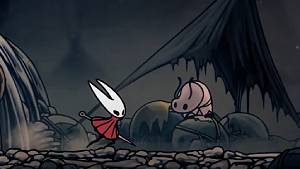
They spend the game in religious devotion, attempting to climb to the citadel where they can meet their God. But most die along the way, or go mad and just start to kill anything nearby.
The currency in the game is rosary beads, to be used for prayer.
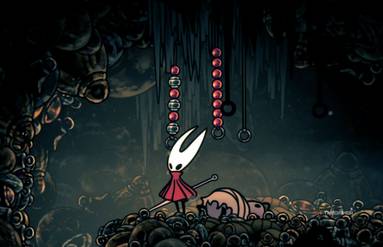
What is the positive affect drawn in? It’s a kind of serenity.
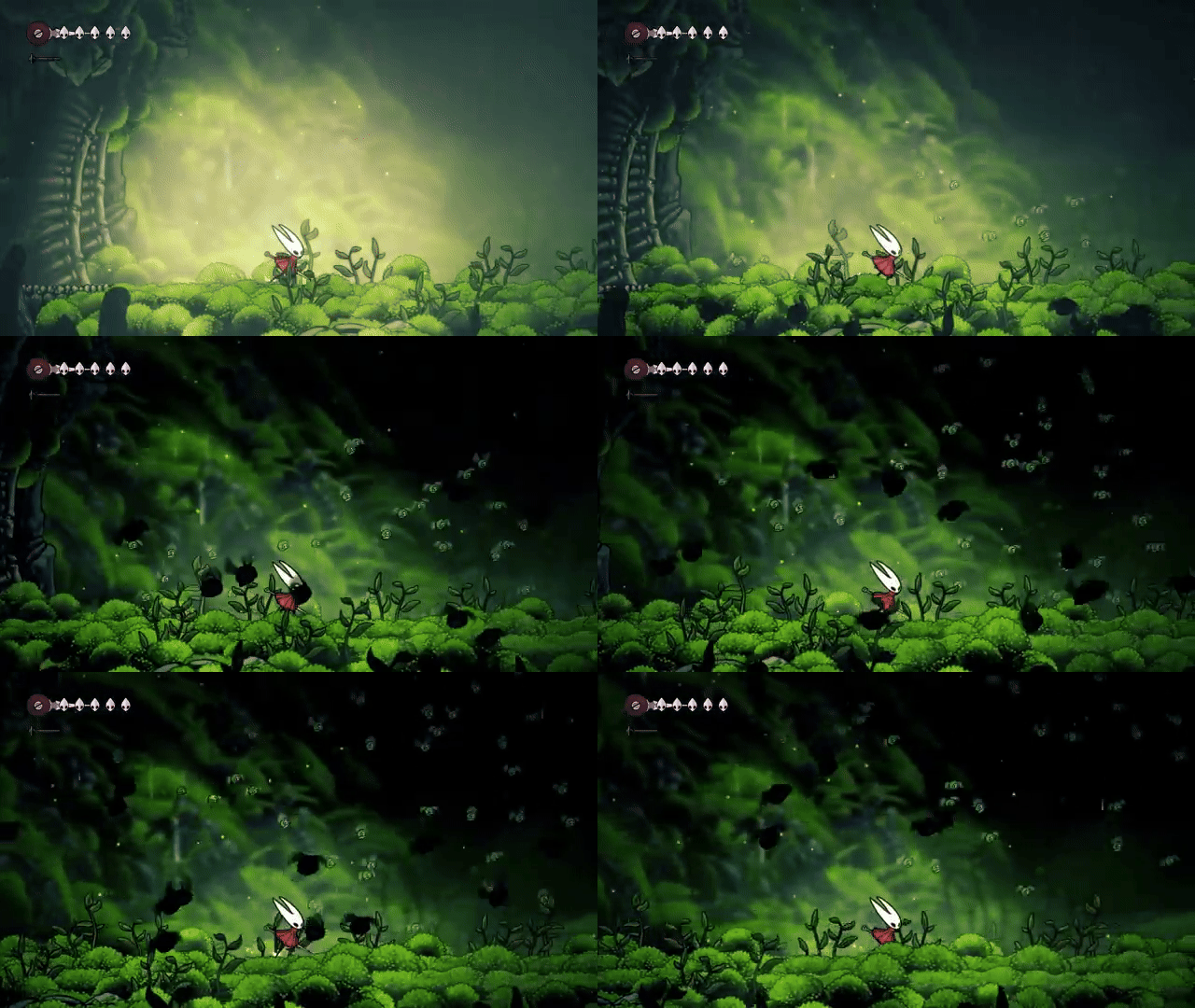
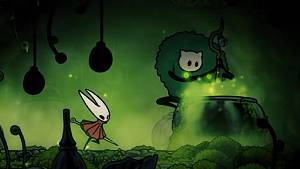
So between the pointlessness and despair, is an occasional “ah, everything is just fine as it is” of feeling at-home. You can hear a bug just laughing to himself, or singing.
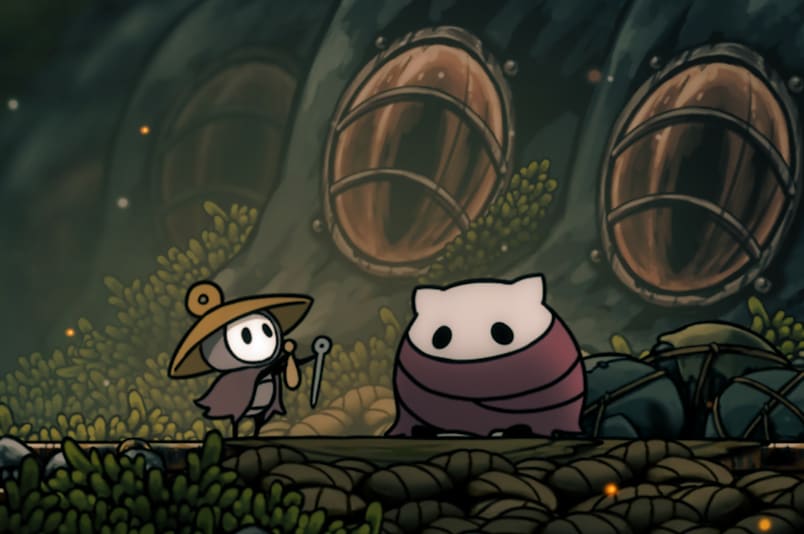
...talking of singing: most people’s favorite character is Sherma. He is always singing and hitting his little metal instrument, believing that singing will get him through this difficult journey. While many people around are going crazy and fighting to the death, he just keeps singing. When you occasionally open doors in his way, he remarks on how it’s clearly that his singing opened the door, rather than you.
His cute song can be heard here (it’s like 10 seconds long).
Do-ni-pwa-nah-vo-li-net
Pi-nah-so-mi-ma-ni-set
Da-na-fo-su-lo-bon!”
It’s actually the case that every character sings in the game. If you use your needle as a bow along some silk that you have, you play a tune, and every single NPC in the game will sing along in their strange weird voice, and give you a little flavor of what they care about.
The best thing from Hollow Knight (the original game) was the music. 6 years later I still listen to it regularly. In Greenpath, the arpeggiated & plucked strings are delicate and energizing; the bowed melodies are ethereal and pretty; everything is a little magical. City of Tears has a similar feeling but the bowed melody is replaced with a woman’s voice, open-throated pure-tone. Harmonically these pieces are rarely arriving anywhere, just holding, moving slightly, droning.
But my favorite tune is Reflection. This was whenever you’d reach a safe spot and sit to gather yourself. Most places in the game you were at risk of dying, but here things are safe, and it can slow down. Gentle piano chords, a little bowed strings coming ni with a slow tune. This is definitely enhanced because of the association with safety; even today when I hear it, I still just release some tension in my shoulders, and relax a little.
Unfortunately, the music felt quite de-emphasized in the sequel, Silksong. I strongly recommend going into the settings and turning up the music relative to all the other sounds—it’s often there but a little quieter.
The de-emphasis on music almost made me not endorse taking the ~60 hrs it took to complete Silksong. However, I got one thing from it that I didn’t get from any other game, and that was a referent for nobility.
See, in Hollow Knight, the main character is just sort of a vessel for the game, and never speaks. There are plot-relevant reasons for why this is the case. Anyway, in Silksong, that is markedly not the case, and the main character has a lot to say. She’s proud and competent and good.
I think the main way that I noticed this, is that she is wreaking havoc through the land, killing gods that have been powerful for centuries. And yet, when she interacts with individuals along her quest line, she takes care not to upset their lives if it is not mandated. This includes not being pushy with rotten people! Some people are very annoying and demanding and rude and unkind, and yet she does not punish them for this; she is largely polite, because even though she is extremely powerful over them, it is not her place to dictate all of morality everywhere she goes.
Relatedly, she moves on from suffering. At one point she endures great suffering at the hands of others, in order to gain a skill necessary to save the kingdom.
At the end, they say
...Alas… spider’s child...
...Four our ways you will think us harsh… You will think us uncaring, unrepentant...
...And so wew must seem, for such is the cost of our wish...
Hornet replies:
You are wrong, Lady...
I knew the wish, and the price to achieve it. And now, across these many ages, I have only come to know it better...
Strength… in mind, in care, in claw. Strength enough that I may live to see a world better than our own, or to craft a world as I desire.
That was the wish, of my mother, of my mentor, and of you...
And then
...Indeed, spider… So much pain you must have passed to speak our hope so simply...
I like that she doesn’t take this personally. Yes, she has experienced immense suffering, but she chose to experience that, and she does not now profess a desire to hurt the people who did this to her, and can simply move on from it.
There is more to say on this game, but I will leave it here because my midnight publishing deadline approaches. I just encourage you to listen to Reflection from the original game for 1 minute 40 seconds, to know the calm that I feel right now.
TL;DR: Hollow Knight was made on a shoestring budget and really quickly, so the music is very simple, which made it extremely catchy, which is actually really good for video game music. Silksong had much more development time, so the composer made more complex tunes which are technically more impressive and cooler but end up being much less catchy as a result.
SPOILERS: I can’t spoiler-out youtube previews, so this will include the names of two areas from Silksong, neither of which are really spoilerish. I’ve rot13 or spoiler tagged everything else that could be a spoiler.
I think that the music had much more work put into it than in Hollow Knight, but the changes in style made it much less catchy. Playing through I was constantly impressed by the music, but I can literally only remember two or three tracks by heart now (obar obggbz, ovyrjngre naq gur bar sbe jvqbj/svefg fvaare).
Let’s talk themes. Themes are most clearly seen in Classical music, where they’re often called “subjects” Here’s an example’
The first twelve seconds are one theme, then the next fifteen seconds or so are the second theme. You can easily tell the difference, even if you’re a non-musician. If you keep listening, these themes get changed and developed a lot throughout the rest of the piece.
But modern music doesn’t just draw from Mozart. It draws from other things. Take a look at The Beatles here:
In a piece of pop music, the tune of the verse is one theme, and the tune of the verse is another theme. There’s repetition, but not much interplay. This makes it simpler and easier to remember, which makes it catchier.
Let’s look at Greenpath
(Only listen to the first 2:30 of this. The section after that is a piece of combat music, which appears in small doses when the player character gets into a big fight, but isn’t part of the main track. It’s just wrapped up in here for a bit of variety and completeness)
Don’t let the instrument choice fool you: this is—structurally—pop music. We have an intro, which builds up a backing track, then two themes which just kind of alternate. Quite often, two instruments will play the melody at the same time, just to make doubly sure that you know which part to listen to. They borrow some tricks from classical music; there is call-and-response, but overall it’s much more like Hey Jude than Mozart’s Sonatas.
Now lets listen to some Silksong music:
It’s much less repetitive: the whole 1:30 is basically one long melodic line. The line is just in one instrument, which isn’t very punchy at all, since it’s violin (and it isn’t plucked). I love this track, but I can’t remember the tune.
Ironically, I think the reason why Hollow Knight’s music is so catchy is often that it’s so simple. Greenpath has literally like thirty seconds of unique melody (and its one of the most complex tracks too).
Minor spoilers for Hollow Knight and Silksong
The theme for the (non-true) final boss of Hollow Knight is literally a sped up, more complex version of the goddamn title theme. And the second phase is very similar again. This works really well because I’ve heard this theme before and know what it means.
The same can’t be said of the true final boss of Silksong, because I don’t recognize either phase’s music from anywhere
Silksong had a lot more thought put into the music, see here for an investigation of the motifs behind it:
AND: there’s also a big exception to the Silksong music catchiness:
This track is near-universally loved, despite being from one of the most hated areas in the game.
Hear that? It’s the Hollow Knight formula back! I actually suspect that this track was written shortly after the end of Hollow Knight, was cut from Hollow Knight and augmented, or was just written in a bit of a hurry.
Often, a talented musician vibing out a couple melodies + layers of accompaniment makes “better” video game music than that same musician spending ages to craft a rich and complex piece of classical music with developed themes. It’s why a goddamn Terraria mod has some of the catchiest music in gaming, despite it having been made by a guy who I think wasn’t even paid
I’d guess that some musicians are just naturally better at “folk” music (focused on repetition) while others are better at “serious” music (focused on development), and people often aspire to do something else than what they’re naturally talented at.
Heck, sometimes people don’t even like what they’re talented at! There have been people who were world-class at something but hated every minute of it, like Douglas Adams with writing.