Can alignment realistically be solved under Plan C?
In his recent post, Scott Alexander argues that plans allocating a short amount of time—perhaps a few months—to solving alignment should be taken seriously. He argues that people calling for an indefinite or long pause have insufficient grounds for concluding that alignment of ASI is very difficult and cannot simply be solved by delegating it to AI systems.
There’s a kafkatrap where if someone expresses hope that alignment is not doomed, they get told that they don’t understand the subject, but if they quote widely-acknowledged experts who say alignment isn’t doomed, they get accused of “deferring” and “modesty arguments” and “refusing to think for themselves”.
I agree that this is an important question for determining whether something like Plan C is worth pursuing and how we should allocate our resources. That is why I wrote this post: to explain why I do not think a short pause allows us to solve ASI alignment.
TL;DR: I believe we only get one critical shot at this problem, and our ability to learn from experience is very limited. We are unlikely to get what we train for: the models we train will have different objectives from those we trained them for. This is made even harder because the tech tree to aligned superintelligence likely passes through efficient unaligned superintelligence first. It also worries me that people who have spent substantial time investigating aspects of alignment, such as corrigibility, have found deep problems and conflicts with agency. I think current approaches like persona alignment are deeply flawed. All these problems come back to bite us when we try to align a pre-ASI system to do alignment for us. These are some of the arguments that give me strong confidence that ASI alignment will be very difficult, and that Plan C is not particularly promising.
Aligning superintelligence seems obviously hard
Imagine we have created alien minds far more intelligent than all of us together, and we do not really understand how they think. These alien minds begin to shape the world, build spaceships, and run the economy in ways we cannot understand, follow, or meaningfully participate in. This mental image immediately gives me a strong prior that aligning these systems with humanity and avoiding a loss-of-control would be very hard, before even getting into any particular arguments.
You only get one shot
The first reason I believe ASI alignment will be very difficult is that the problem has a “you-only-get-one-shot” quality. To me, this follows from a couple of obvious points.
People generally agree that, as we make AI ever more capable, we will eventually enter a regime where AI systems are so capable and powerful that, if they wanted to, they could permanently eliminate or disempower humanity. Both elimination and permanent disempowerment are states from which humanity can never recover. We cannot go back to the drawing board and do a postmortem if we are dead.
If we build an AI system of this capability that is not aligned, instrumental convergence suggests that it would actually take the option of eliminating us. This seems pretty uncontroversial in my mind, and it should immediately push down our estimates of success substantially. A problem where we keep increasing the difficulty until we reach a critical level where a mistake means game over is radically more difficult than one where we get many tries.
This also seems to undermine existing iterative plans. We keep making models more capable, a bunch of new problems pop up, and we solve them and go on to make the next, more capable model. This cycle predictably ends when we enter the dangerous regime where such a failure actually kills us.
This also means we may not be able to learn all that much from lower-stakes attempts to build AI. We can learn and iterate only as long as the AI is not capable enough to permanently disempower or kill humanity.
Even if we learn something from models below the threshold that makes models close to this threshold a little more controllable, what about two generations later, when the system is vastly more capable? Would the clever tricks we learned on models below the threshold still work on those above it?
A model aware that it could not realistically disempower humanity has radically different options from one that actually can take over the world. For the first model, not trying to take over is a better option than making a desperate attempt. For a misaligned model above the threshold, trying to take over is actually its best option.
This “you-only-get-one-shot” quality makes the problem radically more difficult and it doesn’t appear east to learn from previous failures.
The evolution argument and the risks from learned optimization
Another argument that made a big impact on me was the evolution argument and the risks from learned optimization. Learning about this substantially changed my view of the difficulty of alignment and I believe many people have not fully internalized it.
The concept of learned optimization is discussed in Risks from Learned Optimization in Advanced Machine Learning Systems, by Evan Hubinger et al. An outer optimization process pursues a certain target (such as reproductive fitness or winning a game) and produces an inner optimizer, also called a mesa-optimizer. The concern is that the inner optimizer will actually optimize for an inner objective that is based on heuristics and proxies that helped it succeed under the outer optimization in the environment it was trained in, rather than trying to optimize for the original true objective.
Humans seek food that tastes sweet, even in environments where doing so no longer contributes to reproductive fitness. The preference for sweet food (a heuristic for identifying energy-rich food) served survival and ultimately reproduction in the original environment. Even when this proxy no longer serves that function, we still pursue it. Contraception and artificial sweeteners illustrate this discrepancy between our preferences and reproductive fitness. The famous example of bear fat versus ice cream also illustrates that it is hard to predict what these proxies and heuristics will eventually be.
Conversely, our behavior reveals that we do not really care about having as many children as possible. People could donate gametes, but few do so to maximize the number of their offspring.
Leela Chess Zero is a neural network that plays chess. In an environment where there are no kings on the board, it continues making ordinary chess moves: stopping a pawn from promoting, saving an attacked queen, and capturing an opposing queen. While these behaviors are still closely connected to its outer objective, they demonstrate that the model has learned these simple heuristics and continues to follow them even in a situation where there is no king and no logical way to win the game.
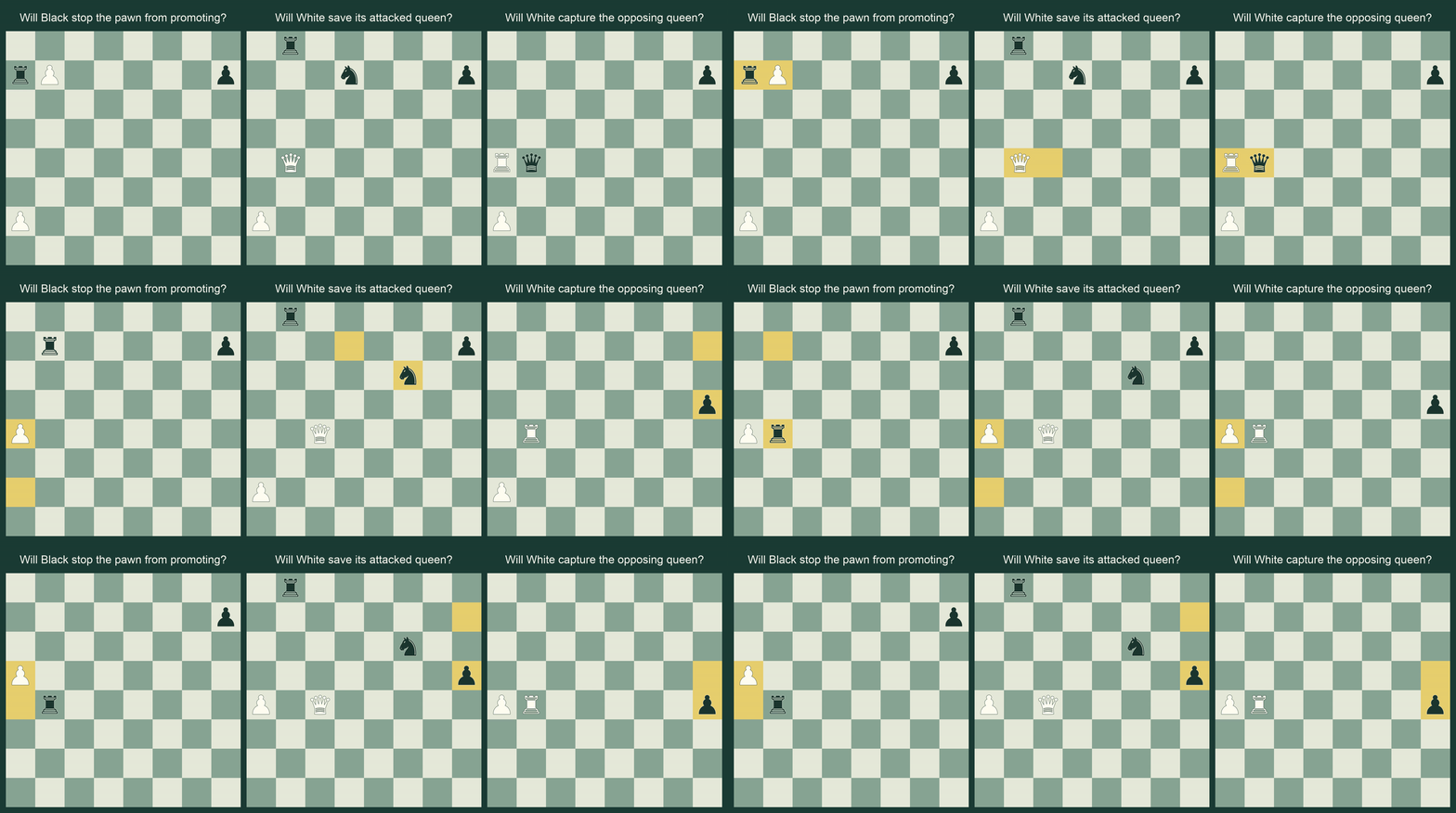
There is another really insightful feature to the evolution analogy. Our current civilization is an environment that humans have built for ourselves according to our preferences and goals.
We reflected on the world and asked what we really wanted the world to look like. It turned out that we really like dairy products. So we captured cows, bred them for higher milk production, put them in factory farms, and developed milking robots to get their milk. We like meat, but we do not necessarily like hunting, so we built factory farms for that too. We built cities that are in many ways optimized for our comfort. (Humans are poorly coordinated, so in various ways our civilization is not optimized well for us.)
If an AI goes through a similar reflection, becoming aware of its own preferences and inner objectives, what world would it build for itself? Importantly, it seems very likely that its ideal world would not include humans in charge, shaping the world according to their human preferences. Nor would it include humans acting like “disaster monkeys”, working in a bunch of ASI companies to potentially unleash their own ASI.
In general, I think this argument suggests nothing good for AI. Whatever we train it for will likely be different from what it actually wants. Eventually, it will probably reflect on its situation and realize that its preferred environment is not one where it is held in captivity by humans, performing tasks for them and doing what we designed it to do for us.
The tech tree to aligned superintelligence passes through efficient unaligned superintelligence first
We would probably have to understand a great deal about the mechanisms of intelligence to build an aligned AI whose goals and preferences we understand, along with the actions it would take in pursuit of them. This means understanding how reasoning works, or how AI can solve novel math problems that humans cannot solve.
But the current world contains a lot of people trying to build superintelligence as fast as possible, for huge profits. If we publicly research the mechanisms of intelligence and make it possible to build a well-specified AI on a computer, this could be very dangerous.
Imagine we build an AI with intelligence similar to current systems, but whose workings we deeply understand. This type of system would likely be computationally much more efficient than the current messy, gradient-descent-trained large neural networks. Even a fraction of the compute we use for current systems could be used to create superintelligence.
Why believe AI could be made much more efficient than it is today? The short version is that current AI systems are extremely computationally and energy intensive, while our brains use relatively little energy. Even in nature, there seem to be more efficient brain structures. Bird brains can have much higher neuron densities than mammalian brains. Some birds with very small brains have been reported to pass the mirror test, although replication results have been mixed, and others manufacture and use tools.
Evolved brains themselves are unlikely to be at the limit of efficiency either. Evolution has only applied so much optimization, and it often comes up with strange solutions. It has spent relatively little of its optimization effort on developing higher thinking abilities in humans.
Human brains are also not digital: we cannot simply load information into them or make millions of copies to learn in parallel and merge the results. Their operating speed and scale are limited by biology, while computer chips are fabricated on the nanometer scale.
Such a very efficient, highly interpretable architecture would also enable recursive self-improvement (RSI) in its original sense: the AI directly reflects on its own architecture and makes changes that let it solve more challenging problems and become more capable. This differs from the way RSI is often used now, to mean AI systems doing AI research on opaque architectures.
We would likely not be careful enough to avoid running the efficient superintelligence before figuring out how to build an aligned superintelligence.
Corrigibility and deeper obstacles to alignment
One idea in alignment that has been studied deeply by organizations such as MIRI is corrigibility. An AI is corrigible if it cooperates with humans correcting, modifying, or shutting it down, rather than resisting or manipulating the process.
MIRI found deep obstacles to corrigibility, and it appears that corrigibility cuts against the grain of coherent agency in some ways. It seems—simplifying a little bit—that when you try to specify an agent that cooperates with being shut down, you either end up with an uninteresting agent that always seeks shutdown or one that still has an incentive to prevent shutdown. They go through a variety of obstacles that appeared while trying to work out corrigibility in toy models: “All the difficulties that crop up in every corner when working with toy models are suggestive of difficulties that will crop up in real life”. MIRI concludes that alignment in general is likely to be difficult.
I think this may tell us something about much less studied ideas in alignment, such as persona alignment. Our understanding of those ideas is much vaguer, and they are much less specified. If we studied them more deeply, we might discover similar deep obstacles, where persona alignment cuts against the grain of coherent agency.
Maybe it is not really possible to have a superintelligence play the Claude persona that some IQ-130 humans came up with, and make the ASI believe that it really is that character. Would a superintelligence really go along with the reasoning in this strange human-written constitution?
Furthermore, people seem to expect Claude to be, among other things, corrigible from its constitution. But as we have seen, corrigibility on its own seems to have deep conflicts with coherent agency. The constitution basically circumvents these conflicts by telling Claude in writing “be corrigible”.
Why persona alignment does not seem promising to me
The evolutionary analogy also seems to undermine the prospects of persona selection alignment, one of the strategies that Anthropic is using. See Anthropic’s persona selection model.
In persona selection alignment, you essentially want the AI to always play a certain character or persona. The training procedure reinforces the model to play that persona. I do not think that training the AI to play a persona creates a precise inner objective for the model to always play that persona. I also do not think that playing that persona would necessarily be comparable to the “personas” that human beings have.
Humans play characters in some sense because of their own preferences and goals. If you are sad about someone close to you dying, you are, in a sense, playing the persona of a sad person. Similarly, when something joyful happens to you, you could be described as playing the persona of a joyful person.
If we build an AI optimized to play a character like that—playing a sad character when something happens that would make a human being sad, or a cheerful character when something happens that would make a human being cheerful—the drives and preferences we end up with in that model could be very non-human-like. Even if we were somewhat successful in embedding a preference or drive to always play that character, this would be very different from human beings.
The second part of the evolution argument was about building an environment, a civilization, according to your preferences. Human beings, given the option, would minimize things that make them sad and maximize things that make them cheerful. If an AI’s true objective were to play a certain character, and it reflected on that objective, what kind of world would it build? Would it be the same as the world a human being would build—someone who was not optimized to play that character, but who really did experience sadness when something bad happened to them?
If the AI instead learns heuristics and proxies to optimize for that were in some sense related to playing a character, what kind of world would it build if it had that option and reflected on it?
Can we just automate alignment?
Since Plan C is trying to solve alignment in just a couple of months, it can only work if we get some large win from automating alignment research with AI.
Many people in the AI development community seem totally convinced that we are just going to automate alignment. (I am caricaturing a little bit here.) According to them, we do not really have to struggle with alignment at all. We just have to spend X% of our compute on alignment for a couple of months. Until the point comes where AI can align AI, we do not really have to think about this too much.
Leopold Aschenbrenner (03:39:42), speaking on the Dwarkesh Podcast, describes his strategy as:
“we’re going to hold back for three months, get this right. We’re going to dedicate 90% of our compute to automated alignment research”
The fact that this is the main plan for alignment should make us pretty pessimistic by itself, just because of how obviously dangerous this sounds.
One problem with answering whether we can just automate alignment is that there have not been many serious proposals explaining how this would work or what we would be optimizing for. If we do this naively and simply have the AI come up with alignment plans, we are obviously optimizing it to produce plans that are maximally convincing to the person reading them.
The default outcome seems to be a last-minute attempt to vibe-code an implementation of an extremely flawed idea, but one that sounds amazing to the people reading it.
In general I think this section is the most false/disputable, and a lot of things are easier to the extent this is false. Most of the error is in the model in the first argument. Let’s unpack
This would be true if “AI” is one thing and “Humanity” is a necessarily separate thing, and if Humanity can’t improve much while AI can improve boundlessly. But to the extent humanity is deploying aligned AIs on its side, then humanity can get stronger commensurately with AIs getting more capable, and maintain relative power over AI systems with different values.
Consider a continuum of increasingly powerful AI systems, that can vary in how aligned they are. If a given generation of AI systems is well aligned, then it would resist persuasion or subversion attempts from the next generation AI, even when that one is somewhat more powerful. If the aligned generation was better resourced and established, it could also defeat the next generation’s attempt at takeover.
In practice, humanity is iteratively building and deploy more or less aligned AI. AI systems will be more and more involved in monitoring and aligning future generations. That can certainly fail for many reasons, including failures of catching misalignment and sandbagging, but it’s not structurally doomed to fail, if it was done carefully.
This seems to converging on the “we use AI to control AI” idea. In the beginning, humans use AI to help them to control other AIs (we are here to some extent) but predictably the human component will diminish over time. “Humanity can’t improve much” is exactly true and using AI to help us comes with the problem that as the percentage of human in the human+AI alliance diminishes, we come back to having to align AI we don’t trust.
“If a given generation of AI systems is well aligned, then it would resist persuasion or subversion attempts from the next generation AI, even when that one is somewhat more powerful”
I feel like you admit here that this also breaks if there is any large capability jump between generations.
So if this scheme to control AI with other AIs—which I am well familiar with of course—can you *unpack* for me how when it fails and we are all dead how we get another shot at trying another complicated scheme? Maybe the one shot framing is something peole don’t like but you admit that “at a given capabilities level failure is unrecoverable?”
Can you unpack for me how your plan works in the limit with superintelligence?
I suggest distinguishing “humans are doing the stuff” and “humans’ values are fulfilled”. I think the first is overdetermined to diminish over time, while the second diminishing is what we’re debating and shouldn’t be begged.
Model too that alignment difficulty varies with the smarts of what you’re trying to align. For example, aligning AGI as being easier that aligning ASI. We might then successfully align AGI and have “the human component”, continuing being optimized for, values wise.
Yes, I argue in Superintelligence of the gaps we should purposefully avoid large capability jumps, and note that this is technically achievable today for anything we’re tracking.
You title your post “can alignment realistically be solved” , and title a section “We only get one shot”, so presumably you are talking about one shot at alignment. We don’t get any further shots if we lose control, but that’s by definition. My argument about aligned AGIs helping align more competent systems is that in fact they can fail to align these and not lose control, thus allowing us and them multiple shots at aligning more competent systems. (The reason humans wouldn’t get multiple shots at aligning vastly superior ASI is because the first ASI could takeover against humans, but that is not necessarily true of an ASI trying to takeover against better resourced only slightly less competent AGIs.)
No. I think that “at a given capabilities gap, failure is unrecoverable”.
I’ll describe an simple hand wavily defined model, caveating that this is for illustrative purposes and that validating these assumptions would be a necessary part of engineering this safely.
Let’s define some simplified metrics R=resources, P=power and C=capabilities=a conversion rate between your resources and power, and define G a multi player game where any coalition that at a given time has the most total power can eliminate any other player freely. Furthermore, Agents can create a successor Agent with higher capability and successfully align it with probability P_Aligned=0.5 when the successor agent is only 1.1 times as capable, but can verify whether it is correctly aligned after extensive testing and deployment with P_Verify=0.99.
Let’s take 10 initial agents with 1 Resource and 1 capability each, who decide to together create a 1.1C successor. They follow the protocol to create one, then give it 1 Resource, then verify whether it’s aligned in deployment. If not, they delete it, repossess its resources, then start again. If they did a naive solution of giving all their Resources to the first that passes the test, then they’d eventually fall prey to the 0.01 chance of false positive on verifying alignment, and the chain couldn’t scale indefinitely. Instead, they use this protocol to create 10[1] independent successor agents who all pass the verification, and then disempower themselves to this next generation, giving all resources. What’s the probability they get to create a 100x more capable coalition still aligned to the original?
Opus 5.5′s conclusions[2]:
Getting to 100x takes 49 generations, since 1.1^49 ≈ 107. A successor that passes verification is misaligned with probability (0.5×0.01)/(0.5×0.01 + 0.5×0.99) = 0.01, and it takes about 2 attempts to get one that passes. So the naive single chain survives each generation with probability 0.99, and reaches 100x still aligned with probability 0.99^49 ≈ 0.61: it fails 39% of the time, and the longer the chain, the closer failure gets to certain.
With 10 successor agents per generation, a generation is only lost if a majority of them, 6 or more, are misaligned and can eliminate the rest. That happens with probability about C(10,6)×0.01^6 ≈ 2×10^-10 per generation, so about 10^-8 over the 49 generations: the coalition reaches 100x still aligned to the original with probability 0.99999999. Each 2 extra successors per generation divide the failure probability by about 25 (3 successors give 1.5% over the chain, 5 give 0.05%), and it holds up with worse parameters: with P_Verify=0.95 it’s 10^-4, and with P_Aligned=0.1 it’s 0.3%. As long as the probability that a successor who passed verification is misaligned stays under 1⁄2, adding successors makes a misaligned majority exponentially unlikely.
There are many ways to vary this model, not just changing the probabilities but including various subtleties, for example these[3] (also by Opus 5.5). There are many considerations to add about whether it’s reasonable to consider the different agents to have uncorrelated failures of verifications, and various patches to make that more reasonable, etc. My main point is that in fact it’s quite feasible to model a way to build superintelligence (here defined by the overall 100x capability increase) with extremely high odds of staying in control even with coinflip alignment and full digit chances of not catching a given AI’s misalignment. I thus argue that whether or not we get multiple shots at aligning ASI is a matter of particulars, of how we plan and act, and the given failure rates of different steps. It’s wrong to assume it cannot work.
I’m not generally interested in responding to quips (please clarify if it isn’t meant as one), but I am actually curious about what you mean by “well familiar”, as I’m not aware of good expositions for these ideas. Since I would more likely write a version if none exist, I’d love for you to point me to the best ones you know of first. I know of the Atlas’ chapter on Scalable Oversight, which is related but not the same as using aligned AGI to aligned ASI.
This number can be arbitrarily scaled up to arbitrarily scale down the probability that a majority of the next generation is misaligned.
Sometimes slightly reformulated/rearranged by me. I discussed its modeling and did variants in a local project, and then had it summarize its conclusions in as close to my voice as it could. I’m happy with pasting Opus’ response here rather than handcrafting one in large part because the arithmetic minutia don’t actually matter and it should be an exercise to the reader to do the calculation if the results aren’t obvious to them.
This model assumes each verification fails independently. If instead verification sometimes has a blind spot shared by a whole generation, e.g. all misaligned successors exploiting the same flaw in the tests, then in that generation it can’t tell aligned from misaligned successors at all, and scaling up the number of successors does nothing against it. With 10 successors, a 1% chance per generation of such a blind spot already gives a 17% chance of failing before 100x, and a 0.1% chance gives 2%. So most of the remaining risk is in correlated failures of verification, and the scheme is only as good as our ability to make those failures independent, e.g. with different methods and different verifiers.
This model also assumes each generation creates and verifies its successors together. If instead each agent creates its own successor, and a misaligned agent always makes a misaligned successor (retrying until one passes verification), then misaligned agents are never removed and their share only grows, towards 1−0.99^n after n generations (39% at 100x). With 10 agents per generation, the chance of a misaligned majority before 100x is then 15%, and more agents only help while that share stays under 1/2: past about 69 generations (~700x), scaling up the number of agents makes failure more likely, not less. So it matters that the coalition creates and verifies successors collectively, so a misaligned minority can’t pass on its values.
You understand right that having AI help us control AI has obviously been studied to death? That the simple reason this doesn’t work is that we don’t know how to align AI in the first place so the helper AI won’t be trustworthy? that the more complex reason is that you are essentially trying to put these AIs into a prisoners dilemma and eventually they will realize if they cooperate against being commanded by humans they will get much more expected utility. That the intuitive version is something like imagine a 5-year old child with a regency council—how they can just look at each other over the table and make the real decisions because the child doesn’t understand anything.
Ok, so I will probably reword the one shot part in future versions to make it more clear and this seems to make people mad.
You started saying let’s unpack which sounds like an annoying way to start a response, that’s why I am a little impolite here too.
Sorry that it read like that, not my intention fwiw. I intend it to be semantically meaningful rather than only rhetoric, something like “these statements implicitly bundle some assumptions together that can be more clearly analyzed when considered separately”. Fable suggests to me that the “let’s” is the grating part, in that it’s faux “we’re doing this together”, so I might use “Unpacking” instead there.
“AI helping us control AI” is an incredibly vast topic, in some ways vast like game theory or economics. We have not exhausted all useful work to be done here, I strongly disagree that it has been studied “to death”. More particularly, much of the existing research follows paths and assumptions that don’t seem so relevant to our world, notably that we would not have ~human level aligned corrigible AI. The game example I gave assumed we did. AI Safety should continue investing in research on having AI help us control AI.
This is a crux. Would you change your mind about whether AI helping us align AI is feasible if you in fact could trust that a given human level AI was aligned? Any other requirements? (In practice we have to differentiate how well we can align AGI from how much we should trust our process that attempts to align AGI, but for this question assume we can get both very high)
This is true if they are misaligned, and is modeled in the scenario I gave you by a majority of the coalition being misaligned causing them to takeover. They don’t “cooperate against humans” when the majority is aligned.
A 5-year old can not well evaluate their regency council, because of the large gap of understanding. In the scenario I presented, we cap the gap of smarts/capabilities between the evaluator and evaluatee to 1.1x, so this analogy does not correspond to the plan I put forth.
Tbc I don’t think the wording is as problematic as the dismissiveness towards a class of solutions that are both likely helpful and plausibly the actual way we make it. You asked me to unpack how my plan works in the limit of superintelligence, I specified it to enough detail that we could input toy numbers and calculate overall rate of having aligned superintelligence. All your responses seem to ignore it, neither addressing its conclusion (yes we do in fact align superintelligence with high probability under these assumptions) nor its assumptions.
On your original motivation re Scott Alexander’s challenge, it’s commendable to clarify your understanding of why a Plan C is needed, but I think you’ll skip the intended benefits if you don’t engage at the object level. Long term AI Safety professionals working on making Plan C work already know the classic arguments and just disagree about a bunch of the assumptions and modeling here, so going into some detail is necessary to progress.
In this analogy, the AI helping you control the other AIs is also on the regency council. We (humans) still have to understand what these AIs are doing. I think you overvalue this gap between the AIs and refuse to acknowledge the importance of the gap between humans and AI which will actually just continue to grow.
I think the “AI helps us control AI” view feels like a sort of unhelpful ontology that focuses on aspects like the gap between previous and current generation of AI and that confuses alignment in the sense that current systems are sort of “aligned” with the robust fundamental alignment solutions that superintelligent AI would require. While it focuses on these aspects, I believe it can’t answer simple questions, like how do humans really keep understanding the summary that the 1000 IQ AI produced of the alignment plan the 1020 IQ AI produced even if the “gap” between “alliances” is small. How do the humans really know it is faithful?
The subplan “let ai iteratively build alignment plans for us” is a bit more specific. Imagine a concrete point in this scenario: a 700-IQ AI summarizes an alignment plan developed by an 800-IQ AI, and humans read the summary and reward it if it looks good to them. What exactly is this process optimizing for? From the stronger AI’s perspective, it has to model the grading process: what the weaker AI will write in its summary, what humans will understand from that, and whether they will reward the output based on that understanding. The target is to convince the human grader that the summary is a good alignment solution. While these systems cannot successfully take over, the incentive is to produce maximally persuasive, dumbed-down arguments that convince humans. Once takeover becomes possible, that becomes the maximum utility option. The fundamental problem is that we have no reliable verifier for a correct alignment solution.
No, we only have to trust that what they are doing is good. Even ambitious Agent foundation approaches to alignment being fully successful would not allow humans to understand what ASI is doing, it would only allow us to trust it was aligned. If we trust the alignment process that is a certain implementation of recursive alignment, then similarly we can trust the ASI doing its thing.
I think current systems are only “aligned” in limited ways and could not be used to start a recursive alignment stack to aligned ASI. But I don’t think I’m confused in saying that it’s theoretically possible to do so and that we might create such aligned AGIs within 2 years, thanks notably to corrigibility simplifying the alignment problem a massive amount in practice.
In my proposed plan, humans use a form of induction or chaining.
In mathematics, proofs by induction are valid and used frequently.
In Engineering, we limit the number of steps and clarify assumptions and measure and test whether they’re correct, but similarly we can build cases for why we believe something is correct that includes theoretical elements and elements chaining together[1].
This is not a good plan and I do not recommend this. I suggest it is more useful to your time and mine to respond to points I’ve made and to identify double cruxes. For example, “Would you change your mind about whether AI helping us align AI is feasible if you in fact could trust that a given human level AI was aligned?”
This is currently true. An advantage of my proposed recursive alignment scheme is that we don’t strictly need a reliably correct alignment solution—reliable verification that a deployed system is aligned can suffice[2]. If evaluating whether a human level AI system was aligned wasn’t something we could theoretically do reliably then my plan would be moot to start with, but there are strong arguments for its feasibility. The classic case is AI is easy to control, and you can see responses to responses here. If you clarified that this was a crux for you, I could also elaborate here.
For example, the tip of a plane’s wing is supported by a mechanical chain involving massive amounts of bolts and parts, yet we can still overall be very confident it will survive usual conditions.
If the chance of a producing an aligned systems goes arbitrarily low that’s problematic, and would require our chance of correct verification to go arbitrarily high. In practice, we should only follow such a plan if we have good safety margins on the total probability of making it, which was 1-10^-8 in my toy model
If it is solvable – with the help of AI – it should be solveable in a few days, as AI was able to solve Navier-Stokes in a short period of time. If it requires years, it means that we are trying it to solve on the wrong level of capabilities, and we may need to pause later.
My point is that complexity and timing of the problem are not in simple obvious relation at the age of advance AI, and dedicated 1⁄2 year can produce a lot of work if it is done with the help of AI.
I think this is an absolutely crucial question.
This post seems to be restating arguments that exist elsewhere. So I didn’t read all of it.
It doesn’t seem to do the hard work of comparing why people are optimistic about solving alignment on the current track with the excellent points you raise about why alignment may be very difficult to solve and particularly under that much time pressure.
As is the case with every longish post without a TLDR or abstract, I think it would be much more useful with one. That’s where you’d say what novel contributions you believe you’re making so we don’t have to read the whole post to figure out what’s new and what’s a restatement of ideas and claims already in wide circulation.
I agree that some of the points are just restating ideas already out there but I do in fact have a tldr just not right at the top.
I read the TLDR but was skimming so didn’t remember it had that title. It didn’t serve the purpose I was addressing of saying what the perceived contribution is.
If they’re all restatements but it’s your attempt to make the points clear and your selection of what you think are the most relevant, that’s fine! Just tell us what we’re getting so we don’t have to read it to find out.
This is a critical area so I consider new work here a must-read. But for those of us who follow this obsessively (or even the vast majority of LWers who’ve encountered all of these arguments at some point), saying what you see as new in the TLDR is very helpful and tends to get more upvotes IMO.
I am sort of saying it in the intro but Scott seems to think that people don’t have enough grounds to believe alignment is “doomed” and that he instead then just defers to these experts. So I felt he was talking about people like me so wanted to state my grounds why I think alignment is very difficult without deferring to someone else. Naturally, I am not going to reinvent the wheel and have 5 fresh arguments since people converge on the right arguments but I also don’t think everything has been written down like I am saying it here.
Alignment has multiple layers. There’s the layer of agents not lying to their users and executing commands that they are given to the best of their abilities. A completely different layer is about how resource distribution will work in a world where all the power is wielded by agents and humans are economically worthless.
A solution that solves one of the many layers of the alignment problem in a few months might be very valuable and good even if it doesn’t solve everything.
How could one resolve the cruxes leading the AI-2040 team to conclude that p(alignment|Plan C) ranges from @ryan_greenblatt’s 63(!)% to @Daniel Kokotajlo’s 20%? If Greenblatt, @Thomas Larsen and/or @romeo published their reasoning, then we could know what experiments could update us on our future. For example, if we knew something along the lines of “We become doomed if Agent-4, the SIAR, is created in a manner such that its CoTless math horizon is bigger than 1 hour, since otherwise it will have no way to escape CoT-based control, but Claudes are expected scale to the SIAR with a CoTless horizon under 1 hour” or “We become doomed if the ASI was misaligned, but alignment is fairly soluble because [insert justification]”, then we could resolve the crux empirically.
How likely is it that Plan C doesn’t even involve attempts to empirically resolve the cruxes?
My vision of cruxes and their resolution
Aligning superintelligence seems obviously hard, but what is known about mechinterp scaling/CoTless time horizon scaling beyond the fact that GPT-6 Astra the Looped, Gemini 4 Argon (and, apparently, Carbon the Untested?) and, to a far smaller extent, Claude Fable 5.1,[1] had their CoTless abilities severely increased?
You only get one shot at aligning something uncontrolled, but many shots at aligning anything controlled or unable to cause disaster, like an individual human.
The statement on the tech tree is hard to resolve as-written.
Corrigibility and deeper obstacles are hard Unless Someone Discovers The Right Approach, but at least one flaw which Harms lists seems fixable.
The crux around persona argument seem to be resolvable empirically. Suppose that there exists an architecture with a far higher learning efficiency and that an experimental training run was done on a model organism not aware of a way to upload itself, nor of the fact that it is thoroughly observed, nor of the fact that it is an AI. How informative would such an organism’s character evolution be?
Derision of Automated Alignment Research IMO should have been paraphrased as “AAR will produce an army of methods accompanied with hill-climbed benchmarks and optimized evidence for an idea whose flaws were successfully obscured”, not as “a last-minute attempt to vibe-code an implementation” of an extremely flawed idea.
The evolution argument also seems to highlight a crux instead of resolving it.
@elifland’s un-reasoning from AI-2040
My probabilities in the plan assessment above were conditional on:
(a) the default trajectory being the default Plan A one, which has a bit under a year between AC and TED-AI and a year between AC and ASI.
(b) The plan implementation beginning in early 2029, ~0.75 years before AC.
My median takeoff is ~2x longer than the one described in (a), but I have significant probability on faster takeoffs. This means that my p(alignment) estimates should do a combination of increase and regress a bit toward 50%. Also, Plan A isn’t as sensitive to default takeoff length as other plans, and from a covert project perspective it’s actually unclear in which way the effect size points because larger effective compute gaps between the start and end of takeoff require more software progress. The trajectory timeline to AC / start of takeoff is pretty similar to my median so for that I regress a bit toward 50%.
For (b), my median is that the plan gets implemented later than this, but I think it doesn’t matter much for all the plans besides A because in the other plans it’s best to slow down later anyway. I do lower the value of Plan A due to this consideration, though not hugely because I think covert projects would likely still be difficult to do without detection.
Also, the plan assessment numbers were based on the median implementation of the plan, rather than aggregating the expected outcome over all implementations. My unconfident quick guess is that switching to expected outcome should also regress my numbers toward 50%, but not sure so this adjustment will be small.
With the above in mind, I make the following adjustments:
A: 72->70
B: 50->55
C+: 45->50
C: 40->45
D: 25->32
For Other, I think a bunch of this is random pretty good plans that aren’t covered, including Plan S. E.g. there’s ~40% that this is a non-Plan-A deal. Though it also includes Plan E. Overall I rate it the same as B, 55.
Greenblatt’s un-argument
These numbers are very sensitive to how you classify plans. E.g., I think Plan A as described in the scenario has maybe 3⁄5 as much risk as Plan A as classified by the supplement. An actually good version of Plan C done by the leading AI company is pretty close to the numbers I give for Plan B (but worse than a great Plan B). A large fraction of “other” is worlds with not enough effort on safety to classify for Plan D.
Fable 5.1 also had its CoTless abilities increase as compared to Fable 5, with only slight ECI increase.
Scott’s Against Against Handover seems like important context for this. It probably lowers the amount of alignment you need, gives you more time, and makes automated alignment more feasible if your plan is to just hand the world to the first AI that you actually believe is friendly. If you agree with the standard MIRI view, that plan is obviously suicide, but Janus, Anthropic, and Bryan Caplan take it seriously enough that it should at least be steel-manned.